Podcast: Play in new window | Download
Subscribe To Our Podcast




In this episode, host Anji reconnects with Kara McClanahan, executive business consultant at Aesthetic Practice Partners and VP of Operations at Genesis Lifestyle Medicine, to break down why most aesthetic practices aren’t struggling because of marketing or device mix. They’re struggling because owners have never learned to audit their own operations honestly. Kara argues that chasing revenue and vanity metrics misses the point entirely; the real answers live in the processes behind those numbers.
Kara walks through her three-part “Uncovering Excellence” audit: process-mapping every patient touchpoint from first lead to post-treatment follow-up, knowing your true financial numbers beyond a sales report, and identifying which services are actually driving patient demand and profit. She also confronts the audit’s hardest truth: that most team performance problems trace back to hiring, training, and leadership support gaps that owners are reluctant to own.
The episode closes with Kara’s framework for turning audit findings into action: clearly articulate the problem, build a realistic 30/60/90-day plan, assign ownership, and prioritize fixes instead of tackling everything at once. She leaves listeners with a single starting question for their own audit, one that, she says, will surface the exact obstacle keeping their practice from its next level of growth.
Key Takeaways
- Audit your processes, not just your outcomes. Revenue and cost-per-acquisition only show results. Process-map every patient touchpoint, from first lead response to post-treatment follow-up, to find where the real gaps live.
- Know your numbers beyond the sales report. Track profit margins, cost of goods per treatment, and overhead percentage, and make sure any manager running your practice has that same financial transparency.
- Audit what’s actually driving patient demand. Look past marketing spend to which treatments patients request and which services are most profitable, and flag stagnant services as a signal to retrain or re-motivate providers.
- Own your people problems before you blame your people. Most performance issues trace back to a bad hire, poor onboarding, or a lack of ongoing coaching and accountability from leadership.
- Turn every audit finding into a communicated, owned plan. Clearly define the problem, assign ownership, and build a realistic timeline instead of rushing a quick fix that creates new problems later.
- Prioritize fixes instead of tackling everything at once. A real audit typically surfaces five to seven issues. Rank them by impact on patients and operations, and push compliance issues straight to the top.
- Start your own audit with one question: what keeps you up at night. The recurring problem you keep tucking away is the fastest route to the biggest obstacle standing between you and growth.
Kara emphasized that the real obstacles holding a practice back are rarely visible in the numbers alone. They surface only when owners honestly audit their own processes, people, and priorities. This session is your chance to bring that same clarity to your marketing, so your patient acquisition strategy finally matches the operational excellence you’re building.

- Get a 1-on-1 diagnosis of your online presence & patient acquisition funnel
- Identify critical, untapped growth levers (SEO, Social, Referrals)
- Define a clear action plan to attract and convert your ideal patients
- Receive expert solutions for your most pressing marketing challenges
Resources

Live Webinar: Future-Proofing Your Aesthetic Practice: Decisions You Must Get Right in the Next 18 Months
Join industry experts to modernize operations, enhance patient experience, and drive sustainable growth.
Wednesday, May 20, 2026 @ 7:00 PM EST – 9:00 PM EST

Are you ready for the “GLP-1 Body” Era?
Download the 2026 Aesthetic Patient Behavior Model to see the numbers driving decisions this year:
- Why 73% of patients now define beauty by “individuality” over transformation?
- The shift away from non-invasive fat reduction (down ~40%).
- Real data on the rise of the male aesthetic patient.
Key Highlights:
- 00:00:14 – Introduction & Speaker/Topic Setup
- The episode tackles why most aesthetic practices struggle: not from bad marketing, but from owners never learning to audit their own operations clearly.
- Host Anji welcomes back guest Kara McClanahan, managing partner and executive business consultant at Aesthetic Practice Partners and VP of Operations at Genesis Lifestyle Medicine.
- The episode centers on Kara’s "Uncovering Excellence" audit framework: how to surface hidden growth obstacles and turn findings into an executable strategy.
- The episode is sponsored by Ekwa Marketing.
View TranscriptAnji: Most aesthetic practices are not struggling because of bad marketing or the wrong device mix. They’re struggling because the owner has never been taught how to look at their own operation clearly enough to see what is actually in the way. Welcome back to the Business of Aesthetics podcast. I’m your host, Anji.
To help us tackle that problem head on, we’re joined again today by Kara McClanahan. Am I saying that right? Kara McClanahan? McClanahan. Very close. McClanahan. McClanahan. All right. We’re joined again today by Kara McClanahan. If you caught her first episode with us, you already know she’s not here to give you a theory. She’s here to give you the exact methodology.
Kara is the managing partner and executive business consultant at Aesthetics Practice Partners, a board-certified medical practice executive, and the sitting vice president of operations at Genesis Lifestyle Medicine. She spent nearly 30 years building and fixing operations inside some of the most complex aesthetic practices in the country, and today she is bringing her Uncovering Excellence audit framework directly to you.
We’re talking about how to deep dive into your own practice operations, how to surface the growth obstacles you did not even know were there, and how to turn what you find into a strategy your team can actually execute.
This episode is brought to you by Ekwa Marketing. All right, let’s get into the conversation.
- 00:02:01 – Why Practice Owners Audit the Wrong Things
- Kara explains that owners typically audit outcomes (revenue, cost per acquisition) instead of the processes that produce those outcomes.
- The shift she teaches: stop watching vanity metrics and start examining how the work gets done.
- This insight came from her own experience as a practice administrator trained to read metrics without questioning the process behind them.
View TranscriptAnji: So Kara, you have walked into a lot of aesthetic practices over nearly 30 years and every single one of them thought they had a handle on their own operations rather. So when you started developing what you call the uncovering excellence approach, what was the moment that made you realize most practice owners are actually auditing the wrong things?
Kara: Yeah, I love that. So I think that it’s really hard to look at our own businesses and be agnostic or be very intentional about what we have to look at. So most business owners look at things like revenue, like cost per acquisition, like all of our marketing metrics that are supposed to tell us how well we’re doing. But I think when they sit back and look objectively, what we’re missing the mark on is how are we actually doing what we’re doing, not what is the outcome of what we’re doing. So instead of looking at those vanity metrics, we teach practices to look at the processes that produce the outcome.
And I think the turning point for me was having been a practice administrator and an operator myself is we were trained to look at metrics. And those metrics told us how well our businesses are doing. But we were looking, like you said, at the wrong things. We need to be looking at how we’re doing what we’re doing that produce the outcomes that tie back to those metrics. And it’s really just a mindset shift. And I think that that’s where businesses really miss the mark when we’re looking at assessing how we’re doing in our business.
Anji: Yeah, and that is the trap because owners are not being careless. They’re measuring what is visible. They’re looking at the dashboard numbers, the revenue reports, the booking rates. But what your warts and all audit is really doing is going beneath the surface layer into the places the owners walk past every single day without recognizing what is sitting right there.
- 00:04:10 – The Three-Part Internal Audit: Patient Journey Mapping
- Kara outlines the first audit pillar: process-mapping every patient touchpoint from first lead contact through post-treatment follow-up.
- Key checkpoints include lead response speed, referral tracking, appointment confirmations, intake forms, front-desk experience, and post-treatment check-ins.
- She shares her own habit of walking the exact path a patient takes to spot blind spots owners grow numb to over time.
View TranscriptAnji: Which brings me to the process itself because I want our listeners to be able to take this and actually run it inside their own practice. So when you teach a practice owner or a manager how to run this kind of deep operation audit on themselves, not hire a consultant, but actually do it themselves, what are the three specific areas inside their own practice they must audit first? And why do those three reveal more than everything else combined?
Kara: Yeah. So you start with the patient journey. So process mapping your patient journey and every single touch point the patient has through your practice shows you where there’s operational gaps, where there’s revenue opportunities, where there’s customer service opportunities. If you think about why we’re here, yes, we all want to make money. We all want to make everyone look pretty, but at the end of the day, it’s outcome-based. And our business should be outcome-based as well.
So the very first thing that I encourage every single practice owner to do is process map your patient journey. So think about every single touch point. When you’re marketing, your driving leads to your door, right? So what are you doing to get those leads in the door? You need to start with your lead processes. How quick are you responding to leads? How are you following up with leads that you didn’t contact right away? Listening to the reasons why leads maybe didn’t book an appointment is just as important as paying attention to the ones that did. Obviously, we’re looking at our referral sources because we want to know how our marketing channels are working, what our relationships with other patients look like for referrals.
So when you break it down, now you’re looking at they’ve made their appointment. When they’ve made their appointment, what happens? Are you sending them a welcome email? Do they get the warm and fuzzies the minute they made that appointment? Is there an introduction to what’s going to happen when they come into the clinic? Do they fill out their intake forms via a portal? If they fill them out via a portal, are you missing information that you need to deliver a great experience? Or are you waiting for them to come into the office and fill out old school forms?
Look at those processes and every single touch point tells you what you can do better or what you’re doing really well already operationally so you know what those gaps are. Look at your customer service at your front desk when a new patient walks in the door. What do they see, feel, hear? What is that experience? And then continue that patient process mapping all the way through treatment, consultation. What happens after treatment? What is the post-treatment experience? Does the provider call them two days later and ask them how they’re doing? Are we checking in to make sure that they’re using their post-treatment serums? Are we checking in two weeks later to make sure that they have their next appointment booked?
So quite literally, process mapping down to the very, very minute detail every single experience a patient has with your office. And when you do that from lead to post-treatment and how you’re following up on them, you’re going to see those blind spots that we don’t see every single day. You know, I give the example when I’m consulting with a practice or even 15 years ago when I ran a practice myself, I walk in the front door every single day, even if the back door is more convenient. And I walk the journey the patient is going to walk from the front door to check in to the treatment room before I sit down because I want to see what my patients are going to see. Look, you know, what are they going to see if they’re standing at the front desk? Can they see behind the front desk and there’s a lot of sticky notes and mess and clutter? Or is it nice and neat and pristine and organized? These little details we miss unless we’re analytically looking at it every single day, because when they’re in our own practice, we just grow blind to it.
- 00:08:19 – Pillar Two: Know Your Numbers
- Kara stresses that a sales report isn’t enough. Owners must know profit margins, cost of goods per treatment, and overhead percentage.
- She flags a common gap: owners who know their high-level numbers but delegate operations without giving that manager full financial transparency.
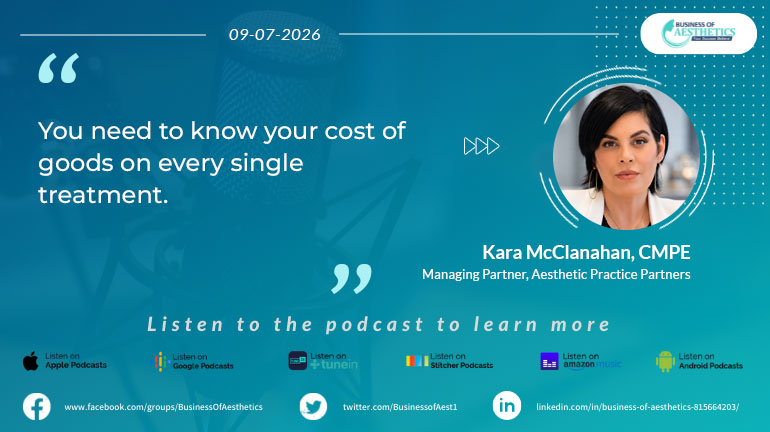
View TranscriptKara: These are the number, the biggest thing that is going to tell you where you have gaps, but you have to look at it objectively. That’s only one thing. That’s the first part of the internal audit. The second is dive into your numbers. And I know that everyone says that, but it’s not enough to run a sales report. It’s not enough to know what your revenue goal is. You need to know your profit margins. You need to know your cost of goods on every single treatment. You need to know your overhead percentage to your operating costs.
So the second thing that I think is most important, and I think that practice managers and owners are getting much more savvy today because there’s a lot of education out there like Business of Aesthetics and other organizations where they can get these insights. But I can’t stress enough how important it is for business owners and managers to know their numbers.
And I say business owners and managers very strategically because oftentimes our business owners, our practice owners know their numbers or they at least know their high level numbers, but then they expect someone else to manage their business without the transparency of those numbers. And so I think it’s really important if you’re an owner operator, obviously you have to know your numbers. But if you’re an owner and you have somebody else as an operator manager, there needs to be transparency and understanding of those numbers as well. And I think that’s also a big miss for a lot of practices I work with today. So the number two step is know your numbers.
- 00:09:46 – Pillar Three: Understanding What Drives Patients to Specific Services
- The third audit pillar looks past marketing spend to which treatments patients actually request and which services are most profitable.
- Kara flags stagnant services on the menu as a signal to check provider training, provider confidence, or marketing gaps.
View TranscriptKara: And then third is understanding what’s driving patients in your practice, not just your marketing dollars, but what treatments are they requesting? What are your highest profitable services that your providers are doing on repeat? What are the services that we forget? Are there items on your service menu that you’re just not moving? Are you not moving them because your providers need to be re-educated on clinical processes? Do they not believe and trust in the outcomes or are you not marketing those services?
So to recap, your question was, what three things do practice owners need to look at? Process mapping your patient journey, understanding your numbers, and then third, understanding the drivers of service in your clinics.
- 00:11:01 – Recap & Transition to the People Side of the Audit
- Anji reframes the audit as an ongoing discipline, not a one-time event.
- The conversation shifts to leadership and team performance, the part of the audit Kara says gets the most uncomfortable.
View TranscriptAnji: That is such an interesting answer and it was so clear as well, I love that answer. So what I love about the framework also is that it’s not theoretical, it is a sequence and what you’re really saying is that the audit is not a one-time event, it is a skill, it is something the owner has to develop the discipline to do repeatedly. And Kara, you’re doing this right now in real time as VP of Operations at Genesis Lifestyle Medicine. You’re not advising from the outside, you’re inside a live operation. So I want to push into the people side of this because that is where I know the audit gets the most uncomfortable.
So in your experience running operations at the enterprise level, when a practice owner does a genuine warts and all audit of their people and their leadership, not their systems, not their numbers, but their actual team performance, what is the single hardest truth that almost always comes up and why do most owners keep avoiding it?
- 00:11:45 – The Hardest Truth: People Problems Are Leadership Problems
- Kara names the truth most owners avoid: team performance issues almost always trace back to hiring, training, or support failures by leadership.
- She breaks it into three recurring root causes: wrong hire, right hire but poor onboarding, or right hire with no ongoing support and accountability.
- The core issue: owners get consumed running the practice and forget the team needs the same support as patients do.
View TranscriptKara: Because the challenges they have with the people side almost always come down to what we are doing or not doing as business owners or managers. The hard truth is most of our people problems are our faults as leaders. And that’s the thing that’s really, really hard to both look at and then hard to correct.
Whenever, if I put my consultant hat on, not my Genesis hat for a moment, and I talk about all the practices that I go into, and I go into hundreds of practices as an independent consultant a year, one of the biggest things we do is practice assessments, not even ongoing consulting and coaching. One of the things that we do a lot of is just assess practices and deliver what’s working and what’s not working. And the hardest truth for every single business owner is the people are not performing because we’ve done a couple things.
We either have not hired the right person, so we just did not have the right recruiting process. We hired someone outside of their skillset. We just didn’t hire right for whatever reason. Or number two, we hired the right person, but we did not train them properly. So I think having a really robust onboarding and training program within the organization is critical, because what happens in practices is we have a position of need, whether it’s the front desk or a provider. Somebody quit, somebody moved, somebody went out on leave, whatever reason they’re not with the practice, but we have a gap that in order to serve patients and generate revenue, we need to fill that gap. And we fill that gap quickly because we put a body there. That body could do the treatments or can answer the phones, but we have not necessarily set them up for success. And so we have either hired improperly or we’ve hired properly, but we’ve not trained properly.
And the third piece to that is not supporting them. It’s our job as leaders to hire the right people, give them the tools, support and resources to do their jobs and then let them do their jobs. But there has to be accountability. There has to be performance management. There has to be ongoing coaching. And so for a lot of business owners, they either do one or all three of those things backwards or not at all. And that’s the hardest truth: a lot of the challenges within our practice are things that we as leaders and owners can own, can control, but we get so busy trying to fill positions, trying to treat patients, that we forgot the people that do the jobs need as much support as our patients.
Anji: Yeah. That right there is the conversation most practices are not having because it requires the owner to look at their team and sometimes at themselves with total honesty. That kind of clarity changes everything.
- 00:14:52 – Sponsor Break: Ekwa Marketing MSM Offer
View Transcript
Anji: And speaking of clarity, I want to take just a moment for our listeners here. So if you have been wondering whether your marketing is actually doing its job or whether it’s slightly underperforming while your clinical and operational team is doing everything right, our team at Ekwa Marketing can help you find out. Now, we are offering our BOA listeners a complimentary 60-minute marketing strategy session. It is a completely one-on-one, no pitch, no pressure, just a focused conversation to help you map out a realistic 12-month roadmap for attracting the high-value patients your practice deserves. So you can book your spot right now at www.businessofaesthetics.org/msm. That is www.businessofaesthetics.org/msm.
- 00:15:42 – From Diagnosis to Strategy: Turning Audit Findings Into Action
- Once problems are identified, Kara says most owners freeze. The diagnosis is easy, execution is the hard part.
- Her framework: clearly articulate the problem, communicate roles and impact, build a realistic plan and timeline, and assign clear ownership.
- She warns against fixing everything at once. Prioritize by impact, especially compliance issues, and work through a 30/60/90-day action plan.
View TranscriptAnji: All right, back to Kara. Now, once the audit surfaces the problem, the next question is always the same, right? Now, what do I actually do about it? Because this is where a lot of practice owners get stuck. They do the audit, they find the gap, and then they freeze. Because translating a diagnosis into a strategy that the whole team can actually execute is a completely different skill set.
And Kara, this is where your background in building strategic operating plans starts doing the heavy lifting. So I want to get very specific about what happens after the audit. Once a practice owner has completed their internal audit and identified two or three real growth obstacles, not assumptions, but actual confirmed gaps, how do you help them build a strategy around those findings that their team can execute, not just a plan that sits in a binder and never moves?
Kara: I love that because I think that, like you said, this is where the heavy lifting comes in. It’s fun to do the uncovering. The audit part always gets us excited because we see the opportunity. We’re digging into our business. We feel like we’re doing something. And then those hard truth moments come when you identify the problem, but the real work starts once the audit is done, like you said.
And so I think number one is clearly articulating what the challenge is. Everybody needs to understand what the challenge is and what it affects in the organization. So is it a customer service problem? Is it a patient flow problem? Is it a documentation problem? Whatever it is, there needs to be clear articulation of what the problem is. And everybody needs to understand what their role in either correcting it or the process of it affects. So I think communication is number one.
Number two is have a real plan to fix it. We’re not going to talk about it. We’re going to identify the steps that we need to take to correct this problem or get us moving in that direction and have a realistic plan and timeline. When you rush things, you fix problems with a quick solve resolution that probably is going to create other problems down the road. So again, being thorough as well as making sure that your team understands, map out the process, designate staff members. Somebody has to own fixing this problem. Somebody has to own correcting this process or this procedure. So clearly articulate it, communicate understanding, and then have ownership and have a plan.
You know, again, it’s a roadmap. Whenever we consult with practices, even if we’re just doing a practice assessment, we give them their diagnosis and then we give them a 30, 60, 90 day action plan. Oftentimes when you’re doing these audits, you don’t find one or two things. You find five to seven things. Don’t try and fix everything at once. Prioritize the gaps and how it impacts your operations, how it impacts your patient care. If it’s a compliance issue, it needs to go right to the top. So prioritize your challenges. Don’t try and fix everything at once so that you can be strategic and thorough in everything that you do. So again, communicate, outline accountability and have a strategy.
Anji: So a plan that actually moves versus a plan that just looks good on paper.
Kara: Exactly. That’s right.
- 00:19:46 – The One Question That Unlocks Everything
- Anji asks Kara for the single starting question every owner should answer before beginning their own audit.
- Kara’s answer: "What keeps you up at night?" The recurring problem owners tuck away instead of solving.
View TranscriptAnji: So the audit is only valuable if something changes on the other side of it, which brings me to our final question. And I want to make this as practical as possible for every single person listening right now, whether they’re running a solo practice or managing a multi-location group. So for a practice owner or manager who is ready to start their own uncovering excellence audit this week, not someday, but this week, what is the very first question they should sit down and answer about their own operations? And why does that one question unlock everything else?
Kara: What keeps you up at night? What’s that one burning thing that you keep seeing come up again and again and again? Oftentimes, small problems flare and you hear about it and we don’t do anything and we tuck it away. But then it comes back and now it’s a bigger problem. So it’s that one thing at the end of the day that you always know you should do or that challenge that keeps resurfacing. So what’s keeping you up at night? What is the one thing that you feel is the biggest obstacle to having the practice flowing the way you want? And I guarantee you every single practice owner and manager will identify one or two things that are reoccurring themes.
Anji: That’s actually perfect.
- 00:21:10 – Closing & Final Sponsor CTA
- Anji closes by pointing listeners to Kara and Aesthetic Practice Partners, and repeats the Ekwa Marketing MSM offer.
View TranscriptAnji: All right. So that was Kara McClanahan. And if this conversation gave you that moment of clarity where something finally clicked about what is sitting between you and your next level of growth, that is exactly what it was designed to do. The uncovering excellence audit is not complicated, but it does require the owner to be honest enough to look at their own operation with fresh eyes and courageous enough to act on what they find. This is the work, and Kara is one of the best in the industry at walking practice owners through it.
Now, if you’re ready to take that step, I strongly encourage you to connect with Kara and explore what Aesthetic Practice Partners can do for your practice. You can find her at aestheticpracticepartners.com. And as always, if clarity on the marketing side of your practice is what you need right now, Ekwa Marketing is offering our listeners a complimentary 60-minute marketing strategy session. One conversation, a realistic 12-month roadmap for attracting high-value patients. No pressure, no pitch. Just go to www.businessofaesthetics.org/msm and grab your spot.
GUEST – Kara McClanahan

Kara McClanahan is the Managing Partner and Executive Business Consultant at Aesthetic Practice Partners, where she leverages nearly 30 years of industry experience to help practices navigate strategic change. A Board Certified Medical Practice Executive (CMPE), Kara has partnered with physicians, private equity groups, and medical device leaders to design operational frameworks that drive next-level success.
Currently serving as the Vice President of Operations at Genesis Lifestyle Medicine, Kara specializes in moving practices from ‘mom and pop’ management to enterprise-grade efficiency. Her expertise covers the full spectrum of practice growth, from financial auditing and staff development to executing complex strategic operating plans.
Beyond her corporate leadership, Kara is the founder of Empower Esthetics, a nonprofit dedicated to advancing women in leadership and providing educational grants to survivors of domestic abuse, helping them achieve self-sufficiency through careers in aesthetics.
Learn more: www.aestheticpracticepartners.com
HOST – Manjali Kulathunga

Drawing on her background in radio broadcasting, Angie brings confidence, energy, and a conversational approach to every virtual event she hosts. As the host of Business of Aesthetics (BOA) webinars and podcasts, she leads discussions with renowned industry experts, creating an engaging environment where knowledge is shared and meaningful conversations thrive.
Recognized for her approachable hosting style and strong communication skills, Angie excels at connecting with both speakers and audiences. Her ability to keep conversations engaging, encourage audience participation, and maintain a seamless flow helps make every webinar and podcast an insightful and enjoyable experience.
Connect with Us:
Category: Business of Aesthetics Podcast