Podcast: Play in new window | Download
Subscribe To Our Podcast




In this episode, host Don sits down with Naren Arulrajah, founder and CEO of Ekwa Marketing, to dismantle the med spa playbook of cheap ads and low-price Botox deals. Naren argues that discount-first marketing doesn’t just underperform, it actively damages your position in the market and fills your schedule with patients who were never going to stay.
The conversation gets specific about the numbers owners are ignoring. Naren breaks down why the average practice books only one in three new patients and just one in six from ads, why organic leads cost $60 to $70 against roughly $300 for paid, and why a patient who doesn’t book is a phone-handling problem rather than a marketing one.
He closes with the framework he insists on with every client: build the funnel around find, like, and trust, rank for at least 100 search terms to survive Google’s messy middle, and generate 10 or more paragraph reviews every month. Ads earn a place only after all three are working, as an adjunct, never the engine.
Key Takeaways
- Stop treating symptoms and diagnose the funnel. A discount ad is Tylenol for a fever — it masks a broken patient journey instead of fixing why qualified patients never find, like, or trust you.
- Refuse to lead with price. The moment patients associate your name with a discount they subconsciously downgrade your competence, which fuels second-guessing, unhappy visits, and negative reviews.
- Build the funnel in three stages: find, like, trust. Rank organically for what patients actually search, make each page speak only to the topic that brought them there, and reinforce it with reviews before they ever call.
- Set a hard floor of 100 keyword rankings and 10 paragraph reviews per month. Google’s messy middle means patients loop through exploration repeatedly, so single-keyword visibility lets a more present competitor win by repetition.
- Demote ads to an adjunct, never the engine. Use them for retargeting or a specific device push once organic is humming, ideally funded by the manufacturer’s co-op dollars.
- Track conversion rate and cost per new patient opportunity, nothing else first. Organic leads run $60–$70 while ads run around $300, and the average practice books just one in three patients, one in six from ads.
- Read your last 20 paragraph reviews to define your ideal patient. The recurring praise in those reviews tells you exactly what to lean into across your website, marketing, and phone conversations.
“Naren made the case that lasting growth comes from becoming the practice patients find, like, and trust long before they ever pick up the phone, not the one with the cheapest offer. This session gives you an objective read on where your own patient journey breaks down, so you can build that trust engine instead of guessing at it.”

- Get a 1-on-1 diagnosis of your online presence & patient acquisition funnel
- Identify critical, untapped growth levers (SEO, Social, Referrals)
- Define a clear action plan to attract and convert your ideal patients
- Receive expert solutions for your most pressing marketing challenges
Resources

Live Webinar: Future-Proofing Your Aesthetic Practice: Decisions You Must Get Right in the Next 18 Months
Join industry experts to modernize operations, enhance patient experience, and drive sustainable growth.
Wednesday, May 20, 2026 @ 7:00 PM EST – 9:00 PM EST

Are you ready for the “GLP-1 Body” Era?
Download the 2026 Aesthetic Patient Behavior Model to see the numbers driving decisions this year:
- Why 73% of patients now define beauty by “individuality” over transformation?
- The shift away from non-invasive fat reduction (down ~40%).
- Real data on the rise of the male aesthetic patient.
Key Highlights:
- 00:00:14 – Introduction & Topic Setup
- The episode opens on the collapse of the old med spa playbook: cheap Facebook and Instagram ads paired with low-price Botox deals that attract price shoppers instead of loyal patients.
- Host Don introduces the guest, Naren Arulrajah, founder and CEO of Ekwa Marketing and co-founder of the Business of Aesthetics community, with more than 15 years helping medical, dental, and aesthetic practices get found online.
- The conversation is framed around four questions: why discount-first ads no longer work, what the modern patient journey looks like, the biggest no-nos in aesthetic marketing, and how to measure whether a funnel is working.
- The episode is brought to you by Ekwa Marketing.
View TranscriptDon: For years, a lot of med spas relied on a very simple playbook. Run a cheap Facebook ad or an Instagram ad, offer a low price Botox deal, and hope that the phone starts ringing. But that approach is becoming harder and harder to sustain. Because while cheap ads may still get attention, they often attract price shoppers and create short-term interest without building long-term trust.
So today, we are asking the bigger question: how do you build a modern marketing funnel that earns trust over time? Welcome back to the Business of Aesthetics podcast. I’m your host for the session, Don. It’s great to have you here. And to help us unpack this, I am joined by Naren Arulrajah, founder and CEO of Ekwa Marketing, as well as a co-founder of the Business of Aesthetics community.
Now, Naren has spent more than 15 years helping medical, dental, and aesthetic practices get found online, build stronger digital trust, and attract better fit patients. In this episode, we’ll talk about why discount-first ads are no longer enough, what the modern patient journey really looks like, the biggest no-nos in aesthetic marketing, and how to measure whether your funnel is actually working. This episode is brought to you by Ekwa Marketing. With that being said, Naren, I humbly welcome you back to our show.
Naren: Hey, hey Don, so nice to be here, and I’m really looking forward to our conversation today.
- 00:01:44 – Treating Symptoms Instead of the Cause
- Naren frames discount advertising as a symptom-level fix, comparing it to taking Tylenol for a fever caused by a serious underlying illness.
- Practices see a problem and reach for an ad instead of diagnosing what is actually broken in the funnel.
- He draws on 19 years of experience watching what practices do, and don’t do, that ends up hurting them.
View TranscriptNaren: Beyond the Botox Coupon, I like the title. Building the Modern Multi-Week Funnel. I know this is the trap that a lot of practices fall into. They kind of see a problem and they think running that ad attracting XYZ patients is the answer. And to be honest, it is the wrong approach.
It’s kind of like you have a serious illness and you think taking Tylenol to get rid of the fever is going to solve it, right? You need to find the underlying illness that’s causing the fever and address that illness, not necessarily just try to get rid of the fever. Kind of the same thing. I think a lot of practices unfortunately take that same approach: let’s treat the symptoms versus treat the cause.
So today we’re going to unpack all of that. We’re going to talk about, with my 19 years of experience, what people do and don’t do sometimes that ends up hurting them, especially the wrong approach. So let’s jump right in.
- 00:02:43 – Why the Cheap Ad Playbook Stopped Working
- Cheap ads attract cheap intent, Naren uses Groupon as the cautionary example of customers who never return and never value the business.
- Discount-first marketing damages market position; he contrasts it with Apple, which never trains customers to wait for a sale.
- Because aesthetics is personal and paid for with hard-earned money, price signaling makes patients doubt the provider, which drives second-guessing, unhappiness, and negative reviews.
- Thin margins from discounting starve the practice of the profit needed to invest in people and technology.
- The ideal patient, the one looking for a permanent home, researches extensively and will not be won by a one-click Botox deal.
- Ads-only visibility means patients never move through find, like, and trust, so the front desk fights an uphill battle on every call.
View TranscriptDon: Right, so let’s talk about this underlying cause. We’re seeing a lot of med spas struggle with ads lately. So why has the old playbook of running a cheap Facebook ad for the $10-a-unit Botox stopped working?
Naren: Great place to start and a great question to start with. Cheap ads attract cheap intent. I’m sure those of us who know Groupon, right, the company went bankrupt. They know that anyone who came for a Groupon never showed up again, or was not their right client. They got the Groupon, they said thank you very much, bye-bye. Or they got the Groupon and they’re like, where’s my next Groupon? You’re wasting my time. So you can’t make profit giving Groupon deals every time a patient comes in.
Same thing with cheap ad patients. They just want cheap. The patient is responding to price, not trust. And having studied successful aesthetic practices over the years, I know trust is key. You really want to build a fan base, people who love you, people who love what you’re about and keep coming back, and perhaps even encourage others to do so in the form of a review or in the form of a referral.
The other problem with people who are attracted to cheap ads is they may not care who the provider is. They don’t care about quality. They don’t care about the time and effort you put into training. They don’t care about the amount of money you invest in technology. They don’t care about anything. So unfortunately, if you cater to that bottom of the funnel, you would end up with a practice that keeps becoming that low-end practice, becoming that practice that you wouldn’t personally want to go to. So it not only hurts you in the short term, it also hurts you in the long term.
The discount-first marketing also, being a marketing person, I know this, damages your position in the market. Do you ever see Apple giving a discount? Do they say, come today, I’ll give you 50% off an iPhone. Come three weeks from now and I’ll give you 35% off something else. They don’t do that. Why? Because the minute people start associating you with discounts, they subconsciously think you are not good enough. You are cheap. You are not worthy.
And remember, aesthetics is very personal. A, it’s hard-earned money. And B, you are doing something on their face, in their bodies. So they really, really know. Even though they might say I want a low price, they don’t want to go to a low-price vendor. So they really will start doubting you. This is why you end up with negative reviews. You will end up with people who are unhappy because they are second-guessing you all day long. So if you’re wondering why some of these issues are happening, then one of the causes may have been that discount-first mindset.
The other thing is, if you have enough profits, you can invest in good people, you can invest in technology. It’s kind of like imagining trying to swim for the first time in a pool where the water is literally to your nose. It’s really, really hard, right? Because you’re trying to learn how to swim. So if your practice is going through a hard time, or you’re still continuing to improve as a practice owner, you don’t want to be working with tight margins with discounts. Anytime you’re swimming for the first time, or you’re in trouble and you have water to your nose, you’re going to panic, you’re going to do even more damaging things. So really keep that in mind.
And one of the things that practice owners don’t realize is the patient journey is no longer one click. If you really want your ideal patients who are looking for a permanent home, they are not going to make decisions based on a Botox deal. The people who are coming to you on a Botox deal are not your ideal patients. They’re not looking for a permanent home. They don’t really value you. So you end up with the wrong people, and also you end up not catering to the right people. Why? Your entire marketing is based on a one-click deal and hoping to get lucky.
The real patients, the good ones, are doing lots of research. You’re not showing up, because you can’t afford a fifty thousand dollar ad budget to show up everywhere. And even if you did, they don’t trust you, because the only way they see you is through ads. They’re not liking you, because if they come through ads they’re doubting you from the first click itself. So there’s not even any room for them to like you with your videos and get to know you.
And last but not least, they don’t trust you. Why? Because they have this doubt in their mind. They’re talking to your team on the phone, and they’re thinking, what’s the catch? What’s wrong with this place? So your team has to climb an uphill battle. And remember, your team is also human. Anytime somebody has a doubt, the person on the other side, it will be really hard for them. Either it’s going to suck their soul out of them trying to convince someone who doubts you, or they’re just going to give up and say forget it, I’m not going to give it my all.
So it creates this huge hole. You are putting a lot of money in marketing with these cheap ads. A, you don’t get the right patients in. And then your margins are really low and you really suffer. So don’t go down this trap of, I’m going to use something cheap to fill a schedule or get a new patient, because it’s really detrimental to the practice. Attracting these price shoppers and filling up your schedule with them, you’re going to lose your own sanity trying to work on them, and you might not be doing what you love.
- 00:08:06 – Marketing as a Trust-Building System
- Naren reframes marketing away from finding desperate deal-seekers toward attracting patients looking for a long-term home.
- Step one is to help patients find you organically for the things they are actually searching for.
- Step two is to help them like you, page-specific video and education that speaks only to the topic that brought them there, not to the practice’s own credentials.
- Step three is trust: a target of ten or more paragraph reviews every month, which both lifts search visibility and reassures patients who have already found you.
- Ads belong in the mix only as a supplement once the organic engine is humming, for example, retargeting or promoting a specific device, sometimes funded by the manufacturer.
- He describes Ekwa’s 1-800 review line, which lets happy patients call in and have their words turned into video testimonials.
View TranscriptDon: Let’s talk about the other type of patients, the ones who take the time to research before they book a major treatment. Since ads don’t work the same way when we have to earn trust first, how should a practice owner think about marketing in 2026, where trust is so important?
Naren: Great, great question. You hit the most important point right in that question. Trust, trust, trust. That’s what makes a great practice from the one that is not great. So marketing should be a trust-building system. Let me explain.
It’s not, let me find the person who is desperate, i.e. wants a deal two minutes from now. But rather, how do I find those people who are looking to trust a practice for the long term, and how do I attract them? How do I get them to choose me?
So step one is helping patients find you. Those patients who are looking for a home, who are looking for someone they can trust and build a relationship with, help them find you first. What are the kind of things they’re looking for, and are you showing up organically? Step number one.
Then help them like you. Use videos. Once they find you and land on your right page organically without ads, help them get to know you. For example, they were interested in Botox for their eyes, they have a lot of content educating people, talking about it, and making people welcome to that page. Provide a lot of information: useful, relevant, to the point. If they are on a particular page, talk about that topic, nothing else. Not about you or anything else. Just cater to them as if you’re talking to them while they’re in front of you.
And then finally, continue to work on reviews. I recommend everyone getting 10 or more paragraph reviews every month as a starting point. So work on that. Why? These paragraph reviews not only influence search engines, so more people will find you, but they’ll also give confidence to the people who have found you that they made the right choice. So when they’re calling your office, they’re more likely to have an open mind versus having doubts. Of course, the last piece is that your person on the phone has to do a good job in the way they answer the phone and make people feel welcome and reassured.
Use ads, but use it only if needed, as a supplement. Don’t make it, hey, I’m desperate, let me run ads. That’s a very bad approach. For example, your practice is doing really well, your organic machine is humming along, people are finding you tens of thousands of times, they’re liking you, your websites are taking them to the right page and making them fall in love with you, and then your trust is amazing — the 10 or more paragraph reviews that I talked about. Now maybe you want to increase sales for a device you have. Use ads to augment. Perhaps retargeting ads, so the people who came to that page, retarget them. Or run some targeted ads for that particular brand for a short time. And sometimes you might even get money from these companies, so use those funds. But use ads as an adjunct, not as the core.
Organic trust matters more. So everything I touched on — reviews could be in the form of Google reviews, it could be in the form of testimonials. One of the tools we created is a 1-800 number, so practices can offer this to their clients when they’re in the office who are happy and say, hey, do you mind sharing why you love us? There’s a room, maybe here’s a number you can call and tell us why you love us — and convert that into a video. And we have clients who have used this hundreds of times and have created wonderful video testimonials from it with the real patient voice. And if the patient doesn’t want to use their voice, you can use their words and we can create a review from that.
- 00:11:49 – Google’s Messy Middle and Building Trust Signals Into the Funnel
- Patients explore, evaluate, then loop back and explore again, often several times before they ever call.
- Ranking for a single keyword lets a more visible competitor win by repetition, which is why Naren insists his clients rank for 100 or more search terms.
- Trust signals — Google reviews, before and afters, provider authority, clear expectations, and FAQs, must be built into the workflow, not bolted on.
- The team on the phone should be referencing those same reviews and FAQs so the patient experience stays consistent over the long term.
View TranscriptNaren: Google’s messy middle also applies here. And I know you are wondering, what the heck is a messy middle? Let me explain. Patients are exploring options, then they evaluate, then they go back and explore again. They may do this several times before making a call. The practice has to stay visible throughout the loop.
So let’s say you are ranking for a certain keyword, but you’re not ranking for anything else. Now people are like, oh, this other practice keeps showing up a lot more than you do. They forgot you. So you want to make sure not only are you showing up once, but you’re showing up multiple times. This is one of the reasons I recommend to all my clients, and I insist, that every one of them rank for at least 100 or more search terms before the end of the year. This is because of the messy middle problem. People today don’t just say, I am in, after the first time they hear about you. You have to keep convincing them.
Trust signals also have to be built into the funnel. So Google reviews, before and afters, provider authority, clear communication on what they can expect and what they need to do, FAQs, these all have to be part of your workflow. And even when your team is talking to a patient, they should be incorporating, they should be talking about the reviews, they should be talking about some of the things that are covered in the FAQ. Because you want to make sure the patient experience is not only great today, but it’s great over the long term. It’s not just great today. It’s great every day.
- 00:13:15 – The Other No-Nos in Aesthetic Marketing
- Depending on a single channel is a structural risk, no matter how much a practice loves Instagram or Facebook.
- Sending paid traffic, which is five to ten times more expensive than organic — to a weak website wastes the spend, because the bar for paid visitors is far higher.
- Generic, vanilla pages fail in a long-tail search world; every page must speak to one specific person and one specific need.
- Neglected Google Business Profiles with weak photos and incomplete information cost enormous visibility; strong clients appear thousands of times per month.
- Geographic targeting is often too narrow, practices outside dense metros need to build a radius that includes adjoining towns.
View TranscriptDon: Now, beyond those cheap discount ads, what are some of the other no-nos you see in aesthetic marketing right now?
Naren: That’s a great question. The other no-nos are depending on one channel. I know some people are like, oh, I love Instagram, I like Facebook. And again, that’s a bad idea.
Sending paid traffic to a weak website. We already know paid traffic is five to ten times more expensive than organic, because people don’t trust you. So imagine them going to a web page that doesn’t grow confidence, that rather distracts. Let’s say I’m interested in Botox and you’re talking about you having this degree. You know what? First convince me that you are really good at Botox, with before and afters and any relevant information I might be looking for. So the bar is really, really high when the paid traffic is involved. So your website has to be exceptionally good. Not only what it has, but how fast it loads and how it functions on different devices and everything else.
Today, we live in the world of long tails. So generic messaging, generic pages don’t work. I know a lot of practice owners look at it from their point of view versus the point of view of that niche person who’s looking for something very specific. So your website is like a vanilla, we-are-everything-to-everybody. It could be everything to everybody, but each section or each page has to cater to somebody. Of course, it has to rank in the first place, because it has to attract that person to that page.
Ignoring Google profiles, I see this time and again. Weak photos, incomplete profiles, Google Business Profile doesn’t show up. In other words, remember I said a hundred or more times — we have clients, many of them show up thousands of times on Google Business Profile every single month for all these different search terms. So you have to also work on search and make sure that your Google Business Profile is also showing up in search.
And last but not least, you want to make sure you are targeting the right area. For example, it might not be just one town or one city, depending on where you are. If you’re in New York, it could be a very small area. But if you’re in the rest of the country, let’s say a small city or a small town, you want to target adjoining towns. So have enough of a radius that you’re targeting. And ideally, like I said, target it organically.
- 00:16:08 – The Numbers That Actually Matter
- The average practice books only one out of three new patients, and with ad-driven leads that drops to one in six, because trust is missing.
- Metric one is conversion rate, tracked separately for organic and paid, with an ideal range of 70% to 80%.
- Metric two is cost per new patient opportunity: roughly $60–$70 per organic lead versus around $300 from ads.
- A failure to book is a phone-handling and training problem, not a marketing problem.
- Supporting metrics: ranking for 100 or more keywords, and 10 or more five-star paragraph reviews every month.
View TranscriptDon: Targeted organically, which brings us to a fantastic question. How does a practice owner know if this kind of marketing is actually working? What are the numbers that they should be watching beyond likes, clicks, and impressions?
Naren: Yeah, great question. The average practice only books one out of three new patients. And when it comes from ads, that number drops to one out of six. Let me repeat: the average practice only books one out of three new patients, and when it comes to ads, that number drops to one out of six. Why are ads one out of six versus one out of three? It’s because they don’t trust you.
So either number is bad, right? You’re spending $1,000. First case, you’re getting $300 worth of benefit, because the other 700 don’t work. In the other case, you’re getting $150 worth of benefit out of 1,000, because the other 850 are not booking. So you need to know what your conversion rate is, both for ads and for organic. And you want to improve it. The ideal is around 70% to 80%. So that’s the first metric: conversion rate.
Second is cost per new patient opportunity. If they don’t book, that’s not really a marketing problem. That’s a training problem. That’s the way the phone is handled. So you want to know the cost per new patient opportunity. If you’re doing organic, we have noticed people having costs of $60, $70 per new patient call or new patient lead. With ads, we have noticed it’s around $300. You need to know this. Trust me, figure it out, because everyone’s numbers could be different. So find out. Set up call tracking, set up lead tracking, find out the cost of a new lead. Those are the two main things I would look at.
Now, if you are an SEO practice that’s ranking for 100 or more keywords and you are really dominating, then of course make sure that you are showing up for 100 or more keywords. So that’s the metric I would track. The other metric I would track for every practice is, am I getting 10 or more five-star paragraph reviews every month? So those are the high-level metrics. Of course, there are other metrics, but get this right first. And once you get this right, hey, write to me and I’ll help you with the other ones. So that’s where I would start.
- 00:18:14 – What to Stop, and Where to Start
- Stop leading with price, stop treating ads as the whole of marketing, and stop measuring vanity metrics like likes, reach, and impressions.
- Replace them with qualified calls, booking rate, conversion rate, cost per new patient opportunity, keyword count, and paragraph review count.
- Begin with a patient journey audit: are people finding you across 100 or more search phrases on Google, which still holds 95–98% of the market.
- Define the ideal patient by reading the last 20 paragraph reviews and identifying the common threads, then lean hard into whatever they consistently praise.
- Build the multi-week funnel outward from organic, tracking monthly growth in keywords and organic discovery, and fix landing page gaps like missing before-and-afters or welcome videos.
View TranscriptDon: Okay. And now for the owners listening in who realize they’ve been relying too much on these discounts or one-off ads and attracting the worst kind of, I mean, let’s not say worst, but not the ideal kind of patient. What should they stop doing, and where should they start?
Naren: Yes. Step one is stop leading with price. Do not discount the first reason to choose you. We went through a lot of reasons why this is bad for you. So remember it, go back and listen to the podcast, take notes, decide I’m not going to lead with ads. I might use it once everything else is working, my funnel is working, people are finding me, liking me, trusting me, booking my appointments, then I might use it as an adjunct. But till all of that is done, I will not touch ads.
Second, treating ads as your whole marketing. Like I said, that really can hurt you.
And along with that, stop measuring vanity metrics. I know people measure likes, reach, impressions, and cheap leads. These are all you letting the wrong things drive you, and drive you into a ditch. Instead, focus on qualified calls, how many are booking, conversion rate, cost per new patient opportunity or cost per new patient lead. How many keywords are ranking for you? How many paragraph reviews do you have? So that’s what I would focus on.
Start with the patient journey audit. Are people finding you? Are you showing up for 100 or more search phrases or different types of searches on Google? Remember, Google is still 95, 98% of the market. Actually, it has gotten bigger since AI came along.
Understand your ideal patient. Read your paragraph reviews, the last 20, and figure out what are the common things they are saying. That’s where your ideal patient lives. If they love great technology, lean into it. If they love being treated like family, lean into it. Find out what your ideal patients want and continue to work on it week after week. And everything you do should be to cater to that person, that persona, everything in your marketing, everything in your website, your phone conversation, everything.
Start building a multi-week funnel, starting with organic. You’re showing up, and the number of keywords and phrases and number of people finding you organically continues to grow, track that metric on a monthly basis. Is that number growing? These are things we do with our clients. Make sure your landing pages, when there are problems, let’s say they don’t have enough before and afters, or they don’t have a welcome video, you start addressing them. Find a way to connect all the dots.
- 00:20:50 – The Complimentary Marketing Strategy Meeting
- Naren offers a no-cost marketing strategy meeting for owners who lack the time, expertise, or objectivity to audit their own funnel.
- The session reviews the patient journey, whether patients are finding the practice, and how the practice stacks up against local competition.
- His framing: you don’t have to be the best, you only have to outrun your competitors, when the bear is chasing, you just need to be faster than them.
- Roughly six hours of research goes into each session, delivered as a plan covering what’s working, what isn’t, and what needs fixing.
- The offer is valued at $900 and is booked at www.businessofaesthetics.org/msm.
View TranscriptNaren: So you know what, if this looks overwhelming, and you’re not objective in figuring out if you are doing a good job or not doing a good job, which can be true for some of you or many of you, either because you don’t have the time or the expertise, and or because some of the ideas that were not working were some ideas you were involved in, get a third party opinion. We offer a marketing strategy meeting at no cost.
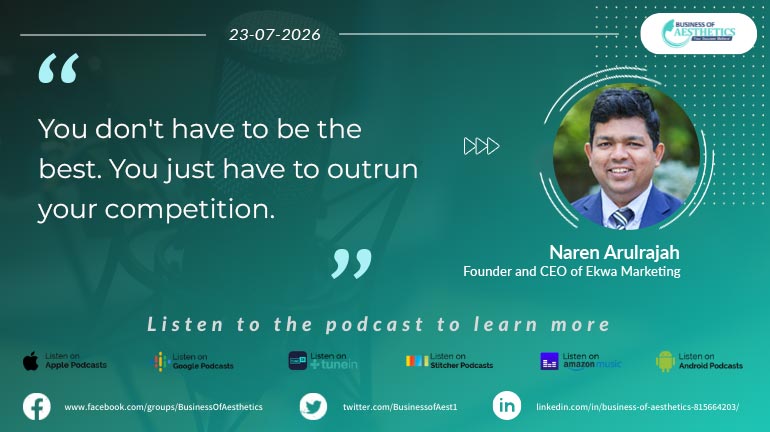
The link is www.businessofaesthetics.org/msm. We will look at your patient journey. We will see if people are finding you. We will look at your competition compared to you. So you don’t have to be the best. You just have to outrun your competition, right? When the bear is chasing you, you don’t need to be the fastest runner in the world. You have to be faster than your competitors.
You also want to know how well you’re doing. That’s the other part of research we do. We spend six hours on this research, and we’ll tell you what’s working, what’s not, and what you need to fix. We’ll give you a plan. Book that meeting. It’s a $900 value, www.businessofaesthetics.org/msm. That’s my gift to you. And if you need me after you have had that MSM, you know what, I would love to have a conversation. Ask my team to get me involved. We have a 300-person team, but I love talking and solving marketing problems. So I would love to help.
- 00:22:09 – Closing
- Don closes by recapping the core argument: aesthetic practices need to move beyond the Botox coupon.
- Listeners are directed to book the complimentary marketing strategy meeting.
View TranscriptDon: Amazing. Well, that was a valuable conversation with Naren Arulrajah on why aesthetic practices need to move beyond the Botox coupon. Now you can go ahead and make best use of that marketing strategy meeting at www.businessofaesthetics.org/msm.
And with that being said, it has been my pleasure hosting this podcast. Don signed off on behalf of Business of Aesthetics. Thanks for listening. Keep on leading.
GUEST – Naren Arulrajah

Naren Arulrajah is the President and CEO of Ekwa Marketing, a leading digital marketing agency serving medical, dental, and aesthetic practices across North America. With more than 15 years of experience at the forefront of healthcare marketing, Naren has helped thousands of doctors and practice owners build thriving businesses through customized strategies in SEO, social media, online reputation management, and content marketing.
Leading a team of over 180 full-time marketers, Naren has become a trusted authority on practice growth, AI-driven search, and the evolving digital landscape. He has spoken extensively on marketing trends, patient acquisition, and business development, and is known for cutting through industry noise with practical, data-backed strategies that deliver measurable results.
His passion lies in helping practitioners focus on what they do best, patient care, while his team drives sustainable growth in an increasingly digital marketplace.
Learn more: www.ekwa.com
HOST – Adeesha Pemananda

A seasoned marketing professional and a natural on-camera presence, Adeesha Pemananda is a skilled virtual event host and presenter. His extensive experience in brand building and project management provides a unique strategic advantage, allowing him to not only facilitate but also elevate virtual events.
Adeesha is known for his ability to captivate digital audiences, foster interaction, and ensure that the event’s core message resonates with every attendee. Whether you’re planning a global webinar, an interactive workshop, or a multi-session virtual conference, Adeesha brings the perfect blend of professionalism, energy, and technical savvy to guarantee a successful and impactful event.
Connect with Us:
Category: Business of Aesthetics Podcast