Podcast: Play in new window | Download
Subscribe To Our Podcast




In this episode, host Don joins Lisa Waters, founder of Real Skin Pro and a California licensed esthetician, to separate real skincare expertise from social media noise. Lisa explains why clients who arrive armed with ingredient buzzwords still need a professional to interpret what their individual skin requires, and why chasing trends is no substitute for knowledge.
Lisa breaks down how a thorough 30- to 45-minute consultation covering lifestyle, health history, and even gut health shapes a truly personalized protocol. She also shows how to vet continuing education against state board rules, why vendor “loopholes” can leave you uninsured, and how she blends nutritional therapy with esthetics without blurring scope.
Lisa closes with the rule that guides her approach to acne, oncology aesthetics, and every complex case: when in doubt, refer it out. Her advice is to set ego aside, build a trusted referral network, and brand yourself as an educator, because human care is the one thing AI and influencers can’t replicate.
Key Takeaways
- Turn client vocabulary into personalized guidance. When clients arrive quoting retinol or trending ingredients, use their language to explain what their specific skin actually needs instead of dismissing what they’ve read.
- Build your business on the consultation. Invest 30 to 45 minutes in lifestyle, health, and even gut-health questions, and tell clients why you’re asking so the intake builds trust instead of confusion.
- Compete with AI and social media on human care, not trends. Listening, presence, and one-client-at-a-time protocols set you apart in ways the newest modality or a stacked eight-client day never will.
- Verify scope before you buy the training. Conference vendors sell nationally, so check your state board’s website and bulletins before investing in any modality that pierces the skin or reaches the fascia.
- Add nutrition knowledge without crossing scope lines. Use nutritional insight to shape consultations for acne, rosacea, and sensitized skin while never presenting yourself as a dietitian or selling supplements outside your license.
- When in doubt, refer it out. Keep a trusted list of estheticians, dermatologists, and physicians so complex acne and oncology cases get the right care and your credibility grows.
- Brand yourself as an educator, not an influencer. Teach the “why” behind every technique and share knowledge freely to earn trust that product-pushing content cannot buy.
Lisa Waters made it clear that the practices clients trust most are built on real expertise, careful listening, and care tailored to the individual rather than whatever is trending. This session is your opportunity to turn that expertise into a growth plan that brings the right clients to your door and keeps them coming back.
- Get a 1-on-1 diagnosis of your online presence & patient acquisition funnel
- Identify critical, untapped growth levers (SEO, Social, Referrals)
- Define a clear action plan to attract and convert your ideal patients
- Receive expert solutions for your most pressing marketing challenges
Resources

Live Webinar: Future-Proofing Your Aesthetic Practice: Decisions You Must Get Right in the Next 18 Months
Join industry experts to modernize operations, enhance patient experience, and drive sustainable growth.
Wednesday, May 20, 2026 @ 7:00 PM EST – 9:00 PM EST

Are you ready for the “GLP-1 Body” Era?
Download the 2026 Aesthetic Patient Behavior Model to see the numbers driving decisions this year:
- Why 73% of patients now define beauty by “individuality” over transformation?
- The shift away from non-invasive fat reduction (down ~40%).
- Real data on the rise of the male aesthetic patient.
Key Highlights:
- 00:00:04 – Introduction & Guest Setup
- The episode looks at what real skincare expertise means now that clients arrive with more information, and more misinformation, than ever.
- Host Don introduces Lisa Waters, founder of Real Skin Pro, a California licensed esthetician, skincare educator, and certified nutritional therapy practitioner.
- Topics include nutrition, acne, specialized client concerns, and turning clinical knowledge into client trust and a strong professional brand.
- The episode is brought to you by Ekwa Marketing.
View TranscriptDon: Skincare clients have more information than ever, but more information does not always lead to better decisions. Recent research has even linked social media-driven skincare purchasing with significantly higher rates of skin barrier damage among acne patients. Welcome back to the Business of Aesthetics podcast. I’m your host for this session, Don Disha. It’s great to have you here. Now, to help us understand what real skincare expertise looks like in an increasingly complex industry, we are delighted to be joined by Lisa Waters. Lisa is the founder of Real Skin Pro, a California licensed esthetician, skincare educator, and certified nutritional therapy practitioner. With experience spanning both medical and holistic skincare, she brings a particularly valuable perspective on how estheticians can combine science, nutrition, and continuing education to deliver better client care. Now, today we are going to discuss what estheticians need to know to stay relevant as skincare continues to evolve. We’re talking about nutrition, acne, specialized client concerns, and how to turn clinical knowledge into stronger client trust and a successful professional brand. Now, this episode is brought to you by Ekwa Marketing. That being said, Lisa, it’s great to have you on the podcast. Thanks for being here with us.
Lisa: Oh yes, thank you so much. I’ve been looking forward to this. I really appreciate the opportunity.
- 00:01:39 – Interpreting the Well-Informed Client
- Clients now arrive knowing terms like retinol, salicylic acid, and skin barrier, largely because of social media and advertising.
- Lisa notes that client knowledge expanded sharply around 2020, when people were at home researching skincare.
- Rather than dismissing what clients have read, estheticians should use the client’s own language and redirect it toward what their bio-individual skin actually needs.
View TranscriptDon: Wonderful. Let’s get into the conversation. So, Lisa, let’s start with how you think about skin. Clients can arrive today knowing words like retinol, salicylic acid, skin barrier. But knowing the vocabulary and knowing how to interpret it, especially for an individual’s skin, are two different things. So, in your journey in aesthetics that spans both the medical and holistic realms, how has this unique perspective shaped your approach to skincare education and client care?
Lisa: Such a great question, so relevant to what’s going on in aesthetics now. Especially with social media, clients know more than ever right now, and it’s because of social media and ads and advertising. There’s such a niche market for that, and people are paying attention. So when it comes to client knowledge in the treatment room, everybody wants what someone else has or had. They’re taking their social media knowledge and comparing it to their friends or people they’re seeing on social media and getting those sorts of results. So their knowledge goes up. And I feel around 2020, when people were sitting at home, they kind of dove into the knowledge, and their knowledge started to expand. As professionals, when our clients are talking about this and they think they know what’s right, it’s so important for us to really look at their skin and use the language with them instead of, you know, "Oh, that’s not right for you." Let’s take retinol, for instance. "I heard retinol is so great." And this client might not be a great candidate for retinol. Most people are, but this client might not be, and they’re using it, and we’re seeing a disrupted skin barrier. So it’s up to us to be able to educate them. "Well, you have the idea of what retinol is, but let me tell you what can be better for your skin." So using the language with them, but flipping it around so it makes sense to them bio-individually, because all of our clients are bio-individual. They have different needs. So working with their knowledge of skincare and ingredients to really let them know that you’re the expert, and here’s what I recommend for you and why.
- 00:03:52 – What a Holistic Approach Really Means
- Lisa explains that "holistic" is often misunderstood as "natural products." It actually means looking at the whole body and the whole person.
- The holistic approach means asking the right questions about lifestyle, home product use, and even diet and nutrition to understand why skin behaves the way it does.
- Estheticians can’t give nutritional advice, but they can and should have nutritional knowledge to better support clients with concerns like rosacea and acne.
View TranscriptDon: Talk to us a little bit about this holistic approach. What do you mean by this, if you don’t mind?
Lisa: Yes, holistic is a very big buzzword right now. I try not to say "holistic esthetician," but my approach is holistic. When people talk about that, mostly they think holistic is natural skincare, quote unquote. They think it’s about the products, but the holistic approach is about the whole body. So let me look at your skin and let me identify why these things are going on with your skin. We have those clients that have rosacea or acne or hyperpigmentation, and the holistic approach is asking the right questions, really getting to know their lifestyle, their product use at home, even things like diet and nutrition. We have to be a little bit careful with that as estheticians, because we can’t give nutritional advice, but we are always allowed to know about it. Have that knowledge so we can best support the client. So if we’re seeing rosacea and we have a knowledge of nutrition, that’s the holistic approach, because I’m working with the whole body instead of just the skin. I’ve got to see why the skin barrier is behaving the way it is. And the questions I ask can really shape my protocol and my recommendations for the products people use at home. So the holistic approach is not just about the skin, but the whole body, the whole person. It includes things like nervous system relaxation or regulation, which is kind of a buzzword right now too. But it means not just saying you’re doing it, but actually doing it and having the knowledge to do it. With holistic aesthetics, the esthetician has to have a lot of knowledge. It’s not just using natural products or a natural approach. It’s actually taking care of the whole person.
- 00:05:52 – Why the Consultation Questions Matter
- Clients often wonder why they’re asked about their job, lifestyle, medications, and health history on intake forms.
- Lisa argues that you can build a whole business on a thorough 30- to 45-minute consultation.
- Explaining why you ask each question, even about gut health, turns the intake form from a mystery into a trust-building part of care.
View TranscriptDon: Now, the questions you ask, do you actually let your clients know the reason why you’re asking them those questions, particularly when we’re talking about everything holistically?
Lisa: Yes, because a lot of clients, when we’re doing a consultation or they’re filling out their intake forms, wonder why they’re being asked these questions. Why do I have to answer questions about my job, my lifestyle, my medications, my health history? They don’t understand that we’re trying to put the puzzle pieces together so we can best treat them. That’s why the consultation is so important. It’s not just something we throw into our treatments. You can base a whole business off just the consultation and spend a thorough 30 to 45 minutes with your clients, so you can tell them why you’re asking those questions, because they do seem kind of funny. If you get a little deeper into it, these things can seem like TMI. You’re asking about gut health and bowel movements sometimes, if you’re really trying to be that good skin detective. So it is important to talk about why you’re asking, because otherwise your client is just filling out this intake form and wondering why. And then you don’t do anything with the information. Maybe you have it in your head, but they don’t know why you’re asking. So yes, it’s super important to guide them. That’s part of a thorough consultation: guiding them and letting them know why you’re asking those questions.
Don: Oh, that’s wonderful, because otherwise, I’m coming in because I have this acne going on and you’re asking about my gut health.
Lisa: Yes.
Don: There is a bit of a gap right there for the person who is unaccustomed to the relationship between those two.
- 00:08:05 – What Real Education Looks Like Now
- With 17+ years in the industry, Lisa believes the most important skill today is going back to the basics.
- Soft skills like listening, presence, and customer service matter more than stacking modalities or chasing trending ingredients.
- Clients who are rushed through a packed eight-client day get cookie-cutter care, so human, personalized care is what sets an esthetician apart from TikTok, YouTube, and AI.
View TranscriptDon: Now, let’s talk a little bit about what real education looks like now. What are some of the most important skills or knowledge areas estheticians should focus on to stay at the forefront of the industry and still deliver exceptional results for their clients?
Lisa: Such a great question, and this is something that’s always changing. I’ve been in the industry for over 17 years, and I’ve seen it go from what was really important then to what is really important now. I think it’s about going back to the basics and remembering why we’re doing this. Social media is a blessing and a curse. It’s really become that. I’m not knocking it, because that’s why I’m here and that’s how I get to spread the word of education. But right now, I think there’s a big need to go back to soft skills: being a human being, listening, using your ears, using your eyes. You can have as many modalities as you want, and you can do this and that because it’s popular or trending, but how did that client feel when they left you? Did they feel heard? Did they feel like you were actually paying attention to them and giving them a protocol that was just for them? So bring it back to the basics: knowledge of how skin reacts, diving deeper into the consultation questions, and really helping your clients feel heard, rather than thinking the newest ingredient or the newest modality is what sets you apart. It’s really back to the basics. How are you making your client feel? You get that with knowledge and with care, and by really being present. That goes into the holistic thing, but it applies in any realm. If you’re stacked with eight clients a day, that client is most likely not going to get the personalized care they deserve. They can go anywhere and feel rushed or get the cookie-cutter protocol. What really helps an esthetician stand out, and what they should educate themselves on, is business skills, soft skills, and customer service skills, because we have a lot of competition out there right now with TikTok, social media, YouTube, and now AI. I’m not knocking AI, but clients are using it more than ever. So what’s going to set somebody apart? What’s going to make somebody come to you? It’s going back to being human, being passionate, and knowing the basics, because that’s the tool that will help you grow with your clients.
- 00:10:47 – Knowing When a Client Truly Feels Heard
- Don asks how an esthetician can actually know whether a client felt heard.
- Lisa points to retention, follow-ups, and client reactions like "nobody’s ever asked me that before" as the clearest signals.
- Giving clients a written note on recommended products, and explaining why, beats handing them five products at checkout.
View TranscriptDon: People really thought Dr. Google was tough. Now with AI, your whole treatment plan is given out to you, right? When you mentioned whether your client felt heard, I was wondering, how would you really know that? Are you giving back a feedback form? I get it, the client books with you, but is there something deeper there that tells you?
Lisa: Yeah, I should be doing more feedback forms, but the retention in itself is letting you know. I get a lot of it when I’m doing the consultations, or during my hands-on approach. I hear, "Nobody’s ever asked me that before." It also means giving somebody a little note of the retail products you want them to take home to get results at home too, and being thorough and telling them why, rather than just throwing five products in front of them at the end of the service and saying, "Yeah, just take these, I think you’ll like them." And you have to follow up with your clients to see how their treatment was and how they’re liking the products you recommended. The responses say a lot. I like that a lot of the time it’s, "Nobody’s ever asked me that before," and I’m telling them why I’m asking. So it always goes back to that consultation.
Don: So the retention really speaks for itself, primarily with these signals, as you mentioned. "No one has asked me that before." "No one has taken care of me like this." Those kinds of things signal that you’re heading in the right direction.
- 00:12:40 – "But I’m Certified": Training vs. Scope of Practice
- Lisa discusses her podcast episode "But I’m Certified," inspired by a conference where the California State Board warned estheticians about national vendors.
- Companies often relabel modalities, such as microneedling "depth" claims or lash lifts called "keratin treatments," to suggest loopholes that don’t exist.
- Not knowing a state board rule is no defense, and out-of-scope treatments won’t be covered by insurance, so estheticians must research their own state’s rules.
View TranscriptDon: Now, Lisa, you had a wonderful podcast episode recently titled "But I’m Certified." How should an esthetician distinguish between "I learned how this treatment works," "I’m competent enough," and "I’m legally permitted to offer it"?
Lisa: Great thing to think about. All those things are great things to think about. I did that episode because I recently went to an aesthetics conference, and in the episode I mentioned that the California State Board said to be aware of the vendors. They aren’t all from California. They’re not all practicing in scope. These are national brands, so they want to sell. It also comes from my own experience as a newer esthetician, being told that I can microneedle because it only goes a certain depth, or that I can do lash lifts because it’s a keratin treatment, not a perm. So they’re slapping titles on modalities and products that confuse the esthetician. You see these things that are popular, and they’re beauty related, so a lot of people ask themselves, "Why am I not doing that?" instead of "Why am I doing that?" They go in without real knowledge, thinking it’s a trend they have to keep up with to stay relevant in the industry. It really comes down to marketing. That’s what the companies want you to think. I notice a lot of lack of education when it comes to state board rules, and we’re all so different that it’s really hard to get an answer a lot of the time. Some states are really vague, and some companies read between the lines and make you believe there’s a loophole for using these treatments and modalities when there really isn’t. So I encourage estheticians to really do the research and find out whether they can do it or not. Write to your state board. You are licensed, and you have a duty to follow what your license allows. An example I always use: say there was a new law starting in 2026 that you have to stop at a stop sign for 20 seconds. That’s kind of ridiculous, right? And you don’t know about the new law, so you don’t stop for 20 seconds, and you get pulled over. Is the cop going to say, "You didn’t know, go ahead"? They’re not going to say that. So it’s up to us to find the information, sign up for scope-of-practice email notifications, and be involved in what’s going on in your state, because that makes you a stronger esthetician. You shouldn’t be relying on cool, trendy modalities that you can’t even do. It doesn’t make you a better esthetician, your insurance is not going to cover you, and you can get in trouble using out-of-scope modalities or ingredients. So protect yourself and protect your clients. If you can’t do it, don’t do it. Use your skills in other ways to really know the skin, and approach it that way. You don’t need fancy modalities that you can’t use.
- 00:16:05 – Vetting Continuing Education
- Before pursuing any continuing education, estheticians should first confirm the modality is legal in their state.
- State board websites, including California’s industry bulletin email notifications, are the clearest source of scope information.
- Lisa believes schools should teach students how to access state board information, and practitioners should compare a modality’s claims against what their license allows.
View TranscriptDon: Yeah, being ignorant of the law doesn’t mean you’re not liable for it, right?
Lisa: Right.
Don: Now, Lisa, just to follow up on that, what questions should estheticians be asking before deciding that a piece of continuing education is genuinely worth pursuing?
Lisa: Yes. First, find out whether it’s legal in your state. Go to your state board website. I obviously haven’t been to every single state board website or resource, but in California you can sign up for email notifications for industry bulletins and be involved that way. Typically, the information is right on the website if you pay attention. I do think schools should be educating students more about where to find this information, because that’s why they’re there. People go to school to get an education and pass their state board exam, and one of the things that should be taught is how to access that information. There’s always going to be something new out there, and people talking about buzzwords and new modalities. So if you’re interested, find out what the modality does and what the claims are, then go to your state board website and compare. Am I allowed to do this? And you’re going to see, "No, I can’t, because this pierces the skin," or "No, I can’t, because this is body contouring and it’s going into the fascia." The state board is very clear if you know how to get the information, and that’s typically through the state board website.
- 00:17:46 – Bringing Nutritional Therapy into Skincare
- Lisa clarifies that a nutritional therapy practitioner is not a dietitian or nutritionist. It’s training in a holistic, whole-food, nutrient-dense approach to digestion and health.
- She pursued it to better support clients with acne, sensitized skin, rosacea, psoriasis, and eczema without simply layering on products.
- She runs the two disciplines as separate businesses and uses the consultation to bridge them, which builds results and client lifetime value.
View TranscriptDon: Wonderful. Now, you recently became a certified nutritional therapy practitioner. Break down for us what that means. How has this knowledge enhanced your approach to skincare, and what advice would you give estheticians looking to incorporate nutrition into their client consultations?
Lisa: Okay. So the nutritional therapy practitioner is training. It’s not a dietitian, and it’s not a nutritionist. You have to be careful with the verbiage. But it’s a holistic approach to nutrition, mostly learning how the system works, how digestion works, and how it affects our skin or general health. It was very interesting to learn all of that. I got into it because I had skin issues of my own that I was trying to figure out, and I fell in love with the nutritional therapy part of it. It’s really a whole-food, nutrient-dense diet. My focus going into the program was how I can help my clients with acne, sensitized skin, rosacea, psoriasis, and eczema. I wanted to know how I could support them even better without just slapping a bunch of products on their skin. I wanted that holistic approach. And I really do think estheticians should have some kind of knowledge in nutrition. But like I mentioned before, it’s a little tricky, because as an esthetician I can’t give nutritional advice, and as a nutritional therapy practitioner I can’t put my hands on people to support their skincare goals that way. So I keep them as two different businesses. If I’m doing a consultation, it incorporates nutritional therapy and skin rather than one or the other. That way I can lay the groundwork for the nutritional therapy support and then take the client into my treatment room as an aesthetics client. So it is a little tricky. I don’t want to misrepresent myself in either profession, but it has helped me a lot with getting down to the concerns of clients, particularly with rosacea. Of course, we don’t diagnose. If I think a client has rosacea, I ask whether they’ve been diagnosed. Most of them don’t know, or some think they have it because their skin is red. But with the ones who do know, I now know the approach. I keep the nutrition knowledge in my head and can make those little recommendations during my consultation to support them inside out.Don: Now, that would definitely increase the lifetime value of a client of yours, right?
Lisa: Yeah, definitely, because they see the results. That’s information they can’t get from AI or Google, because I listened to them and took both approaches to get a more well-rounded, personalized protocol for my clients.
- 00:20:52 – Drawing the Line Between Scopes
- Lisa admits drawing the line between esthetician education and nutritional advice is the hard part.
- She cites an acne education brand that began selling supplements as an example of crossing that line.
- Her solution is a rotating structure of consultations and treatments that stays within the scope of both roles, with clear communication about what her titles mean.
View TranscriptDon: Okay. Where do you really draw the line? Does it come naturally to you now that you’ve been doing it for a while, or do you need to be very conscious about drawing the line between an esthetician being educated enough to recognize these nutritional issues and giving advice?
Lisa: Yeah, that’s the hard part, drawing the line. There’s a particular brand of education that focuses on acne, and it was a really exciting thing when they came out with supplements to support their program, and I thought, you can’t do that. That’s why I’m super careful. Again, I focus on the consultation. The initial consultation incorporates both, and that stays within the scope of both esthetician and nutritional therapy. I don’t want to say I get the nutrition stuff out of the way, but that’s the groundwork. I say, "These are the options for nutrition. This is what I would like to see you work on." It’s kind of like a rotation. We do a consultation focused on nutrition and skin health, then a treatment. Then another consultation follows up to see how they’re doing with the recommendations from the prior consultation, along with the next treatment. So it’s a balance, a little back and forth. I’m a rule follower, and I’m very careful not to blur the lines. That’s why I don’t represent myself as a dietitian or a nutritionist. I make sure the client knows what the goal is of the nutritional therapy practitioner title alongside the esthetician title.
- 00:22:33 – Sponsor Message: Ekwa Marketing
- Ekwa Marketing is offering Business of Aesthetics listeners a complimentary 60-minute marketing strategy session.
- The session is designed to help aesthetic practices identify growth opportunities and build a customized plan for attracting high-value patients.
- Reserve a time at www.businessofaesthetics.org/msm.
View TranscriptDon: Well, that’s so good. Now, Lisa, we have arrived at the midpoint over here.
Lisa: As an esthetician and skincare educator, I know firsthand how challenging it can be to deliver excellent care while also attracting the right clients and growing your business. That’s why I wanted to mention an opportunity available to Business of Aesthetics listeners. Ekwa Marketing is offering a complimentary 60-minute marketing strategy session designed to help aesthetic practices identify growth opportunities and build a customized plan for attracting high-value patients. If you’d like to take advantage of the complimentary session, visit www.businessofaesthetics.org/msm to reserve a time.
Don: Right. Let’s keep moving on over here. All right, back to the questions.
- 00:23:26 – Oncology Aesthetics, Acne & Knowing When to Refer
- Lisa argues that advanced education in acne and oncology aesthetics is a need, not a niche, because both are so prevalent.
- She entered oncology aesthetics in 2020 after a friend in remission explained which treatments were contraindicated, knowledge Lisa hadn’t learned in 10 years of practice.
- With proper training, estheticians can safely modify massage and customize care for oncology clients. Without it, they should follow the rule "when in doubt, refer it out" and keep a trusted referral list.
View TranscriptDon: So now, Lisa, this next area brings home the importance of knowing not only what you can do, but when you should modify something or involve another healthcare professional. You’ve trained in oncology aesthetics and acne treatment. How can estheticians better support clients with these specific concerns, and what are some of the most effective protocols or approaches you’ve encountered?
Lisa: Yes, unfortunately there’s a big need for education in both oncology aesthetics and acne. We’re seeing a lot of both, again, unfortunately. Acne is a very popular area for people to get education in aesthetics, and I think what we learn in school is just the tip of the iceberg. So going into more advanced education is not a want, it’s a need. It’s a responsible decision for estheticians to educate themselves on acne because it’s prevalent everywhere. Same with oncology aesthetics. It feels more popular to me because I’m involved in it and hear about it a lot, and I have colleagues doing the same thing, but I still don’t think estheticians really know about this niche. And I don’t even want to call it a niche, because it shouldn’t be. It’s a need for you to know, because we’re seeing it all the time. I got involved with oncology aesthetics in 2020. I was giving an old close friend of mine a facial one day, and she said she couldn’t have any massage. She had been in remission from cancer. I didn’t know why, but she knew, which is rare, because usually our clients don’t know they can’t do certain things because they had cancer or are going through active cancer. So she told me why. I don’t want to get into that giant story, but I wanted to know more, because even at that point in my career, 10 years in, I had never heard of these treatment contraindications. What I had learned was only that we can’t treat somebody who’s in active cancer or seeking cancer treatment. That’s it. So I thought, don’t touch anybody who’s had cancer. But it goes so much deeper than that. It’s again that client care, that human care. With these particular clients, because we don’t have the knowledge, it’s "Oh, I can’t touch them. I was told not to touch them. I don’t want to harm them." So educate yourself, and you can touch them. With oncology aesthetics in particular, it’s so important to know how to modify your massage movements and how to customize the skincare based on everyone’s needs, again with that bio-individuality, because you absolutely can treat them. If you don’t have the knowledge to do that, then you absolutely should be referring out, and it’s okay to do that. If somebody walks in with grade three or four acne and you think, "I’m just going to slap a peel on it because I saw someone else do it and call it a day," that is not the right approach. It happens because the esthetician didn’t want to seem like they didn’t know how to do it, so they did what they thought they knew. We don’t want to create harm. We don’t want to make anything worse. So know your limits and know that it’s okay not to know how to do something. Your client will appreciate that so much more than you potentially ruining their skin, or with oncology aesthetics, maybe creating harm because they’ve had lymph nodes compromised or removed and now have lymphedema. Hopefully that doesn’t happen, but it’s so important to know the boundary and know that it’s okay. As a professional, you should have a laundry list of people you refer out to for certain things. I went from medical aesthetics, to doing eyebrows for a long time, to holistic aesthetics. I can do all of those things, and waxing, but I’m just not good at some of them. So I have people I refer to. It’s not because I’m not great, it’s because I know somebody else can do it better or has more skill and knowledge than me. You’ve got to put the ego away a little bit, get the education and the certifications from a company you trust, and really inform yourself. When in doubt, refer it out. I’ve always told my students that, and I still do, whether they’re new or seasoned estheticians. When in doubt, refer it out. Have that list of resources so your client can trust you. They’ll trust you more than anything if you can say, "You know what, I don’t think this is the job for me, but I’m going to refer you to this really great esthetician who can," or this physician or this dermatologist. You should have that list of resources.
Don: Seems like a real passion project for you.
Lisa: It is, yeah. It definitely is, and it’s ever growing. I’m always learning more, and I’m so excited that I get to share this with people, because especially with oncology aesthetics, people didn’t know it existed, and that includes the oncology clients themselves. How wonderful is it that an esthetician can have the knowledge to help them feel good? To me, that’s really what’s lacking in the industry: that care.
- 00:29:28 – Building Real Skin Pro: Educator, Not Influencer
- Lisa built Real Skin Pro to clearly separate real professional education from non-professionals giving advice on TikTok and YouTube.
- Her positioning is to teach the "why" behind techniques across different learning styles rather than show off glass-skin results or trending ingredients.
- She sells no product or brand other than herself and champions staying connected, learning from each other, and "no gatekeeping."
View TranscriptDon: Oh, that’s beautiful. Speaking of what’s lacking in the industry, you founded a fantastic brand, Real Skin Pro. What strategies have you found most effective for building a successful skincare brand and attracting loyal clients? And I’m curious, what gap are you actively filling in the industry?
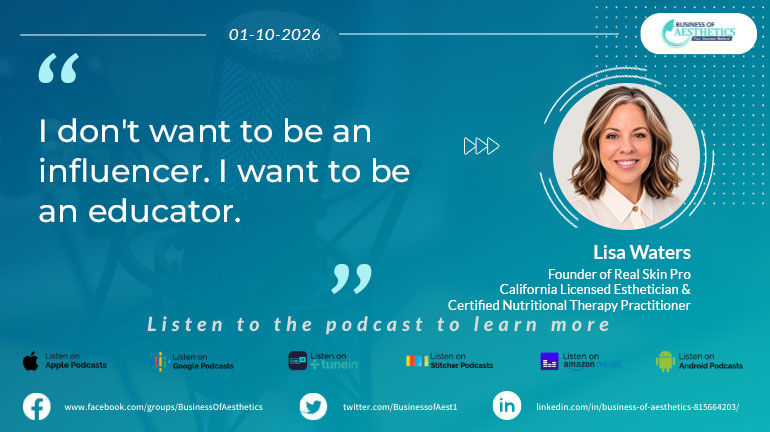
Lisa: That’s a good question. I want to know from other people what that is too. For me, I don’t want to be an influencer. I want to be an educator. I think that’s what stands out with Real Skin Pro education, and that’s why it’s in the title, Real Skin Pro. With TikTok and YouTube, you have non-professionals giving professional advice, or they think they are. I wanted to make sure people know this is real education from a real pro, a real skin pro. I try not to be the influencer, and instead use my background and education to actually teach, rather than saying, "Look at this cool thing I have. Look at my client’s glass skin. I’m using this new hot ingredient or this new hot modality." Let’s go back to the basics and ask why we’re doing this. I have technique to share, and I explain it through education, trying to hit all the different learning styles rather than just throwing information out there. I feel like it’s in the infancy of the attention it’s getting, but I do think that’s what sets me apart a little: I educate. I’m not there to sell a product. I’m not there to sell a brand other than myself. I’m really teaching as if the person has never heard the information before, and that goes for seasoned estheticians or new estheticians. Treat everybody like they’ve never heard it before, because we can always learn something new from each other. That’s what it’s all about: keeping connected, staying informed, learning from each other, and no gatekeeping the information. - 00:31:36 – Closing Thoughts & Where to Find Lisa
- Lisa reflects that the conversation covered the issues she most wanted to highlight in the industry.
- Listeners can find Lisa on Instagram at @real_skin_pro, on the Real Skin Pro Education podcast on Apple Podcasts, at realskinpro.com, and by email at lisa@realskinpro.com.
- Don reminds listeners that Ekwa Marketing’s complimentary 60-minute marketing strategy session is available at www.businessofaesthetics.org/msm.
View TranscriptDon: Lisa, since we’re now arriving at the end of the podcast, I’m curious, was there any particular question you wish I had asked you?
Lisa: No, not really. I think these were all great questions. They’re so relevant in this industry, and I’m glad you asked the ones you did, because I wanted to bring attention to some of them. It was great.Don: Okay, wonderful. Well, that was Lisa Waters, founder of Real Skin Pro, on mastering the art and science of skincare. Where can people find you and the work you do?
Lisa: You can follow me on Instagram at real_skin_pro. I’m not really on TikTok. I kind of am a little bit, but I’m not dancing for attention yet, so that’s a little scary to me. The podcast is on Apple Podcasts. It’s Real Skin Pro Education. You can always visit my website at realskinpro.com and email me at lisa@realskinpro.com.
Don: Wonderful. And if you would like to strengthen the growth side of your own practice, Ekwa Marketing’s offer to our Business of Aesthetics listeners, the complimentary 60-minute marketing strategy session, is still available to you. Go ahead and reserve your session at www.businessofaesthetics.org/msm. I’m Don Disha. This has been the Business of Aesthetics podcast. Thanks for listening, and until next time, keep on learning.
GUEST – Lisa Waters

Lisa Waters is a California licensed esthetician and the founder of Real Skin Pro, a company dedicated to advancing skincare education and empowering estheticians to thrive in their craft. With over a decade of experience in the field, Lisa has established herself as a knowledgeable and passionate leader in the skincare industry.
Lisa’s expertise spans both medical and holistic aesthetics, giving her a unique perspective on skincare that embraces a comprehensive approach to health and beauty. She believes that true skincare goes beyond topical treatments, recognizing the critical role that nutrition plays in achieving healthy, radiant skin. Driven by this conviction, Lisa completed a rigorous 1,226-hour program to become a certified Nutritional Therapy Practitioner in July 2023, enabling her to offer her clients and students a more integrated understanding of the skin-nutrition connection.
As an educator, Lisa is committed to sharing her knowledge and experience with fellow estheticians, helping them grow professionally and deliver exceptional care to their clients. She is known for her ability to translate complex concepts into practical, actionable insights that professionals can immediately apply in their work.
Throughout her career, Lisa has demonstrated a deep commitment to ongoing education and professional development. She regularly attends in-person classes, esthetics events, and online courses to stay at the forefront of the field. Lisa is oncology trained, acne certified, and a proud member of Associated Skin Care Professionals and NASN Pro.
With Real Skin Pro, Lisa is on a mission to elevate the skincare industry by empowering estheticians with the knowledge, skills, and confidence they need to build thriving careers and deliver transformative results for their clients. She believes that investing in oneself through education is the key to unlocking one’s full potential, and she is dedicated to being a lifelong learner and teacher in the world of aesthetics.
www.realskinpro.comHOST – Don Adeesha

A seasoned marketing professional and a natural on-camera presence, Adeesha Pemananda is a skilled virtual event host and presenter. His extensive experience in brand building and project management provides a unique strategic advantage, allowing him to not only facilitate but also elevate virtual events.
Adeesha is known for his ability to captivate digital audiences, foster interaction, and ensure that the event’s core message resonates with every attendee. Whether you’re planning a global webinar, an interactive workshop, or a multi-session virtual conference, Adeesha brings the perfect blend of professionalism, energy, and technical savvy to guarantee a successful and impactful event.
Connect with Us:
Category: Business of Aesthetics Podcast