Podcast: Play in new window | Download
Subscribe To Our Podcast




In this episode, host Don Adeesha sits down with Dr. Tiffany Hall, Chief Growth Officer at Aesthetic Record, to dismantle the biggest myth in medical aesthetics: that revenue is the number that decides whether a practice survives. Dr. Hall, who sits on top of one of the largest pools of real-world operational data in the industry, argues that most owners misdiagnose a marketing problem when the real bleed is happening at the operational and follow-up layer. She walks through the exact data trail an owner can pull tomorrow morning, speed to lead, conversion, retention, and frequency of visit, and explains why “fishing in your own pond” beats chasing new leads every time. From the 2.5-visits-per-year golden number to the 80% utilization sweet spot to the inventory and COGS metrics a PE firm scrutinizes during due diligence, this is a tactical map of where revenue hides inside your own EMR. Dr. Hall closes with her one Monday-morning fix for any owner staring down 24 months to scale, sell, or stall: run your 12-month inactivity report, find every patient who came in once for one thing, and start re-engaging them. The data is the goldmine, most owners just never sit down and dig.
Key Takeaways
- Stop diagnosing a revenue problem when you have a retention problem. Revenue is an outcome, not a lever. So track frequency of visit and re-engagement inside your current patient list before you spend a dollar on new leads.
- Make 2.5 visits per year your golden number. The industry average is roughly 2.2 visits annually; getting each patient back just one additional half-visit across a large list, at a healthy average ticket, compounds into serious revenue with zero new acquisition cost.
- Hold provider utilization near 80%, never 100%. A fully maxed calendar produces diminishing returns through burnout, so build in breather time to protect both satisfaction and long-term productivity before you hire your next provider.
- Let the system track the data so your team doesn’t have to. Manual spreadsheets and cross-system clicks destroy data integrity, build your EMR correctly from day one so KPIs are captured automatically as staff simply do their daily jobs.
- Redeploy your people as the “human in the middle.” Automate the mundane lead-response and tracking work so your front desk can do the high-value human tasks, calling, converting, and nurturing patients, that actually raise your valuation.
- Pull the four-point lead trail to find the operational bleed. Track who came in, how fast you responded, whether they converted to a consult, and what they actually bought, these four data points expose whether the leak is marketing or follow-up.
- Run your 12-month inactivity report first. Any patient who hasn’t been in, rebooked, or bought in 12 months is effectively lost; if that list outnumbers your active patients, the problem is your nurturing pipeline, not your ad spend.
Dr. Hall made the case that the answer to sustainable growth is already sitting inside your own practice, in the patients you’ve stopped nurturing and the revenue hiding in plain sight. This session is your chance to build a 12-month roadmap that pairs operational discipline with the right high-value patients walking through your door, so your EMR finally has winning numbers to track.

- Get a 1-on-1 diagnosis of your online presence & patient acquisition funnel
- Identify critical, untapped growth levers (SEO, Social, Referrals)
- Define a clear action plan to attract and convert your ideal patients
- Receive expert solutions for your most pressing marketing challenges
Resources

Live Webinar: Future-Proofing Your Aesthetic Practice: Decisions You Must Get Right in the Next 18 Months
Join industry experts to modernize operations, enhance patient experience, and drive sustainable growth.
Wednesday, May 20, 2026 @ 7:00 PM EST – 9:00 PM EST

Are you ready for the “GLP-1 Body” Era?
Download the 2026 Aesthetic Patient Behavior Model to see the numbers driving decisions this year:
- Why 73% of patients now define beauty by “individuality” over transformation?
- The shift away from non-invasive fat reduction (down ~40%).
- Real data on the rise of the male aesthetic patient.
Key Highlights:
- 00:00:21 – Cold Open & Topic Setup
- The episode opens on a stark premise: a practice’s EMR has been keeping score since day one, and the data inside it predicts whether the business survives the next 24 months.
- Host Don Adeesha introduces the guest, Dr. Tiffany Hall, Chief Growth Officer at Aesthetic Record, who manages one of the largest pools of real-world operational data in medical aesthetics.
- The topic is the "data-backed diagnostic", why owners misdiagnose their business problems and how to audit operations for a high-value exit. The episode is sponsored by Ekwa Marketing.
View TranscriptAdeesha: Your EMR has been keeping score on your practice since the day you opened. And somewhere inside those numbers is the definitive answer to whether you’ll still be in business 24 months from now, or if you’re just working for the landlord. Welcome back to the Business of Aesthetics podcast. I’m your host, Don Adeesha. To help us decode the data that separates elite-scale practices from the ones treading water, we’re joined by none other than Dr. Tiffany Hall, Chief Growth Officer at Aesthetic Record. She manages one of the largest pools of real-world operational data in the industry and has spent the last decade watching exactly how the math of a med spa translates into its long-term survival. Today we’re discussing the databacked diagnostic, why most owners misdiagnose their business problems and how to use your own software to audit your operations for an eventual high-value exit. This episode is brought to you by Ekwa Marketing, the growth partner behind this podcast. Dr. Hall, thanks for being here. Welcome to the podcast.
Dr. Hall: Thanks for having me. I’m excited to get into this conversation. I love data, so this is a good topic.
- 00:02:07 – The Real Survival Signal: Retention Over Revenue
- Dr. Hall argues revenue is the wrong primary metric, profitability and patient retention matter far more to long-term survival.
- It’s cheaper to keep an existing patient than to acquire and "train" a new lead; everything a practice needs to survive is usually already inside its own patient list.
- The key questions: are patients retaining, engaging with memberships and treatment plans, and converting into multiple modalities rather than a single toxin visit?
View TranscriptAdeesha: You sit on top of one of the largest pools of operational data in medical aesthetics. When you look at that data today, what’s the single clearest signal that separates a med spa that’s going to be thriving in two years from one that’s dying right now?
Dr. Hall: People want to focus on revenue as the core metric that dictates success. To me, it’s not really a revenue problem. Revenue is a great number, we all need to make money to survive, but it’s more about your current patient population and whether they’re retaining and engaging. Are they coming back more than once a year? Do you have memberships? Are they engaged in treatment plans? Are they engaging with your new services and coming back for more? If you fish in your own pond, all you need to survive is already in the practice. Profitability matters more than revenue, and it’s cheaper to keep a lead than to go get new ones. Marketing to an existing patient list is a lot easier than getting new leads and training them on your practice. Conversion metrics are really important, are you converting those leads, and once they convert, is it a single toxin or a whole plan across lasers, skincare, and wellness? The big glaring number for me is your retention number and frequency per visit.
- 00:03:39 – Frequency of Visit & the Chair-Time "Holy Grail"
- Dr. Hall’s ideal: every patient returning at least 2.5 times per year, versus the industry average of roughly 2.2.
- Getting each patient back one more half-visit per year across a large list, at a healthy average ticket, compounds into significant revenue.
- "Chair time" is the holy grail, once a patient is numb, consented, and photographed, the goal is to maximize revenue for every minute they’re in the seat.
View TranscriptAdeesha: And what’s a good retention number, according to you?
Dr. Hall: Gosh, I’d love something like 75%, but it depends on the practice. If you could get every patient to come back one more time per year, think of what you’d make. If you have a 10,000-person patient list and they each came back half a visit more on average, at a $400 average ticket, that’s a ton of money. It depends on your calendar too, can you even fit them all in? Utilization matters a lot. My ideal is every patient coming back at least two and a half times a year. Frequency of visit is what I hang my hat on. We look at toxins four times a year, that’s unheard of, but the average is about 2.2. If they come back 2.5 times and they’re doing multiple services, that’s the key. If they’re going to sit in your chair, chair time is the holy grail. They’re already numb, already consented, already had their pictures. Maximize the time in the chair. It even allows a little discounting because you’ve already had that sunk cost. Get them back more often and spend more when they come, that’s the magic formula for growing a business.
- 00:05:08 – Utilization Benchmarks & Avoiding Burnout
- Before hiring another provider, a single practitioner should be at roughly 80% capacity, the practice overall sitting in a 70– 80% utilization band.
- 100% utilization is dangerous: it leads to provider burnout and diminishing returns at the end of the day.
- A satisfaction and happiness component genuinely drives productivity, so providers need breather time built into the calendar.
View TranscriptAdeesha: When you mention utilization, what’s the benchmark for best utilization where sustainability is maintained while making the best of profitability?
Dr. Hall: We like to say before you hire someone else, you should be about 80% capacity for a provider. That’s a full practice for a single practitioner, enough to function, take a break, use the bathroom, eat lunch. So your practice overall sits around 75%, roughly 70 to 80% utilization across the board. New providers will be slower, an esthetician may not be as booked, but good producers at 80% are in a sweet spot. You need wiggle room. A provider doing nothing but injecting or devices all day, nose to the grind, hits diminishing returns, they’re burned out. Despite all of us loving revenue, there’s a happiness and satisfaction component that drives productivity. So 100% utilization is a dangerous place to be. I’d never recommend that for a calendar. If they book it themselves, fine, but about 80% to me is a pretty full schedule.
- 00:06:29 – Staff Buy-In Without Micromanaging
- The thriving practices don’t ask staff to "track" anything, the system captures data automatically, the way a phone tracks steps without participation.
- Introducing a human into manual tracking erodes data accuracy and integrity; the front desk should focus on daily metrics (calls, speed to lead, checkout, financing offers), not data entry.
- It’s the owner’s or manager’s job to read the resulting data for trends and directional decisions.
View TranscriptAdeesha: To keep an eye on these KPIs, we need to track things. Frontline staff often struggle with that. How do thriving spots get their team to buy into the data without feeling micromanaged?
Dr. Hall: They don’t have to. Our phones and computers track all our data every day and we do nothing, it just tracks for us. You want your systems set up so that whatever you do in your day-to-day workflow, checking in, checking out, charting, lead generation, is tracked with or without human involvement. The minute you introduce a human, you get less data accuracy and integrity. The goal is the front desk person never thinks about data all day. She thinks about her metrics, calls per day, speed to lead, checking people out, offering financing. If she does her daily job, the metrics are just there. Then it’s the owner’s or manager’s job to look at those points and decide if it’s a trend worth acting on. It gets dicey when people manually track in spreadsheets or click between systems, you can’t depend on that data. In a competitive industry, you have to trust the numbers, and it has to be part of your ecosystem, or you can’t track enough manually to make it worthwhile.
- 00:08:13 – From Spreadsheets to a Properly Built EMR
- The hardest transition is paper to technology; it’s uncomfortable at first, but the payoff is a system that clicks and tracks everything for you.
- Build it out correctly from the start, right inventory, right costs, individual units, because empty fields destroy your end-of-year story on usage, sales, and waste.
- Pair an EMR with a CRM that delivers a true ROI number; without lead-to-revenue tracking, you can’t tell whether marketing spend worked.
View TranscriptAdeesha: What are the steps to go from spreadsheets to the ultimate EMR?
Dr. Hall: It’s not always easy, I’ll be honest. I’m a techie girl, I love AI and all things tech, so give me a beta test and I’ll buy in. But for someone in a paper-only practice, there’s comfort there, and moving to technology is hard at first. At the end of the day, build it out correctly from the beginning, the right inventory, the right cost, all those fields exist for a reason. At Aesthetic Record we see people who don’t enter cost of goods or individual units for their Botox vial. Those things have value when you look at yearend: what did we use, what did we sell, what was our waste? Inventory is where practices get off-kilter. So spend four or five weeks, rip the bandaid off, do the training, get a strong foundation, then teach your staff. A big technology gap is that everyone learns together at launch, but the person hired six months later learns nothing because no one’s there to teach them. Stay on top of feature launches, compliance changes constantly. If I could recommend two things, it’s an EMR and a CRM that work together, because if your lead system doesn’t give you an ROI number, what are you doing? The front end of lead generation, the back end of the EMR, and the nurturing sequence around it, that’s where the value is. It takes a minute to set up, but the payoff is exponential.
- 00:10:45 – Diagnosing the Operational Bleed (the Four-Point Lead Trail)
- Many owners think they have a marketing problem when they have a front-desk or follow-up problem.
- The proof is a CRM-to-EMR data trail answering four questions: did leads come in, how fast did we respond, did they convert to a consult, and did they buy?
- Automation guarantees speed to lead, an instant SMS, email, WhatsApp, or Facebook reply at 4 a.m., while a nurturing sequence keeps asking for the appointment until it books.
View TranscriptAdeesha: Most owners think they have a marketing problem when they actually have a front-desk or follow-up problem. What’s the specific data trail an owner can pull tomorrow morning that proves the bleed is at the operational layer?
Dr. Hall: That’s where you need the CRM-to-EMR connection. I want to know four things: what leads came in, how fast we contacted them, when they booked, and whether they came in. Did we get leads? How fast was our response? Did we convert them to at least a consult? Did they come in and buy something? All of that is a data point you’ll get just by clicking through your system normally, a few quick reports tell the whole story. A lead is great, but not if no one works it; it just sits in a list while the front desk is busy. That’s why automation matters. If a lead comes in at four in the morning and immediately gets an SMS, email, WhatsApp, or Facebook message back, the process starts with no human involved and we know it’s done correctly. That speedto-lead report will look good. Then if they don’t convert, the nurturing sequence keeps asking for the appointment until it’s booked. When they come in, we know what they received and whether they’ve booked their next visit. So the four points are speed to lead, who’s coming in, do they convert, and what did I actually make on the back end. That tells you how good your lead management funnel really is.
- 00:12:34 – The "Human in the Middle"
- Dr. Hall reframes "human in the loop" as the "human in the middle", the quality-control engineer of the whole journey.
- Their role is twofold: QA the AI and automation (messaging, sequences, brand) and do the high-value human work, calling, converting, and nurturing patients.
- Aesthetics is uniquely human-centric and "white glove"; automation should strip away mundane tasks, not the human touch a patient wants for a facelift consult.
View TranscriptAdeesha: You mentioned the human in the loop. What does the human do here?
Dr. Hall: I call it the human in the middle, she’s not in the loop, she’s in the middle of the whole process. Everyone says SaaS is dead; I manage a SaaS company, but the human in the middle for aesthetics is critical. It’s a very personal, vulnerable business. That human is the quality-control engineer. If things aren’t converting, what’s going wrong, wrong messaging, wrong sequence, wrong brand message? They’re the QA for what’s happening on the AI and automation side. But they’re also part of the story, because once AI handles the mundane tasks, they can actually call patients and leads and interact human to human. They’re not buried in paperwork or spreadsheets. I can’t tell a PE firm "she does paperwork all day." But if I say she’s calling and converting leads all day and doing LTV calls, that makes a buyer happy.
Adeesha: So the human touch is a skill in itself.
Dr. Hall: Absolutely. People want all these AI phone things, and I’m all for the 4 a.m. capture, but we still need the human part. Aesthetics is more human-centric than almost any industry. It’s a face, it’s unique, it’s VIP, it’s white glove. I don’t want a robot booking me for my facelift. I want to talk to the person who’ll be in the room walking me through pre-op and post-op. You can’t strip that away. But you can let them focus on it intentionally because they’re not doing the BS that keeps the business running.
- 00:14:57 – Which AI Actually Moves the Needle
- Dr. Hall calls the AI hype a causation-correlation problem: when a practice adds an AI chat widget or phone system, it’s usually the built-in automation, not the "AI" label, driving the lift.
- Face-analysis tools (e.g., Ageless with RepeatMD) are "sexy" and pull eyeballs and traffic, but traffic only matters if the nurturing and automation convert it into a paying patient.
- Beyond patient-facing tools, AI is genuinely useful for reports and dashboards, email content, graphic design, research, and legal, but the real practice lift is in lead-gen from interest to intent.
View TranscriptAdeesha: There’s a wave of AI tools being sold into aesthetics. What’s the one category genuinely moving the needle versus the expensive theater?
Dr. Hall: There’s a lot. Everyone loves to slap "AI" on something. Honestly, it’s a causation-correlation problem. If a practice brings in an AI chat widget or an AI phone system or AI responses for email and SMS, they probably built automations now too. So I can’t tell if it’s the AI or the automation, because before, the front desk girl was praying she had time on her lunch break to call back a lead. Now there’s a true system, and what we want most from AI is consistent, repeatable behavior, a widget that triggers an automation to follow up in two days. The lead part is most important because it’s easy to quantify. The face-analysis tools are very sexy right now, Ageless just launched with RepeatMD, a niche, unique experience. "Look at my before-and-afters" gets eyeballs and traffic, but turning traffic into a true lead means running them through the nurturing process. The most value is in whatever takes patient interest into actual buying intent. To be less presbyopic about it, AI also helps with reading reports for direction, building dashboards, email content, graphic design, research, and legal, we use 15 or 20 tools a day. But the true practice lift is that lead-gen path from interest into the practice.
- 00:17:42 – Sponsor Break: Ekwa Marketing
- A great EMR is the ultimate diagnostic tool, the engine tracking the health of the entire business, but it needs the right highvalue patients as fuel.
- Ekwa Marketing positions itself as the other half of the success story: providing the patient flow so the EMR has winning data to track.
- Listeners are offered a complimentary 60-minute marketing strategy session and a realistic 12-month roadmap at www.businessofaesthetics.org/msm.
View TranscriptAdeesha: We’ll take a pause here. Dr. Hall is showing us that a great EMR is the ultimate diagnostic tool, the engine that tracks the health of your entire business. Our team at Ekwa Marketing sees themselves as the other half of the success story: providing the fuel for that engine, ensuring the right high-value patients walk through your door so your EMR has winning data to track in the first place. When your marketing and your EMR are in sync, that’s when you see real scale. To help you get that engine running at peak performance, we’re offering our listeners a complimentary 60-minute marketing strategy session, a zeropressure, one-on-one deep dive into your practice’s digital footprint. We’ll build a realistic 12-month roadmap designed to feed your practice and your EMR the exact patients you’ve been looking for. Book a time at www.businessofaesthetics.org/msm. Let’s give your EMR some incredible numbers to work with.
- 00:18:57 – What Drives Valuation in Due Diligence
- Operational effectiveness is the number-one driver, a clean, sound practice is instantly more attractive to a PE firm than one with numbers all over the place.
- Lifetime value (often via memberships and recurring revenue), revenue and profit per hour, and discounting discipline are top of the list; heavy discounting signals a weak value proposition.
- Inventory and COGS-to-sales ratios reveal resource efficiency and clean bookkeeping, inventory is the second-biggest cost after HR.
View TranscriptAdeesha: Consolidation is reshaping the industry. When a buyer pulls a practice’s EMR data during due diligence, what are the three or four operational metrics that drive the valuation multiple up or down?
Dr. Hall: Operational effectiveness is number one. If a practice is truly operationally sound, you’re instantly more attractive to a PE firm than if your numbers are all over the place. That comes from being diligent about how you set up your EMR and track everything. Number one specific metric is lifetime value, are patients coming and staying and producing long-term revenue? That’s often a product of memberships and recurring revenue. I also want revenue per hour and profit per hour, if the chair is occupied, what can you make, and what are your inputs? If revenue is crazy high and profit is crazy low, I want to know what the mess in the middle is. Discounting is a product of that, if you’re giving away the house to make the money, it’s not working, and it scares a PE firm about your value proposition. Then inventory: what’s your COGS versus what you’re selling? A high COGS and low sales raises concerns about efficiency and how you manage shrinkage, turnover, and expiration. Strong inventory numbers show clean bookkeeping you can reconcile. Inventory turn matters because, other than HR, it’s your biggest cost. If patients are staying and spending and you’re controlling cost well, you’re probably a sound business.
- 00:21:41 – Measuring Operational Effectiveness
- Effectiveness is an ecosystem: rebooking rates (low rates mean staff aren’t asking), invoice/ticket size, and upsell/cross-sell discipline like buy-now-pay-later.
- Per-hour revenue and room turnover, including the unglamorous cleaning buffer, directly affect throughput and profitability.
- The 12-month lag is the red flag: any patient who hasn’t engaged in a year is effectively lost, and if that group outnumbers active patients, the nurturing pipeline is broken.
View TranscriptAdeesha: How are you measuring that operational effectiveness?
Dr. Hall: It’s an ecosystem. Rebooking rates are critical, if they’re low, your people aren’t asking, and that’s revenue left on the table. Invoice amount matters: is staff trained to ask for the upsell, to use buy-now-pay-later? If every ticket is one flat $300 item, that’s not effective, we’re not teaching upsell, cross-sell, and packaging. Per-hour revenue and room turnover matter too. Turning a room isn’t sexy, but the cleaning buffer really matters. And the big one: if a patient hasn’t been here in 12 months, not engaged, not bought online, not rebooked, not been in, I’ve lost that patient. If more patients haven’t been in for 12 months than have, you have a nurturing problem. So effectiveness is also the nurturing pipeline and the referral number. It’s all the places revenue can hide, cancellation policies, leads not converting, no upsell, no membership sell. How you do one thing is how you do everything.
Find where the money’s left on the table, and you find what’s driving those decisions.
- 00:23:29 – The One Monday-Morning Fix: Fish in Your Own Pond
- Faced with a practice owner who has 24 months to scale, sell, or stall, Dr. Hall’s single fix is to mine the existing patient base.
- Week one is a fact-finding mission: run the 12-month inactivity report, find patients who came in once for one thing, and look for patterns (a device that hurt, a poor outcome, no follow-up).
- Then re-engage with VIP, personalized "we miss you" outreach, even asking lapsed patients directly why they left, and package easy-to-sell pairings for a quick revenue uptick.
View TranscriptAdeesha: If you were sitting across from an owner who has 24 months to scale, sell, or stall, and they could only fix one thing starting Monday, what is it, and what does week one look like?
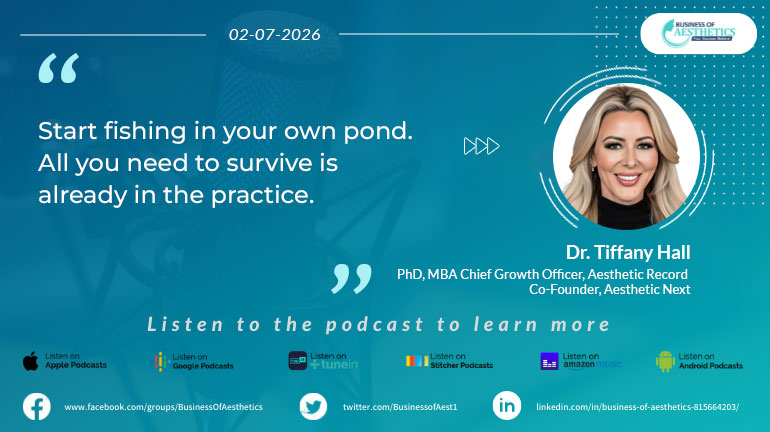
Dr. Hall: In my Arkansas accent, start fishing in your own pond. First thing I’d do is look at my current patient population and start with that 12-month metric. Go home today and see how many patients haven’t been in over the last 12 months, or who only purchased one thing and came in once. Start a nurturing sequence to re-engage them and re-up their loyalty. That’s week one, just identifying who hasn’t been in, and what they had done last. Is there a pattern? Did a device hurt? Was the outcome poor? From there you look at what to pair together, your best sellers plus a package, to get a quick revenue uptick. But the goal is to reengage and then keep them engaged. Maybe you’ve never done memberships and should start. Maybe you only do injectables but you’re losing patients to GLP-1s or lasers elsewhere. Understanding why they don’t come back is a hard lesson but very important. I’d love to ask a patient, "Why did we lose you? What did we not do well? We’d love to try again." That VIP "we miss you" touch gets you the real information. It could be the front desk, a missed follow-up, an adverse event they fixed elsewhere. You don’t know what you don’t know. Go sit beside the person who does the job and find out what’s not being done. Week one is a fact-finding mission, and from there you build strong nurturing plans.
- 00:26:06 – Knowing When to Add a New Service
- To gauge demand for a new service, survey patients and listen in consultations, even for services you don’t yet offer.
- If patients ask for something daily (e.g., GLP-1s) and you can’t provide it, they’ll go where they can also get their toxin and filler, putting your retention at risk.
- If the cost to add is low, no six-figure device, no extra room, minimal training, beta test it for about six weeks before committing to a full marketing campaign.
View TranscriptAdeesha: You mentioned adding services, like GLP-1s if you only do injectables. How do you determine whether there’s enough demand to add one?
Dr. Hall: If I knew that perfectly I’d be a multi-billionaire. Part of it is surveying your patients and listening in consultations. If you do a thorough consult, you’ll hear what they want even if you don’t offer it, "I really want a GLP-1, I want to lose weight, I want to be healthier." If you hear that every day and can’t solve it, and that same patient type isn’t coming back, guess where they’re going, somewhere that has the service plus their toxin and filler. If the cost to bring it in isn’t exorbitant, not a $100,000 device, you have someone trained, it’s not a huge room risk, it’s a great way to beta test. Give it a good six weeks, toe in the water, before going guns ablaze with a full marketing campaign. If you’re hearing demand in consultations, your spidey sense should go up: bring it in, because if they’re not getting it from you, they’re getting it somewhere. But if it requires a device, an extra room, a build-out, or a new hire, the decision is far more complex. If it’s an easy add, it never hurts to try, give it a whirl and track whether it helps retention.
- 00:28:04 – Key Takeaway & Where to Find Dr. Hall
- The golden nugget: stop chasing leads and start data mining your own CRM and EMR to find where you’re leaving money on the table.
- Patients coming in once a year for one service represent a boatload of unrealized revenue, and it’s a disservice, since they likely need more than one thing.
- Get half your patients to return one more time per year and spend a little more, and you’ve made your number, happier patients refer, and it compounds.
View TranscriptAdeesha: One last thing, a golden nugget. What’s the key takeaway from our conversation?
Dr. Hall: People want to say revenue and leads, leads, leads. But it’s really data mining your own CRM or EMR to find out what your patient behaviors are and where you’re leaving money on the table. If your patients come once a year for one service, you’re leaving a boatload of revenue behind, and it’s a disservice, because they need more than one thing. None of us needs just one thing. Maybe the consultation isn’t going well, you’re not upselling or cross-selling. The revenue sitting in your practice and your EMR is astounding. Go do some digging and find where the leaks are. If you can get half your patients to come back one more time a year and spend a little more, you’ve made your number. A happier patient who feels better tells their friends, referrals come in, and it all fits together. The data is the goldmine, you just have to sit down and look.
Adeesha: Dr. Hall, where can our listeners get in touch with you and your work?
Dr. Hall: You can find me on Instagram at @drtiffanyhall, or go to aestheticrecord.com, or, coming soon, aestheticnext.com, and come to our conference in September.
Adeesha: Thank you very much, Dr. Tiffany Hall. And a quick reminder as we wrap up: if you’re looking for clarity on the digital side of your practice, Ekwa Marketing is offering our listeners a complimentary 60-minute strategy session, a one-on-one conversation to help you map out a realistic 12-month roadmap for attracting high-value patients. Grab a time that works for you at www.businessofaesthetics.org/msm. I’m Don Adeesha, and this has been the Business of Aesthetics podcast. Thanks for listening, keep on leading.
GUEST – Dr. Tiphany

Dr. Tiphany Hall is one of the most influential operators in medical aesthetics, and a rare example of a software executive who has scaled a category-defining platform without a dollar of venture money. As Chief Growth Officer at Aesthetic Record, she joined in 2019 with the company at 5 employees and fewer than 1,000 clinic locations, and has since built it into a team of 60 powering more than 9,000 locations and over 2 million patients across the United States. From inside the platform, she sees what the rest of the industry only guesses at, the booking data, payment flows, and operational patterns that quietly decide which practices compound and which ones fall behind.
Beyond the core EMR, Dr. Hall is a true multi-vertical operator. She led the launch of LeadAR, the CRM and marketing automation SaaS layer built to work in tandem with the EMR, and AR Sync (Powered by Yext) to give practices control of their online reputation and SEO. She is also the Co-Founder and Director of Aesthetic Next, the international medical-aesthetic education conference that now draws 1,500 attendees, 100+ faculty, and 100+ exhibiting companies to Dallas each year, and Executive Producer of Aesthetic Next Productions, the brand’s in-house media and conference arm. She hosts the weekly For The Record podcast, now in its fifth season, and is a Top 25 Woman Leader in Healthcare Technology and recipient of the 2025 Dallas Business Journal Women in Technology Award. She holds an MBA and a PhD in Organizational Development, and is a regular voice on stages and in the press on practice operations, technology, and the business of aesthetics.
Learn more: www.aestheticrecord.com
HOST – Adeesha Pemananda

A seasoned marketing professional and a natural on-camera presence, Adeesha Pemananda is a skilled virtual event host and presenter. His extensive experience in brand building and project management provides a unique strategic advantage, allowing him to not only facilitate but also elevate virtual events.
Adeesha is known for his ability to captivate digital audiences, foster interaction, and ensure that the event’s core message resonates with every attendee. Whether you’re planning a global webinar, an interactive workshop, or a multi-session virtual conference, Adeesha brings the perfect blend of professionalism, energy, and technical savvy to guarantee a successful and impactful event.
Connect with Us:
Category: Business of Aesthetics Podcast