Podcast: Play in new window | Download
Subscribe To Our Podcast




In this episode, host Don Adeesha sits down with Alana Zurek, founder and CEO of Beverly Hills Hairfree and CEO of Electrology Tech, to expose the patient gap laser-only med spas don’t see coming. Alana argues that roughly 75% of the population, clients with gray, white, blonde, red, or hormonally-influenced hair, simply cannot be served by laser, and that techs across the industry are finding it harder than ever to sell laser packages as clients wise up to its non-permanent results.
The conversation digs into the clinical realities practice owners need to understand: paradoxical hypertrichosis, where laser stimulates the androgen hormone and makes hair growth worse instead of better; how to run a 60-to-90-day demand audit before adding a new service line; and why multi-probe galvanic electrolysis outperforms single-probe treatment on comfort, scalability, and technician fatigue.
Alana closes with her framework for positioning permanent removal inside an existing laser practice, treating electrolysis as the natural extension of laser rather than a competitor, training staff to hand off clients once they’ve exhausted laser’s ceiling, and building consultations around relationships instead of transactions so patients never feel like they’ve been duped.
Key Takeaways
- Add multi-probe galvanic electrolysis to capture the market laser can’t touch. Gray, white, blonde, red, and hormonally-imbalanced hair make up roughly 75% of the population, and laser-only practices are leaving that entire revenue stream unaddressed.
- Screen every client for hormonal imbalance before recommending lasers. Lasers can trigger paradoxical hypertrichosis, stimulating the androgen hormone and making hair growth worse instead of better, especially in undiagnosed clients.
- Treat the consultation as a diagnostic tool, not a sales step. Request photos in advance, assess skin and hair remotely, and build an individualized treatment plan before the client ever sets foot in the office.
- Position electrolysis as the natural next step after laser, not a competing service. Train staff to hand off clients who’ve hit laser’s ceiling into permanent multi-probe treatment instead of losing them to a competitor.
- Choose multi-probe over single-probe electrolysis to scale the service line. Multiple probes let technicians treat larger areas comfortably, reduce operator fatigue, and control daily treatment volume instead of racing the clock.
- Be upfront with laser clients about permanence limits before they invest. Clients increasingly research treatments beforehand, and an honest conversation about laser’s limitations builds the trust that keeps them in-house for electrolysis later.
- Track medication restrictions like Accutane during intake. Certain medications require a pause before starting electrolysis, and catching that early avoids wasted appointments and frustrated patients.
Alana Zurek’s philosophy is clear: an educated client who understands both the possibilities and the limits of a treatment is a practice’s best long-term partner, not a quick sale. This session gives you a clear roadmap for expanding your service mix and capturing the patients your current offerings are unintentionally turning away.

- Get a 1-on-1 diagnosis of your online presence & patient acquisition funnel
- Identify critical, untapped growth levers (SEO, Social, Referrals)
- Define a clear action plan to attract and convert your ideal patients
- Receive expert solutions for your most pressing marketing challenges
Resources

Live Webinar: Future-Proofing Your Aesthetic Practice: Decisions You Must Get Right in the Next 18 Months
Join industry experts to modernize operations, enhance patient experience, and drive sustainable growth.
Wednesday, May 20, 2026 @ 7:00 PM EST – 9:00 PM EST

Are you ready for the “GLP-1 Body” Era?
Download the 2026 Aesthetic Patient Behavior Model to see the numbers driving decisions this year:
- Why 73% of patients now define beauty by “individuality” over transformation?
- The shift away from non-invasive fat reduction (down ~40%).
- Real data on the rise of the male aesthetic patient.
Key Highlights:
- 00:00:13 – Introduction & Speaker/Topic Setup
- The episode opens on the core problem: laser reduction is not the same as permanent removal, and gray, white, red, hormonal, and previously-treated hair remain difficult or impossible for laser alone to address.
- Host Don Adeesha introduces guest Alana Zurek, founder and CEO of Beverly Hills Hairfree and CEO of Electrology Tech, who has nearly three decades of experience advancing multi-probe galvanic electrolysis.
- The episode previews three themes: the patient gap laser-only practices miss, how to determine whether demand justifies adding electrolysis, and what the multi-probe galvanic model means for service line economics and team training.
- The episode’s sponsor, Ekwa Marketing, is acknowledged before the conversation begins.
View TranscriptDon: But for many patients, reduction is not the same as reaching the finishing line. Gray, white, red, hormonal, and previously treated hair can remain difficult or impossible to address with just laser alone. When practices do not have a clear solution for those patients, they may be overlooking an important gap in both the patient journey and their service mix.
Don: Welcome back to the Business of Aesthetics podcast. I’m your host for this session, Don Adeesha. And joining us today is Alana Zurek, founder and CEO of Beverly Hills Hairfree and CEO of Electrology Tech. With nearly three decades of experience in permanent hair removal, Alana has built her career around advancing multi-probe galvanic electrolysis, educating practitioners, and helping patients achieve results when traditional hair removal options may no longer provide the complete answer.
Don: Today we will be exploring the patient gap practices miss when they rely only on laser, how owners can determine whether their demand justifies adding electrolysis, and what the multi-probe galvanic model means for service line economics and how practices can train their teams and position permanent removal effectively during consultations. This episode is brought to you by Ekwa Marketing. Alana, welcome back to the Business of Aesthetics podcast.
Alana: Thank you so much, Don. It’s really good to be back.
- 00:01:50 – The Patient Gap: What Laser Clinics Miss
- Laser clinics have no way of treating gray-haired, salt-and-pepper, blonde, or red-haired clients, roughly 75% of the population, leaving that entire revenue stream unaddressed.
- Technicians across the industry are reporting it’s increasingly hard to sell laser packages because clients now understand lasers require a lifetime commitment and isn’t permanent.
View TranscriptDon: Absolutely. So Alana, let’s get into it. What patient gap do established med spas miss when they rely only on laser removal?
Alana: Yeah, that’s a great question. I think the follow-up to that question, because we spoke about this in our first podcast as well, but since some time has passed, I’m starting to learn that there’s more to the patient gap, or the client gap, than we actually discussed. So it’s a two-part question. The first part is: what laser clinics are missing is they have no way of treating the clients that are gray-haired, salt-and-pepper, blonde-haired clients, even redheads, which is about 75% of the population. So they’re missing that entire revenue stream.
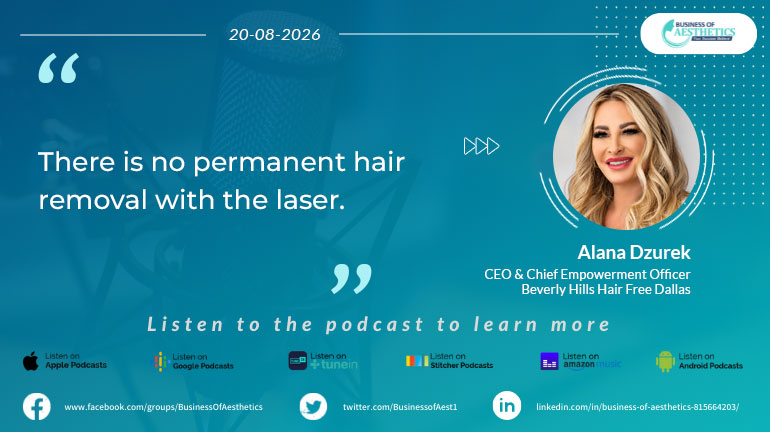
Alana: Additionally, I have since been on a lot of, let’s just say, message boards, and the technicians are also having issues selling laser packages. This is what I’m hearing from many of the techs that are currently either owners or working for the med spas. They’re claiming that it’s getting more and more difficult and challenging to sell these packages because the clients are starting to understand that it is a lifetime commitment. There is no permanent hair removal with the laser.
Alana: So I hope that answers your question. And I’m starting to see an aspect of the med spa that I haven’t seen before, where the techs are now coming forward and talking about how it’s been challenging to sell these packages to the clients.
- 00:03:24 – Patient Case Study & Paradoxical Hypertrichosis
- A client who had prior laser treatment saw hair regrow once she stopped her laser sessions and switched to electrolysis, illustrating that laser reduction reverses without ongoing maintenance.
- Lasers can trigger paradoxical hypertrichosis, stimulating the androgen hormone and making hair growth worse, particularly in clients with an undiagnosed hormonal imbalance.
- Most electrolysis walk-ins have already researched both options and know electrolysis is the only route to permanent results; there’s also a hidden "hormonal gap" laser techs can’t screen for.
View TranscriptDon: Would you be able to walk us through a typical patient journey in which a laser delivered meaningful reduction but could not provide the final result, just so we can have a broader understanding of the problem here?
Alana: Yeah, so I’m really glad you asked that, because recently I had a client who came to me who did have laser treatment on her face. And she came to her first session with me because she didn’t think that she had the kind of results that they promised her. So in other words, she saw reduction, but not significant enough to just continue her laser sessions.
Alana: So at her first session, we both said, wow, you don’t have that much hair, I think you’re going to be a great candidate for this. Each time she came back for her monthly appointment, we both noticed there was more and more hair.
Alana: So I asked her about that, and I said, well, what do you think is causing it? I already know how lasers work, because to me, after almost 30 years of watching this phenomenon, I know that if you don’t go to your laser session, the hair will come back. So because she stopped going to the laser and started electrolysis treatment, and she wasn’t doing anything in the interim except shaving, she noticed that all the hair she had paid for with her laser sessions had come back, which was very uncomfortable for her. So we agreed that when she first started, it definitely wasn’t the kind of hair that she had at her fourth session.
Don: Okay. And also, does lasers actually encourage hair growth?
Alana: Yeah, so that’s another phenomenon. It’s called paradoxical hypertrichosis. And we have had many clients in our office because of this. What the laser does is it stimulates the androgen hormone. So for example, if somebody already has a hormonal imbalance and they don’t know it, and the laser tech doesn’t know it, the laser will do the opposite, instead of getting rid of the hair, it will actually make the hair growth worse. So I have had ladies in my clinic who started off with just peach fuzz, fine hair along their sideburns, and they ended up with thick, dark, coarse hair right on the chin. That is devastating, because you’re paying for sessions for the laser to help you with a mediocre problem, and then you end up with more facial hair, and now it’s so coarse and thick that you have to pay more money to get rid of it. It’s also devastating while you’re going through the process: you go in to get something removed, you come back out, and now you have more hair and a whole new problem. So those are the kinds of things that I’m seeing in my clinic.
Don: Okay, so you’re not necessarily seeing first-time walk-ins, but rather ones who have already tried the treatment.
Alana: We are seeing walk-ins for electrolysis, and it’s funny, because when you asked me the first question, what is the gap, there’s also the hormonal gap that we didn’t discuss. A lot of laser techs won’t know that somebody has a hormonal imbalance unless the client tells them, and oftentimes the client doesn’t know they have a hormonal imbalance either. So it’s kind of a very touchy situation where you don’t really know that you’re going to put more hair on the client, but it happens, because the client doesn’t know they have a hormonal imbalance as well.
Alana: Yes, we do get first-time walk-ins, and the majority of our clients who come in to see us already have done their research about electrolysis and lasers. And so they know that electrolysis is the only way of achieving permanent results. They don’t want to risk the laser alternative at this point. They don’t want to try it just to see if it’s going to work or not, they would rather invest their money in a solution they know is going to be permanent, within, you know, 18 to 24 months.
- 00:08:03 – Justifying the Addition of Multi-Probe Galvanic Electrolysis
- Given that lasers can’t serve blonde, gray, or red-haired clients, or anyone with a hormonal imbalance, adding multi-probe galvanic electrolysis is framed as a near-mandatory decision for med spa owners in 2026.
View TranscriptDon: Okay, now, how can practice owners determine whether gray, white, red, hormonal, or failed-laser hair cases justify adding multi-probe galvanic electrolysis into their practice?
Alana: Well, I think at this point, it’s 2026. It’s really a no-brainer. Are you going to be able to treat the clients you know are not laser candidates, or are you going to leave that entire market to somebody else? Because we now know it’s not a maybe. It is not going to work for blonde hair, gray hair, red hair. And now we know that anybody who has a hormonal imbalance is not a laser candidate either. So if I’m a med spa owner, I’m absolutely going to add multi-probe galvanic to my treatments.
- 00:09:03 – Demand Audits and When Laser Still Has a Place
- A 60-to-90-day demand audit should track how many prospective clients, including those traveling in from other cities because local laser techs told them the laser isn’t working, are surfacing for electrolysis.
- Laser still has legitimate use cases: clients preparing for vacation, or clients on medications like Accutane that require a pause before starting electrolysis, or those who want to delay the electrolysis investment by a year or two.
- On a straight cost basis, lasers are not actually cheaper than electrolysis.
View TranscriptDon: Are there any particular pieces of information that a practice owner should be collecting during a 60- or 90-day demand audit, just to see if the demand is strong enough?
Alana: I think they’re going to be able to see that. I’m learning a lot from my clients who are traveling from other cities and locations, and they’re finding us because their laser techs are telling them that lasers are not working.
Don: So you’re seeing that answer play out already.
Alana: Yeah, I think at this point it’s more of "when do we get multi-probe galvanic in," rather than "should we." And, you know, we’ve talked about this before: should they throw away their laser? No. I do know med spas that are getting rid of them, but I think lasers still have their place. For example, if someone’s going on vacation or going out of the country and doesn’t want to shave, and doesn’t want to go through electrolysis treatments because they want to start when they come back, that’s a perfect use case in the meantime.
Alana: Or if a client is taking some kind of medication that prevents them from starting a treatment like electrolysis, for example, we can’t treat anybody who’s taking Accutane, because it’s very drying for the skin, and the client has to stop. So certain medications, whether applied to the skin or taken orally, mean we ask our clients to stop before they start the treatment. I’m not exactly sure if that’s a risk for laser candidates as well, but that would be another alternative solution, if the client wants to finish their medication in three months, six months, whatever it is, that might be another option for them.
Alana: The other thing we recommend: if somebody starts electrolysis, they’re obviously going to make a considerable investment in the beginning, until they get to a point where they don’t have as much hair and aren’t coming in as often. Sometimes people want to save that money and start in a year or two, so that’s another way they can stay hair-free temporarily and go for laser treatments until they’re ready to start. But I do want to say, if you look at the price and cost analysis, lasers are not cheaper than electrolysis.
Don: Okay. Okay.
- 00:11:40 – Inside the Electrolysis Consultation Process
- Consultations are thorough and conducted remotely, no in-person visit required. Clients submit photos, describe their goals, and receive an individualized treatment plan based on skin and hair assessment.
- Consultations are free, not billed, because the process doesn’t require bringing the client into the office.
- The consultation is framed as being more for the practitioner than the client, its real job is surfacing unrealistic expectations before treatment begins.
- Logistics differ by client type: local clients may book 15–30 minute sessions, while clients traveling internationally need multi-day treatment plans built around their trip.
View TranscriptDon: Something you mentioned is that you figure out what kind of medication clients are taking to see if they qualify for electrolysis, right? Is that something you do with every client?
Alana: Yeah, so our consultations are incredibly thorough. The reason being, I’ve been in this industry for 30 years, and for somebody like yourself or myself who doesn’t have a major facial hair issue, it’s not devastating. But for somebody who’s looking for a solution, gets a treatment, and ends up with more hair, like we discussed with paradoxical hypertrichosis, that is more devastation on top of what the client was looking to reduce in the first place.
Alana: So our consultations are very thorough. If I’m on the phone with a client, and by the way, we don’t even need to do in-person consultations, we ask that clients submit photos of whatever area they want treated, and explain what they’re looking to achieve. Once we get those photos, we examine the skin and hair, and sometimes we as professionals will notice things the client doesn’t notice. Once we receive the photos, we figure out how much time this client needs to achieve the results they’re searching for.
Alana: So everything is disclosed right there in the open. And if the client decides they need more time to think about it, that’s fine. I’ve noticed, after 30 years, when a person is ready, they’re ready and they want to get treated tomorrow. When they’re not ready, that’s okay too, because our best client is an educated client. Consumers are smart, and eventually they figure out what’s working and what’s not.
Don: That’s right, and I really appreciate you bringing that point up, an educated client is a great client to have. Do you also charge for that consultation, that triage?
Alana: No, that’s by choice. I know a lot of electrologists do, because it’s their time and they bring the person into the office. Since we don’t need to bring the person into the office, I can basically conduct a consultation on the phone, I don’t even need to see the person. Sometimes that’s a lot more comfortable for the person calling in, because if you’re a first-time electrolysis client, you don’t know what to expect, and a lot of clients can be very nervous. So it kind of breaks the ice when I give them all the information over the phone. I say, you can think about it, send me the photos, and when I get them, we’ll discuss your treatment plan. Everybody gets an individualized treatment plan, because everybody’s hair issue is different.
Alana: Some people are on camera, we see that a lot in our California location, so they have to be careful when they get their treatment because the camera picks everything up. So we discuss with them when they’re available. Somebody who travels to our location from out of the country isn’t going to want to spend just an hour in our office, so for those clients it’s important that we plan out their treatment, if they’re here for three days, we keep and treat them across those three days so they’re not wasting their time. For somebody local, they may only want to come in for an hour or two.
Alana: But for somebody who’s got a couple of menopausal whiskers, obviously she lives close by, she’s going to come in for 15 or 30 minutes. That’s very different from somebody flying internationally to get a full facial beard removed. This is why it’s so important to get a thorough consultation. We also want to know: do they have unrealistic expectations? I always say, even when I teach my program, the consultation is really more for us, the professional, than for the client, because if the client expects to walk out after two treatments completely hair-free and never come back, that’s obviously not going to happen. If I can get that person on the phone and understand that, I can determine whether it’s somebody I even want to take on as a client.
- 00:16:23 – Laser vs. Electrolysis: Transactional vs. Relationship-Based Business
- Laser is described as a transactional business, client comes in, gets a session, leaves, money exchanges hands, repeat, with little personal relationship built along the way.
- Electrolysis clients build long-term relationships with their practitioner, sometimes flying back specifically to finish treatment with the same provider rather than starting over elsewhere.
View TranscriptAlana: I think with laser, just to give you an example, laser seems to be more of a transactional business, there’s no real personal relationship with clients, and that’s the biggest difference. That’s okay, but they’re two very different business models. For example, I had a client who flew in from a different state and spent almost seven hours with me, we did her legs. She booked two days and we got done in one, so she didn’t have to come back the other day. You get very close and personal, and you build relationships with clients. They’re also very grateful when they’re done.
Alana: I think that’s the difference with lasers, it’s a very transactional business. A client comes in, gets their session, leaves, money’s exchanged, and that’s kind of rinse and repeat. So I wanted people to understand it’s a very different business model, we’re so much more about relationships. This is why clients who finish their treatment and move out of town don’t want to go for their last 15-minute session wherever they’re moving to. They would rather get on a plane and come back here to get it done.
- 00:17:43 – Multi-Probe Economics: Comfort, Flexibility, and Scalability
- Single-probe technicians are tied to how fast they can physically work through a client, locked into position for hours at a time, it’s exhausting for the operator.
- Multi-probe technicians instead decide how many treatments they want to run each day; inserting multiple probes lets the technician step back while the probes do the work.
- Spreading current across 16–32 probes instead of one pinpoint makes treatment significantly more comfortable for the client.
View TranscriptDon: That’s an amazing loyalty to the brand, Alana. So let’s talk a little about how the multi-probe galvanic model might change the economics of electrolysis compared to a traditional single-probe treatment. How does it do that?
Alana: Single-probe operators rely on how fast they can work their magic, how quickly they can get through a client. And it is exhausting. I know this because the first two years of my career I did single-probe, and I didn’t like it, and my clients didn’t like it. So I’m very grateful I got to switch over, and I’ve been practicing multi-probe for almost the last 30 years. The difference between the models: a single-probe technician has to rely on how fast they can treat a client. Multi-probe technicians basically decide how many treatments they want to do today, that’s the difference.
Don: Okay.
Alana: I can elaborate. So if you think about a single-probe technician, they are literally tied to the client. They can’t take their eyes off the client. They’re locked in the same position for an hour, two hours, five hours, whatever the treatment time, and this happens pretty much every single day. For a multi-probe practitioner, the probes basically do the work themselves. Once you insert 32 probes, you can sit back and stretch a little until they’re finished. You can work in many different ways, eight probes at a time, 16, or all 32, so you have a much larger canvas, much more flexibility, and your body doesn’t get as tired.
Alana: And the client is very much pain-free, because here’s the difference: when you’re practicing single-probe electrolysis, you get the current, whether it’s heat or galvanic, it’s still a current, concentrated in one tiny pinpoint. When you spread that same current out across 16 or 32 probes, it’s no longer concentrated in one tiny tip, so it’s incredibly comfortable.
- 00:20:19 – Training Teams & Positioning Electrolysis as the Permanent Solution
- Training should frame multi-probe galvanic electrolysis as a natural extension of laser treatment, the service a client graduates into once laser reduction plateaus or fails.
- Multi-probe electrolysis is especially well-suited to body work and large areas (backs, legs) where single-probe electrolysis is too slow and monotonous.
- Dermatologists are increasingly recognizing the same gap, even though doctors also profit from lasers and are sometimes required to have one on staff.
View TranscriptDon: Okay, so from a comfort perspective it seems multi-probe is the way to go as well. So then, how should a practice structure its training so multi-probe galvanic electrolysis becomes a scalable service line?
Alana: I think they should look at the training as an extension of the laser treatment, because when the client is no longer getting results from laser, either it didn’t work or we know it’s not permanent, they can simply be switched over to multi-probe galvanic, which is great for body work and large areas where single-probe is not. That was one of the drawbacks, laser is so quick, and single-probe electrolysis is very monotonous on a back or a large area like legs, where multi-probe takes care of that. So the only thing that needs to happen is the shift: it should be taught as the permanent solution once somebody is done with laser or has gotten the reduction they wanted, because we know they’re not going to get permanent results with laser.
Don: Okay, we know that. And hopefully our listeners are also being enlightened toward the process of multi-probe galvanic treatment.
Alana: I’ve had a couple of med spa owners reach out to me because they saw my last podcast with you, and they were interested. I think, in addition to med spas, dermatologists are starting to understand that too, because they’re sending their clients over to laser clinics. And let’s not forget, doctors make money off lasers, because in some states you can’t operate a laser or have one in your practice unless you have a doctor on staff. So they’re also making money off the laser. But they’re starting to understand they can’t send their gray-haired client to a laser tech, or a redhead, or somebody with a hormonal imbalance, and often the same doctor treating that client for the hormonal imbalance doesn’t realize they can’t do laser on that client because of it. That’s starting to come to light now too.
- 00:22:39 – Alana’s 30-Year Passion & Handling Frustrated Post-Laser Patients
- Alana attributes her longevity in the field to the relationships she’s built, and describes moving from single-probe to multi-probe in 1997 as the turning point that let her actually deliver predictable results.
- When a patient arrives frustrated after failed laser treatment, the recommended approach is honesty: acknowledge laser isn’t right for them, and immediately offer the multi-probe alternative rather than losing the client entirely.
View TranscriptDon: That’s amazing. I’m just curious, over the past 30 years, Alana, you speak so passionately about multi-probe galvanic electrolysis and hair removal in general. How have you kept that passion up?
Alana: I think it’s building relationships. I have to be honest, I don’t think I would have met the variety of clients doing anything else but this. I’ve met some incredible people, people who’ve done big things, people who’ve done very meaningful things that aren’t recognized all over the world. I can honestly tell you, I have some stories.
Don: I bet. So, Alana, how should practices position permanent removal during consultation so patients understand the role of electrolysis after perhaps laser reduction?
Alana: Well, I have to be honest, Don, I think the clients are already onto that. I think the last 20 years, maybe the last five, have sped up the process. Like I said, the consumer is smart, they can only be hoodwinked for so long. So I’m a big believer in giving the consumer what they’re looking for, and not just operating a transactional business because I’m making money from it. That was the reason I actually got away from single-probe, I couldn’t figure out how to master it. I didn’t know how many sessions my clients were going to need. It was painful. And my clients were asking me questions I didn’t have answers to. It was only when I took the multi-probe galvanic class back in 1997 that I really started to see the dots connecting, this is working. I never went back to single-probe, because I couldn’t figure out when I was going to see results with it. The clients were paying for a transactional business, 15 minutes or a half hour at a time. But for me, that just didn’t do anything. I really wanted to fix their issue. I wanted them to leave after 18 or 24 months and say, "you really helped me." When I get young women who struggled and finally found me, or heard from somebody we helped, that’s really why I do what I do. I’m not just satisfied by a transactional business, and if I ever get bored of my clients, that would be the time I’d have to step away, because I wouldn’t do something I don’t enjoy.
Don: Got it. Now, you’re a pro at this, how should the consultation change when the patient arrives frustrated after having invested in multiple treatments but not receiving the outcome they’re looking for?
Alana: I think laser techs should be honest. I’ve had a handful of them where a client comes to us and says, "you know what, you really shouldn’t do your face." But here’s the thing, if the laser tech is giving that consultation and says, "I don’t think laser is appropriate for you," if they had the multi-probe galvanic system, they could say, "but I would definitely do the galvanic multi-probe for you." So they wouldn’t lose the client, and the client would appreciate that. Whereas if somebody is a perfect laser candidate, by all means let them know you’re going to do these treatments with laser, and then move them over to multi-probe once they’ve exhausted their options. Clients are so happy to hear that laser may not be a permanent solution, but that you have a permanent solution if they’re interested, so they don’t walk away feeling like they were duped.
- 00:26:56 – Electrolysis as a Complementary Service, Not a Competitor
- Alana frames electrolysis and laser as complementary rather than competing services, laser can’t treat an armpit in ten minutes the way electrolysis can finish it permanently, and vice versa.
- Combining both, with electrolysis positioned as the finishing step, allows a practice to capture the roughly 75% of the market laser alone can never reach, including an aging client base that will increasingly present with gray hair.
View TranscriptDon: Or they have to go to Atlanta.
Alana: Right, which is kind of what I’ve been doing for the last several years, picking up the slack left over from laser, because clients say, "well, I can’t do anything else, it hasn’t really worked for me."
Don: That’s right.
Alana: I don’t know, there’s such a stigma with laser techs, or even electrology techs, in my industry, where they feel like they can’t do both, or can’t transition the client into multi-probe. I never saw it as a competition. I always saw it as a complementary service, because I know I can’t treat an armpit, or two armpits, in ten minutes the way a laser can. And we never duped the client about that. So if a client chose laser first, and we’ve had some who have, and now they’re stuck with 20 or 30 hairs under the armpit, that would be the best way for them to get permanent results.
Don: Okay. So perhaps the combination might be a good idea for some cases.
Alana: I think it’s a good combination for anybody who’s not achieving permanent results from lasers. If you have the system in your med spa, you should absolutely put the client on that treatment plan afterward, and you’re going to capture the 75% of the market you’re not able to capture otherwise. That’s a no-brainer to me. There’s nothing a laser can do for the gray-haired client, and let’s face it, clients are aging. That’s inevitable. We’re all going to end up with some gray hair, salt and pepper, and some of us all gray. So how do you justify only treating the younger population, and leave the rest of the…
Don: And leave the rest to us.
Alana: Yeah.
- 00:29:05 – Closing Thoughts & Where to Find Alana
- Alana notes that the shift she’s describing has accelerated in just the last few months, laser techs openly acknowledging packages are harder to sell, and local laser locations sitting empty.
- She reiterates that practices don’t need to abandon lasers altogether, but should recognize its limitations as the consumer becomes more educated.
- Alana points listeners to Beverly Hills Hairfree and Beverly Hills Hair Free Dallas for more information, consultations, and research resources.
View TranscriptDon: Alana, as we approach the end of our conversation, I would love to know, is there any question you wish I had asked?
Alana: No, I think you’re really good about asking questions. We started a little bit last time I was on your podcast, and you moved into this space where we kind of picked up where we left off, because it’s been a while, and we’ve had some new developments over the last couple of months. I’m now seeing, like I said, a lot of laser techs saying it’s getting harder to sell the packages. I read the reviews. We have a laser place really close to my location, and I never see anybody in there. I think it’s a sign of the times. I think clients are starting to understand, after all these laser companies have put their lasers into med spas, that it’s just not going to work. It’s not going to be permanent.
Don: Well, that’s an eye-opener right there, Alana. How can people find you? Where can they find you and your work?
Alana: Yep, so they can go to Beverly Hills Hairfree, and Beverly Hills Hair Free Dallas. We have everything listed on our website. They can also reach out through our online inquiry and ask all the questions they have, and I’m happy to get on the phone with them or do a video chat. We have so much information we’ve collected, me personally too, because I love to do research, I’m a big research nerd. There are definitely options for med spas and laser techs. I don’t think they need to throw away their laser. I think it’s a very useful thing. I do think it’s limiting, though, and I think the consumer is starting to understand that.
Don: Appreciate that, Alana. Alana Zurek, everyone, thank you very much for your time.
Alana: Thank you, Don. Thank you.
GUEST – Alana Dzurek

With over 27 years of experience, Alana Dzurek is the Founder and CEO of Beverly Hills Hair Free, the globally recognized authority in permanent hair removal. A pioneer in the field of Multi-Probe Galvanic Electrolysis, Alana has revolutionized the industry by modernizing a 150-year-old modality into a high-speed, scalable business solution.
She is the creator of the proprietary EPX16 technology, which utilizes up to 32 probes simultaneously to deliver results 30x faster than traditional electrolysis methods. Unlike laser, which is limited by hair color, Alana’s protocol offers the only FDA-recognized ‘Permanent Removal’ for all hair types, closing the critical revenue gap for patients with gray, white, red, or hormonal hair that laser clinics are forced to turn away.
In addition to running her flagship locations in Beverly Hills and Dallas, Alana is the CEO of ElectrologyTech, where she focuses on equipping the next generation of aesthetic practices with the tools to treat the ‘untreatable’ patient and solve complex cases like Paradoxical Hypertrichosis.
Learn more: beverlyhillshairfree.com
HOST – Adeesha Pemananda

A seasoned marketing professional and a natural on-camera presence, Adeesha Pemananda is a skilled virtual event host and presenter. His extensive experience in brand building and project management provides a unique strategic advantage, allowing him to not only facilitate but also elevate virtual events.
Adeesha is known for his ability to captivate digital audiences, foster interaction, and ensure that the event’s core message resonates with every attendee. Whether you’re planning a global webinar, an interactive workshop, or a multi-session virtual conference, Adeesha brings the perfect blend of professionalism, energy, and technical savvy to guarantee a successful and impactful event.
Connect with Us:
Category: Business of Aesthetics Podcast