Podcast: Play in new window | Download
Subscribe To Our Podcast




In this episode, host Don Adeesha sits down with Naren Arulrajah, founder of Ekwa Marketing, to tackle the single most disorienting shift in aesthetic practice growth right now: the collapse of traditional search and the rise of AI-driven patient discovery. Naren argues that most practice owners are not just missing the opportunity; they are actively hurting themselves by applying yesterday’s logic to a fundamentally different game.
Naren breaks down exactly why Google AI overviews now appear on nearly 65% of question-form searches, how ‘query fan-out’ in Google’s AI mode is rewarding deep content libraries over thin keyword pages, and why a single AI-generated blog post can trigger a penalty that wipes out years of organic ranking. He draws a sharp line between where AI should and should not be used, from patient communication and clinical note-taking to the one area where it will cost you dearly.
Naren closes with a clear benchmark every practice owner can act on today: if you are not showing up for 100 or more different types of popular searches on Google, you are in the bottom 95%, dependent on expensive, low-trust ads while your competitors collect free, high-intent traffic. The path forward starts with knowing exactly where you stand.
Key Takeaways
- Stop chasing AI hacks and dominate Google first. Google controls 98% of all search activity, a 500X volume advantage over ChatGPT and Perplexity combined, so practices that master Google automatically perform well across every other platform.
- Never use AI to write content for your website. Google actively detects and penalizes AI-generated content as an attempt to game the system, and a single penalty can erase years of organic ranking progress.
- Shift your content strategy from keywords to patient questions. Question-form queries trigger AI overviews 64.7% of the time, so service pages must answer who the treatment is for, what to expect, and why your approach is different.
- Build a deep content footprint, not just a homepage. Internal detail pages that once ranked 10th or 11th are now surfacing as the top AI overview results. Practices with broad, high-quality content libraries are seeing their Google traffic double.
- Treat quality reviews as AI search fuel, not reputation management. Reviews with 50 or more words give Google’s AI rich signals about your services, outcomes, and expertise. Aim for 10 or more detailed paragraph reviews every month.
- Use credentials from recognized institutions as a competitive weapon. Google’s E-E-A-T framework heavily weights university-level education over informal training, so every name-brand credential your team holds should be prominently featured on your site.
- Deploy AI for communication and data analysis, never for published content. AI shines when drafting patient emails, taking clinical notes, writing referral letters, and surfacing trends in complex reports, saving hours of staff time without touching your Google rankings.
Naren Arulrajah made one thing unmistakably clear: the practices winning in AI search are not the ones chasing tricks, they are the ones that have built genuine authority, broad content, and a visible presence Google cannot ignore. This session is your opportunity to find out exactly where you stand, close the gaps your competitors haven’t found yet, and walk away with a clear roadmap for owning your market in 2026.
- Get a 1-on-1 diagnosis of your online presence & patient acquisition funnel
- Identify critical, untapped growth levers (SEO, Social, Referrals)
- Define a clear action plan to attract and convert your ideal patients
- Receive expert solutions for your most pressing marketing challenges
Resources

Live Webinar: Future-Proofing Your Aesthetic Practice: Decisions You Must Get Right in the Next 18 Months
Join industry experts to modernize operations, enhance patient experience, and drive sustainable growth.
Wednesday, May 20, 2026 @ 7:00 PM EST – 9:00 PM EST

Are you ready for the “GLP-1 Body” Era?
Download the 2026 Aesthetic Patient Behavior Model to see the numbers driving decisions this year:
- Why 73% of patients now define beauty by “individuality” over transformation.
- The shift away from non-invasive fat reduction (down ~40%).
- Real data on the rise of the male aesthetic patient.
Key Highlights:
- 00:00:16 – Introduction and The Evolution of Patient Search
- Search has fundamentally shifted from simple keyword queries to conversational, decision-oriented questions.
- Host Don Adeesha introduces Naren Arulrajah, founder of Ekwa Marketing, to unpack the do’s and don’ts of marketing in the age of AI search.
- The episode is brought to you by Ekwa Marketing, offering a complimentary session at www.businessofaesthetics.org/msm.
View TranscriptAdeesha: Search has changed. For years, practice owners thought the goal was simple: show up on Google, rank high, get the click. But today patients are searching differently. They’re asking Google more complex questions. They’re seeing AI overviews. They’re using ChatGPT, Gemini, Perplexity to compare options, understand treatments, and decide which practice feels trustworthy before they ever make that call. They’re discussing how search has evolved, what practice owners are getting wrong, whether Google is still king, how reviews now affect AI visibility, and where AI can help beyond search. This episode is brought to you by Ekwa Marketing. With that being said, Naren, welcome to the show.
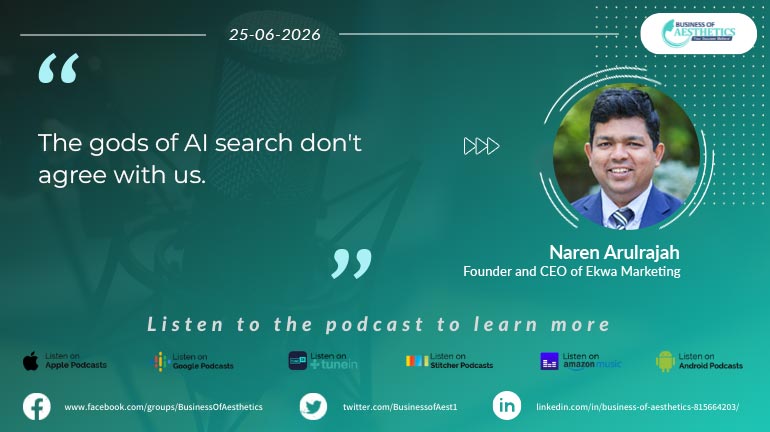
Naren: Hey Don, so glad to be here. And I really think the topic we are covering is a very important topic. And it’s a timely topic: do’s and don’ts in the age of AI search. The reason I believe this is a great topic is I do see a lot of practice owners not doing the right thing, and more importantly, doing things that actually hurt them. And we all use common sense and we think what our common sense is, is correct. And usually our common sense comes from similar experiences in other areas and so forth. But the gods of AI search don’t agree with us. So a lot of times what we think is a good idea, like using AI to write content, you get punished. So we’re going to unpack a lot of those do’s and don’ts. Take some notes. Hopefully you will do something about it. Because if you’re not going to do the things that you need to do and stop doing the things you shouldn’t be doing, your prospects may not be as good as they could be. So hopefully you get some benefit from this podcast. Let’s dive right in, Don.
- 00:02:08 – How AI Has Changed the Patient Search Journey
- Patients have moved from typing simple keyword queries to asking full conversational questions such as ‘who is the best med spa for natural-looking results near me?’
- A 2026 study found Google AI overviews appeared on 64.7% of question-form queries, meaning roughly 65 billion monthly searches are now answered through AI.
- Practices must ensure they appear in AI-generated answers, not just traditional Google Maps or keyword rankings.
View TranscriptAdeesha: Amazing. So Naren, let’s start with the big picture. Search used to mean someone typed a few words into Google and clicked a website. Now we have Google AI overviews, AI mode, ChatGPT, Gemini, Perplexity: a new AI just popping up every single day. So what has actually changed in how patients search for, and most importantly, choose an aesthetic practice?
Naren: Great question. So you are literally asking me, if I were to summarize it, how has search changed in the age of AI? I think that’s a great place to start. The biggest change is that search has become more conversational and more decision-oriented. Patients are no longer just typing in ‘med spa near me’ or ‘Botox clinic, zip code.’ They’re asking questions like, ‘Who is the best med spa for natural-looking results near me?’ or ‘What should I look for before choosing a provider for fillers?’ That matters because a 2026 study found Google AI overviews appeared on 13.7% of queries overall, but on 64.7% of question-form queries. So total search on Google, I think, is around 500 billion. Now, out of 500 billion people using Google every month, 13% of them, that means 65 billion of them every month, are asking these kinds of questions. So that’s a big number. 65 billion people asking these types of questions. So you want to make sure that you are changing as the users are changing. You are not only ranking on Google Maps, ranking for near me or zip code, but you’re also ranking for these conversational questions. So the more patients search in question form, the more likely they are to meet AI-generated answers before they see a traditional website result. So what do you need to do? You have to make sure you are also showing up in the AI answers, and that you are provided as one of the top one, two, or three links that AI is using to generate those answers. And this is something we pay a lot of attention to. Google still is king. It controls literally 98% of the search market. Let me repeat: 98% of the search market still has a Google answer associated with it. So the question is, how do you make sure that whether it’s AI overview, AI mode, Google Search, Google Maps, or Google SEO, they’re all supporting you as patients go through this buying journey, so you are the one they are picking. The shift is from simply ranking for keywords to being understood as a credible answer. Google has said AI overviews are used by more than 2 billion people every single day. And AI mode can handle complex multipart questions using what Google calls query fan-out, where it runs multiple related searches across subtopics simultaneously. So for a practice, that means your website, your Google business profile, your service pages, your reviews, your local signals, like when was the last time somebody used Google Maps to get to your location, they all need to be clear and consistent. If nobody is using your Google Maps to find you, Google thinks something is wrong. So what do you do in this world? You have to make sure you’re paying attention to all of this. If you do it right, you will have an unfair advantage. We noticed many of our clients saw their traffic from Google literally double. The ones who were just ranking for 100 different things are now ranking for 300 different things. For those who know how to play the game right, this is a gold rush.
- 00:07:25 – The Biggest Mistakes Practices Are Making in AI Search
- Mistake 1: Treating AI search like a trick. Google still processes over 417 billion searches per month versus ChatGPT’s 1 billion, making Google a 500X larger platform.
- Mistake 2: Using AI to generate website content. Google actively detects and penalizes AI-written content, viewing it as an attempt to game rankings.
- Mistake 3: Ignoring quality reviews. Short star ratings no longer carry weight. AI platforms use 50+ word paragraph reviews to understand and surface your practice.
View TranscriptAdeesha: Now, that is a very nice distinction you made over there of the richness, how things are much more easier to find, but the answers are becoming more unique to your particular need. So let’s talk about where practice owners are getting this wrong. What are the biggest mistakes practice owners are making right now when it comes to AI search? Where do you see people reacting the wrong way or focusing on the wrong things?
Naren: This is a great question. So what are the common mistakes in AI search? Let me start getting into that. But before I do, I want to give you some numbers so you have some perspective. Because without perspective, we might focus on the wrong things. The first mistake is treating AI search like a shortcut or a trick. Some owners think there will be one technical hack that gets them recommended on ChatGPT, Gemini, Perplexity, or Google AI. But the data tells a totally different story. Google Search processed over 417 billion searches in a recent month. Google Maps was used 100 billion times in that same month. So combined, it’s 517 billion. ChatGPT in a month was used around a billion times. Perplexity around a billion times. So pretty much Google search is 98% of the overall volume. Comparing 500 billion to 1 billion, there’s literally a 500X difference. So one of the mistakes I think people make is they forget the platform that’s still used by 98% of the people, that is Google, and instead kind of think only about ChatGPT or Gemini, which still has less than one or two percent of the market share. If you do Google right, automatically you’re going to do ChatGPT right. Many of our clients are ranking for 40 plus searches on ChatGPT and 100 plus on Google. If you do Google right, you’re going to do the other platforms right. Why? Google has 20 years of experience. And by the way, Google has been using AI starting literally 10 years ago. The CEO of Google said in 2017, ‘We are going to be an AI-first company.’ So they started incorporating AI into search even in 2018. Pretty much everybody else when it comes to the consumer space is following Google. The second mistake is AI content. People think, oh, I can use AI to write an email, I can use AI to create a document, why can’t I use AI to create content that ranks on Google? Google knows if everyone can create AI content and rank on Google, there’s no value for Google anymore. Think about it: AI is cheap. We are talking cents on the dollar versus a human doing something. So Google doesn’t want to become worthless. They have very clearly said they will not rank AI-generated content. Not only will they not rank you, they will punish you, because in Google’s mind, you are trying to cheat them. So using AI to write content for Google? Don’t do it. Always use humans, make sure you comply with Google standards, no duplicate content, make sure it is long-form where possible, and human-generated content that meets Google’s guidelines. The third mistake that is becoming even more prominent is ignoring quality Google reviews. Many of you have Google reviews, but you don’t have quality Google reviews. What I mean is a paragraph review where somebody talks about the particular services. Reviews are no longer just star ratings. They are about treatments, outcomes, comfort, professionalism, consultation quality, how much they trust you, how you treat them. Those reviews help both humans and, more importantly, Google’s AI and all the other AI platforms understand your practice and what it’s known for. A real human review carries a lot more weight than something you created. A five-star review that says ‘great place’ is nice, but not detailed enough. The gold standard is reviews with 50 or more words. Try to get 10 or more of those every month. Count that, grow that. It’s no longer about the number of reviews. It’s about the quality.
- 00:14:15 – What Practices Need to Show Up Well on Google and AI Platforms
- Google’s AI mode now uses ‘query fan-out’ to run parallel searches across related subtopics, so thin keyword pages no longer cut it.
- Internal service pages that previously ranked 10th or 11th are now surfacing in AI overviews, meaning a broad, deep content footprint doubles visibility.
- Credentials from recognized institutions (universities, name-brand programs) are heavily weighted by Google as E-E-A-T signals and should be prominently featured.
View TranscriptAdeesha: You know, that point about reviews and how much richness it truly brings to your practice’s visibility is huge, because a lot of owners still see reviews as a reputation box to check. But in the age of AI, they are almost part of that discovery engine. So, as you mentioned earlier, Google is the undeniable king of search. So let us know, what are the new things practices need to pay attention to so that they show up well on Google and across all these different AI platforms?
Naren: Yes, you are correct. Google is the king of search and controls 98% of the market. Knowing that, remember, if you take care of Google, there’s a 90% likelihood you will do well with ChatGPT, Gemini, and Perplexity. How do we know this? We have 500 practices and we have seen the numbers. Every quarter, we check how our clients are doing on these newer search platforms. And we notice they’re doing extremely well, as long as they’re doing very well on Google. There is a one-to-one correlation. So what is new? Google’s AI mode now handles multipart questions and uses query fan-out to search across related subtopics and data sources. So practices need content that answers real patient questions, not just thin pages built around keywords. For example, your service pages should explain who the treatment is for, what concerns it addresses, what the patient should expect, and why your approach is different or better. Another important point: AI overviews do not always pull from the same pages a traditional first-page ranking would show. We noticed many of our internal pages that might be ranking 10th or 11th on a standard Google search are now showing up as the first, second, or third result in Google AI overview or AI mode. Why? Because those are the detail-oriented pages. Google is pulling from inside pages. This is why many of our clients saw double the traffic. They had a lot of foundational supporting pages, and now even those are coming up in AI overview and AI mode. The lesson for practice owners: traditional SEO still matters, but it’s not enough by itself. You need a broader footprint: strong website content, credible paragraph reviews, complete local profiles, consistent brand language, and most importantly, patient education content that proves your authority. For example, if you have taken a course at a university recently, get that highlighted. Google really, really wants experts. A university is seen as a greater authority than, say, someone who ran a weekend course. So having credentials from name-brand universities is better than informal training. Keep that in mind as you pursue continuing education, and make sure those credentials are being highlighted correctly on your site. Google gives you guidance on how to do it right. Follow that guidance.
- 00:18:11 – Where AI Can Help Your Practice Beyond Search
- AI is highly effective for practice communication: drafting patient emails, writing referral letters, handling follow-ups, and taking clinical notes.
- AI-driven patient communication tools can reduce average call times from 10 minutes to 1 minute, with human handoff reserved for sensitive or high-stakes conversations.
- AI can also analyze complex reports and surface trends, freeing practice owners from data-heavy tasks they lack bandwidth to handle manually.
View TranscriptAdeesha: Beyond search, where should practices use AI? This is another question that we often see in our events and expert panels. What are the practical areas where AI can help without making the practice feel robotic or generic?
Naren: This is a great, great, great question. Beyond search, where can we use AI? So I do think, and I’m being blunt, a lot of times, doctors use AI to write responses to upset patients. They tell the AI in spoken language: hey, create an email that doesn’t upset the patient, addresses the issue, and makes these three points in a nice way. You can train your AI to have those common elements built in, like always keep the patient calm, so you don’t need to repeat yourself. That’s an example of where you can use AI beautifully. Use AI for communication. And if you want to go a step further, people are starting to play around with technology that communicates directly with patients. I was sitting next to a tech person at a telecom company. He told me their average customer call used to take 10 minutes. Now it takes one minute. Why? AI can answer pretty much anything: why is my bill high, is there a better rate plan, all of that in real time. The only time they connect a human is when the client is upset and wants to cancel. Even then, AI is listening and feeding the human the answers in real time. No more putting you on hold to find out something they should already know. He told me that from 40,000 employees, they may one day go to 4,000. Literally 90% of their labor cost can be cut with the help of AI. So those are all examples of where AI adds enormous value. I hear this from doctors all day long. Even taking notes, more and more AI is taking notes. Writing summary documents. Writing follow-up letters to referrals. Whether it’s automated texting with existing patients or smart AI flagging to a human when it has doubts: those are all examples of where AI works well. The other place I would use AI is studying data and numbers. If you get reports that are very complex, you can ask AI to go through the whole thing and give you trends, things that are working well, things you may want to look at. As humans, we’re not great with complexity. So those are some examples where you can use AI wisely.
- 00:23:39 – Where Practice Owners Should Start
- The first step is understanding your current AI and organic search visibility. Are you showing up for 100 or more different types of popular searches on Google?
- Practices ranking for 100+ searches are in the top 5% and capture the vast majority of both traditional and AI search traffic.
- A Marketing Strategy Meeting with the Ekwa Marketing team provides a six-hour analysis and complete roadmap, available at www.businessofaesthetics.org/msm.
View TranscriptAdeesha: This is all very technical. For the owner listening in, for the medical director listening in, of course they are highly qualified people, but this might not be the main thing on their to-do list. So for the owner who knows AI search matters but feels overwhelmed, where should they start? What is the first practical step to make sure their practice is ready for this new search environment?
Naren: Absolutely. You want to know how well or poorly you are doing with AI search and regular search. Of course, regular search is still 87% of the market. Even Google said 13% is AI now. So you want to do well everywhere. You want to transition to conversational search, not just ‘doctor near me’ or ‘Botox near me.’ So I would really focus on finding out how well or poorly you are doing. A good metric is: are you showing up for 100 different types of popular searches or more on Google? When you’re showing up for 100 or more searches on Google, that means you are in the top 5%. That means you’re going to get 95% of the search traffic, including AI search traffic. Now, it’s very, very hard and time-consuming to figure this stuff out on your own. One of the things we recommend is a marketing strategy meeting where we would spend six hours studying you, studying your competition, figuring out how well or poorly you are doing when it comes to AI search. If you’re doing really well, we’ll tell you why. Is it because of CRUX? Is it because of original content? Is it because you are using E-E-A-T, all these qualifications, the right way? Or is it because you are not doing these things? You normally get a report card: are you in the top 5%, or are you in the bottom? And then what you need to maintain, or what you need to change. Unfortunately, 95% of practices are in the bottom, meaning they don’t get any free traffic, or very little, which means they have to depend on ads. And ads are getting more and more expensive. Plus, people know it’s an ad, so they don’t trust it. They second-guess themselves. The bar gets really high. For those reasons, I think dominating search organically is really important. And I do think that a marketing strategy meeting is a good place to start. Once again, the link is www.businessofaesthetics.org/msm.
Adeesha: Appreciate that, Naren. That was a powerful conversation with Naren Arulrajah on the do’s and don’ts in the age of AI search. After this episode, go ahead and Google yourself for the treatments you’re offering, the way a normal person would, and see if you’re showing up in the AI overviews. If not, and you want some help answering that question, go ahead and book a marketing strategy meeting with Naren’s team. It’s a 60-minute call. You will get a complete six-month roadmap on what are the best steps you can take to ensure growth in 2026. The link is www.businessofaesthetics.org/msm. I’m Don Adeesha. This has been the Business of Aesthetics podcast. Thanks for listening. Keep on leading.
GUEST – Naren Arulrajah

Naren Arulrajah is the President and CEO of Ekwa Marketing, a leading digital marketing agency serving medical, dental, and aesthetic practices across North America. With more than 15 years of experience at the forefront of healthcare marketing, Naren has helped thousands of doctors and practice owners build thriving businesses through customized strategies in SEO, social media, online reputation management, and content marketing.
Leading a team of over 180 full-time marketers, Naren has become a trusted authority on practice growth, AI-driven search, and the evolving digital landscape. He has spoken extensively on marketing trends, patient acquisition, and business development, and is known for cutting through industry noise with practical, data-backed strategies that deliver measurable results.
His passion lies in helping practitioners focus on what they do best, patient care, while his team drives sustainable growth in an increasingly digital marketplace.
Learn more: www.ekwa.com
HOST – Adeesha Pemananda

A seasoned marketing professional and a natural on-camera presence, Adeesha Pemananda is a skilled virtual event host and presenter. His extensive experience in brand building and project management provides a unique strategic advantage, allowing him to not only facilitate but also elevate virtual events.
Adeesha is known for his ability to captivate digital audiences, foster interaction, and ensure that the event’s core message resonates with every attendee. Whether you’re planning a global webinar, an interactive workshop, or a multi-session virtual conference, Adeesha brings the perfect blend of professionalism, energy, and technical savvy to guarantee a successful and impactful event.
Connect with Us:
Category: Business of Aesthetics Podcast