Podcast: Play in new window | Download
Subscribe To Our Podcast




In this episode, host Don Adeesha sits down with Dr. Whitney Hovenic, a double board-certified dermatologist and fellowship-trained Mohs surgeon, to tackle a problem every practice is now facing: an entire generation builds trust with brands long before they ever walk into a clinic. The challenge is no longer spending more to acquire Gen Z patients. It’s becoming relevant to them first.
Dr. Hovenic breaks down what actually changes Gen Z behavior. She explains why immediate benefits like glow and feel beat distant cancer warnings, how peer ambassadors and campus education outperform top-down authority, and why aggressive pricing and over-upselling quietly destroy trust at the counter.
Her framework is simple. Be authentic, give patients a real range of options, and use accessible gateway treatments to start relationships that pay off for decades. Don’t try to be Gen Z. Meet them where they are, and let trust do the long-term selling.
Key Takeaways
- Sell the glow, not the fear. Gen Z is more motivated by immediate benefits like hydration, shimmer, and how a product feels on their skin than by distant risks such as skin cancer.
- Make peers your credibility engine. They trust friends, student ambassadors, and on-campus influencers more than authority figures, so use authentic peer advocates to spread your message.
- Price for the first job, not the C-suite. Since Gen Z has limited disposable income, they offer in-office products and treatments at affordable price points that encourage repeat visits.
- Translate to them without imitating them. Avoid forcing slang or trying to sound like Gen Z from a clinical account. Instead, stay authentic and involve genuine Gen Z voices in your social media content.
- Use gateway treatments to build long-term relationships. Affordable entry procedures such as acne-scar laser treatments or microneedling can establish trust and lead to future higher-value services like Botox.
- Skip the packages and keep the trust. Rather than locking patients into six-treatment commitments, reassess their needs at each visit so they feel guided instead of pressured.
- Never over-stack the counter sale. Recommending an expensive skincare product alongside a costly treatment can damage trust and push Gen Z toward retail alternatives. Keep product recommendations honest, practical, and accessible.
Dr. Hovenic made the case that winning the next generation of patients comes down to relevance and trust built long before anyone books a treatment, not louder or more expensive marketing. This session is your chance to map exactly where those high-value relationships begin and build a strategy that turns early trust into lasting practice growth. Reserve your complimentary Marketing Strategy Session: www.businessofaesthetics.org/msm

- Get a 1-on-1 diagnosis of your online presence & patient acquisition funnel
- Identify critical, untapped growth levers (SEO, Social, Referrals)
- Define a clear action plan to attract and convert your ideal patients
- Receive expert solutions for your most pressing marketing challenges
Resources

Live Webinar: Future-Proofing Your Aesthetic Practice: Decisions You Must Get Right in the Next 18 Months
Join industry experts to modernize operations, enhance patient experience, and drive sustainable growth.
Wednesday, May 20, 2026 @ 7:00 PM EST – 9:00 PM EST

Are you ready for the “GLP-1 Body” Era?
Download the 2026 Aesthetic Patient Behavior Model to see the numbers driving decisions this year:
- Why 73% of patients now define beauty by “individuality” over transformation.
- The shift away from non-invasive fat reduction (down ~40%).
- Real data on the rise of the male aesthetic patient.
Key Highlights:
- 00:00:12 – Introduction & Topic Setup
- Don Adeesha opens on the core tension: practices are spending more than ever to acquire patients while a whole generation builds brand trust long before they ever enter a clinic.
- Guest Dr. Whitney Hovenic is introduced as a double board-certified dermatologist and fellowship-trained Mohs surgeon based in Reno, Nevada, who is building a sun care brand designed specifically for Gen Z.
- The episode is framed around Gen Z behavior, building trust through prevention, and converting that trust into long-term patient relationships, with Ekwa Marketing named as sponsor.
View TranscriptAdeesha: Most practices are spending more than ever to acquire new patients, while an entire generation is building trust with brands long before they ever step into a clinic. Welcome back to the Business of Aesthetics podcast. I’m your host, Don Adeesha, and to help us understand how to connect with the next generation of patients, we are joined by Dr. Whitney Hovenic. Dr. Hovenic is a double board-certified dermatologist and fellowship-trained Mohs surgeon based in Reno, Nevada. Alongside her clinical work in skin cancer and cosmetic dermatology, she is building a sun care brand designed specifically for Gen Z, focused on education, prevention, and real behavior change. Today we are discussing Gen Z behavior, building trust through prevention, and how to turn that trust into long-term patient relationships. This episode is brought to you by Ekwa Marketing, the digital growth partner behind this podcast and a trusted resource for aesthetic practices looking to dominate their local market. Now let’s get into the conversation.
- 00:01:20 – The Gap in Sun Care for Gen Z
- Dr. Hovenic saw that clinics had beautiful but clinical products, with nothing fun or exciting for the younger patient.
- Even her own daughters, who had access to the best sunscreens, would reject them, so she set out to create something bold and edgy that didn’t feel like "your mother’s sunscreen."
- The gap was both formulation and communication: Gen Z wants simplicity, dual skincare-and-protection benefits, and an accessible price point.
View TranscriptAdeesha: Dr. Hovenic, when you started building for Gen Z, what gap did you see in how traditional sun care brands were approaching young consumers?
Dr. Hovenic: Thank you for having me. I’ve been a dermatologist for a long time and sold product in my office for a long time, and what I saw is that we really didn’t have anything in the office that was fun and exciting for that younger patient. We have beautiful products and they’re very clinical. I have two daughters, and they’ve had access to the best sunscreens their whole lives, because when you’re a dermatologist, your mom is giving you the best sunscreens. And they would still say, "Ugh, I don’t want this." So I knew we needed to address this differently, because we all know how important sun protection is. I wanted to bring something into the clinical space that was a little bold, a little edgy, and made them feel more comfortable choosing to wear something that just wasn’t necessarily their mother’s sunscreen.
Adeesha: And was that gap more about the formulation, or is it the communication, how the brands talk?
Dr. Hovenic: I think it’s a little bit of both. Gen Z wants a different product, and they want simplicity. They want products that serve as both skincare and sun protection. Those products exist in the clinical space currently, but a lot of times they’re at a price point that’s not accessible to that younger consumer. So we saw an opportunity to create a sun care line with skincare benefits at a price point that’s more Gen Z friendly. Oftentimes they’re in their first job, they’re going to college, they don’t have a lot of disposable income. They will spend money on skincare, but when we’re asking them to make something part of their daily routine, I strongly believe we should present it at a price point that’s going to be accessible.
- 00:03:01 – What Brands Get Medically Wrong Trying to Be Trendy
- Overdoing it is the biggest mistake; you can speak to Gen Z without trying to be Gen Z.
- Gen Z cares about skin looking and feeling good, not distant skin cancer risk, so the brand promise should center appearance and "glow."
- Product naming (Cheeky, OG, Ghosted, Do Me, Face Shots) grabs attention and signals edge without forcing slang.
View TranscriptAdeesha: As a Mohs surgeon, what is the one thing traditional brands get medically wrong when trying to be trendy?
Dr. Hovenic: It’s hard to talk to Gen Z and Gen Alpha. My kids have their own language. They’ll say, "Mom, that’s the riz, the T," and I’m like, I don’t know, is that good or bad? So you need to speak to them, but not necessarily try to be them. You want to build their trust and say, look, this is going to help your skin. They don’t necessarily care at this point about not getting skin cancer. They care about their skin looking good, feeling good, they want to glow up. My daughter told me at one point that the reason girls want to tan is because they don’t want to have the "winter fuglies." They’re very concerned about their appearance. So as a brand, you want to say, not only will this protect you, it’s going to make you feel good and enhance that inner and outer glow. You just have to be careful not to be preachy, but also not try too hard. There’s a balance.
Adeesha: Not trying too hard, how does that show up in your own product development?
Dr. Hovenic: The good thing is I have my own test base in my house. In not trying too hard, we don’t want to overcomplicate the messaging. We want to say these products are here, we want them integrated into your life, they feel great on your skin. Our product names are a little different to give them that edge. That’s why we have products called Cheeky, OG, Ghosted, Do Me, Face Shots, so they catch your attention. But I’m not calling it "get your tea, get your riz." It’s translating to them without trying too hard to be them, if that makes sense.
Adeesha: That does make sense. So the gap you really saw was a big gap in communication as well as product positioning in the marketplace.
- 00:05:24 – Making Sun Protection Feel Relevant Every Day
- Sun protection has to feel seamless, not like an extra step, so patients see or feel an immediate difference.
- The product needs to deliver instant payoff through hydration, glow, or shimmer rather than feeling tight, sticky, or like a chore.
View TranscriptAdeesha: Dr. Hovenic, how do you practically make sun protection feel relevant to Gen Z in their daily lives?
Dr. Hovenic: That’s always a challenge. You have to make it something they’re going to want to wear, whether it’s how it makes their skin feel or look, because I don’t think they’re so concerned about cancer at this point unless somebody in their family has gone through skin cancer. They live in this space of "it’s not going to happen to me." I was a teenager and I was terrible about sun protection, and now the consequences are there. So you have to make it feel seamless. Make the product not feel like an extra step in their routine, but the one step they actually want to wear. When they put it on, they see the difference immediately, whether it’s hydration or a little glow, or their skin just feels better because it’s not tight and sticky. It’s not going to feel like a chore. It’s going to feel like something they want.
- 00:07:08 – Developing the Sensory Experience
- The first thing people do is feel the product and the second is smell it, so the sensorial experience was the top priority from day one.
- The team tested every mineral sunscreen on the market, scientifically benchmarking stickiness, chalkiness, and scent.
- They use only zinc oxide and titanium dioxide, and the highest compliment is when someone says they didn’t know sunscreen could feel like this.
View TranscriptAdeesha: That sensory experience, feeling better immediately, how long did it take to develop it to a level you were happy with?
Dr. Hovenic: That was really the first thing we knew going into product development. The first thing people do is put it on their skin to see how it feels, and the second thing they do is smell it. So that sensorial experience is very important. It took a while to get to the right formulation, because we literally tried every single mineral sunscreen available on the market. We only use zinc oxide and titanium dioxide, no other filters. We knew a big pain point for why people wouldn’t use sunscreen was stickiness, chalkiness, pastiness. So we tried every mineral sunscreen in a scientific way, putting it on our skin and asking, does it feel sticky, does it smell. From that we benchmarked what we wanted our product to feel like, because if you put something on your skin and don’t like how it feels, it doesn’t matter if it’s the best product on the planet, you’re not going to use it. Luckily we got it right, and what makes me so happy is when people try the products and say, "I didn’t know that sunscreen could feel like this."
Adeesha: That is a wonderful compliment when you’re working with a product that’s been notorious for being sticky and pasty.
- 00:08:33 – What Actually Changes a Young Patient’s Habits
- Peer influence is the strongest lever; Gen Z trusts friends over a dermatologist, so the brand needs champions trying and recommending the product.
- Avoid being preachy and reframe the goal around preventing severe sunburns rather than banning the sun, since a single blistering sunburn doubles melanoma risk.
- The company is built on education, using college-age ambassadors to present on skin health in campus organizations like sororities.
View TranscriptAdeesha: Dr. Hovenic, what actually gets a young patient to change their sunscreen habits in real life?
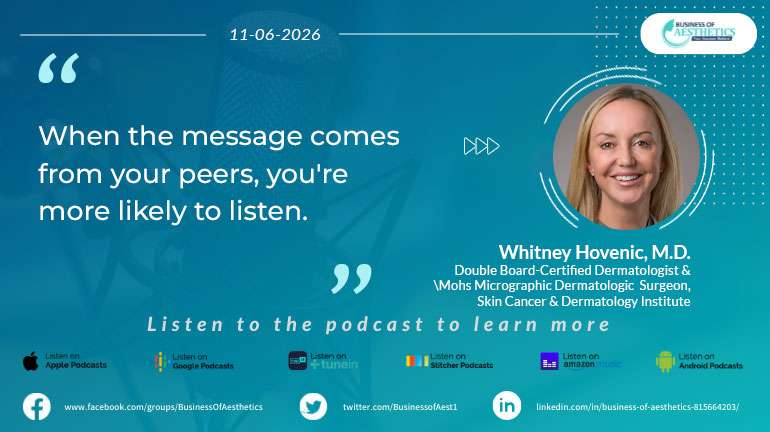
Dr. Hovenic: First of all, if their friends are doing it, they’ll do it. They trust their peers, so you have to have champions in that space, people trying your products, liking them, and telling their friends. We miss that sometimes. This audience is going to trust each other more than they trust you. Even as a dermatologist, it gives me some credibility when I recommend a product, but they really look to their peers, which is why platforms like Instagram and TikTok have become such a source of information for the Gen Z consumer. It’s hard to build that trust when you’re communicating digitally, but when their peers like it and tell them this is something they should do, they’re much more likely to listen. You also need to not be preachy. As dermatologists, we often tell people to stay out of the sun, and the reality is they’re going to go out in the sun. Our whole thing is, please use our products so you don’t burn. Tanning causes UV damage, yes, but true blistering sunburns like the ones you see on TikTok double your risk of melanoma with just one. So in our product development and our company core, we’re very focused on education, and we use college-age students to spread our message on campuses. Our brand ambassadors talk about our products and also go into organizations like sororities to give presentations on skin cancer and sun health. When the message comes from your peers, you’re more likely to listen. I did this as a resident at the University of Missouri, but I was already a doctor, so it’s even better when it’s a student talking to other students. We’re really selling a mission of skin protection and skin health, not just sunscreen.
- 00:11:52 – From Resident Educator to Student Ambassadors: Debunking Myths
- When Dr. Hovenic trained, information came from journals; today Gen Z is hit from every direction with conflicting claims like "sunscreen causes cancer" or beef-tallow alternatives.
- The job now is debunking myths and framing yourself as a credible, believable expert who is there to help.
- Fun product names and tag lines earn attention so young patients ultimately choose to use the product on their own.
View TranscriptAdeesha: What is the core difference in the messaging you see between your time as a resident educating peers and now, where college students educate their own peers?
Dr. Hovenic: These young people are getting hit from so many different sources. I did my residency in the Facebook days, that’s all we had. There was no Instagram, certainly no TikTok, and people still trusted journals and other sources. Now they’re getting all kinds of different information: sunscreen causes cancer, use beef tallow, all these things. So it’s trying to debunk some of these myths and present information they’ll believe. If they believe the myths, they may not believe you, so you have to frame the conversation so you can be the expert but also make it believable and real, so they understand you’re there to help. I have a 15-year-old, and if I tell her to do something, she does not want to do it unless she truly believes in the mission, or unless her best friend tells her to do it. By giving our sunscreen fun names and fun tag lines, the kids pay attention, and then hopefully they choose to use it on their own.
- 00:14:02 – Instant Gratification vs. Fear of Cancer
- Immediate benefits beat distant fear; even mid-surgery, patients tell her they won’t wear sunscreen.
- The "it makes your skin feel good and gives you a little sparkle" message converts better than "you might get melanoma and die."
View TranscriptAdeesha: That premise of instant gratification through messaging and through the look and feel — have you found it works much better than the fear of cancer decades from now?
Dr. Hovenic: I think so. As a Mohs surgeon, I cut out cancer all day long. I can be removing cancer on someone and ask if they wear sunscreen, and they say no. I’m making a hole in your face — are you planning to wear sunscreen? No. I distinctly remember doing two Mohs surgeries on a 27-year-old man who told me he was not going to wear sunscreen. So you have to know you’re not going to convince everybody, but that immediate benefit, it makes your skin feel good, gives you a little sparkle and glow, is going to get them to wear it more than "you might get melanoma and die."
- 00:15:37 – Younger Skin Cancer Patients and the Tanning Bed Problem
- Dr. Hovenic now routinely sees skin cancer patients in their 30s and 40s, where they were once mostly 60 to 90.
- Much of it traces to childhood sunburns and teenage tanning bed use, which persists today, even marketed as an amenity in student apartment complexes and gyms.
- Tanning beds are a WHO-classified carcinogen, yet many young people use the UV index and apps to optimize tanning rather than protect themselves.
View TranscriptAdeesha: A 27-year-old Mohs patient, that’s another striking number.
Dr. Hovenic: I treat a lot of 20- to 30-year-olds. When I first started, most of my skin cancer patients were between 60 and 90. Now, routinely every week, I have patients in their 30s and 40s. 20-year-olds are still somewhat rare, but it happens, and a lot of it is childhood sunburns and teenage tanning bed use. It amazes me that people still use tanning beds, but it’s real. There’s an apartment complex across from the university here that attracts students with benefits like a gym, a pool, and tanning beds, and they’re in a lot of our local fitness centers. I was shocked, because I thought we as a society had done a better job educating people that tanning beds are a carcinogen per the World Health Organization. These girls say, "Oh yeah, I’m going to the tanning bed." As dermatologists, we did a better job reaching people in their late 20s and early 30s, who are good about sun protection now. But in the late teens and early 20s, there’s a whole different perception. People use the UV index not to protect themselves but to tan, and there are apps that tell you how to get the best tan. I grew up with tanning culture in the ’90s, and I don’t think we’ve translated the message well, because it’s still happening. There’s a perception that you look better, thinner, prettier when you’re tan, but they don’t understand the long-term consequences, especially through a tanning bed. I’d so much rather you put on sunscreen and go outside than go into one of those death chambers.
- 00:18:06 – Sponsor Break: Ekwa Marketing
- Ekwa Marketing offers Business of Aesthetics listeners a complimentary, personalized Marketing Strategy Session.
- The team spends roughly four to five hours researching your online presence, competition, and biggest growth opportunities before the meeting.
- Spots are limited each month; listeners can reserve at www.businessofaesthetics.org/msm.
View TranscriptAdeesha: Before we continue, a quick word from our sponsor, Ekwa Marketing. If you’re a practice owner looking to attract more high-value patients, Ekwa is offering our Business of Aesthetics listeners a complimentary marketing strategy session. This is a personalized session built around your practice. Their team spends about four to five hours researching your online presence, your competition, and your biggest growth opportunities before the meeting, so you’ll walk away with a tailored plan and not just generic advice. On the call, they’ll show you how to improve visibility, increase qualified patient inquiries, and build a clear path to measurable growth. There are only a limited number of spots available each month. To reserve your session, visit www.businessofaesthetics.org/msm. Now let’s get back to our conversation.
- 00:19:18 – Where Brands Lose Gen Z’s Trust
- Price is a real ceiling; above a certain point, Gen Z won’t buy no matter how good the product is.
- Many strong clinical brands simply don’t resonate or feel "for them," and complexity is a turnoff.
- Over-upselling at checkout, especially stacking expensive products on top of a costly treatment, breaks trust and pushes them to retail.
View TranscriptAdeesha: Dr. Hovenic, where do most brands lose Gen Z when they try to build trust around skincare?
Dr. Hovenic: Price becomes a consideration. If you’re building a good product, there’s a certain price point Gen Z is not going to purchase. There’s also just not being for them. There are wonderful skincare brands out there that I fully support and carry in the office, but they don’t necessarily resonate, though some do, there’s that "I’m using real skincare now, I’m an adult" feeling. But a lot comes down to not wanting something too complicated, and then cost. Gen Z is going into the med spa space now for hydrafacials, microneedling, and Botox. When I was in college I barely had enough money for food, but there’s a market for it now. The thing is, if you’re getting Botox and then at the counter they say you should have this serum and this sunscreen, and it’s just as much as the Botox treatment, I think you lose their trust. They want to buy from you, but they want to know you’re not trying to squeeze every penny out of them. Even when it’s completely unintentional and you just want them on a good routine, there’s a level that becomes too much, and then they won’t buy and they’ll go to a retailer. As the person doing treatments, you actually want to know what they’re using, so it helps to have an in-office offering at a price they can afford. That way, when they come back with an issue, you know what products they used and where they came from. A lot of times people get a treatment like microneedling, then get a rash because they used something they shouldn’t have.
- 00:22:40 – How She Set the Price Point
- Dr. Hovenic benchmarked against the big mass players in the sunscreen space at Target, Sephora, and Ulta rather than clinical brands, deciding to sit just under them.
- Mineral sunscreens are expensive to formulate, so the price is actually higher than ideal, but it lands as a slight luxury item with added skincare benefits.
View TranscriptAdeesha: This upselling question, how did you figure out the pricing that was comfortable for your target audience?
Dr. Hovenic: We looked at who the big players are in the sunscreen space and how they priced their products, and we decided we wanted to be just under them. These aren’t the big players in the clinical space, these are places like Target, Sephora, and Ulta. Mineral sunscreens are very expensive to formulate, so the price point we’re at is actually higher than where we want it to be, but for practical reasons that’s where you have to be. Knowing what they were paying across the space for moisturizers and other sunscreens, we felt we were at a good point. It’s still a little bit of a luxury item, but we’re also giving them additional skincare benefits with that product.
- 00:23:34 – Authenticity vs. Trying Too Hard
- Forcing Gen Z slang from a clinical founder erodes credibility, because Gen Z values authenticity above all.
- Dr. Hovenic stays a clinical authority by being herself and lets genuine Gen Z voices on social media do the translating.
View TranscriptAdeesha: When a brand tries a bit too hard using Gen Z slang, does that actually erode the clinical credibility they need?
Dr. Hovenic: It’s a fine line. Most of us are not Gen Z, and I don’t want to pretend to be. We talk to a ton of Gen Z in our focus groups, with our brand ambassadors, and with my own kids, so you want to be authentic, Gen Z wants authenticity. That’s why I’m never going to go on social media and try to speak like a Gen Zer; it would sound so fake. I don’t even get what my daughters are saying half the time. I can still be a clinical authority, but I want to be myself and talk to them without talking down to them. They’re not kids anymore, they’re looking for answers. If I’m trying too hard, it’s obvious. That’s why we have other voices on our social media who are Gen Z and can help translate, so that as the dermatologist and founder, I’m not trying to be someone I’m not. It’s about communicating where they’re at and delivering that.
Adeesha: I’m a millennial myself, so I might be missing some of these Gen Z things too. But like you said, it’s meeting them where they’re at instead of treating it as a gimmick, which is where a lot of brands drop the ball. And this is a critical time in their life for sun protection.
Dr. Hovenic: Truly. The sun you get in your late teens and early 20s will impact you for the rest of your life. If you’re going to do one thing, wear some sunscreen, because it will make a difference. So we’re trying to deliver that message but still make it feel like they’re choosing what they’re going to do, and give them a really good product so they’re happy to wear it and their skin looks great.
Adeesha: The first time around, it might be a friend who recommends the product. The second time around, it’s their decision whether the product is worth revisiting.
- 00:26:28 – The First Move to Earn Gen Z Credibility
- Be open to real conversations, avoid trying too hard, and serve as a genuine source of education.
- You need product and treatment offerings that aren’t a turnoff on price; she kept laser treatments like Fraxel for acne scars accessible with half-face options.
- Stock a range of entry-level introductions like microneedling and facials, and staff people who can relate to the Gen Z customer.
View TranscriptAdeesha: Dr. Hovenic, if a practice owner wants to earn credibility with Gen Z today, what is the first move they should make?
Dr. Hovenic: Be open to conversations with your audience, be real, don’t try too hard, and serve as a source of education. If a practice is going to address the Gen Z segment, you have to have product and treatment offerings that aren’t going to be a total turnoff. If they walk in wanting a laser on their scars and it’s $2,000 a treatment, it’s not going to work. I’ve always been firm about keeping those treatments at a price point that won’t break the bank for families. Laser treatments are expensive, but if I was doing Fraxel on acne scars, we had a price for a half-face treatment that’s very different from a full resurfacing. Obviously the practice can’t take a loss, but having a wide variety of offerings, microneedling, facials, different aesthetic procedures, gives good introductions to the practice. And having people in the practice who can relate to that customer can be your best asset, because they understand their peers. Then the provider is there as a credible source, so when patients spend the money, they know they’re getting treatments of value.
- 00:28:48 – Building the Long-Term Revenue Relationship
- Gateway treatments like acne or acne-scar work build trust, and most of her cosmetic patients come from her dermatology patients.
- Trust earned in their 20s converts to Botox in their 30s and higher-value laser procedures later, because they return to the provider they trust.
- She doesn’t sell packages; she estimates a range, reassesses every appointment, and lets patients stop early, which keeps the relationship honest.
View TranscriptAdeesha: Say they come in for acne scars as the gateway treatment. How do you start building that long-term revenue relationship?
Dr. Hovenic: If you fix their acne scars, or even earlier, if you treat their acne, they trust you. Most of my cosmetic patients come from my dermatology patients. Whether they’re Gen Z or not, I’ve treated them for skin cancer, pre-cancers, or acne, so they’re much more likely to put their trust in me for cosmetic procedures. If they’re in their 20s and you treated their acne scars and they got a good improvement, then by the time they want Botox, who are they going to go to? The person they trust. As they hit their 30s and 40s and want more laser or more expensive treatments, you’ve already started that relationship. So it’s about trust and credibility. And when you’re seeing these younger patients, give them options. With acne scars, we always talk about lasers, microneedling, peels, I give them a broad spectrum and my advice about what will help most, but I’ll also say if you only have the ability to do one thing, we can start there and build on it. It’s why I don’t sell packages. I’ll tell people it’s probably going to be four to six treatments, but we’ll reassess at every appointment and determine the best next step, so they’re not locked into six laser treatments. If they’re great after three, fine — I’ll see you in five years when you want Botox.
- 00:31:06 – Final Takeaway: Be You
- Communicate with these patients in a way that builds genuine connection, and give them a real range of services so they can start as a patient or customer.
- Give advice; they come seeking help, so talk to them like any patient without forcing the communication.
- Even if they don’t book on the spot, an honest consultation makes them far more likely to return when the time is right.
View TranscriptAdeesha: Dr. Hovenic, as we wrap up, I’d love one last key takeaway, the golden nugget on how practice owners can really connect with the Gen Z audience. What’s the first step?
Dr. Hovenic: Be you. You’ve built your practice. Communicate with these patients and talk to them in a way where they get that connection with you. Give them that range of services so they can start to be a patient or customer in your practice. And give them advice. They’re coming to you because they’re seeking help, whether it’s acne scars or eczema, so talk to them like you would any patient, communicating well and not forcing it. They may not book an appointment, you might have a full consultation and they may not do anything, but if they’ve had that conversation with you, they’re much more likely to come back when the time is right.
- 00:32:15 – Closing & Sponsor Reminder
- Don Adeesha frames the big idea: winning Gen Z is about relevance, consistency, and meeting them long before they need a treatment, not louder marketing.
- He points listeners to Dr. Hovenic’s work in prevention and education, then closes with a final reminder of the Ekwa Marketing complimentary strategy session.
- Listeners can reserve at www.businessofaesthetics.org/msm.
View TranscriptAdeesha: That was a powerful look at how to build trust with the next generation of patients with Dr. Whitney Hovenic. If you’ve been struggling to connect with younger audiences or wondering why your messaging isn’t landing, this conversation should give you a completely different lens. Winning Gen Z isn’t about louder marketing. It’s about relevance, consistency, and meeting them long before they ever need that treatment. Mastering that shift is how you build long-term patient pipelines in a market that’s only getting more competitive. Dr. Hovenic, where can our listeners reach you?
Dr. Hovenic: I’m always happy to answer by email.
Adeesha: Before we wrap up, one final reminder from our sponsor, Ekwa Marketing. If you want a clear plan for attracting more high-value patients, they’re offering Business of Aesthetics listeners a complimentary marketing strategy session. Their team will review your online presence, identify missed growth opportunities, and give you a tailored action plan just for your practice. You can reserve your session at www.businessofaesthetics.org/msm. I’m Don Adeesha, and this has been the Business of Aesthetics podcast. Thanks for listening. Keep on leading.
GUEST – Whitney Hovenic, M.D.

Whitney Hovenic, M.D. Double Board-Certified Dermatologist & Mohs Micrographic Dermatologic Surgeon, Skin Cancer & Dermatology Institute.
Whitney Hovenic, M.D. is a double board-certified dermatologist and fellowship-trained Mohs Micrographic Dermatologic Surgeon at the Skin Cancer & Dermatology Institute in Reno, NV. She is one of only four fellowship-trained Mohs surgeons in all of Northern Nevada, treating skin cancer alongside a full scope of medical and cosmetic dermatology. She is also the co-founder of Spooge, a Gen Z–focused mineral sunscreen brand that launched at Cosmoprof North America in 2025.
A California native, Dr. Hovenic earned her medical degree at the University of Nevada School of Medicine and completed her dermatology residency at the University of Missouri, where she also practiced general dermatology. She went on to complete a fellowship in Mohs Micrographic Surgery at the University of California, Irvine, with extensive additional training in lasers and cosmetic dermatology. Her clinical interests span acne, eczema, and psoriasis, as well as laser treatments for both medical and aesthetic purposes. A trusted dermatology voice, she has shared expert skincare insights with national outlets including Allure, Real Simple, and Better Homes & Gardens.
Learn more: www.skincancerderm.com/providers/whitney-hovenic-m-d/
www.beautyindependent.com/dermatologist-mayor-provocative-playful-gen-z-brand-sunscreen-spooge/
HOST – Adeesha Pemananda

A seasoned marketing professional and a natural on-camera presence, Adeesha Pemananda is a skilled virtual event host and presenter. His extensive experience in brand building and project management provides a unique strategic advantage, allowing him to not only facilitate but also elevate virtual events.
Adeesha is known for his ability to captivate digital audiences, foster interaction, and ensure that the event’s core message resonates with every attendee. Whether you’re planning a global webinar, an interactive workshop, or a multi-session virtual conference, Adeesha brings the perfect blend of professionalism, energy, and technical savvy to guarantee a successful and impactful event.
Connect with Us:
Category: Business of Aesthetics Podcast