Podcast: Play in new window | Download
Subscribe To Our Podcast




Complimentary Strategy Session (Listener Gift)
A gift for Business of Aesthetics listeners: book your complimentary strategy session with Ekwa Marketing here: https://www.businessofaesthetics.org/msm/
In this episode, host Anji joins Sean M. Duncan, CPA, president and founder of SMD Consulting and Accounting and founder of Chief Proactive Advisors, to expose the gap between a full schedule and a profitable one. Sean explains why a single blended revenue number hides the service lines quietly losing money, and how top-line growth can coexist with a shrinking bank account.
Sean breaks down how to cut the P&L into three to ten revenue categories, match true costs to each service, and build toward margin per room hour by starting with revenue per room before layering in time, supplies, and overhead. He also tackles the hardest call in practice ownership: what to do when the losing service is the fully booked one, from fixing pricing and vendors to proving a loss leader actually drives the upsell.
Drawing on his own decision to walk away from two thirds of his firm’s revenue, Sean lays out a phased exit plan that honors memberships and patient commitments, and warns that tax strategy left until December is strategy lost. Go deeper with Sean’s book: https://a.co/d/5zJx7Hq
Key Takeaways
- Stop reading one blended revenue number. Break your P&L into three to ten revenue categories so you can see which service lines generate income and which quietly drain it.
- Measure margin per room hour, not revenue per treatment. Start by tracking revenue per room with an estimated margin, then layer in provider time, supplies, and overhead as your data matures.
- Never treat a full schedule as proof of profit. A service that loses $15 per visit, multiplied across a year of bookings, steals from every other part of the practice.
- Fix before you cut. Test pricing, provider efficiency, and vendor costs first, and keep a loss leader only if you can prove it actually produces the upsell.
- Phase out losing services without breaking your word. Honor active memberships and agreements, give patients advance notice, and set the pace of change against your three-year vision.
- Sell your specialty instead of every patient request. Demand does not equal profitability, so position as the expert in your highest-margin services and refer out or sublease the rest.
- Book year-end tax strategy by October. Moves not made by December 31 generally don’t count for the year, and a December call leaves your CPA almost no runway to implement.
Sean made it clear that a full schedule and a profitable schedule are not the same thing, and that the healthiest practices fill their best rooms with the right patients rather than simply more of them. This session is your opportunity to build a clear plan for attracting the patients who turn your most profitable service lines into your busiest ones.

- Get a 1-on-1 diagnosis of your online presence & patient acquisition funnel
- Identify critical, untapped growth levers (SEO, Social, Referrals)
- Define a clear action plan to attract and convert your ideal patients
- Receive expert solutions for your most pressing marketing challenges
Resources

Live Webinar: Future-Proofing Your Aesthetic Practice: Decisions You Must Get Right in the Next 18 Months
Join industry experts to modernize operations, enhance patient experience, and drive sustainable growth.
Wednesday, May 20, 2026 @ 7:00 PM EST – 9:00 PM EST

Are you ready for the “GLP-1 Body” Era?
Download the 2026 Aesthetic Patient Behavior Model to see the numbers driving decisions this year:
- Why 73% of patients now define beauty by “individuality” over transformation?
- The shift away from non-invasive fat reduction (down ~40%).
- Real data on the rise of the male aesthetic patient.

Key Highlights:
- 00:00:03 – Introduction & Guest Background
- Anji opens with the episode’s core warning: the busiest treatment room may be the one costing a practice the most money, and the loss compounds as the schedule fills.
- Guest Sean M. Duncan, CPA, is introduced as president and founder of SMD Consulting and Accounting and founder of Chief Proactive Advisors, a firm built around proactive planning instead of year-end paperwork.
- Sean ran this same analysis on his own business and walked away from roughly two thirds of his revenue when the numbers told him to.
- The episode covers margin per room hour, fully booked losing service lines, and pre-year-end decisions, and is sponsored by Ekwa Marketing.
View TranscriptAnji: Your busiest treatment room might be the one costing you the most money. And the fuller a schedule gets, the faster that loss compounds. Welcome back to the Business of Aesthetics podcast. I’m your host, Anji.
To help us pull apart the P&L most practices never actually cut by the service line, we’re joined by Sean M. Duncan, CPA. Sean is the president and founder of SMD Consulting and Accounting and the founder of Chief Proactive Advisors, an advisory firm built around proactive planning instead of year-end paperwork.
And he has a particularly interesting perspective on this conversation, because he ran this kind of analysis on his own business and ultimately walked away from roughly two thirds of his revenue when the numbers told him to.
Today, we’re discussing how to calculate real margin per room hour, what to do when the losing service line is also the fully booked one, and the decisions practice owners can make before year-end that determine their profit long before anyone files anything. This episode is brought to you by Ekwa Marketing. Sean, welcome to the show.
Sean: Thank you. That was an awesome introduction. I want to meet that guy you were talking about.
Anji: Me too, me too.
- 00:01:31 – Cutting the P&L Apart by Service Line
- Sean explains that financial statements exist for one purpose: making management decisions, not simply handing data to a CPA for a tax return.
- He recommends three to ten major revenue categories on the P&L, using QuickBooks subcategories for added detail without overcomplicating the view.
- Tracking margins by type of work is how Sean decided to fire two thirds of his firm’s revenue: low-margin, high-stress, tax-prep-only clients.
- Revenue alone isn’t enough; product, time, room, rent, and staffing costs must be matched against each service so the margin is visibly positive.
View TranscriptAnji: All right. Sean, now most owners in this audience open their P&L and see one blended revenue number for the whole practice. So walk me through exactly how you cut that P&L apart by service line. What specifically has to get allocated down to each individual treatment before an owner is looking at a number they can actually trust?
Sean: Right. And honestly, if they even open the P&L at all, that’s already ahead of a lot of other practices, because most people just take that financial information and throw it to their CPA to fill out a tax return. And when I teach a lot of this stuff, the purpose of the P&L, the profit and loss, the income statement, and all the other financial statements, their sole purpose is to make management decisions. That’s it. It’s not for the CPA. It’s not for the lawyer. It’s not for the banker. The original intent was so that you can make decisions, and that also goes for investing in companies, right? It’s this rule set.
So anything that helps you make a decision is valuable. That’s the first starting point. Now, a lot of people will say, "All that information is in my practice management software. I don’t have to do anything." Not true, because you can get buried in the details.
So what I like to tell clients is, whether you’re an aesthetics practice, a plastic surgery practice, or a construction company, the rules are generally the same. What are the major categories of revenue that you’re interested in keeping track of? Is it injectables and laser products and skincare rejuvenation? What is it you’re interested in? Because obviously you have services. You can overdo it. You can have a hundred different things. "Oh, I need a line for every type of injectable." No, not really.
But if you’re trying to understand subcategories, you know, "Here are my injectables, but these are the five main product categories I have, and two thirds of my revenue comes from one of them," you might want to track that at that level. The good news is QuickBooks lets you do subcategories, so you can total and compress. So that’s the key: what are the major categories you need to look at? If you’re a plastic surgery practice, facial work is different from breast augmentation, which is different from a tummy tuck. We would want to know where that revenue is.
And again, the purpose of this is so you can know if it’s doing what it’s supposed to do, which is, I know it’s going to shock you, generate income. It’s a big surprise. But if you don’t have that detail, you’re looking at this one giant pool of numbers and going, "Well, it’s getting bigger."
Bigger is not better. And in fact, I’ll jump on that. You mentioned this too, and we’re probably going to talk about the emotional responses and what’s expected of a practice. I own a CPA firm. What we are specialized in and known for is proactive, fixed-fee advice as the year goes, not hourly, so right away that’s already different. But if you were to call me up and say, "Hey, I just need a tax return done," I would decline and refer you to someone else. We do tax prep, but we only do it if we’re helping you as the year goes. You alluded to this in the intro, and I didn’t think we were going to talk about it, so this is kind of cool, because it really relates to the emotions and the expectations. I was the largest firm in town.
And two thirds of my revenue was coming from tax-prep-only clients. They were super low margin, lots of grunt work. CPAs are top five in suicide and divorce rates every year because of tax season. It is a grueling, horrendous grind. Well, I looked up and said, "This stuff is low margin. It’s low appreciation. It creates stress and anxiety for me and my family and my employees. This is dumb. This is not what I signed up for."
So I fired it. I fired two thirds of my revenue. Now, wait, I’m a CPA firm. I’m expected to do that. Now, let’s flip this back to you guys. How did I know? Well, I tracked tax work versus consulting work versus bookkeeping work versus special projects. I tracked it and I could find those margins the same way you would. What are my injectables doing? What is my body contouring doing? What are my product sales doing? If you see those numbers, you can then get a feel for, "Man, that’s just not doing what I expected."
Now, it’s not just revenue. I’m sorry if I’m getting a little nerdy; maybe this is where you’re going to go. It’s also the costs that match against it. Because obviously, if you do an injectable, there’s a cost. You bought the product. But there’s also the time, the room, the rent. There’s an allocation for the people and the hours. We’ll probably get into some of that if we get to that level of detail. But we want to know revenue minus cost equals some number. That number needs to be positive.
That sounds so obvious. But if you don’t know if it’s a positive number, you’re continually losing money. If I told you every time you did an injection you would lose $15, you’d say, "Eh, it’s only $15." Now think about it: the entirety of all the people that walk into your spa for an entire year, times negative 15. Unless you’re running a nonprofit on purpose, all you’re doing is stealing from yourself and hurting everything else that would work.
So that’s the premise of it: how do you break down the revenue categories? It’s the categories that give you the biggest impact to understand. You can do subcategories, but you can overdo it. I personally recommend three to 10 categories. Ten’s a little heavy, but three to 10 is a good range to have as major line items in your P&L’s revenue section. More than that, you’re probably going overboard. That’s where the subcategories come in.
So, probably a bigger answer than you meant to get, but I’m very passionate about it, because the purpose of accounting is to give you information to make decisions. If you’re never looking at it, you’re guessing. And I can’t tell you how many practices we go into that are just losing money hand over fist because they don’t have a clue. They say, "Well, revenue’s going up." Yeah, but your bank account’s getting smaller. That’s not what we’re shooting for here. So hopefully that gives you the big picture and maybe sets up 85 other questions. I don’t know.
Anji: And now it’s time for our clinical tip.
- 00:08:06 – Clinical Tip: RF Microneedling vs. Mechanical Microneedling
- Alana, CEO and founder of Beverly Hills Hairfree, addresses the FDA warning on RF microneedling, drawing on 30 years in electrolysis and thermolysis.
- Misplaced radiofrequency heat or an inexperienced provider can cause burns, tissue damage, and collagen destruction that leaves pitting resembling acne scars.
- She distinguishes mechanical microneedling, which uses no radiofrequency, from high-heat RF microneedling.
- Her advice: choose a reputable, experienced provider, ask questions, review photos, and skip the procedure if in doubt.
View TranscriptAlana: Hey, you guys, it’s Alana from Beverly Hills Hairfree. I wanted to talk about this FDA warning for RF microneedling. And I also wanted to let you know that this is right up my alley, because as the CEO and founder of Beverly Hills Hairfree, I’ve been in the electrolysis industry, permanent hair removal, a laser alternative, for 30 years. And we use radiofrequency, which is called thermolysis. It’s a high-heat radiofrequency delivered through a probe.
The reason I know so much about this is because in our industry we also see a lot of what the FDA is talking about here with RF microneedling. Because if you put the heat in the wrong place, or you go to somebody who’s not super experienced, you can end up with burns, tissue damage, and disruption in collagen where it looks like acne scars or pit marks, because once you burn the collagen, you can’t regenerate it and it doesn’t come back.
So there’s a distinction here. Regular microneedling is a mechanical form. It doesn’t use radiofrequency. What mechanical microneedling does is push product into the skin. So if you’re looking for microneedling, don’t confuse that with RF, radiofrequency. That’s the one that generates really high heat. So there’s the distinction for you.
Don’t be afraid to get procedures done. Just make sure that you go to somebody reputable and that you ask the necessary questions. For the FDA to put out a concern like this, they definitely had some information they’re looking out for, because I see this a lot in my own industry. There’s really nothing you can do once the collagen is destroyed, so just be aware that this is not regular mechanical microneedling. It is RF, radiofrequency, microneedling, and there’s a distinction.
So look for a professional that knows what they’re doing, ask for photos, make sure that you hear what you are comfortable hearing, and if you have any doubt, you might want to skip the procedure and find somebody you feel more comfortable with. That’s what I always tell our clients: you don’t have to come to me if you’re not comfortable with me, but you absolutely should do your research and look into things before you do them. I hope this helps.
Anji: That’s this episode’s clinical tip. Now let’s get back to the conversation.
- 00:10:27 – Provider Compensation, Overhead & Starting With Your Why
- Sean argues every cost decision, from provider pay to rent, starts with why the owner built the business and what life it’s meant to support.
- Profit is framed like the airplane oxygen mask: a practice that can’t take care of itself can’t take care of its team or patients.
- Paying great employees well has to be balanced against the reality that a money-losing company folds and their jobs go with it.
- Premium overhead, like a high-visibility Beverly Hills corner, works only if pricing and spending are built to support it.
View TranscriptAnji: You touched on this point a little bit, Sean. How should they think about things like provider compensation, consumables, equipment costs, support staff, and overhead?
Sean: Okay. Big question, right? Let me give you the most generic answer, but it’s completely true. Why did you start this business in the first place? What were you trying to accomplish? Obviously you want to start a business and make money, that’s fine, but you have a different goal than just making money. Did you want to work 110 hours a week? Did you want to build three locations? Did you want to build something to sell? Did you want to work 20 hours a week and have everybody else do it? All of the numbers are going to help tell you what’s going on. And I will say that… Did your recorder stop? Because it looks like it left the room. I just want to be sure the podcast is still working.
Anji: Yeah, let me check. No, mine’s still working.
Sean: Okay. Sorry to everybody listening for the interruption. I saw an image disappear and I wanted to make sure everybody gets to hear. So as I was saying, when you’re looking at all of this, think about why you did this. If you did this to be altruistic, to help a bunch of people out, and you really don’t care about making money, hey, we’re not as worried about margins.
Pretty sure that’s not what you wanted to do. It’s like, why do we put the mask on our own face first on the airplane? So that we can help other people. Because if you can’t take care of yourself, you can’t take care of anyone else. And that’s the purpose of profit. So when we look at overhead, costs, and provider compensation, it actually starts with what you were trying to do.
And then you work into that. Look, I have some of the most amazing employees here in my office, and I want them to make as much money as humanly possible. But if I’m losing money, the company folds and they don’t have jobs either. So there’s a balancing act. It comes down to business plan 101: what are we trying to create? And then we start working into the systems that build that.
That might have been a big foo-foo answer, but honestly, I teach this exact same concept. I call it "How to Write a Real Business Plan," at accounting conferences, financial advisor conferences, and real estate conferences. I teach this all the time, because the why actually drives the numbers more than you realize. I can go into examples, both in the aesthetics space and the accounting space, but it starts there.
So when you’re looking overhead, everybody wants a bougie little place. We want marble, we want flowers, we want the right incense. Awesome. Can you afford that? Do you have the money to pay the rent in Beverly Hills on that high-value, high-visibility corner? Maybe you don’t. Or maybe you do, and you just have to spend differently. You have to charge differently. But create the vision of what you’re trying to do, and then build into it from there. I can go into as many details as you like, but that’s where I always start with every practice. I coach other accountants, and it’s exactly where we start.
- 00:13:58 – Building Margin per Room Hour
- Calculating margin per room overwhelms most owners at first, so Sean recommends baby steps, starting with revenue per room.
- Apply a general margin estimate to each room’s revenue, then refine over time using time tracking from practice management software.
- Room-level data exposes provider efficiency gaps, and dedicating rooms to specific services makes the analysis much easier.
- Watch for diminishing returns: spending 15 hours a week perfecting precision costs more than the extra insight is worth.
View TranscriptAnji: That’s amazing, Sean. Now, this brings me to the line item I think everyone underestimates: the room itself. You’ve said the real unit isn’t revenue per treatment, it’s margin per room hour. So take me through the mechanics of building that number for a single treatment room. What goes into the denominator, and where do owners consistently get the utilization assumption wrong?
Sean: Yeah. First of all, creating that calculation per room immediately overwhelms everybody. So if you’re hearing that and going, "Oh, it’s just too much work," absolutely, it is a lot of work to do immediately. So what you first do, like I said, is start with the P&L. Make sure your categories are fine; that might drive how we assign to the room. Now, when you get to the room, you literally just start with tracking revenue.
Because if we say, "I need you to track revenue, I need you to track hours, I need you to track the supplies that are in the room, I need you to check the electricity," everybody immediately clams up. It’s accounting. Come on, y’all, nobody’s excited about accounting. But if you say, "Okay, this room has this level of occupancy, it’s doing these services, and I know these services," just start getting revenue numbers per room. It is literally baby steps. Just start there.
Because in a lot of ways, as we just talked about, you can back into some of those expenses if you’re tracking the other stuff anyway. If you have a general feeling for what an injectable’s margin is, we can back into it. Over time, you get more and more precise.
There are a ton of practice management tools out there that allow you to track the time in the room, right? We’ve all seen them. You may or may not have them, because obviously they aren’t cheap, but you can literally see on the software that this room has had somebody sitting in there for three minutes and 55 seconds, 56 seconds, 57 seconds. Very, very cool. That’s good. That’ll be data you use later. Start with revenue.
And if you have a general feeling for the margin, you can apply it to that room, and now we’re starting to get a margin per room. Then, as you get that, you can get more precise. "Okay, I know that Susan spends seven hours there, but Kathy spends one. Why does the other one spend only four hours in total in the other room generating the same services?" Now you can start getting more precise about who’s being efficient and who isn’t. That’s the purpose.
Now, why do we do this? So you can make decisions. Do we have slow people in the room? Are we doing higher-quality services in that room? The more you can dedicate a room to a specific service, the easier this gets: that’s the injectable room, that’s the laser room. But that’s not always practical. Sometimes they’re just exam rooms. But you can start logging. So do it in baby steps. Go read up on all the different things you can do, because you can do revenue categories and hours spent in the room. You can allocate your overhead and electricity bill to it. You can include the supply costs. You can build to that, but don’t let yourself get overwhelmed.
If you start with revenue and have a general feeling of margin, you’ll get enough information to begin getting there. Because you wouldn’t be listening to this podcast if you were already an expert measuring it down to the penny. It’s not normal for an aesthetics practice to get that granular first. You build and build and build. Accounting practices don’t do it either. In fact, I go to accounting conferences, and again, we’re all super number nerds, and hundreds of people will be in a room talking about how we calculate realization and know that an employee is profitable. This is every business out there, ever. You work your way into it and you make reasonable estimates.
But there’s also a diminishing returns concept. If you’re spending 15 hours a week calculating the precision of each room, you could be spending your time better. Maybe two hours is probably fine, because now you’re going to capture back 13 hours. There’s a point where the extra information you gain for the work you put in to get to that precise number is just obsessive and has no value to you. So there’s a balancing act, because your time has value too.
- 00:18:20 – When the Losing Service Line Is Fully Booked
- Sean admits dropping tax prep felt as unnatural as an aesthetics practice dropping a core service; he explored every option for nearly three years first.
- Step one is asking whether it can be fixed through pricing, efficiency, or a different vendor.
- A loss leader must be proven: track whether the $1-per-injection loss actually produces the $7,000 upsell.
- Other paths include subleasing space to a dedicated provider, applying "highest and best use" thinking to your office, and becoming the known specialist in your strongest service.
View TranscriptAnji: That definitely explains a lot. And I think it explains something even more uncomfortable: what happens when the losing service line is also the one that’s fully booked? Here’s the part that stings. When a practice has a service line that’s genuinely underwater, but the room is packed with it every week, the busy schedule becomes the argument for keeping it. So how do you actually get an owner past that emotional block and to a decision? What’s the conversation you have in the room?
Sean: Yeah. And I’m really glad you brought up the way we changed our firm. Think about the emotional impact of a CPA firm saying, "Look, we don’t do tax returns." We do, but only through a system. You call a CPA up and say, "Hey, I need my tax return," and I say, "We don’t do that." That would freak you out, right? "I am not providing the service that we’re supposed to provide." That’s exactly how it feels on your side too. Trust me, I felt weird, and it took me a little while to get myself over that hump. But this comes back to what type of practice you are trying to have.
And if you’re losing money and spending hours and time on something, is that allowing you to achieve your goals? So first and foremost, you start with: can I fix it? Is it really just a matter of mispricing? Am I inefficient? Do I have the wrong vendor? Absolutely an option. And trust me, using my own example, I explored every possible option for the better part of three years before making the decision. Try it out, try to figure it out. But remember, if you’re losing money, all that does is steal from you.
Did you really not want to buy a new home because you’re losing $15 on every injection? Probably not. You wanted to be profitable. If it can’t be fixed, the next conversation we almost always have is about the loss leader. "Oh, this gets them in the door so I can upsell." That’s where we start tracking. Did you actually get the upsell?
Did I lose only $1 per injection, but I just sold $7,000 something? I’m happy to lose a dollar to get the $7,000. But we have to have proof that the upsell happened, because the emotional response is, "Well, that’s what we have to do to get them in the door." Look, it’s great to have people in the door, but the more people that come in the door, the more wear they put on your office. And the more you’re going to have repair costs and maintenance costs and electricity bills, and you have more employees, and employees want pay raises. It ends up being this ever-growing cost drag because of a bad revenue choice.
You can partner up with other practices that do just that. It’s almost like a locums, right? Some people say, "I am just the injectable person." Cool. You want to sublease the space to that guy or gal who’s going to do that. Now you just take a margin off of it and your costs are lower. Let them lose a dollar per injection, or their costs are lower than yours. There are ways to solve these things, but this is business, not emotion. And I say that, and I fail at it every single day.
I take what I do very, very seriously. My team and I are usually more worried on behalf of the clients than the clients are themselves. We’re more worried about that audit. We’re more worried about you losing $100,000 in taxes, and we stress out about it. That’s empathy, and it’s good. It’s healthy to a point. But I don’t want your kids to miss a vacation that year because you lost $75,000 in the practice on a terrible service.
You have to stop and ask. And if you don’t know, if you’re guessing, that’s why we started with the data. What’s the revenue? What’s the margin? Does the data tell you this is not the best use of your time? There’s a concept I use all the time that you’ve probably heard about in real estate: the highest and best use of the property. How many times have you driven down a really high-end road and seen a crappy little building? That land has got to be worth $2 million. Why is this little shanty here? You know instinctively that is not the best use of that high-traffic road.
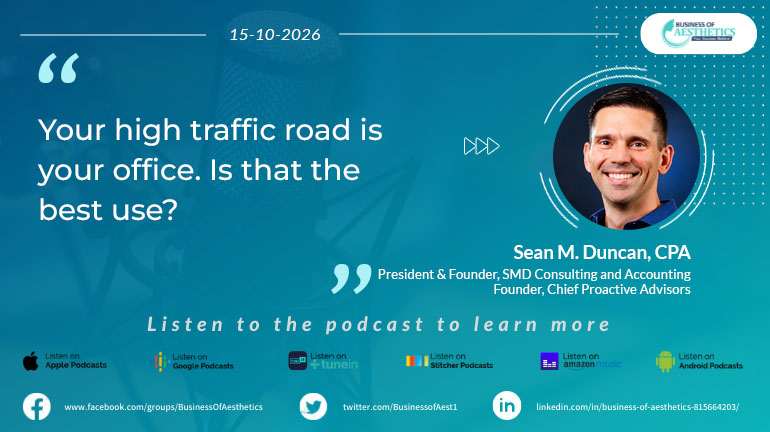
Your high traffic road is your office. Is that the best use? If you get rid of this losing service and only get 10 patients, but you make $150 per patient, would you rather have 10 patients that make you $150 or 100 patients that lose you a dollar each? When you really get to the numbers, it makes a whole lot of sense. So it’s a phased process. Can I fix it? Does it have intrinsic value as a loss leader that allows me to upsell, and do I have proof? Or do I just need to get over the hump and remember I’m actually running a business here and not a nonprofit?
There’s a progression we go through, and every single aesthetics practice is different. Every single one of y’all. There are best practices, and there’s tons of great data out there, but your clientele and your region ask for different things. Cater to what they want and pay for, and let everybody else do the rest. I am more than happy to let other CPA firms work 90-hour weeks for an entire three months of tax season, until everybody is exhausted, so that my staff doesn’t have to, and so we can focus on being responsive and helpful. It’s a choice we’ve made. You can make the same choice, and then you can be a specialist.
"We are the laser specialists. We are the best in town. We are a premium cost, but we are the best." Word gets around when you’re the best at something. "Yeah, we don’t do injectables. We’re the best at lasers." Think about what that might mean. You could partner with other places that send you those referrals. So you can really niche into something special if you do it right.
- 00:24:28 – Confusing Demand With Profitability
- Patient demand doesn’t equal profitability; patients will push scope creep and try to get as much as possible for free.
- Sean warns against Groupon-style discounting in aesthetics, since it trains patients to wait for the deal.
- Position as the specialist, refer out what others do well, and guide patients away from misinformation picked up on YouTube and TikTok.
View TranscriptAnji: Now, I am a little bit curious, Sean. Do you find owners sometimes confuse demand with profitability, almost thinking, "Patients want it, therefore it must be good for the business"?
Sean: That’s where the numbers tell you the story. Patients can want all they want. Patients also want it all free, don’t they? How many times have you had scope creep? "We’ll just do that for you." Or, "I thought this was included." Every business has that conversation. Every patient will push you to the point of trying to get as much free out of you as they can. They’re going to try to game the system. It’s why you don’t do Groupon in this industry. They’re just going to wait for the dang Groupon, print 75 copies of it, and you’re going to lose even more money.
There’s a business purpose to it. Just because the patient says they want it does not mean that’s the best use of your time. Our clients say they want tax returns. Absolutely, they do need a tax return. But we are specialists in giving advice on how to be profitable, how to save money in taxes, accumulate wealth, and protect assets. That’s a specialty.
It’s just who we are. It’s what we do. You can do the same thing. "We are specialists in this space. I know that you want that, and that’s awesome. And by the way, Joe down the street does that, and he is awesome at it. This is what we’re great at." Word will get around that you’re the specialist in that space. And sometimes patients don’t know what they need. That’s hard. It’s hard to tell them, "You don’t need that. This is what you need, and it’s more expensive." But you’re the specialist. You’re the expert.
Sometimes they come in saying, "I need Botox every day, because darn it, I just want to make sure." We all know that is a horrible idea, right? That is not safe. Tell them that. You would tell them that. Tell them that’s not the best use of your time; that’s not what we do. It’s okay. But watch your market. Your market will tell you what it wants. But just because they said they want it could be because of YouTube or TikTok. I have that in my world. Everything you see on YouTube and TikTok, and even podcasts (sorry, I mean this one’s a brilliant one, I’m sure), can give you false information. The same thing happens in medicine. They might have gotten the wrong information, and our job is to guide them to the best information.
- 00:26:52 – Sponsor Break: Ekwa Marketing
- Once owners realize their busiest room isn’t their most profitable one, the next question is where the right patients will come from.
- Ekwa Marketing offers Business of Aesthetics listeners a complimentary 60-minute marketing strategy meeting to build a realistic 12-month roadmap for attracting high-value patients.
- Listeners can book at www.businessofaesthetics.org/msm.
View TranscriptAnji: The conversation we just had is probably one of the hardest conversations in business, and I want to come back to what happens after that decision gets made. But let’s take a quick break before we get into the fix.
A quick word for anyone listening who just did the math on their own schedule and didn’t love the answer. If you realize your busiest room isn’t necessarily your most profitable one, the next question is usually: where are the right patients supposed to come from? That becomes a marketing problem before it becomes an operations problem.
Ekwa Marketing is offering Business of Aesthetics listeners a complimentary 60-minute marketing strategy meeting. It’s a one-on-one working conversation designed to help you map out a realistic 12-month roadmap for attracting the high-value patients that fill your best rooms, not simply your busiest ones. You can grab a time that works for you at www.businessofaesthetics.org/msm. Once again, www.businessofaesthetics.org/msm.
- 00:27:50 – The Decision Tree Before Cutting a Service
- Sean notes that niche marketing messaging attracts the patients you want and steers away low-margin requests before they reach the schedule.
- Step one is identifying every promise already made, including memberships and contracts, and honoring them.
- Next, set the pace of change against a three-year vision and notify patients early that a service is ending.
- Accept that today’s patients may not be your patients in three years; most practices phase services out and adjust speed as high-margin patients arrive.
View TranscriptAnji: All right, Sean, back to it. Let’s say an owner has now identified the loser. Killing the service line is obviously only one option on the table. So walk me through the decision tree you’d run before cutting anything. What has to be tested first, and in what order?
Sean: Yep. Before we went there, I didn’t anticipate saying this, but since you just talked about marketing, and I was talking about niching: how you message your marketing can attract the right type of client. When I say we’re specialists in medical practices, aesthetic practices, medical in general, the moment I say I’m a medical practice CPA firm, you immediately know something different. I’m not a construction guy. Do I know construction? Yes. But this is who we are. You can do the same thing.
So when people are walking in asking for services you don’t want to offer, or that are low margin, you can tweak that with your marketing messaging to start attracting the right type of patient. You can actually guide the marketing to pull in the services you want. So you can reposition your marketing to get to these same results. I know that wasn’t part of our planned topic, but since we’re talking about niching and specialized, profitable services, your marketing helps attract the right type of client. Not just bodies: the right people, so it’s the right use of your time.
So, the decision tree on getting rid of services. It depends on the service. It depends on whether we have subscriptions. Do people have memberships? If you have a membership program, we have to honor our agreements. So if you have a membership and everybody has three, six, or nine months left on it, and you offer these low-profit injectables, you have to honor the agreement. You have a contract with them. You can buy out the contract, but usually that’s not the best thing.
So you look at what you’ve made promises on first. That is literally where I start. Where do I have promises? Because your word matters. How do I honor these agreements? All right, decide how that’s going to work. It’ll change your supply orders; it’ll change your booking. Then you decide how fast you want to make this change. Because again, if you’ve built the business plan that says, "This is who I want to be in three years," and it doesn’t include this service, what steps do I have to take today?
I’m not going to go into full business planning 101, but again: the vision of what you want to create, the services and types of patients you’d have in a perfect universe. Why am I not there today? We begin a roadmap of how to get there. But we start with our promises, because we’re not going to break our word to our patients. And then you begin notifying: "Hey, I just wanted to let you know your membership ends in six months. We do these injections now, but at the end of the six months, we won’t."
And I keep saying injectables because they can have big scope creep. They can be very low margin and done inefficiently, and you do lose money on them. Sometimes the gigantic laser machine is way too dang expensive and you can’t charge enough for it because your area doesn’t support that. So I use injectables as an example, but they’re not the evil empire. Don’t assume you have to fire injectables. It could be contouring. I don’t know.
If you decide this is what’s going to go, you tell your patient base: "This is no longer a service we’re going to offer. We are going to honor our agreement. I just wanted to let you know, and here’s how exciting this is and what the future looks like." I say this to medical practices, and I say it when I’m coaching accounting firms.
You have to be okay that the people who are your patients today may not be your patients in three years, because the type of service and vision you have is not what these people signed up for. I’m going to make up an example, literally pulling things out of the air. Say your vision is to sell a ton of products at three times their cost and be a skin rejuvenation guru. It’s super high margin, and you’re going to make 10x the cost on everything you do, whereas on the injectables you make a few bucks each.
Well, the people who signed up for all these injectables didn’t sign up for a skin rejuvenation super spa. They will go away. They have to; they didn’t want this service. So you have to begin the migration, and this is where the marketing part comes in, attracting more and more of the new patients. And then you decide how fast you’re going to make the change. You may choose to say, "We only do this type of injectable and this type of laser," knowing that two years from now, you’re going to get rid of the laser.
You can build the transition as fast as you’re comfortable with. Look, we all have to make a living. You can be insane like I was. I literally fired two thirds of my revenue in 30 days. I honored my agreements. Anything that was still outstanding, I did. But I gave everybody six to eight months’ notice: "This is not a service we’re going to be offering next year." Boom, two thirds of my revenue. That’s a little banana. I’m not saying do that.
But you might say, "We’re going to do this for one more year and attract more of the new patients, and if I get more of these high-margin ones, I might make it in only six months." You can adapt. No decision is locked into place. You can roll with it. Most practices phase it out. Where do I want to be in three years? Why am I not there today? Which services are going to go away? How do I want to phase them out? And then give yourself wiggle room.
If you have more success attracting high-margin clients, awesome, you get rid of the low-margin ones faster. If it’s harder than you thought, nobody knows you’re getting rid of it until you tell them. Drag it out another six months. You get to decide. I just want to make sure, though, that if these services are losing you money, you get rid of them as fast as possible, because losing money is still losing money. I don’t want you losing money. That’s bad. Is that helpful?
- 00:34:18 – Year-End Timing: Tax Strategy vs. Fractional CFO Work
- Sean distinguishes tax strategy, which reduces taxes, from "tax planning," which often just means calculating quarterly estimated payments to avoid penalties.
- Moves not completed by December 31 generally don’t count for the tax year, so asking in March or April is too late.
- His ideal tax strategy window is late September through October; a December 15 call leaves two weeks, and his firm closes from Christmas to New Year’s.
- Margin and KPI analysis (fractional CFO work) should start as soon as possible; he urges owners to book a proactive CPA now, local or national.
View TranscriptAnji: Let’s get to something I’ve heard you be pretty direct about, and that is timing. You’ve argued that by the time the accountant calls, the leverage is already gone. So for a practice owner running a full menu right now and heading into the final part of the year, what specifically should be sitting on their calendar between now and year-end? And when does each of those windows actually close?
Sean: Okay, I love that question, because this is near and dear to my heart. Between now and the end of the year, reach out to your CPA and say, "Is there anything I should do before 12/31 so I don’t miss an opportunity?" First and foremost, there are different layers of strategy from accountants. There’s a tax strategy: making sure we’re minimizing your taxes. And there’s tax planning. This is a hidden term in our world, and I hate it. Tax planning is often just telling you how much you’re going to owe.
You’re familiar with the term quarterly estimated tax payment? Every quarter, you’re supposed to send in a portion of what you owe. CPAs charge for that as tax planning. You probably heard "strategy," but they said "planning." Tax planning that just tells you how much you have to send a check for is not actually helping you. It’s avoiding penalties.
So you want a strategy on reducing taxes, but there’s also practice management and KPIs. Some people call it fractional CFO or virtual controller work. That’s a lot of what we’ve been talking about, because we haven’t talked about tax nerd stuff. Some firms offer both tax strategy and business planning, which is what we do, and some firms offer one or the other, so you want to make sure you’re talking about the same thing.
On the tax strategy side, if you don’t do something by 12/31, it didn’t happen in the calendar year, and therefore it’s most likely not a tax deduction. When you’re asking in March and April, "Hey, what should I do to reduce my taxes?" It’s too late. The year ended. So end-of-year strategy as it relates to taxes is vital. My favorite time is around the end of September or sometime in October. Some CPA firms are in the middle of tax deadlines, so they might have a limited calendar. Waiting until December is too late, because if you call them on December 15th and ask, "Okay, what could we do?" you gave them two weeks.
And at my firm, as a culture choice for how I want to treat my employees, we close from Christmas to New Year’s. So if we haven’t already implemented the strategy and you call us on December 21st, it is simply not happening, because my employees get to spend time with their families for the holidays. Business choice, right? You might make that same choice too. You want to give yourself a couple of months to implement. Do I have to set up a 401(k)? Do I need to buy these supplies? You want some runway. That’s tax.
On the KPIs, the margins, the profitability, and analysis of the balance sheet and financial statements, any time is a good time. But the sooner the better, because if you’re looking at margins right now in September and you realize, "Man, this product stinks, it’s losing me money," or "This product’s better than I thought," or you have no idea, you want time to do all the analysis we were talking about. It takes time to dig into the financials, pull data out of your practice software, and run the numbers. Give yourself time so you can see those values and make decisions.
So on the fractional CFO work, as fast as possible is best, because I want you to have as much visibility as possible. It affects patients and pricing and marketing and everything else you’re doing. And it’s not just revenue minus cost of sales. Marketing spend, overhead, supply costs, training, travel, all of that matters. It can be overwhelming, but the sooner you start, the more you can focus and learn as the year goes on.
For tax strategy, my favorite time is the October-ish window, because we now have visibility into most of the year. We have an idea of what your tax bill is going to look like, and we have two or three months to fix it. And then for some of the strategy, we’ll push it into 2027. We’re not worried about it. So, two answers, because it depends on your focus. And you might have noticed that’s why we do the throughout-the-year approach: we have multiple conversations during the year, and we bounce around depending on priorities.
But I would say call your CPA now. To be fair, it is currently September 3rd as we record this. There’s a September 15th tax filing deadline and an October 15th tax filing deadline, and a lot of CPAs are losing their minds right now. They’re working those 90-hour weeks. It might be hard to reach them, but reach out anyway. Even if you schedule for October 30th (because Halloween’s on a weekend, which I just learned this week), that’s fine. Get on the calendar.
It is worth the money. I know a lot of people say, "Oh, it’s too expensive." Do you think the cost of that accounting meeting is going to be greater or less than the savings you get? It’s less. You’ve got to find value greater than that. So please, please, please, I beg you. And if you don’t have an accountant who does that kind of work, you don’t have to reach out to me. Yes, it’s what we do, but I’m not here to sell you anything. Find someone who does. They don’t have to be local; many of us work nationally. I work nationally. But find someone who helps with proactive advice, not just filling out the form and firing it off to the IRS. Not that I’m passionate about that at all.
- 00:40:14 – Closing Thoughts
- Anji recaps the core takeaway: a full schedule and a profitable schedule are not necessarily the same thing.
- Knowing margin per room hour is framed as the difference between a schedule that looks successful and a practice that produces healthy profit.
- Listeners are pointed to Sean’s work at SMD Consulting and Accounting and to Ekwa Marketing’s complimentary 60-minute strategy meeting at www.businessofaesthetics.org/msm.
View TranscriptAnji: That was very, very useful, Sean. And I suspect a few people probably just paused this episode to write some of this down. That was excellent. Thank you for being so direct about it. That was a genuinely uncomfortable and genuinely useful look at practice profitability with Sean M. Duncan.
If you’ve been staring at growing top-line revenue and shrinking take-home pay and couldn’t explain the gap, I hope this conversation gave you a different framework for looking at the business. The key takeaway is simple: a full schedule and a profitable schedule are not necessarily the same thing.
Knowing your margin per room hour isn’t just a bookkeeping exercise. It can be the difference between a schedule that looks successful and a practice that actually produces healthy profit. If Sean’s approach resonated with you, I’d recommend connecting with him and exploring his work at SMD Consulting and Accounting, where his focus is helping business owners make proactive financial decisions instead of discovering the consequences after the fact.
And before we wrap up, if you’re looking for some clarity on the digital side of your practice, Ekwa Marketing is offering our listeners a complimentary 60-minute marketing strategy meeting. It’s a one-on-one conversation to help you map out a realistic 12-month roadmap for attracting high-value patients. You can grab a time that works for you at www.businessofaesthetics.org/msm
I’m Anji, and this has been the Business of Aesthetics podcast. Thanks for listening. Keep on leading.
GUEST – Sean M. Duncan, CPA

Sean M. Duncan, CPA, is the Founder of SMD Consulting & Accounting, LLC, and Chief Proactive Advisors. With over 25 years of experience, Sean is recognized for helping business owners move beyond traditional tax preparation toward proactive financial strategy and long-term profitability.
Known as “The Chief Proactive Advisor,” Sean specializes in strategic tax planning, wealth management, asset protection, and business advisory services. He works with medical practice owners and entrepreneurs to uncover hidden profit leaks, make smarter financial decisions, minimize tax liabilities, and build sustainable wealth.
www.smdaccounting.comHOST – Manjali Kulathunga

Drawing on her background in radio broadcasting, Angie brings confidence, energy, and a conversational approach to every virtual event she hosts. As the host of Business of Aesthetics (BOA) webinars and podcasts, she leads discussions with renowned industry experts, creating an engaging environment where knowledge is shared and meaningful conversations thrive.
Recognized for her approachable hosting style and strong communication skills, Angie excels at connecting with both speakers and audiences. Her ability to keep conversations engaging, encourage audience participation, and maintain a seamless flow helps make every webinar and podcast an insightful and enjoyable experience.
Connect with Us:
Category: Business of Aesthetics Podcast