Podcast: Play in new window | Download
Subscribe To Our Podcast




Free for BOA listeners: Book a complimentary 60-minute marketing strategy session with Ekwa → www.businessofaesthetics.org/msm/
In this episode, host Angie joins Deborah McDowell, Founder and CEO of Oncology Aesthetics & Wellness, to explore a challenge most aesthetic practices were never designed to handle: supporting patients whose appearance is changing because of cancer treatment rather than personal choice.
Deborah breaks down how her team structures the journey before, during, and after chemotherapy, from listening and hair preservation planning to post-treatment restoration. She also explains how clear timelines, role-playing, emotional intelligence, and trust-based team training give vulnerable clients a greater sense of control.
Her central message is that extraordinary patient experience cannot be reduced to décor, branding, or procedures. Practices that want to serve oncology patients responsibly must intentionally design the people, processes, environment, communication, and continuity of care around the moments when patients need them most.
Key Takeaways
- Design the patient journey before delivering the service. Map what clients will experience before, during, and after treatment so they never have to navigate a vulnerable transition without knowing what comes next.
- Use information to restore a patient’s sense of control. Explain timelines, likely changes, available options, and decision points early so clients can act deliberately instead of reacting to unexpected events.
- Build trust before discussing solutions. Start vulnerable consultations by listening to fears and concerns, then recommend services only after the client feels understood and safe.
- Hire for emotional intelligence, not just technical competence. Use role-playing during interviews to identify team members who can demonstrate empathy, patience, and trust-building in emotionally sensitive situations.
- Train teams to create partnerships rather than transactions. Reinforce through onboarding and weekly meetings that the goal is to guide the client through a journey, not simply sell a product or procedure.
- Design the environment around the emotional reality of the patient. Oncology clients already spend substantial time in medical settings, so aesthetic practices should intentionally create a more private, reassuring, identity-centered experience.
- Extend care beyond the immediate treatment. Continue supporting patients through recovery and restoration so the practice becomes a trusted long-term partner rather than a one-time service provider.
Deborah never lets a client walk into the next stage of treatment without knowing exactly what comes next. Most practices can’t say the same about their new patients: what they see when they search for you, what your reviews tell them, and where they drop off before they ever call. As a gift to BOA listeners, an Ekwa strategist will walk that path the way a new patient does and show you exactly where it breaks, in a complimentary 60-minute session.

- Get a 1-on-1 diagnosis of your online presence & patient acquisition funnel
- Identify critical, untapped growth levers (SEO, Social, Referrals)
- Define a clear action plan to attract and convert your ideal patients
- Receive expert solutions for your most pressing marketing challenges
Resources

Live Webinar: Future-Proofing Your Aesthetic Practice: Decisions You Must Get Right in the Next 18 Months
Join industry experts to modernize operations, enhance patient experience, and drive sustainable growth.
Wednesday, May 20, 2026 @ 7:00 PM EST – 9:00 PM EST

Are you ready for the “GLP-1 Body” Era?
Download the 2026 Aesthetic Patient Behavior Model to see the numbers driving decisions this year:
- Why 73% of patients now define beauty by “individuality” over transformation?
- The shift away from non-invasive fat reduction (down ~40%).
- Real data on the rise of the male aesthetic patient.

Key Highlights:
- 00:00:01 – Introduction & The Oncology Aesthetics Patient Journey
- The episode explores how aesthetic patient experience changes when appearance-related changes are caused by cancer treatment rather than elective procedures.
- Angie introduces Deborah A. McDowell, Founder and CEO of Oncology Aesthetics & Wellness, whose work focuses on supporting women through medical hair loss.
- The discussion centers on designing care around preparation, trust, dignity, and control before, during, and after chemotherapy.
View TranscriptAngie: So for most aesthetic patients, an appointment is elective. But imagine walking into the same environment knowing your appearance is about to change from a treatment you never chose. That puts every promise we make about patient experience, personalization, and trust under a very different kind of pressure.
Welcome back to the Business of Aesthetics podcast. I’m your host, Angie.
Today, I’m joined by Deborah A. McDowell, Founder and CEO of Oncology Aesthetics & Wellness. Deborah has spent more than two decades across beauty, wellness, aesthetics, and practice operations. And since 2016, her work has focused on helping women navigate one of the most emotionally complex side effects of cancer treatment, medical hair loss.
Her team has built a patient journey around what happens before chemotherapy begins, while treatment is underway, and during the transition back into hair growth and restoration.
So today, we’re going inside that journey. We’re talking about how you prepare someone for a change they never asked for, how you create trust when that patient is at her most vulnerable, and what every aesthetic practice owner can learn from designing care around dignity and control.
This episode is brought to you by Ekwa Marketing. Deborah, welcome to the Business of Aesthetics.
Deborah: Thank you for having me, Angie. I’m happy to be here.
- 00:01:38 – Building Trust Before Chemotherapy Begins
- Deborah explains that the first consultation should begin with emotional connection rather than immediately discussing services or solutions.
- Listening allows the team to understand the client’s fears and questions before explaining what to expect from hair shedding and restoration.
- Clear education helps transform an unfamiliar and frightening experience into a structured journey the client can understand.
View TranscriptAngie: All right, let’s get into the conversation. Now, Deborah, when a woman comes to you before chemotherapy begins, how do you structure that first consultation so she leaves feeling like she has a plan rather than another problem to solve?
Deborah: Typically, when a client comes in, I try to refer to them as clients versus patients. When they come to the treatment center, the first greeting is that of a silence and a hug because they’re walking into an unfamiliar environment, they’re nervous, and they’re unsure of the process.
So once we greet them and there’s a hug that occurs, it kind of softens the encounter and the experience.
Once we start speaking with the client, we listen so that they can share their fears and have questions that we can answer. Everything becomes about a connection initially when they first walk into the treatment center so they can, again, feel safe.
We start the process after listening to them by explaining what to expect in regard to when the hair will start to shed and at what point they will need to prepare for a wig.
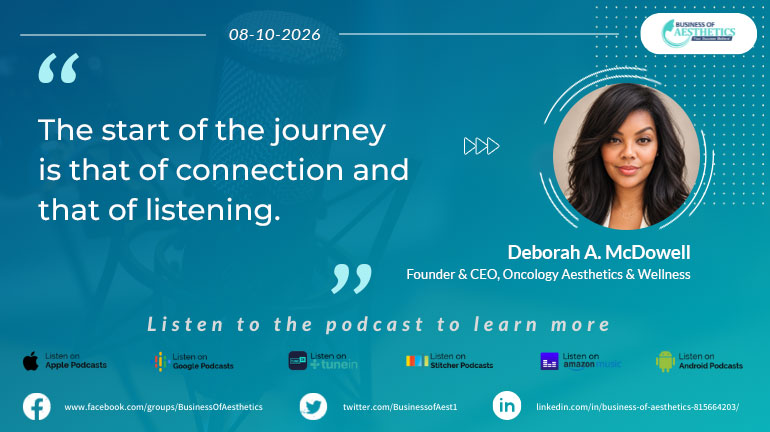
If they’re deciding on preserving their own hair, we walk them through their options for that. But again, the start of the journey is that of connection and that of listening.
- 00:03:20 – Creating Control Through Preparation and Hair Preservation
- Deborah says patients regain a sense of control when they know what will happen and when they need to act.
- Hair preservation and repurposing options allow women to maintain a stronger connection to their identity during chemotherapy.
- Providing information before hair loss occurs makes patients feel prepared rather than reactive.
View TranscriptAngie: Now, once the treatment is underway, how do you structure the patient experience so she still feels a sense of control when so much else in her life may feel outside of her control?
Deborah: We structure it by giving them the information of what to expect and when they should act. That gives them control of time.
When they know that they can have the option of preserving their hair through cutting it and repurposing their hair into a wig, that gives them a sense of control versus waiting for the first shed.
So we structure their pre-chemo journey so that they are able to still have their hair, a sense of self-identity, through the hair preservation and the reattachment through a wig while they’re going through chemotherapy.
That information alone helps them feel empowered and that they still have a sense of control because they know what to expect and they know what to do. So we provide them with the tools.
Angie: I think that’s such an important distinction because at that stage, you’re not simply delivering a service. You’re helping somebody maintain a piece of normalcy while everything around her may be changing.
Deborah: Absolutely.
- 00:04:26 – Designing the Post-Chemotherapy Recovery Journey
- The patient journey is planned across three stages: pre-treatment, during treatment, and post-treatment recovery.
- Deborah explains that hair restoration options can begin once sufficient regrowth has occurred, sometimes relatively soon after treatment concludes.
- OAW continues supporting clients well beyond chemotherapy so they do not have to navigate recovery on their own.
View TranscriptAngie: So then treatment eventually ends, but that doesn’t mean the patient journey suddenly ends with it. How do you decide when a patient is ready to transition from managing hair loss into rebuilding her own hair after chemotherapy?
Deborah: Post-chemotherapy, during the initial structuring of their journey, we walk them through the pre, during, and post stages. So they’re very well educated in regard to their options and their hair loss and hair recovery journey.
Post-chemo, we always educate the clients that once your hair is about an inch in regrowth, at that point you can start reconsidering. Once the hair is about an inch long, that’s like two months post-chemo once all the treatments have concluded. We can start the process of reattaching their hair.
We let them know that you can wait it out. You can go three months. You can go four months post-chemo, or you can immediately transition shortly after.
A lot of times, Angie, when clients are finishing their final rounds of chemotherapy, they do have hair regrowth.
We’ve had clients as early as one month post-chemo when they’re able to start the process of getting back to normalcy, back to a sense of self.
Again, it’s the education around the client, knowing that we walk them through starting their treatment, we’re there with them during their treatment, and then post-chemo, we help them get back to themselves quickly.
Thereafter, we are typically with our clients a year post-chemo. So it’s a very structured program. There is nothing left for them to try to discover. They have all the information.
- 00:06:42 – Turning Patient Experience Into a Repeatable Growth System
- Angie connects Deborah’s structured patient journey to the systems required for sustainable practice growth.
- A strong reputation alone is not enough if patient discovery, evaluation, and conversion are disconnected.
- Ekwa Marketing’s strategy session is positioned as an opportunity for practice owners to identify gaps and create a clearer 12-month direction.
View TranscriptAngie: Deborah, I want to come back to something underneath everything you’ve been describing. None of this happens accidentally.
The patient sees the experience, but behind that experience, there has to be a process. And that same idea applies to practice growth.
You can have excellent providers, great outcomes, and a strong reputation. But if the way patients discover you, evaluate you, and ultimately choose you isn’t working together, growth can become much harder than it needs to be.
That’s why Ekwa Marketing is offering Business of Aesthetics listeners a complimentary 60-minute marketing strategy meeting. It’s a one-on-one conversation designed to help you step back, look at where your practice is today, and map out a realistic 12-month direction for attracting more of the high-value patients you actually want to serve.
There’s no obligation. It’s simply an opportunity to get clarity on what may be working, where the gaps may be, and what deserves your attention next.
You can book your complimentary session at www.businessofaesthetics.org/msm.
- 00:07:59 – Hiring and Training for Empathy Instead of Selling
- Deborah emphasizes that emotionally vulnerable consultations should be treated as partnerships, not sales transactions.
- OAW hires for emotional intelligence and empathy, using role-playing during interviews to assess candidates.
- Trust-centered communication is then reinforced through onboarding, weekly meetings, and organizational culture.
View TranscriptAngie: Now, Deborah, I want to move from the patient journey to something practice owners listening today have direct control over: the people delivering that experience.
So how do you train a team member to handle an emotionally vulnerable consultation without slipping into either clinical detachment or sales mode?
Deborah: One of the things is that we have weekly meetings, and what’s important during those meetings is to have a sense of not transactional selling, because it’s not that.
It’s a partnership that we want our employees to build with the clients by gaining trust and not by selling solutions or selling products.
So it’s important that they first have the emotional intelligence and the empathy for this market, this client, this demographic. And so we really hire for that.
During an interviewing process, we do a lot of role-playing. And once we onboard our staff, it’s just ingrained in the culture in regard to the importance of a client feeling like they can trust us and that we have outlined a journey that they can follow because it’s for their good.
And they believe that they made the right decision in selecting us based on that trust and that initial onboarding experience they have when they first come in the door.
Angie: Yeah, definitely. That’s very powerful because so many practices think patient experience is something you create with the room or the branding. But ultimately, the patient experiences the practice through another human being.
Deborah: Exactly.
- 00:10:00 – What Practices Must Build Before Serving Oncology Patients
- Deborah argues that practices must design the physical and emotional experience before simply adding oncology-related services.
- Supporting these clients requires understanding their broader journey, including image, hair, skin, wellness, financial concerns, and insurance.
- The goal is to create an environment that feels fundamentally different from the clinical settings patients already spend significant time in.
View TranscriptAngie: So let’s bring this all the way back to the owner listening to us. If an established aesthetic practice wants to support oncology patients responsibly, what should it build first before adding a single new service?
Deborah: I think that an aesthetic practice looking to work closely with the cancer client, the physical experience is important.
Again, they spend a lot of time with doctors. They spend a lot of time in medical facilities. The aesthetics of a woman’s journey is not just the word aesthetics, it’s the experience.
It’s the wellness of the experience, the solutions that an aesthetics practice provides for the patient’s journey throughout their journey, and understanding how they can help that client through that insurance and financial part of their journey as well.
Again, when a client is coming in and you remove the medical information part of why they’re there and you deal in the aesthetics, because after all, it’s their image. It’s what they’re coming there for.
It’s their image, their hair preservation, their skin preservation. I always call it their hair esteem. That’s our area.
But the solutions in the physical environment, and then just understanding beyond that the cost of this experience, is what’s important for a practice to outline for the client coming in.
- 00:12:01 – Final Takeaway: Design for the Patient’s Most Vulnerable Moment
- Angie concludes that the true test of patient experience is how well a system works when a patient is at her most vulnerable.
- Deborah’s model demonstrates the importance of intentionally designing preparation, communication, privacy, dignity, and continuity into care.
- Listeners are directed to Deborah’s work and invited to apply the same level of strategic clarity to their own practice growth.
View TranscriptAngie: All right. So that was Deborah McDowell, Founder and CEO of Oncology Aesthetics & Wellness, on a patient journey most aesthetic practices were simply never designed to handle.
And I think the biggest takeaway is that a great patient experience isn’t defined by how well your process works when the patient is comfortable. It’s defined by how well it works when the patient needs you most.
What Deborah has built across the before, during, and after stages of chemotherapy shows just how intentional that process can become when preparation, communication, privacy, and dignity are designed into the experience itself from the beginning.
So if Deborah’s work resonated with you, I highly recommend exploring Oncology Aesthetics & Wellness and the work they’re doing to support women navigating medical hair loss.
And as we wrap up, if you’d like that same kind of clarity around the growth side of your own practice, you can book a complimentary 60-minute marketing strategy meeting with Ekwa Marketing at www.businessofaesthetics.org/msm.
I’m Angie, and this has been the Business of Aesthetics podcast. Thanks for listening. Keep on leading.
GUEST – Deborah A. McDowell

With more than two decades of experience spanning beauty, aesthetics, wellness, and practice operations, Deborah A. McDowell is the Founder and CEO of Oncology Aesthetics & Wellness (OAW), a Beverly Hills-based destination dedicated to supporting women navigating cancer, chemotherapy, and medical hair loss.
Deborah’s work in oncology aesthetics began with Hair With A Cause, which she founded in 2016 after recognizing how profoundly treatment-related hair loss can affect a woman’s identity, confidence, and emotional well-being. What began as specialized hair restoration support evolved into Oncology Aesthetics & Wellness, bringing together restorative hair solutions, aesthetics, wellness, and a highly personalized approach to the cancer journey. Today, Deborah and her team provide custom human-hair wigs and specialized hair restoration techniques designed to help women feel like themselves again before, during, and after treatment.
Her career also includes experience in medical practice administration, salon entrepreneurship, hospitality, and spa development, giving her a unique perspective on both the patient experience and the operational side of building service-driven businesses. She previously served as a Practice Administrator at The Roxbury Institute and founded and managed Laurence Michaels Studio.
Deborah is passionate about closing the gap between medical care and the emotional and aesthetic realities patients face during cancer treatment. Through OAW and Hair With A Cause, she continues to advocate for a more integrated approach to care where confidence, dignity, wellness, and personal identity are recognized as meaningful parts of the healing journey.
www.oncologyaestheticsandwellness.comHOST – Manjali Kulathunga

Drawing on her background in radio broadcasting, Angie brings confidence, energy, and a conversational approach to every virtual event she hosts. As the host of Business of Aesthetics (BOA) webinars and podcasts, she leads discussions with renowned industry experts, creating an engaging environment where knowledge is shared and meaningful conversations thrive.
Recognized for her approachable hosting style and strong communication skills, Angie excels at connecting with both speakers and audiences. Her ability to keep conversations engaging, encourage audience participation, and maintain a seamless flow helps make every webinar and podcast an insightful and enjoyable experience.
Connect with Us:
Category: Business of Aesthetics Podcast