In this episode, host Don Adeesha joins Kara McClanahan, VP of Operations for Genesis Lifestyle Medicine, to discuss why most aesthetic practice goals crumble by March. Kara introduces her “warts and all” operational audit, identifying the single most common blind spot owners ignore: staffing and performance management. She explains that this issue persists simply because it is uncomfortable to address, advocating for a “management by walkabout” approach where owners step out of the treatment room to truly understand the patient experience .
Kara breaks down her methodology for “stress testing” growth goals, arguing that a revenue target without operational reality is just a wish. She illustrates this with the example of a plastic surgeon aiming for $500,000 in monthly fees without the necessary operating room capacity. She details how to “back into the math” by calculating the exact number of leads, consults, and clinical hours required based on conversion rates to ensure targets are statistically viable before communicating them to the team .
Finally, Kara explores the Private Equity mindset, urging independent owners to adopt a non-emotional, analytical view of their business. She identifies the “silent metrics” that matter most, warning that payroll costs exceeding 30% of revenue signal a critical inefficiency. She concludes by advising on provider compensation, suggesting that incentives should drive behaviors like retention and reviews rather than just raw sales, aligning personal financial goals with the practice’s long-term health.
Key Takeaways
- Stop judging staff by personality and start measuring performance data. Operational blindness often hides in personnel issues because they are uncomfortable to address, yet undefined performance is the primary revenue leak in most practices.
- Implement “management by walkabout” to personally uncover friction points in the patient experience. Provider owners must schedule time away from the treatment room to physically shadow the team and build business systems.
- A revenue goal without capacity analysis is just a wish that leads to team burnout. Mathematically stress test your targets by calculating the exact leads, consults, and clinical hours required to hit your number.
- Adopt the Private Equity mindset by removing emotion from your financial review. Strictly monitor your payroll to revenue ratio, as costs exceeding 30% indicate critical inefficiency or underutilization.
- Align incentives with long term loyalty rather than immediate sales volume. Structure compensation to reward specific behaviors like retention rates and reviews to prevent providers from overselling or prioritizing commission over outcomes.
Podcast: Play in new window | Download
Kara emphasized that hitting your financial targets requires “backing into the math” to determine exactly how many high-quality leads are needed to fill your schedule . This session allows you to translate those operational numbers into a concrete acquisition strategy, ensuring your patient funnel is robust enough to make your 2026 goals a reality.

- Get a 1-on-1 diagnosis of your online presence & patient acquisition funnel
- Identify critical, untapped growth levers (SEO, Social, Referrals)
- Define a clear action plan to attract and convert your ideal patients
- Receive expert solutions for your most pressing marketing challenges
Resources

Live Webinar: Enhancing Modern Aesthetic Practices in 2026
Join industry experts to modernize operations, enhance patient experience, and drive sustainable growth.
Wednesday, January 21, 2026 @ 8:00 PM EST.

Are you ready for the “GLP-1 Body” Era?
Download the 2026 Aesthetic Patient Behavior Model to see the numbers driving decisions this year:
- Why 73% of patients now define beauty by “individuality” over transformation.
- The shift away from non-invasive fat reduction (down ~40%).
- Real data on the rise of the male aesthetic patient.
Subscribe To Our Podcast



Key Highlights:
- 00:00:11 – Introduction & The Operational Audit
- The episode focuses on the difference between a wish and a strategic plan, and why goals often drift by March.
- Host Don Adeesha introduces guest Kara McClanahan, VP of Operations for Genesis Lifestyle Medicine, to discuss the "Warts and All" audit.
- Kara identifies staffing and performance management as the single most common operational blind spot that owners find uncomfortable to address.
- The episode is sponsored by Ekwa Marketing, a digital growth partner for aesthetic practices.
View TranscriptDon Adeesha: Welcome back to the business of aesthetics podcast. Today we are discussing the difference between a wish and a plan. I’m your host Don Adeesha and it’s great to have you here as we look towards 2026. Every practice owner has a number in their head, a revenue goal they want to hit but very few have a strategic operating plan to actually get there. Most annual goals succumb to drift. They look great on paper in Jan but by March the daily chaos of the clinic has taken over and the plan is collecting dust. To help us fix this execution gap, we are joined by Kara McClanahan. Kara is a board-certified medical practice executive with nearly 30 years of experience. She currently serves as the VP of Operations for Genesis Lifestyle Medicine and works directly with private equity groups to professionalize practice operations. Today she is walking us through her methodology for a warts and all audit. We’re discussing why most strategic plans drift off course, how to mathematically stress test your growth goals and the specific metrics that tells you if your business is actually healthy or just busy. This episode is brought to you by Ekwa Marketing, the digital growth partner behind this podcast and a trusted resource for aesthetics practices looking to dominate their local markets. With that being said, Kara, welcome to the Business of Aesthetics podcast.
Kara McClanahan: Thank you, Don, for having me and for Business of Aesthetics for having me back. I always love joining the group for sharing education like this, either podcasts or webinars. And I’m just grateful to be here. So thank you.
Don Adeesha: Absolutely. Welcome. And we’re grateful to have you here, Kara. Now, let’s get into the conversation. When conducting a deep operational audit of a practice, what is the single most common operational blind spot, whether it’s toxic staff behavior or a leaky patient funnel that owners habitually ignore because it is too uncomfortable to address?
Kara McClanahan: Oh, so if you had not added that last sentence, too uncomfortable to address, I would have had 10 issues for you. But the uncomfortable to address, I love the addition to that question because before I answer it, I’ll tell you one of the biggest operational issues that practices have is owners that don’t like to be uncomfortable, right? So we love our businesses, we love our teams, and sometimes we live in that uncomfortable because it’s too uncomfortable to address. So the answer to that question, I don’t think there is a one single one that’s most common, but I will say across the board, the largest is probably staffing issues. Because it’s probably the most uncomfortable to address. And I wouldn’t necessarily say toxic staff. We could be talking about just performance management. So maybe having the lack of system to really, really manage performance. How are we measuring performance beyond what numbers a provider is generating or how nice a front desk person is? We lack in most practices, the actual metrics to monitor performance. Then we’re not doing it and then staff issues become that one leak that affects patient funnel, that affects patient retention, that affects our sales goals. So our team is meant to be the heartbeat and the pulse of our practice that drives our patient experience, which drives everything else in the practice. And the uncomfortable side is the lack of systems to monitor and manage performance. And having like staff that really, let’s be honest, sometimes the inmates run the asylum and that’s an uncomfortable position for a business owner to be in. But that’s the reality, at least in a lot of the practices that I work with. Both as a consultant, but also through our own clinics. At Genesis Lifestyle Medicine, when I stepped in as the VP of Operations, we did what was called managing by walkabout, which meant I was walking in the doors of multiple locations. And when we walked in the doors, we actually found that while our staff is the single most valuable asset in driving growth in the practice, our staff was also the biggest obstacle for us hitting our goals for a variety of reasons. So that’s a really long answer, but I think it’s a really, really very multifaceted for practice owners to really recognize that your team may be the reason we are not hitting the goals that we want, even when we love them. Because what we don’t love and the management issue or really the blind spot or like the blinders we put on as managers and sometimes business owners are connected to our staff.
- 00:05:34 – Management by Walkabout & Owner Balance
- Kara defines "Management by Walkabout" as immersing oneself in the patient experience: sitting at the front desk, shadowing providers, and observing operations.
- Many owner-providers struggle because they are the primary revenue generators and fear stepping away from the chair.
- Advice for owners: You must schedule time to trade revenue-generating hours for business-building hours to create systems that allow the team to grow without you.
View TranscriptDon Adeesha: Okay. Kara, can you please elaborate a little bit on that management by walkabout? What are you doing there?
Kara McClanahan: Absolutely. So you’re really, really thinking about putting yourself in the patient experience. And when I say we manage by walkabout is we are involved in walking in every area of the clinic. Sitting at the front desk, understanding what’s going on, shadowing our providers, talking to our staff, having very, very strong performance management expectations of our leadership, as well as of our staff for self-managing. And oftentimes, small practices have a hard time doing that because the owner is often a provider and also often very much like the main revenue generator or driver in the clinic, that they aren’t stepping back and putting themselves in that management where they can walk about the clinic, where they can shadow the front desk, where they can understand that patient experience. And we’re running around trying to spend marketing dollars to drive patient acquisition. You know all about that, right? But also we’re doing all of these things, but we’re not fixing that leak because it’s the most uncomfortable thing to fix, which is the performance of ourself.
Don Adeesha: Absolutely. And what kind of advice would you have for, you know, owner providers that should do a bit of a management by walkabout?
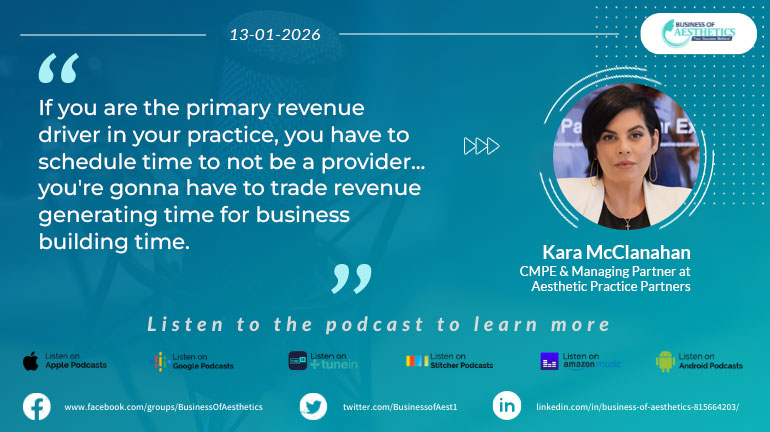
Kara McClanahan: Yeah, you know, it is a really hard thing to balance. So if you are the primary revenue driver in your practice, you have to schedule time to not be a provider and kind of just rip the bandaid off and be uncomfortable for a little bit by knowing that you’re gonna have to trade revenue generating time for business building time. And, you know, again, as a practice owner who is also a revenue generator, we’re afraid to step away from behind the chair, or if we have a pen in our hand versus a needle, we’re not generating revenue. But the reality is when you’re managing your team and you’re managing your business, you’re putting processes and systems and stability in place so that the team can continue to grow with and sometimes without you. You don’t have to be that main revenue generator. But if you are that person, you have to schedule time to manage your business.
- 00:08:28 – Why Plans Drift & The Importance of Transparency
- The "drift" in annual goals is often due to a lack of communication cadence and accountability.
- Kara emphasizes the need for transparency, explaining to the team why and how goals are set, not just assigning a number.
- Setting unrealistic goals (e.g., $500k in surgeon fees without the schedule capacity) harms morale and credibility.
View TranscriptDon Adeesha: Okay let’s talk a little bit more about managing that business right specifically when we set these goals in january why do they you know tend to go adrift per se and where because down the line perhaps in march where daily chaos of the clinic really erodes that focus um what specific operational cadence such as perhaps you know weekly scorecard or daily stand-up is required to guarantee the team stays aligned with the annual goal throughout the year.
Kara McClanahan: Communication processes and systems and accountability. So communication, you just talked about a weekly stand up or, you know, weekly scorecards, all of those things. So again, I reflect back to when I’m consulting with practices that are really, really trying to drive some really large goals. It’s that weekly cadence of continuous communication. transparency with their team, understanding how we get to our goals, having that strategic plan. Once you do all of that, you put these great goals in place, you need to have ways to monitor every single metric. So measuring what’s happening on a continuous basis, communicating with your team through, again, whether it’s a weekly scorecard, monthly team meetings, and being able to adjust. So it’s not about just a monthly team meeting. If you’re only meeting once a month, you’re not discussing where you are halfway to the goal, a quarter of the way to the goal. If we’re off track, how do we course correct? Usually if we’re only meeting once a month, we’re meeting at the end of the month or the first of the month, and we’re not capturing where we can improve in the process. The transparency piece is also another big driver. It’s not enough in this day and age to give your team a goal. You have to tell them why you set that goal, how you set that goal, how we’re going to get to that goal, right? You can’t just say, hey, I want to make $100,000 this month or I want to make $250,000 this month. You know, I have plastic surgeons that I work with that throw out ridiculous goals, like I want to get $500,000 in surgeon’s fees collected this month. But do you even have enough time on your surgery schedule to do $500,000 in surgeon’s fees? How could that be a realistic goal? So really, really setting realistic goals is really important. communicating transparency and strategies, your team and then having those those metrics and those stand up so that you can monitor again the where you’re at, where you’re going.
- 00:11:10 – Setting Realistic Goals & Understanding Financials
- Unrealistic goals stem from owners not understanding the business side: operating costs, schedule utilization, and capacity.
- To set a viable goal, you must understand your numbers, profit margins, net costs, and time constraints (e.g., fewer days in February).
- The negative impact of unrealistic goals is poor morale; staff feel defeated if expectations are impossible, or entitled if expectations are too low.
View TranscriptDon Adeesha: Absolutely. And Kara, I would like to dive a little bit deeper into the how part of that goal setting. Right now, you mentioned like there are plastic surgeons that have these really next level goals set out for themselves as well as, you know, the rest of the team. But when it comes to really the execution part, it’s not as viable. But how would you bring this up to the surgeon or like the leadership team saying, hey, your goals might not be that realistic as much as, you know, they are so elaborate. How would you bring that up?
Kara McClanahan: Yeah, so it’s really easy for me as a consultant because when I’m working with a practice, they already came to me because they want my advice, right? They already came to me because they value the important support and they want me to tell them what they’re supposed to do. I’m going to take that consultant hat off for a second because I think… that the expectation that someone’s giving us guidance and recommendation, if someone came to me for unsolicited advice or they weren’t a client, and instead of saying, I have this realistic or unrealistic goal, what should I do? I would hope that they would come to me and say, how should I appropriately set my goals? Because that’s where I can help. Because I think that what leads to unrealistic goals and expectations is people not understanding the business side of their business. And only seeing the dollar signs versus how do we get to the dollar signs. So in the scenario that I gave you, a surgeon sets a surgeon’s fee goal of $500,000 a month, but he doesn’t have enough time on his schedule to even complete $500,000 worth of cases. So that’s breaking down what’s realistic. What is our realistic expectation? How can we achieve these goals and how do we get to the goals that we need to? So that comes back to understanding the numbers in your practice, which is also a very uncomfortable thing for most business owners. You have to understand your operating costs. You have to understand your percentage of revenue that your staffing takes up. You know, you have to understand your schedule utilization and how much capacity do I even have? You know, it’s not enough to say, oh, in February, I want to do 10 percent more injectables than we did in January. But that’s not realistic because you actually have less days in February. So unless you’re going to find extra hours in the day, which someone helped me with because I could use a couple extra hours in the day, you can’t realistically do more unless you have low schedule utilization. So in order for us to determine what those goals should be, we need to understand the numbers in our business. And I think that there’s a lot, especially nowadays, of med spa owners that went to school to be providers. They spend hours and, you know… a time being excellent injectors or laser technicians or physicians, they don’t spend hours understanding profit margins and net costs and all of those things that aren’t so fun and sexy. And so again, to really make strategic goals that stick and are realistic, you have to understand the numbers in your business.
Don Adeesha: Kara, just one final follow-up on that. What is a con of having an unrealistic goal? Why is that so detrimental to the practice? And perhaps you could talk a little bit about how it contributes to the staffing issue, if it does.
Kara McClanahan: Yeah, I was actually going to say the number one issue with that is poor morale. When you set unrealistic expectations and goals, it feels like it’s defeating to the staff, right? We’re never going to reach it. We’re always underperforming. Or let’s be honest, they’re saying she has really unrealistic expectations. And so the message that you’re sending to your staff is is that you expect more from them that is possible. And your goals are more important than their performance as a whole. And so I think setting unrealistic goals and expectations leads to really low staff morale. But also setting too low of expectations or not having the right ones leads to a lot of other issues. So this is why it’s so important to understand those numbers, set appropriate goals, give your team the tools, support, and resources, and you want them to achieve them. If our teams are knocking out their goals every single month, just like clockwork, and they don’t even have to sweat to get the goal, but they’re getting a big reward, we’ve probably set the bar too low. And what we’re doing is we’re creating staff that is expecting to now get compensated, bonus, all of these things on just the bare minimum versus really an obtaining a goal. The exact opposite, like I said, if you’re setting it too high, you’re creating a pattern of we’re never going to achieve. So again, you know, business decisions tie to staff performance and the morale of your team is a direct reflection of your overall culture. And again, obtaining those goals.
Don Adeesha: Right. Before we continue, a quick message from our sponsor, Ekwa Marketing. Ekwa Marketing are offering our listeners a complimentary 60-minute digital strategy session. This is a one-on-one consultation with the senior strategist to help you map your 12-month high-value patient acquisition roadmap. You will get a personal diagnosis of your online presence and patient funnel, uncover untapped growth levers across SEO and social, walking away with a clear, actionable plan tailored just for your practice. You can check the availability and reserve your spot in under two minutes at www.businessofaesthetics.org/msm.
- 00:17:04 – Mathematically Stress Testing Your Plan
- Kara explains the concept of "stress testing" a growth plan by backing into the math: calculating the necessary leads, consults, and schedule hours based on conversion rates.
- Example: To hit 30 hours in the OR with a 45% conversion rate, you need a specific number of consults and leads.
- Stress testing prevents "throwing spaghetti at the wall", adding staff or marketing spend reactively when unrealistic goals aren’t met.
View TranscriptDon Adeesha: So Kara, for our plastic surgeon who wants to set the goal of 500k a month, how do you mathematically stress test such a growth plan or, you know, a more realistic growth plan to ensure the practice has the room hours and provide availability to really hit those numbers before committing to it?
Kara McClanahan: Yeah. So again, it comes down to capacity and utilization. So before you can increase a goal, you have to understand what the capacity you have to obtain it, number one. And again, the stress test factor comes in to understanding things like if I want to spend 30 hours in the OR a month, And my conversion rate is 45%, which is the national average, but I feel like it’s super, super low. That means you have to see, you know, twice as many paid consults to get those again, that 45% conversion rate so that you get those 30 hours in the OR. That means you need to get a hundred leads to a month if you are converting at 50%. So you got to back into the math. You need to understand what is the goal? How many consults do I need to get there? How many leads do I need to get there based on my conversion rates? And then create a scale that allows you to grow. So understanding the math and understanding the numbers and backing into your goal is what you need to do. So the same thing applies to injectable based practices. It doesn’t have to be surgery. If you want to have X number of dollars or X number of dollars and you know that your average patient ticket is $950 per hour, and you have 35 hours available on your schedule a week, well, you know what you need to do to get there. So understanding what that looks like and taking into consideration account of It’s December. We have two big holidays. Where are their vacations? So you have to factor in all of the exceptions to the rule and to set those realistic goals. And I think, again, numbers, math, math is the way that we understand how we hit our goals. Absolutely.
Don Adeesha: So just so that I understand it correctly. say you know um sure let’s keep on going with the plastic surgeons example right uh i love it because they have such a you know great goal 500k a month great um now How does that unrealistic goal? Now, if we were to take that unrealistic goal, that’s their aspiration. They want to hit it. But to make it realistic, what you’re saying is go through the math, right? I want to hit this much. So if let’s do the math and see how much I can realistically hit. Is that a good way of going about things?
Kara McClanahan: Absolutely.
Don Adeesha: Okay, so, you know, just to stress test before you give it to your team members. It’s critical, is it? Otherwise, you’re always going to set up your unrealistic goals and demotivate everyone around.
Kara McClanahan: Yeah, right. And then you also demotivate yourself when you feel like this is a realistic goal, right? And why is it my business? hitting it and what ends up happening is when you don’t hit numbers you start throwing spaghetti on the wall and trying to see what just starts sticking and that’s where you’re wasting marketing dollars instead of really being strategic with it that’s where I see a lot of practices add another staff member oh if I just add another provider or if I add another salesperson or if I add something else that But now they’ve just added cost before they created a plan to get where they were going. So again, when you stress test it and you understand the numbers, you’re more like responsibly reactive to whether you hit your goals or not. When you set them unrealistic and you’re consistently not hitting your goals, that’s where we have a tendency to be reactive and just start doing a whole bunch of things, hoping that it lands and gets us to our goal.
Don Adeesha: How common is this for you to see when you go in for a consult?
Kara McClanahan: Very common. Very common.
Don Adeesha: Okay. So our practice owners listening in, don’t worry, you’re not the only ones out there.
Kara McClanahan: That’s right. I feel like a lot of practice owners say, I just feel like I’m throwing the whole kitchen sink at it and nothing’s working because the strategy isn’t in place.
- 00:21:40 – The Private Equity Mindset & Key Metrics
- Private Equity groups analyze businesses without emotion, focusing strictly on data, which is a mindset independent owners should adopt.
- The key metric for PE is EBITDA (Earnings Before Interest, Taxes, Depreciation, and Amortization), representing true profitability.
- Kara highlights that payroll should ideally be 25-30% of revenue; seeing it at 40% indicates a major operational inefficiency.
- Owners must understand "true net profit margins" (factoring in staff, consumables, marketing), not just the cost of the syringe vs. the price charged.
View TranscriptDon Adeesha: absolutely now uh let’s move on to private equity and let’s take a look at how private equity groups look at metrics do they look at it differently than the average independent owner and when auditing practice for scalable health what is the silent metric aside from perhaps top line revenue that reveals the true operational maturity of the business
Kara McClanahan: Yeah, so those are two very complex questions, but the easiest one to answer is, do private equity companies look at it any different? What I would say is private equity companies look at it without emotion. They don’t look at the numbers differently per se, in that they look at the numbers without emotion. We as business owners are emotionally connected to our practices. So we can look at numbers or we can look at different things in our operation and come up with rationalization as to why they are the way they are or why they’re not the way we want them to be or a staff member’s performance is what it is. All of that emotion is taken out when a private equity company looks at a practice. And this is why as a consultant, I always say whether you’re planning to sell your practice to private equity or not, you should be operating your business as if you wanted to sell the private equity every single day. That doesn’t mean that you can jump on the consolidation train. Right. That doesn’t mean that you’re preparing for it. But it means that you’re looking at your business very analytically. We have to run our businesses like a business and take the emotion out of it. That’s why I always go back to strategy, policies, procedures, protocol, numbers, because that data doesn’t lie. And it also doesn’t hold emotion. That’s why I think that that is one of the biggest differentiators. However, the number that means the most to private equity companies is the almighty EBITDA, right? So that’s earnings before insurance tax and amortization, that big number that nobody ever knows what it means. That’s the number that’s most important to companies. To private equity companies, because that’s really kind of like your profitability, right? And that’s what they’re looking at. That’s the number that means something to them. But how you get to that number and the metrics that aren’t so silent are what are so important to the business owner.
Don Adeesha: Such as?
Kara McClanahan: Such as your profit margins. So most people don’t look at profit margin the same way. So most practices look at their profit margin as their procedure cost, like it’s $500 for a syringe of filler, which it should be more, but I’m just using that for easy math. Um, and the syringe of filler cost me $200. So my profit is $300, but that’s not true because you have staff costs because you have cotton balls, because you have numbing cream, because you have a receptionist to check that patient in and out because there were marketing dollars associated. So your profit margin, your gross profit margin, if you will, might be that $300, but there’s a lot more that goes into that one syringe of filler that most people are not accounting for. So there’s that, um, So really understanding their true net net profit margin on all services. That is what keeps us from underpricing our services. That is what keeps us with our percentages in line with what really equals that EBITDA. The other one that we as practices don’t look at often enough is percentage of revenue for things like overhead costs, like staffing. When I go in and analyze revenue for a practice, I am shocked when I come in and I see that payroll is 40% of revenue. That means you have a very high payroll compared to what you’re bringing in. And most people don’t even look at that number. They don’t understand that your percentage of revenue, your biggest cost is always going to be your staff. But when you’re in a 35%, 40%, you are overstaffed or underutilized. Either way, your percentage of revenue is way too high. Those are some of those metrics that business owners really don’t look at. They look at production for providers often, so the percentage of revenue that each provider is bringing in, but they’re not often looking at how that number attributes to the total revenue.
Don Adeesha: Right. And Kara, if 40% is a really high percentage for payroll to staffing, sorry, payroll to revenue, then yeah, the percentage of the revenue, then what is the benchmark or, you know, you’d say is a good percentage?
Kara McClanahan: Yeah. I’d say 25 to 30%, 30% being on the high, yeah, just kind of like the top line of where I want my practices to be. A lean practice can run in the 25% range. And also remember, there’s only two ways to increase your profitability in a practice, and this affects your payroll, is decrease costs or increase revenue. So you can keep your staff the way it is if you feel like you’re not understaffed, but that means you really have to increase your revenue. So it doesn’t mean cutting staff. It doesn’t mean just because your percentage of payroll is high. It means you need to do something to upset that balance.
- 00:27:18 – Strategic Compensation & Motivating Behaviors
- Kara discusses provider compensation, noting that injectors typically make 20-30% of their total production due to high cost of goods.
- Incentives should not be limited to sales revenue; they must drive behaviors like retention, rebooking rates, referrals, and education participation.
- Focusing purely on sales can lead to poor patient recommendations. Driving behaviors that create "happy patients" ultimately increases lifetime value and revenue organically.
View TranscriptDon Adeesha: Right. And then now, let’s talk a bit more about strategy and how strategy often fails at the front line because incentives are misaligned with the business goals. You spoke about this a little bit earlier, but we would like to get a bit more detailed into this. And how should provider compensation really be structured so that their personal financial goals are directly tied up to the specific strategic objectives of the practice for that year?
Kara McClanahan: Yeah. So that is also a loaded question. I love you have lots of loaded questions tonight, Don. So I would preface this by saying every state is different on compliance for incentives. For providers. So you first and foremost have to make sure that you are compliant with your state in producing incentives. Right. But it’s common. So, for example, injectors make on average about 20 to 30 percent of their total revenue production. Right. That might be a combination of hourly or salary plus some type of incentive. But the reason it’s a little bit lower, that 20 to 30% of their overall production, is because the cost of goods for injectors is so high. So dermal fillers, neurotoxin, all of those costs of goods are very, very high compared to, say, energy-based devices. So cosmetic injectors, when you look at their total compensation, if I generate, and this is a really low number for an injector, but easy math because it’s late at night for me. And so if I generate $100,000 in revenue, I should be making about 20 to 30,000 in compensation. And that compensation is broken down, like I said, either hourly, salary, or an incentive. But that’s the average. And that’s kind of the math across the board of average pay for injectors. Now, you have to decide what motivators… create performance and that’s what you’re asking. Because sometimes if we overcompensate our injectors or our providers at all, they’re getting paid really well. They’re gonna come up, it doesn’t come to work. It doesn’t matter how busy they are. They don’t care what their retention rate is. They don’t care what their reoccurring revenue is from memberships. They don’t care what their referral rates look like because they show up, they have patients, they’re making good money. And so that doesn’t motivate performance. So we want to tie performance incentives into more than just revenue. And so I like to tie revenue. I like to tie, I’m not sure if I cut out or not. Sorry. I like to tie, okay. I like to tie incentives to motivators in addition to revenue. So we require our providers to also participate in continuing education. So they have to participate in like our social media, writing blogs, patient education, contributing to the overall function and growth of the practice. We also tie things in like their retention rates. They’re rebooking rates. These are things they’re upselling of other procedures. These are things that now motivate more than just sales. They motivate behaviors. And when you only motivate sales, you also fall into the opportunity of providers. making probably not best recommendations, maybe overselling injectables, overselling treatments, maybe not always providing the best recommendations because there are people out there that are incentivized by the dollar and it benefits them to sell more, sell more, sell more, not give good patient outcomes. So I used an injector as an example, but the same can be said for say estheticians. Now with estheticians, their percentage of production is higher, more about 30 to 40% because energy-based devices, facial services, they have a lower cost of goods and often they’re lower or price per patient, price ticket per patient is lower as well. So taking into consideration again, going back to math, when you understand the numbers, it’s easy to create drivers.
Don Adeesha: I’m really curious about this part where you mentioned motivating behaviors. Can you expand a little bit more about that? What kind of behaviors are you trying to really motivate? And how has that really looked like in real world? Like, have the team members been happier? Is the staff retention been better? How has that really transformed into ROI?
Kara McClanahan: Yeah. So if you think about it this way, if you have providers that are focused on increasing their retention rates, increasing their rebooking rates, increasing their referrals, increasing their reviews, that means they’re focused on patient outcomes. They’re focused on patient experience. They’re focused on happy patients. Happy patients refer their friends, that’s new patients, to the practice. Happy patients with good outcomes, they come back, they’re spending more money. And actually, what we consider a lifetime patient, after their third, fourth visit, their spend goes up because their trust score goes up. When I continue to come back and see you, Don, at your med spot every single month, now the next time you recommend that product, that new treatment, or you recognize something that would benefit me, then I’m more apt to buy it. So what has that done that’s increased revenue overall? And now I’m so happy I’m sending my friends. So what you’re doing is you’re driving behavior that says, we want to give really good patient outcomes. We want to give really good customer service. We want our patients to come back and send their friends. So we are going to do the things that make a difference there. Because if we’re only focused on numbers, that means driving units, driving syringes, driving treatments. And that doesn’t always equal happy patients.
Don Adeesha: So happy patients is the absolute goal, is it? I mean.
Kara McClanahan: Happy patients, happy staff, right? As business owners, we want to have a place that staff want to come back to. They’re excited about selling our services and they want to bring their patients back as well. So I’d say optimal outcomes, great patient experience and good culture could all be driven by strategic strategy and operational support in the practice.
Don Adeesha: Absolutely.
- 00:34:08 – Conclusion & Final Takeaways
- Kara’s final key takeaway: Dive into the numbers, set realistic expectations, and maintain a strategic plan rooted in reality while communicating constantly with the team.
- Don summarizes the importance of "stress testing" goals, ensuring operational reality matches financial wishes, and adopting the non-emotional analytical lens of private equity.
- Don reminds listeners about the complimentary 60-minute digital strategy session from Ekwa Marketing.
View TranscriptDon Adeesha: Okay, so Kara, just to wrap things up, what’s one final key takeaway you might have for our audience if they could only take one thing away from this conversation?
Kara McClanahan: So dive into the numbers, set realistic expectations and have a strategic plan for 2026 based in reality, fundamental and strategy and continue to communicate with your team. Pulse check. Don’t be afraid to pivot. That’s a lot of recommendations all in one, but it all means the same thing. Have a strategy, have a plan and base it in reality and know your numbers and your practice.
Don Adeesha: Okay, that was truly a grounding conversation with Kara McClanahan. My biggest takeaway was her concept of stress testing your goals. It’s not enough to simply pick a revenue number because it just sounds impressive. You have to back it into the math regarding your clinical capacity. As she puts it, without that operational reality, a goal is just a wish that leads to team burnout. I also appreciated her advice on the private equity mindset. We often let emotion cloud our judgment regarding staff performance or overhead costs. Learning to look at your practice through a strict analytical lens, focusing on profit margins and behavior-based incentives is truly the key to professionalizing your operations. So before we sign off, a quick reminder, Ekwa Marketing is offering a complimentary 60-minute digital strategy session. This is a one-on-one consultation to help you map your 12-month high-value patient acquisition roadmap. You can check the availability and reserve your spot in under two minutes at www.businessofaesthetics.org/msm. That being said, I’m your host, Don Adeesha, and this has been the Business of Aesthetics podcast. Thanks for listening and keep on leading.
GUEST – Kara McClanahan

Kara McClanahan is the Managing Partner and Executive Business Consultant at Aesthetic Practice Partners, where she leverages nearly 30 years of industry experience to help practices navigate strategic change. A Board Certified Medical Practice Executive (CMPE), Kara has partnered with physicians, private equity groups, and medical device leaders to design operational frameworks that drive next-level success.
Currently serving as the Vice President of Operations at Genesis Lifestyle Medicine, Kara specializes in moving practices from ‘mom and pop’ management to enterprise-grade efficiency. Her expertise covers the full spectrum of practice growth, from financial auditing and staff development to executing complex strategic operating plans.
Beyond her corporate leadership, Kara is the founder of Empower Esthetics, a nonprofit dedicated to advancing women in leadership and providing educational grants to survivors of domestic abuse, helping them achieve self-sufficiency through careers in aesthetics.
HOST – Adeesha Pemananda

A seasoned marketing professional and a natural on-camera presence, Adeesha Pemananda is a skilled virtual event host and presenter. His extensive experience in brand building and project management provides a unique strategic advantage, allowing him to not only facilitate but also elevate virtual events.
Adeesha is known for his ability to captivate digital audiences, foster interaction, and ensure that the event’s core message resonates with every attendee. Whether you’re planning a global webinar, an interactive workshop, or a multi-session virtual conference, Adeesha brings the perfect blend of professionalism, energy, and technical savvy to guarantee a successful and impactful event.
Connect with Us:
Category: Business of Aesthetics Podcast