In this episode of the Business of Aesthetics podcast, host Don Adeesha sits down with Paulina Riedler, CEO and co-founder of Spakinect, to talk about one of the biggest threats facing the fast-growing med spa industry: compliance gaps.
The med spa industry is booming , adding over $1 billion each year , but many businesses are scaling faster than the rules can keep up. Paulina shares real stories from the field, including how skipping important steps like Good Faith Exams can cost a practice everything.
You’ll learn why cutting corners might feel easier in the short term but ends up being costly in the long run. Paulina also explains how a virtual compliance model can unlock real profits, why standard operating procedures (SOPs) are key to safe scaling, and how private equity firms view compliance during acquisitions.If you’re growing a practice or planning an exit, this episode is a must-listen. Don’t just scale fast, scale smart and safe.
Key Takeaways
- The med spa industry is growing fast, but many businesses aren’t keeping up with changing laws.
- Compliance is critical. If you ignore it, you risk legal trouble, reputation damage, and losing your business.
- Good Faith Exams are required yearly, and skipping them can lead to costly investigations.
- A virtual compliance model helps you keep treatment rooms busy and boosts revenue.
Podcast: Play in new window | Download
Paulina emphasized that ‘scaling smart’ requires a foundation that protects your business while you grow. This session is your opportunity to pair that operational safety with a precision marketing roadmap that ensures you attract the high-value patients needed to sustain your expansion.

- Get a 1-on-1 diagnosis of your online presence & patient acquisition funnel
- Identify critical, untapped growth levers (SEO, Social, Referrals)
- Define a clear action plan to attract and convert your ideal patients
- Receive expert solutions for your most pressing marketing challenges
Subscribe To Our Podcast



Key Highlights:
- 00:00:11 – Intro: The Compliance Crisis
- Don sets the stage: the med spa industry is growing fast, but compliance isn’t keeping up.
- Paulina Riedler is introduced as the CEO of Spakinect.
View TranscriptDon Adeesha: Welcome back to the Business of Aesthetics podcast. Today we are discussing the single biggest threat to the fastest growing industry in medicine, the compliance gap. I’m your host, Don Adeesha. And it’s great to have you here.
The stats are undeniable. The med spa industry is exploding, growing by over 1 billion annually with a projected count of nearly 12,000 facilities by the end of this year. We are witnessing a level of hypergrowth that most sectors never experienced. But there is one problem , the rules can’t keep up.
We are operating in a landscape where regulations are confusing, constantly changing, and vary wildly from state to state. This has created a dangerous disconnect where the fastest growing operators are often the most vulnerable to compliance failures.
To help us navigate this, we are joined by Paulina Riedler. Paulina is the CEO and co-founder of Spakinect, a company that serves as the compliance backbone for over 4,000 medical spas across the nation. She has seen firsthand how the smartest operators build bulletproof systems to scale safely, while others risk everything by treating compliance as an afterthought.
Today we are discussing why scaling without infrastructure is a liability, how the Good Faith Exam bottleneck kills revenue, and how to protect your business assets in an era of increased scrutiny.
This episode is brought to you by Ekwa Marketing, the digital growth partner behind this podcast, and a trusted source for aesthetic practices looking to dominate their local markets.
Now, Paulina, welcome to the Business of Aesthetics podcast.
- 00:02:10 – The Industry is Outgrowing Itself
- Paulina explains how business owners scale like retail, ignoring medical rules.
- Compliance and patient safety must grow with the business.
View TranscriptPaulina Riedler: Thank you, Don. Thanks for having me. I’m happy to talk compliance.
Don Adeesha: Wonderful. Then let’s get right into the conversation. So the industry is witnessing hypergrowth that outpaces regulation, creating a perfect storm for vulnerability for the operator scaling fast in 2026. Where is the single most dangerous disconnect between their growth speed and the actual enforcement of state laws?
Paulina Riedler: So the biggest disconnect right now is, you just said it very well, the industry is outgrowing itself. We are outpacing the growth and the infrastructure that exists currently for our industry. Where this disconnect is, is when people come in who have business backgrounds. Let’s talk about, you know, private equity-backed companies, not all of them, but a lot of companies who come in, and they’re used to scaling businesses in other sectors. Maybe it’s technology, maybe it’s retail, you know, maybe it’s even direct-to-consumer. But coming into a medical facility, medical industry, is completely different.
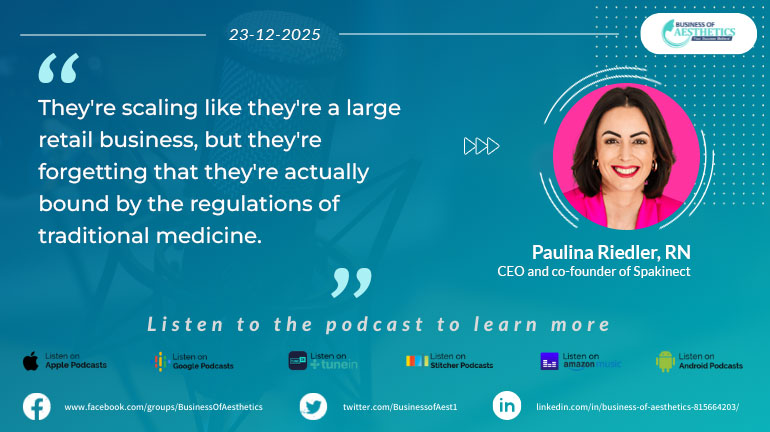
So what I see as a disconnect is when people come in and they’re scaling like they’re a large retail business, but they’re forgetting that they’re actually bound by the regulations of traditional medicine. And they pretend that those two worlds don’t collide, and they very much do.
And so that’s what Spakinect is here to do, is to try to help people sort of navigate that. And that’s become one of my passions, is also to help people navigate that because I’m a nurse and I care deeply about my license, my patients. I worked very hard to get to where I am. And so we want to make sure that, as providers, people understand how to protect their license, how to protect their patients, and make sure that we’re not growing at a pace that’s going to be unsafe.
- 00:04:14 – Real Horror Story: Skipping Good Faith Exams
- Paulina shares how one large practice cut corners and got investigated.
- One patient complaint exposed system-wide compliance failures.
View TranscriptDon Adeesha: Right. Paulina, you mentioned the disconnect between speed and safety. Can you share a specific anonymized example of a horror story where a rapidly scaling brand ignored this disconnect and hit a regulatory wall?
Paulina Riedler: Yeah, I think, you know, there are several stories I could think of. Maybe one that would sort of resonate with listeners, and it has to do with the Good Faith Exams, just because I hear about this and I work in this facet. So I have a lot of stories around people who are doing or not doing Good Faith Exams.
But one company, who had scaled multi-state, we’re talking multiple, multiple locations, in order to cut costs, decided to start to cut back on the number of Good Faith Exams that they were doing. So what they did was they said, well, if a patient has had a Good Faith Exam within the last two years, that’s fine. Good. We don’t have to redo it every single year. Now, that’s sort of the best practice, the accepted standard of care.
Paulina Riedler: And so in order to save on their bottom line, they started to decrease the frequency in which patients were getting Good Faith Exams. Unfortunately, what happened is it took one patient who had a poor outcome, and she ended up reporting this to the medical board.
And what a lot of people don’t know is that when a medical board investigator is sent to investigate your practice, they actually have the authority to look at everything in your practice, not just the complaint that was filed. So even though this patient said, “I had some bruising after a procedure,” they complained. The investigator comes in, and now they have the ability to look at: What are your SOPs? What are all the contracts you have? Do you have delegation protocols?
Paulina Riedler: They’re going to look at everything in your practice, and they can. And so what ended up happening is they found that the physician was liable for all of these patients who had not had up-to-date consent signed, nor Good Faith Exams done.
And that can be crushing to a practice, right? Because it costs thousands, tens of thousands, could even be hundreds of thousands of dollars in legal fees. You have to shut down your practice. Not to mention, it’s not a good look if you have a medical board investigator come in and you have patients in your practice, and then you’re having to shut down and send those patients away. So it’s never a great thing for your reputation when that happens.
But I also like to tell people that, as you grow, you are bound to have an investigation or two. It’s a matter of exposure, right?
Paulina Riedler: So this particular practice was bound to have some kind of investigation at some point, and they could have protected themselves better had they just adhered to the standard of care, spent the extra couple of dollars to make sure that these patients were getting exams every 12 months or more. But they instead, you know, I would argue that whatever they saved in extending those Good Faith Exams to two years, they ended up having to spend double or triple that in recouping costs from legal fees and everything.
So it usually is not cheaper to go ahead and cut costs on the front end. You usually end up paying a lot more on the backend.
Don Adeesha: Absolutely. And it’s not just monetary fees that you’re going to pay up, your reputation’s gone down the drain along with it as well.
Paulina Riedler: Yeah, exactly.
- 00:08:12 – Revenue Bottlenecks & the Cost of Non-Compliance
- Don calls skipping compliance a "quick way to crash."
- Paulina explains how treatment rooms = revenue, but compliance bottlenecks kill profits.
View TranscriptDon Adeesha: It’s a quick and easy way to crash fast, right? If you ignore this disconnect. Mm-hmm. So the Good Faith Exam requirement is often a bottleneck that kills sales when a physician isn’t physically on site. From an operational efficiency standpoint, how does a virtual compliance model unlock the specific revenue per hour that is currently being lost to staffing logistics?
Paulina Riedler: Well, that’s a great question. So the way that we always talk about this is that your treatment rooms are your moneymakers. You know, however many treatment rooms you have in your practice, you want to fill those rooms as much as possible in the hours that you’re open. Obviously, the more patients you have, and the more booked appointment slots you have, the more revenue you’re generating for the practice.
What a lot of people mistakenly think is that, “Hey, I can have my nurse practitioner or my MD who’s on site do those Good Faith Exams, and it’s cheaper than outsourcing those.” And what they’re not thinking about is that actually, if that MD or that nurse practitioner or PA, if they’re actually in that treatment room and doing billable treatments for a patient, you’re going to generate a lot more revenue for the practice that way than having that person do the Good Faith Exam.
Because the Good Faith Exam doesn’t generate revenue for the practice. You could say it helps to, you know, bring, it’s compliance, and it helps to get the patient into your practice, but it’s not going to be a revenue generator like your treatments, your billable treatments, are.
So we always say that every hour that that treatment room sits idle, that’s money that you’re leaving on the table. So why not use your providers, your very skilled providers, to be doing treatments on patients instead of doing those Good Faith Exams?
Don Adeesha: Right. Is it possible for you to give us a breakdown on the math? Exactly.
- 00:10:22 – Math Breakdown: Virtual vs Onsite Compliance
- Paulina shows how nurse injectors can earn $500–$1,000/hour.
- Using them for non-revenue tasks like exams wastes money.
View TranscriptPaulina Riedler: Yeah. So the way that it works is that every nurse, let’s just take a nurse injector, for example, the average nurse injector is generating between $500 to $1,000 an hour for a practice, right? So if you have a nurse injector, let’s say that this particular person is a nurse practitioner, and they can generate $500 on the low end an hour of revenue for a practice, how many Good Faith Exams could that provider do in that same hour?
You could say maybe they could do five to, you know, maybe seven, something like that. Now, those five to seven Good Faith Exams, those are not generating any revenue for the practice, right? They’re costing you money because you have to supply the staff in order to perform those Good Faith Exams.
So basically, you have two options: You can have that NP, you’re paying them, let’s say, $60, $65 an hour, and that NP is doing Good Faith Exams for an hour. You’re not generating any revenue.
Or that same hour, you’re paying them $65 an hour, but they’re generating $500, $600, $700 an hour for the practice. So you’re getting a much bigger return if you’re spending that time and money on them treating patients versus just doing those Good Faith Exams.
Paulina Riedler: So it just comes down to: How much revenue are you generating per provider per hour? And when you look at the math, you realize that, hey, these people are very skilled. So, you know, they’re probably one of your most expensive employees in your practice. They’re going to be your mid-levels and your physician. So why not get them doing the thing that generates the practice the most amount of money?
Don Adeesha: Absolutely. Thank you for breaking that down. I think that sets up a very clear picture from a practice owner standpoint. I’m also curious, Paulina, how does the patient psychology change when they have to wait, perhaps, you know, 20 minutes for a doctor versus getting it cleared instantly? Do you have data on, perhaps, cart abandonment in the clinical chair?
- 00:12:35 – Patient Psychology: Waiting Leads to Drop-Offs
- Paulina says patients get impatient and may leave if there’s a delay.
- Pre-visit telehealth exams keep appointments running smoothly.
View TranscriptPaulina Riedler: Hmm, that’s a really interesting question. You know, we don’t actually have the data to say what percentage of patients are abandoning those calls. However, we do see that any time, and this is just in relation to Spakinect, but when we have patients enter into our network, our average pickup time is well under a minute. So we’re picking up patients in about 30 seconds on average.
Now, that’s average. So there are some outliers at times when we have busier peaks. However, the majority of our patients are being picked up in less than a minute. So it’s a very, very quick turnaround for that patient.
Paulina Riedler: What we do see, though, is when we start to get up to the, you know, over five-minute wait times, if there happens to be a surge of patients that have all come in at the same time, patients do get a bit antsy and they will leave the waiting room after that because they just feel like, mm-hmm, you know, “I don’t have the patience for this.”
It’s harder when you’re on a screen to have patience than it is when you’re in the physical waiting room, because you can see everybody else is waiting. But when you’re just staring at yourself on a phone, you know, it can get, you can get a bit more impatient.
Paulina Riedler: But we do notice that practices who keep up with those Good Faith Exams and have them done before the patient even comes into the practice, they end up being able to stay on schedule. Because the worst thing is when you get backed up all day long because your first appointment was late, and now you’re late for the whole rest of the day.
So the way that we kind of combat that is that we have an offering where people can have their patients seen before they even come into the practice. So you’re not delaying appointments on site.
So let’s say if you, Don, were going to come into my med spa and get Botox tomorrow morning, I would send you an email and I would say, “Hey Don, we need to do this Good Faith Exam before you come in, make sure you’re a good candidate for treatment.” And so you can do that at home on your own time. You could log in, you could see one of our providers, and then when you show up to your appointment tomorrow, I’ve already looked at all your data, that’s already done, and I’m not having to take any time away from you and I in the chair on the day of your appointment.
- 00:15:01 – Is Telehealth Less Safe?
- Paulina debunks myths about virtual care.
- Says the quality is just as high as in-person if done right.
View TranscriptDon Adeesha: That sounds amazing. Yeah. Now I would like, is there a misconception that telehealth is less safe than an in-person exam?
Paulina Riedler: Oh, absolutely. That is a common misconception.
Don Adeesha: How do you address those critics who say a doctor can’t truly evaluate a patient on an iPad?
Paulina Riedler: Sure. Well, I look at it as what we call standard of care. So what most states will say is that you can perform telehealth for various facets of medicine as long as you’re abiding by the same standard of care that you would if that patient was sitting in front of you.
So we have to look at that and put that into aesthetics and say, okay, and again, I’ll use you as the patient, Don, if you were to come in as a patient, and you were sitting in front of me and we were in the office together, there’s nothing that I would be doing to assess you differently when you’re in person versus us being on a virtual call. Right?
So I’m not needing to really do any manipulation. I’m not needing to necessarily, and I say this is for the majority of patients, there are some where you do need to be in person, and you do need to physically put your hands on patients.
Paulina Riedler: But telehealth has been around for a very long time, and we’ve been using telehealth for different facets of medicine, including dermatology and pediatrics. You know, the list goes on and on of the different industries where we use telehealth, and very successfully.
But elective cosmetic procedures do tend to get a little bit more scrutiny in terms of regulators thinking, “Hey, we can’t use telehealth here.” And it is interesting, because you can use it for many other facets of medicine, like I said.
And when you really start to question why that is the case, why people are thinking in this way, that’s the first thing I bring up: What would I be doing differently if Don was in my practice sitting in front of me versus whether he’s on the iPad and I’m seeing him virtually?
There isn’t really anything different that I would be doing.
So again, it just comes down to explaining your case and your point of view. And from a medical standpoint, it’s being able to explain why you feel that you’re giving the same quality of care, whether you’re virtual or whether you’re in person.
And for the most part, we are able to give that same quality and that same standard of care in a virtual setting.
- 00:17:45 – Private Equity: What Scares Them Off
- Compliance gaps are deal breakers.
- Sloppy systems = lower value or no sale.
- Reserve your free Marketing Strategy Meeting at businessofaesthetics.org/msm.
View TranscriptDon Adeesha: Fantastic. Thank you for clearing that up, Paulina. Mm-hmm. Now, private equity firms view compliance risk as a primary deal killer during due diligence. If an owner plans to exit in the next three years, what is the specific red flag in their chart audits or medical director’s structure that will instantly devalue their EBITDA multiple?
Paulina Riedler: Hmm. Well, this, compliance, compliance, compliance, I mean, I can’t say that enough when it comes to private equity. They love compliance. Private equity wants to know that if they’re pulling out their checkbooks and they’re writing you a check for millions of dollars, that that money is a safe investment.
Now, med spas, elective cosmetics, this has been a very safe investment over the last 10 years. The industry has become much more consolidated, and we’ve had so much interest from private equity. However, the one way to really scare private equity away is to have a gap in compliance. They do not like gaps in compliance because that means that there is some instability there, and the money that they’re investing in you and in your practice is potentially at risk.
You know, this is actually great for the industry. The sort of consolidation that’s happening is making people more aware of being compliant. What’s the importance of being compliant? “Oh, maybe I do want to sell my practice in a few years, so what are the things I need to think about now to make sure I’m set up in the right way to be acquired?”
Paulina Riedler: And the thing is, again, compliance is a huge piece of that. Now, compliance is a spectrum. So I always say, you’ll never be 100% compliant because laws and regulations change very quickly. And it’s almost near impossible to be 100% perfect on everything.
However, there are the really big things that you want to make sure you’ve got covered. And those big things are: your medical director being involved, right? You need a medical director who’s not absentee. You need to have the right corporate structure. And you need to make sure that all of your patients are getting a Good Faith Exam and getting a patient order for treatment from someone who is a prescriber.
Paulina Riedler: Those things are the big things that I see coming up often in due diligence and in people who want to be selling their businesses but can’t because they haven’t set up the right structures. So they need to set those structures up and then wait a couple more years to try to go back and see if their business is sellable at that point.
So definitely, gaps in compliance is the number one way to scare off a private equity firm.
Don Adeesha: Right. And, you know, in your experience, when a private equity firm looks at the med spa books, is sloppy compliance history a complete deal killer, or do they just use it as leverage to lower the purchase price?
Paulina Riedler: Yeah, I think it depends on what we’re talking about, right? If you’re, you know, if none of your patients have ever had Good Faith Exams, I would say that probably is a deal killer.
Now, if there are gaps here and there, I think yes, it’s something that absolutely they’re going to use as leverage. Anything they can use as leverage, they will. And so any sort of gaps is, again, a risk. So they have the ability to say, “This is additional risk in the business, and therefore we want to bring the value down by whatever percentage point that makes sense.”
So I think it depends on what the gap is. It could go either way.
Don Adeesha: Yeah. But if it’s one of these three big ones that you mentioned, it would usually, you know, not move forward, is it?
Paulina Riedler: Yes. I think for the most part, they’re not going to move forward. And the reason is that even if you corrected those issues, you need to have those in place for some time before anyone’s going to feel confident to, again, take out their checkbook and write you a check for millions of dollars.
So you have to think about the fact that this is a business, and this is a big investment for firms. And so they want to know that you have a proven process.
And that’s why just fixing those things up and then trying to go back and say, “Hey, okay, we fixed up all these things”, those are processes that they need to see play out time after time.
Paulina Riedler: And also, you know, if you haven’t been spending money on compliance and now you’re spending more money, that’s also going to change your books. It’s going to change the way your margins look.
So they want to see this repeatable process over time and see that you’ve figured out how to create a successful, profitable business, even while having all of these compliance pieces in check.
Don Adeesha: Got it. Alright, so before we continue, a quick message from our sponsor, Ekwa Marketing.
Ekwa Marketing are offering our listeners a complimentary 60-minute digital strategy session. This is a one-on-one consultation with a senior strategist to help you map your 12-month high-value patient acquisition roadmap, a personal diagnosis of your online presence and patient funnel, uncover untapped growth levers across SEO and social, and walk away with a clear, actionable plan tailored just for your practice.
You can check the availability and reserve your spot in under two minutes at businessofaesthetics.org/msm.
Right. So Paulina, state boards are increasingly cracking down on passive medical director arrangements, where the physician has no real oversight, right? So what is the sustainable model for medical supervision that satisfies corporate practice of medicine laws without requiring the doctor to be present 24/7?
- 00:24:28 – Medical Directors: What Boards Want to See
- Passive doctors are a major red flag.
- Clear SOPs, delegation, and legal accountability are essential.
- Reserve your free Marketing Strategy Meeting at businessofaesthetics.org/msm.
View TranscriptPaulina Riedler: This is where standard operating procedures come into play. It’s also where delegation agreements are really important. So anytime a physician is the medical director or has a medical spa, they need to have staff, obviously, that are there and can carry out procedures for them, because they can’t be there all of the time. And as you want to grow your practice as well, you need to be able to hire people underneath you.
Now, the most important thing that boards really look for is: Do you have a delegation agreement? Do you have something in place that says, "Me, doctor, I am allowing you, nurse or nurse practitioner, to perform all of the following procedures"?
You need to have that documented in a way that is very clear, that is current, that’s updated every year, and signed by both the physician and the person who is being delegated to.
Paulina Riedler: Now, there’s a lot of ways that you can go about compiling all this information, but number one, the way that you scale this model without the physician needing to be on site, is having very clear documentation. That is absolutely the number one thing. You have everything documented: What is this person allowed to do? What are they not allowed to do? What are the steps they need to take for a patient who’s coming in for Botox? What’s the SOP for Botox?
If you have all those things documented, this is like, this is a systems framework that goes for really any industry. The way that you multiply your team, the way that you grow your brand, grow your team, you have to have scalable processes. And it’s the same in a medical spa. As long as you have those processes documented, the physician does not have to be physically on site.
Paulina Riedler: The physician does need to be clinically involved, and they need to be legally accountable, and they need to be operationally informed. Those three things must exist.
If your physician is not doing any of those three, they are what we would consider an absentee physician. And that is what medical boards are really starting to look into right now, because they feel that that is not in the best interest of the patient. And we care deeply about patient safety, which is why Spakinect exists, right?
So we are constantly telling people, "Hey, make sure your medical director is doing all of these three things." They need to be clinically involved. They need to be legally accountable. And they need to be operationally informed. They need to know what’s happening in your business. They need to be signing all of the protocols and all of the SOPs and the delegation agreements.
Paulina Riedler: They cannot just be showing up once a month, or even less, and signing a couple of charts and then taking off. They need to be involved in that practice.
Many states are now mandating that the physician’s name is on the wall, is in your marketing, and that’s transparency, which we believe fully in. Every patient who’s coming into a practice should know: Who are the people that are going to be touching me? Who are the people who are responsible for my medical treatment?
That’s good. That is good for patients to have that transparency. So I’m very glad that the industry is starting to come around and put some guardrails there.
But I do not believe that the physician being physically on-site necessarily makes that practice any safer. There are very, very safe and qualified providers who can carry out their work without the physician being on-site, so long as you have those things documented on-site.
Don Adeesha: Okay. And what should a realistic budget be for proper supervision today if you want to be safe?
Paulina Riedler: I mean, that’s a loaded question. It depends on the state. It depends on the physician. I would say this, though: Anyone who’s charging you less than a thousand dollars a month is likely not going to be involved at the level that you need them to be.
- 00:29:01 – Scaling Across States: Standardize the Process
- You can’t standardize the laws, but you can standardize how you handle them.
- Legal teams and state groups help manage changes.
View TranscriptDon Adeesha: Absolutely. Yeah, absolutely. So unlike federal laws, aesthetic regulations vary wildly from state to state, as you mentioned, making multi-state expansion risky for the ambitious owner. How do you build a standardized compliance infrastructure that is robust enough to handle these variances without becoming a bottleneck to growth?
Paulina Riedler: Hmm. This is also a tricky question, because as you scale to multiple states, you have to relearn all of the different regulations, because every single state is so different.
So the best way to do this is to standardize the process. You can’t standardize the law. You cannot standardize the regulations, yet. You know, Spakinect is working on this. But until that exists, you standardize the process.
So how do we standardize the process?
Again, it goes back to documenting everything that we are doing, who’s allowed to do what. So the process may be: When you enter into a new state, we always have a meeting with our legal team. We get the complete understanding of what treatments are allowed to be done by estheticians in that state. What can nurses do in that state? We want a full breakdown of who’s allowed to do what in every single state.
Paulina Riedler: And then we go ahead and move down the line in terms of the steps we take. But if we standardize the process, that gives us a little bit more of a clear pathway, because we will run into roadblocks in different states with these varying regulations, and we can’t control that. And those can change on a dime.
So the best way is to not necessarily build your process off of the regulations. Build your process off of the process that you need to perform to move into new locations. And then those will shift and change, they’ll be informed by regulations that are changing in the background.
But again, I think, I’ll say it again, the process is the most important part.
Having a very strong legal team in your back pocket, somebody who understands the different state regulations.
Paulina Riedler: And number three, really important as well, is being involved in your state advocacy groups. More groups in different states are coming out with advocacy groups now. So joining a local group, whether that’s a group for nurse practitioners in aesthetics or physicians in aesthetics, is a really great way to stay on top of what’s happening in your state.
That is a real full-time job. So if you want to scale to multiple states, you really need somebody who’s going to be looking at what’s happening, not just what’s happened in the past, but looking forward at what people are talking about. What are maybe some of the investigations that are happening in my state right now that aren’t necessarily public knowledge yet, but I can kind of find out from some peers?
So staying really close to your peers in the industry is going to be super crucial as you scale, because those little nuances are going to become even more important to understand state by state.
So definitely, I encourage people to get involved with their local advocacy groups.
- 00:32:42 – Final Thoughts: Empowering Patients
- Paulina wishes more providers educated patients about safe choices.
- She calls on the industry to lead with transparency and care.
View TranscriptDon Adeesha: Okay. So, before we wrap up, I would like to ask you this, Paulina, what’s one question that you wished I asked you during our conversation here?
Paulina Riedler: That’s a great question. I think a great question is: How do we empower patients to choose the safest route possible for their healthcare?
Now, we don’t typically ask this to other med spas and other medical professionals, but I think in this industry, it is super important because patients receive a lot of information from the media, from social media, from, you know, news media about med spas. And so I believe that it is our responsibility as medical providers to teach our patients how to look for a place that is safe, what to look for when you’re going into a med spa.
Unfortunately, we do have to be the ones to sort of teach that, because there is a lack of regulation and accountability in the industry from regulating bodies.
So I would ask the question to other providers: How are we thinking about that? How are we thinking about not only just treating this patient when they come into our practice, but also teaching this patient, right?
Paulina Riedler: How are we taking the time to educate? Because maybe this patient is, you know, they’re my patient now, but they might move, and maybe they need to go see a new provider in another state.
So how do I make sure that I’ve empowered that person to find the right place that’s ethical, that’s safe, and that’s going to provide them the quality of care that they deserve?
Don Adeesha: Okay. Well, thank you very much for that, Paulina. That was a critical reality check.
And if there’s one thing to take away from Paulina and our conversation here today, it is this: Compliance is not a chore. It is an asset.
So if you’re scaling to $5 million or $10 million, but your medical director’s structure is stuck in 2015, you aren’t building a business, you are building a liability.
So if this episode made you realize you might have some infrastructure debt to pay off, share this with your medical director or operations manager immediately. And if you’re not already following the Business of Aesthetics podcast on your favorite platform, hit the subscribe button now so you never miss the strategies that keep your practice safe and profitable.
And if you realize your marketing infrastructure needs the same level of professional auditing as your compliance, remember that Ekwa Marketing is offering that complimentary 60-minute strategy session. Check the show notes below to grab your slot.
With that being said, I’m Don Adeesha, and this has been the Business of Aesthetics podcast.
Thanks for listening in, and here’s to scaling fast, but also scaling safe.
GUEST – Paulina Riedler

An inspiring nurse entrepreneur, she transformed a growing compliance gap in the med spa industry into a healthcare innovation. In 2012, she and her husband, Alain Gazaui, noticed a rise in enforcement actions against providers without proper GFEs and set out to build a model that protected both patients and providers, without slowing down business.
What began in California with three employees has grown into an enterprise that employs 50+ professionals and serves more than 4,000 medical spas across the U.S., all without outside investment. As the original innovator in this space, Spakinect remains the industry leader in the model it created.
Paulina brings more than a decade of experience developing clinical operations protocols and training medical providers. Her expertise has influenced state-level legislation within the med spa industry, and she has shared her insights on leading podcasts including Legal 123s with ByrdAdatto and Spa Marketing Made Easy. She also founded the National Med Spa Society, a nonprofit dedicated to advocating for patient rights in aesthetics.
HOST – Adeesha Pemananda

A seasoned marketing professional and a natural on-camera presence, Adeesha Pemananda is a skilled virtual event host and presenter. His extensive experience in brand building and project management provides a unique strategic advantage, allowing him to not only facilitate but also elevate virtual events.
Adeesha is known for his ability to captivate digital audiences, foster interaction, and ensure that the event’s core message resonates with every attendee. Whether you’re planning a global webinar, an interactive workshop, or a multi-session virtual conference, Adeesha brings the perfect blend of professionalism, energy, and technical savvy to guarantee a successful and impactful event.
Resources


Connect with Us:
Category: Business of Aesthetics Podcast