In this episode, host Don Adeesha joins Colin Carr, founder and CEO of CARR, to audit the second-largest expense on a practice’s P&L: real estate. Colin challenges the assumption that rent is a fixed cost, arguing that a lease is actually a flexible financial instrument capable of funding renovations and boosting valuation. He exposes the hidden costs of the standard dual-agency model, explaining why unrepresented tenants frequently lose $200,000 to $400,000 by failing to understand landlord psychology and the “fear of loss” negotiation tactic.
Colin breaks down the hidden opportunities in lease renewals, debunking the myth that loyal tenants aren’t entitled to new concessions. He details how to reset escalating lease rates to market value and leverage long-term commitments to secure significant Tenant Improvement (TI) allowances, effectively getting the landlord to fund your next build-out. He also advises on the critical 12 to 18-month timeline required to maximize leverage, warning that starting too late forces owners into a position of weakness.
Finally, Colin highlights the specific lease clauses that can instantly kill a private equity exit, specifically pointing to poorly written assignability rights. He contrasts old-school “gut feeling” site selection with modern patient heat-mapping data, allowing practices to identify “Blue Ocean” locations with high demand and low competition. He concludes by urging owners to stop treating real estate as a DIY project and to engage expert representation to protect their most valuable physical asset.
Key Takeaways
- Dual agency is a financial leak.
Using the landlord’s broker forfeits your representation fee and funds the adversary negotiating against you, often costing hundreds of thousands in missed concessions. - Negotiation requires leverage.
Without creating a credible “fear of loss” by demonstrating viable options to leave, you are simply begging for free money that no landlord will grant. - Treat renewals as new negotiations.
Landlords frequently offer better terms to strangers; demand the same free rent and build out allowances that are offered to new occupants. - A lease is a flexible financial instrument.
Leverage a long term commitment to secure Tenant Improvement allowances, forcing the landlord to fund your renovation while preserving your cash flow. - Poor assignability clauses kill deals.
Ensure your lease allows transfers without the landlord’s arbitrary consent, or you risk devaluing your practice during Private Equity due diligence. - Replace “gut feeling” with heat mapping data.
Visualize exactly where your high value patients live to identify “Blue Ocean” locations that capture new demand without losing your existing base.
Podcast: Play in new window | Download
Colin demonstrated how expert lease negotiation can fund your next renovation, but ensuring a return on that investment requires a consistent flow of ideal patients. This session is your opportunity to architect a digital roadmap that fills your newly optimized space with the high-value cases that drive growth.

- Get a 1-on-1 diagnosis of your online presence & patient acquisition funnel
- Identify critical, untapped growth levers (SEO, Social, Referrals)
- Define a clear action plan to attract and convert your ideal patients
- Receive expert solutions for your most pressing marketing challenges
Resources

Live Webinar: Enhancing Modern Aesthetic Practices in 2026
Join industry experts to modernize operations, enhance patient experience, and drive sustainable growth.
Wednesday, January 21, 2026 @ 8:00 PM EST.

Are you ready for the “GLP-1 Body” Era?
Download the 2026 Aesthetic Patient Behavior Model to see the numbers driving decisions this year:
- Why 73% of patients now define beauty by “individuality” over transformation.
- The shift away from non-invasive fat reduction (down ~40%).
- Real data on the rise of the male aesthetic patient.
Subscribe To Our Podcast



Key Highlights:
- 00:00:12 – Introduction: Auditing Your Real Estate & The Tenant-Only Advantage
- Host Don Adeesha introduces the topic: auditing real estate expenses, often the second largest P&L expense.
- Guest Colin Carr, CEO of CARR, explains the "Tenant-Only" representation model to avoid conflicts of interest.
- The episode promises to uncover hidden lease money, build-out funding strategies, and deal-killer clauses.
- Introduction of sponsor Ekwa Marketing and their digital growth partnership.
View TranscriptDon Adeesha: Welcome back to the Business of Aesthetics podcast. Today we are auditing the second largest expense on your P&L, your real estate. I’m your host, Don Adeesha, and it’s great to have you here. Most practice owners look at their rent as a fixed cost, a monthly bill they just have to pay. But today’s guest argues that your lease is actually one of the few flexible financial instruments you have. If managed correctly, it can fund your next renovation, lower your overhead, and significantly boost your valuation at exit. If managed poorly, however, it can be the silent killer of your profit margins. To help us master this game, we are joined by Colin Carr. Colin is the founder and CEO of CARR, a firm that has disrupted the industry with one simple rule. They only represent tenants. They never represent landlords. This no-conflict approach gives him a unique perspective on how the other side operates. Today he’s showing us where the hidden money is buried in your lease. We’re discussing why your friendly lease renewal might be costing you hundreds of thousands of dollars, how to get your landlord to pay for your build-out, and the specific lease clauses that can kill a private equity deal instantly. This episode is brought to you by Ekwa Marketing, the digital growth partner behind this podcast and a trusted resource for aesthetic practices looking to dominate their local markets. Now, let’s get into the conversation. Welcome, Colin, to the Business of Aesthetics podcast.
Colin Carr: Don, thanks for having me. Appreciate being here.
- 00:02:01 – The Financial Cost of Dual Agency
- Discussion on the financial leverage lost when using a landlord’s broker (dual agent).
- Colin estimates losses of $200,000 to $400,000 on typical deals due to poor terms, missed build-out allowances, and rent increases.
- The impact of "little things": slight differences in lease rates, annual increases, and interest on borrowed capital accumulate significantly.
- The "Insurance Policy" analogy: You forfeit the representation (benefit) and the commission (money) paying for it, unable to get a "mulligan" later.
View TranscriptDon Adeesha: Absolutely. So, Colin, straight off the bat, the standard commercial real estate broker represents both landlords and tenants, often in the same transaction. Since your firm operates on a tenant-only model, how much financial leverage is the average practice actually losing by using a dual agent who has a conflict of interest?
Colin Carr: Yeah, the answer is a significant amount of money. The overall dollar figure can vary based upon whether you’re in a 2,000 square foot space or whether you’re in an 8,000 square foot space. The value of the lease rate can differ dramatically. You know I would say if you took even a small space of around like let’s say 2,000 square feet and then you looked at a 10-year term, if you don’t have representation that is specific to your practice, that understands the market, that understands how to negotiate with a specific strategy or posture and that really presses the market or presses the landlord to achieve those terms, you can easily lose $200,000, $300,000, $400,000 on a deal. And truthfully, it gets way higher than that. I mean, you look at little things like even the slight difference in lease rates or annual increases, or if you don’t get the full amount of build-out allowance that you could have captured, if you have to borrow an extra $100,000, $200,000 and pay interest on that over 10 years, if you’re not capturing the right free rent packages, things like that, I mean, it’s very, very easy to have that number swell to where it’s several hundred thousand dollars. Or it’s thousands per month or tens of thousands per year. And the reality is this is money that you can’t get back. Like you can’t get a mulligan or a do over on this. Like if you do a lease and you leave 200,000 on the table, you can’t undo that. Like you’re signing a binding contract. You get one crack at this every five, seven or 10 years. And so it’s one of those things where if you do it properly, it will increase your profitability. It’ll make your practice worth significantly more. If you do it improperly or poorly, you will have to wait, you know, seven more years or 10 more years to correct or fix that mistake. And it’s usually a several hundred thousand dollar mistake.
- 00:04:20 – Landlord Psychology & The "Fear of Loss" Negotiation
- Landlords and listing agents are professional negotiators; unrepresented doctors are at a disadvantage.
- Landlords will often bluff or provide arbitrary reasons ("our lender won’t allow it") to deny concessions.
- The commission structure: Listing agents often get a "double commission" if the tenant is unrepresented.
- You cannot trust a landlord to take care of you any more than an insurance company; they are incentivized to maximize their own profits.
View TranscriptDon Adeesha: Right. And Colin, can you walk us through a real example where a landlord’s broker said, don’t worry, I’ll take care of you. And what the numbers really looked like before and after a true tenant rep stepped in?
Colin Carr: Absolutely. Yeah. And so let’s start with this idea. Landlords hire listing agents that are market experts. So you have a landlord who is a professional negotiator, a professional real estate investor. So right off the bat, they are going to be much more savvy than most healthcare providers than 99.9%. It’s their property. They own it. It’s a multi-millionaire property, typically. I mean, some of these larger buildings can get up in the place where they cost tens of millions of dollars. So you don’t own a building that costs $5 million or $10 million or $20 million if you’re not intelligent and if you’re not savvy financially. And then these landlords hire professional negotiators on top of that. So you’ve got a landlord who knows what they’re doing. You’ve got a professional listing broker who knows what they’re doing. And then you have a health care provider who is incredibly intelligent, like clinically they’re intelligent, academically they’re intelligent. But them coming to the negotiation unrepresented is going to put them in a very, very weak position. And the landlord knows that. The landlord knows if Starbucks shows up, they’re going to have a broker. If Charles Schwab shows up, they’re going to have a broker. I mean, pick your large retailer, your large company that everyone’s at. Amazon’s not doing a deal for a distribution center or an office building without having a team of brokers that are analyzing every deal. And so if you’re a doctor and you’re doing real estate yourself or unrepresented, number one, the landlord’s going to assume you don’t know what you’re doing. Number two, they’re going to say things to you that are not true. They’re going to tell you things like, you know, we can’t do that or we’ve never done that before or our lender will not allow us to do what you’re asking. or no one in the building has that offer to them. And they’ll say things that are just arbitrary. And, and most of the time the doctors will believe it. Like they’ll just assume that the landlord is telling the truth. They’re not telling the truth hardly ever. And again, I know that sounds weird. And I know people are like, well, what do you mean people aren’t telling the truth? It’s a negotiation. It’s a, it’s a, it’s a card game. Like they’re playing poker with you and they’re bluffing. Like a lot of times they’re, they have a really bad hand or an average hand. And they’re acting as if they’ve got a Royal flush, like they’re acting as if, as if there’s no way that you’re going to overcome their position. And so if you’re talking to a listing broker that works for the landlord, they’re also compensated at a higher level when you don’t have a broker, every commercial real estate deal has a set commission waiting to be paid, whether that’s percentage or per square foot on a deal. And so when you don’t have a broker as a tenant, that listing agent that works for the landlord or if they become a dual agent, they get a double commission. So they’re going to tell you things like, you know, I’ll take great care of you. Or if you don’t use a broker, we’ll give you a better deal. And again, all those things are not true. Not only are you going to get a worse deal, but the listing agent is going to take the commission that could have been paid to your representative, your broker, and they’re going to keep it. So you lose representation. The commission that was available to pay your broker is taken by the listing agent. You lack advice. You lack knowledge. You lack posture and strategy. And so you get put in a compromised position. And again, the insult to injury is that you could have had representation at no cost that could have saved you a couple hundred thousand dollars, you forfeited it, and the money that was available to pay your broker gets taken by the listing agent. And so it’s one of those scenarios where It’d be like having an insurance policy that was willing to pay for a procedure and you didn’t get the procedure and you didn’t get the money that you could have had available to pay for the procedure. You lost everything. You lost the benefits and you lost the money that would have paid for it. It’s a bad place to find yourself in, but it’s a place that most doctors find themselves in because most doctors… Just trust the landlord or the listing agent. And when they say, we’ll give you a better deal if you don’t use someone or we’ll take care of you, they just simply believe it. And unfortunately, it’s not true. I would tell you this. You can’t trust a landlord any more than you can trust an insurance company to take care of you at the highest level. It doesn’t work that way.
- 00:08:50 – The Professional Negotiator Advantage
- Listing agents are professional negotiators hired to push margins in favor of the landlord.
- Small concessions (e.g., a few dollars per square foot or 1% higher annual increase) add up to tens of thousands.
- The goal of the landlord’s agent is to minimize free rent and maximize rates.
View TranscriptDon Adeesha: Okay, I love that analogy right there. And also, it’s really interesting to understand that a listing agent is really a professional negotiator. That’s the player you’re missing, you know, trying to negotiate yourself, right?
Colin Carr: Yeah, I mean, that’s what they do. I mean, real estate brokers, yes, they market properties, like they’ll put up signs and they create, you know, they create marketing materials and brochures and floor plans. Like there’s a marketing element, but they’re not being hired to market. They’re being hired to negotiate against you. And if you look at these deals, like let’s say you’re in a couple thousand square foot space, if you pay a couple dollars per square foot higher than you should have paid, which happens all the time, or if you’re paying a 4% annual increase instead of a 3% or a 2%, if you miss out on three or four months extra free rent that you could have captured, again, all of these economic negotiable items, they add up. They add up to tens of thousands of dollars each. And when you add them all up together and take it over 10 years or longer, it’s a lot of money. And so these listing agents are paid and they’re hired to help push the margin in favor of the landlord. You know, they charge you a 4% annual increase and you could have gotten a two and a half or 2% annual increase. Or maybe they give you free rent for build out, but you only get four months and you could have gotten seven months. It’s those kinds of things where they’re just pushing you a little bit further in all these areas or a lot of areas, and they add up to a significant amount of money.
- 00:10:20 – Mid-Negotiation Rescue & Creating Leverage
- It is almost never too late to bring in a tenant rep, unless the lease expires in days.
- CARR often steps in mid-negotiation to level the playing field and restart the process.
- The "Begging vs. Negotiating" concept: Asking for concessions without leverage is just asking for free money.
- The necessity of creating "Fear of Loss": Landlords only concede terms if they believe the tenant has legitimate options to leave.
View TranscriptDon Adeesha: And Colin, for an owner who’s already mid-negotiation with a dual agent, is it ever too late to bring in a tenant-only advisor or are there still levers you can pull to recover money?
Colin Carr: Yeah, no, it’s never… I guess there’s times, I guess, hypothetically, where it could be too late. Like if your lease expires in three days, I mean, you know, you could be in a really tough position. But I would tell you, it’s typically never too late to bring someone in. Even if you’ve tried to negotiate, we get brought in all the time when a doctor realizes, like, look, they’re in over their head. They shouldn’t have been doing this themselves. And then they’ve tried a couple times to negotiate. It’s not going anywhere. And then they find out about us. They call us. We step in on deals all the time. you know, mid negotiation or even after they’ve looked at a lot of properties and we will help level the playing field. We’ll be able to tell people very quickly, we’re going to start this thing over and landlords know when we get involved, they know that we’re going to tell the doctor, this is a bad deal. Like there’s no way we’re going to let you sign this. And then we’re going to take them to market. We’re going to help them look at options, the lease options to purchase. options to stay, options to relocate, we’re going to get really intentional to make sure that the doctor understands they have multiple options. And at the end of the day, that’s what this comes down to. If you don’t have options, you’re going to be in a compromised position. If there’s no way out of this deal and you have to do this deal, why would the landlord give you economic considerations or concessions? I mean, it’s literally as simple as this. And I know this is a really like You might say that’s a bad analogy, but I’ll give it to you. If I walked up to you, Don, and I said, hey, would you give me $200,000? You would say, why? And I’d say, because we’re negotiating. And you’re like, no, we’re not. I’m not negotiating with you. Why would I give you $200,000? And I would say, because I’m asking you for $200,000. That’s what most doctors are doing. When a landlord knows that you’re not going to move, when they know that you have no other options, and then you start trying to, quote, negotiate with them, they’re going to say, no, I’m not going to give you $200,000 because you’re going to do this deal anyways. I can say no to you on everything you ask for, or I can say yes to you on everything, and yet you’re going to do the deal anyways. If you’re a doctor… or if you’re an office administrator and you’re in a property and you have a lease renewal coming up and you tell the landlord things like, I don’t want to move, I can’t move, I don’t have time to move, I don’t have the money to move, they know that whatever they give you, you’re still going to take. So why would they give you a lease that totals $200,000 less than they could give you? They’re not going to. And so the only way to get a landlord to do much of what you want them to is, The landlord has to have a fear of loss. They have to have a realization that if they don’t get competitive with lease rates, you will go to one of their competitors, another landlord. You will move the practice. You will go buy your own building. And you can’t get there unless you have legitimate other options. If you can’t talk legitimate comps or comparables to landlords and say things like, As an agent, I can tell them, listen, we’ve got three other properties that we’re negotiating with. We have an option to purchase. We’re not paying that lease rate. Dr. So-and-so is not going to stay in your property. You’re going to have a vacant space. in nine months, and you’re gonna start losing $10,000 a month until you release it, and the next person that you release this to is not gonna pay what you’re asking either. You’re gonna end up doing a deal much more aggressive, Mr. and Mrs. Landlord, but it’s not gonna be with our client, it’s gonna be with someone else after you sit vacant for a year or two. Unless there’s a fear of loss with that landlord, or a fear that they’re going to have to spend a lot more money to make the next deal happen, they won’t do what you want to do. But if that realization that you’re serious, that you’re not going to be taking advantage of, if that’s real and that’s on the table, then you’ll start seeing them get aggressive and get competitive because they know that if they don’t, the other three landlords down the street will, and they’re going to end up with a vacant space.
Don Adeesha: Right and uh Colin I really appreciate that analogy because it was super blunt and it was so eye-opening to you know to understand that uh when you when it comes to negotiations if you don’t have the right uh as you say postures and uh the right information it’s not a negotiation right exactly you’re really just begging or bluffing i mean like you you’re literally just asking someone to give you free money And landlords don’t give free money.
Colin Carr: Well, when you ask, you know, that’s a signal saying like, hey, I really want to stay here. When you don’t have an agent too, I mean, think about it. Like if let’s say that we had like a retailer, like let’s say it was like Starbucks or something like that. they’re going to have a broker like any national retailer, any national office user, like any large sophisticated company, a Fortune 500 company, they’re going to have a broker. They’re not going to have some random person calling the landlord. So when a doctor is talking to a landlord directly, the landlord is going to assume this person doesn’t know what they’re doing. They don’t have they don’t have a game plan. They don’t know the market and they’re probably not going to move like they’re going to know that landlord is going to assume that this deal is happening at this property because if it wasn’t, I’d be talking to a broker right now. Starbucks, I’d be talking to their broker. Chase Bank, I’d be talking to their broker. And so when a doctor is talking to a landlord directly, they are instantly discredited and it’s instantly assumed that this person is not going to move or they’re not serious about other properties.
- 00:16:07 – Lease Renewals: The Hidden Opportunity
- Debunking the myth that renewals don’t qualify for concessions like free rent or tenant improvement (TI) allowances.
- Concessions available on new deals should be available on renewals, including resetting lease rates and annual increases.
- Strategies to reset lease rates to market value and secure renovation funds even if staying in the same location.
- The double standard: Why landlords treat new strangers better than loyal existing tenants, and how to fix it.
View TranscriptDon Adeesha: Right on. So, Colin, most health care practices renew their leases without professional representation, you know, assuming the landlord will be fair because they are a good tenant. What specific concessions like new tenant improvement allowances or free rent are owners missing out on by not treating a renewal like a brand new renegotiation?
Colin Carr: Yeah, I love that question because a lot of people will look at a lease renewal and then they’ll look at a new deal and they’ll assume that they’re not the same thing. It’s like, well, I can maybe capture those type of insights on a new deal, but lease renewals don’t work the same way. Landlords love to tell tenants, we don’t do that on lease renewals or we’ll give you money for this on a new deal, but if it’s a lease renewal, we don’t do that. And I would tell you, Whatever you can accomplish or capture on a new deal, at least a significant portion of that is available on almost every lease renewal. Now, if it’s a shell space and then you do a full build out, you might not be able to capture as high of a build out allowance and a renewal, but certainly you should be able to capture enough money to renovate the space or upgrade the space or update it. So concepts like market lease rates. Most leases have an annual increase built in. So you sign a lease at hopefully a market rate. If you don’t have representation, you might be way above market. And then that lease ratchets up every year, 2%, 3%, 4%. Well, after 10 years, that lease rate is typically much higher than market. So we need to get that lease rate back down to a fair lease rate, number one. Number two, we need to make sure that the annual increases that you’ve been paying are are fair based upon what other landlords would charge you and so a lot of times we can pull that number down a little bit and then concepts like free rent even though you you might not be doing a full build out or might not be relocating to a new property free rent should still be on the table if you don’t do that deal the next tenant’s going to ask for free rent why wouldn’t we get free rent if you’re going to give the next tenant free rent and then and then the money that you would get to renovate If you would give a new tenant as a landlord a significant amount of money to renovate a space, why wouldn’t we get money to renovate a space after we’ve been there for five, seven or ten years? If you give it to the next person, why wouldn’t we get some if we’re going to pay you rent without without allowing you to have a vacancy? If you’re not going to miss any downtime, like you’re not going to have the space to vacant for two years to find your next tenant and then give them free rent, why wouldn’t we capture free rent? And so those types of considerations, landlords will tell you things like, we don’t do this on lease renewals. Why would they do that? Like, why would they treat you worse as an existing tenant that’s paid them faithfully for the last 10 years? Why would they treat you worse than a total stranger that’s never paid them one dollar? It’s a double standard. And so we expose that double standard and we let the landlords know, listen, we’re not going to be treated poorly or worse than a brand new person. That’s never given you a dollar. We’ve given you a million dollars over 10 years. You’re not going to treat us worse than someone who’s never given you $1. Like it’s not how the game’s going to be played when the landlords know that you’re serious about capturing the best terms and that you’re not going to fold or just walk away on those concepts. That’s when you are able to capture those types of considerations.
- 00:19:21 – Strategic Timelines: When to Start the Process
- Recommended timeline: Start 12 to 18 months before lease expiration.
- The breakdown of time: Evaluations (2 months), Legal (1-2 months), Architecture (2-3 months), Permitting (2-3 months), Construction (3-4 months).
- Buying land requires a 24-month lead time due to development complexities.
- Warning against starting too early (e.g., 3 years out) as landlords won’t negotiate seriously if the tenant is already committed for a long term.
View TranscriptDon Adeesha: And Colin, what are the early warning dates a practice should put in their calendar? Perhaps is it 12 months out, 18 months out? So they don’t stumble into that renewal blind spot.
Colin Carr: Yeah, that’s a great question, too. I would tell you, you know, 12 months should be like the longest that you wait before you start the process. And the reason is this. it doesn’t take 12 months to build out a new space as far as like swinging hammers like you’re not going to have a contractor in a space for 12 months but in order to get to the place where you actually can build out a new space if you decide to relocate or buy something the whole process could take 12 months you’ve got got to give it time to go to market, do the research, negotiate. You’ve got to give it time to go through the legal process with attorneys. And then it might take two or three months just to get the blueprints created, like the mechanical electrical plumbing documents, the construction documents. It could take two, three months to get those documents fully engineered. And then it might sit on the desk of the building department in your county or your area for two, three months before they even look at it. before they say, yes, now you can build out. So you want to give it a couple months for the evaluation, for the negotiations. You want to give it at least a month or two for all the legal discussions and the reviews. You want to give it a couple months for the architectural plans. And then you need to give it at least two, three, four months for the actual build out. And then you want to leave a little bit of margin there. Again, most deals can happen in less than 12 months. They can happen in four, five, six months, et cetera. But it’s one of those things where you’d rather have more time than less time. And then one other variable that I’ll give you as well, if you want to ever buy a piece of ground and build your own building, that is a minimum of an 18-month process. It’s not like going into a neighborhood that’s master plan and picking out a floor plan of a house and all of a sudden, six months later, you’re moving in. It doesn’t work that way in commercial real estate. There’s too many review processes. There’s neighborhood reviews. There’s building department. Sometimes there’s city council. There’s a lot of things that go into commercial development. So if you want to buy a piece of land and build your own building, you should start that process 24 months in advance. If it’s a standard lease renewal or relocation, I would tell you 12 months is the minimum time frame. If you want to start it at 18, you will not be penalized for that. And then I’ll give you one more thing. There is a timeline that is too far in advance, though. For instance, let’s say you’ve got three years left on your lease. A landlord’s not going to respond to an offer if they know that you are fully committed and you have a personal guarantee where you have to pay them for the next three years. They’re not going to negotiate three years in advance with you. Or if they do, you’re going to leave a lot of money on the table. So you can be too far in front if it’s just too far prior to a lease expiring. But Most of the time, that 12 to 18 month timeline, that’s the sweet spot. And that’s where you’re going to have the landlord’s full attention. And that’s where you’re going to be able to capture the highest level of concessions. All right.
Don Adeesha: Colin, thank you so much for that very comprehensive answer.
Colin Carr: Absolutely. Absolutely. Thank you so much.
Don Adeesha: And so before we continue, I have a quick message from our sponsor, Ekwa Marketing. Ekwa Marketing are offering our listeners a complimentary 60-minute digital strategy session. This is a one-on-one consultation with a senior strategist to help you map your 12-month high-value patient acquisition roadmap. You will get a personal diagnosis of your online presence and patient funnel, uncover untapped growth levers across SEO, social, and even AI search, walking away with clear, actionable plan tailored to your practice. You can check the availability and reserve your spot in under two minutes at www.businessofaesthetics.org/msm.
- 00:23:24 – Capitalizing on Tenant Improvements & High Interest Rates
- Leveraging long-term leases (10 years) to get landlords to fund the majority of build-out costs.
- How to position a healthcare practice as the "Right Tenant" (low default rate) to unlock capital.
- Why landlords prefer long-term leases: Guaranteed income stream allows them to offer significant upfront capital.
- Posture is key: Landlords won’t offer max funds upfront; competition drives the price up.
View TranscriptDon Adeesha: Right. So… Colin, in a high interest rate environment, cash is king. For a practice looking to expand in 2026, is it realistic to negotiate for the landlord to fund the majority of the build-out costs through tenant improvement allowances? And what leverage does the tenant need to have to unlock that capital?
Colin Carr: Absolutely. The answer is yes. Landlords are willing to pay for a significant amount of build outs in exchange for the right tenant, which most healthcare practices will check that box. And then the number one thing they’re looking for are long-term leases. You know, unlike a residential lease where maybe you rent your house or you rent an apartment or something like that, those are typically like six month terms, nine month, maybe a year. Every once in a while you see a longer term, but usually like a six month to a year term is pretty standard in residential. Commercial real estate, landlords want long-term leases. They want to see you sign a seven or a 10 or a 12 year lease. If you’re willing to offer them a 10-year lease, they’re going to be willing to give you a significant amount of money in exchange for that. And a lot of times that can equate to a very healthy amount of your build-out or even sometimes all of your build-out, depending on what type of practice you have and the condition of the space currently when you go in there. And so if you’re willing to offer a landlord a 10-year lease and it’s favorable to them to where they can do one lease, and then and then count on that check to hit their mailbox or their account every month in the next 10 years and then they’re going to assume that if you do a really nice base they’re going to assume that you won’t move and so they might do one deal thinking you’re going to be there for 20 years that’s how you capture a lot of the a lot of the tenant improvement concession money that’s available and it’s just it’s just a part of doing deals commercial real estate landlords are willing to pay good money for great tenants And the difference of like the landlord giving you, you know, a certain amount of money versus a lot of money and then having you borrow less and pay, you know, pay an interest rate on that or pay for it over 10 years. Like you said, I mean, it comes down to posture. It comes down to negotiating. Landlords are not just going to offer you like here. Here’s here’s a half million dollars to build it out. You know, go get it. they might start with a certain number and then it’s going to be up to you based upon your ability to strategize and posture because of the market or what other landlords are willing to give you. That’s going to give you a leverage that you need to capture those higher bill-out allowances. If one landlord knows that you can get twice as much money at another landlord down the street, that’s going to force them to bring their number up if they want to stay competitive automatically. or if they want to capture you as a new tenant or as a lease renewal. And so again, utilizing other options as leverage, utilizing other legitimate offers, like actually negotiating simultaneously with multiple landlords, that’s what gives you the leverage or the ability to get landlords to give you the highest build-on allowance possible.
Don Adeesha: Okay. And I was just curious, you spoke about the right tenant. How do you prove you are the right tenant? What are the signals over there? I mean, you mentioned that being a healthcare practitioner or provider is one of those, but how do you prove your track record?
Colin Carr: Yeah. So that’s another thing that a really good broker will do for you is they will they will be an advocate for you and they’ll promote you or I would say they’ll even sell your your use or you as a tenant to the landlord. Some landlords know they love health care. They love health providers. Other ones maybe don’t understand as well. They might be thinking to themselves, well, you’re just a startup or you’re not proven or you’ve only been in practice for a few years. or I’d rather have like a large law firm or a CPA firm. I’d rather have like a technology company or a retailer. Healthcare has one of the lowest default rates of any industry that a landlord can lease to, but some landlords don’t, some landlords don’t know that. So having a really good broker that can promote you as a healthcare provider and your industry and your success rate and the money that you’re going to put into a space and your commitment to fulfilling the lease, that’s going to help get the landlord more confidence and the more confidence the landlord has in you as a tenant. the more money that they’ll definitely be willing to offer you. So the stronger that the landlord sees you as a sure thing or as a sure bet for the next 10 years, the more money they’re willing to offer you. You can try to promote yourself in your practice, but it doesn’t come off the same way as someone else telling the landlord for you. So it’s always going to be better to have someone advocating for you and promoting you than you promoting yourself. And that’s another aspect of what a really good broker will do for you.
- 00:28:00 – Private Equity "Deal Killers" & Lease Audits
- The impact of real estate on practice valuation: Above-market rent lowers EBITDA and valuation.
- The most toxic clause: Poorly written or missing "Assignability" clauses that prevent practice sales.
- The "Cavity to Root Canal" analogy: Fixing lease mistakes becomes exponentially more expensive over time.
- Rescue plays: Leveraging a strong buyer’s financial position to renegotiate bad terms if time permits.
View TranscriptDon Adeesha: Gotcha. Now, we know that private equity firms scrutinize leases line by line during due diligence. What is the single most toxic lease clause, whether it’s a relocation clause or a lack of assignment rights that you see kill deals or devalue a practice as multiple at the closing table?
Colin Carr: Yeah, that’s a great question, too. I would tell you the number one thing that I see that devalues a practice is its overhead. And just if they’re paying too much and the private equity firm knows that that lease rate is way above market, if there’s more than two years left on it, you’re going to get penalized at a pretty high level. If a private equity firm looks at that lease and they know that you’re four or five dollars a square foot higher than you should be and they have to pay that for the next several years, it’s going to cost you. So I would say above market lease rates, above market annual increases, stuff like that. And then you get into like the business terms that you just referenced. if you don’t have, if you don’t have an assignability clause or an assignability clause that has good language in it, both are an issue. So there’s doctors that don’t have an assignability clause to sell or transfer their practice. And then there’s doctors that do have it, but it’s not a good one. Like just because you have a quote clause doesn’t mean it’s good. It’s like, just saying, just like, cause you’re paying rent doesn’t mean you’re paying a good lease rate. You can be paying rent. That’s way above market. So I see leases all the time where, they’ll have an assignability clause, but the terminology is terrible. It’s in favor of the landlord 100% and it will cost the doctor, you know, some money or a lot of money during a transition. So I would tell you, you know, just overall cost of the lease is number one. And then from a business perspective, you need to have an assignability clause, but it has to have the right language in it.
Don Adeesha: Okay. And when you discover a deal killer clause late in the game, what does the rescue playbook look like?
Colin Carr: Well, it depends on how much term is on that lease and it depends on who the buyer is so if the buyer is gonna be stronger than the current tenant like let’s say it’s a large group that has you know a greater financial position we can typically promote the new buyer to the landlord as far as why this is an upgrade for them financially and why they’re gonna have an even more secure investment why they’re gonna you know we can we could renew the lease extend the lease so if there’s less than two years left or we can typically overcome that issue through a couple of different strategies. If there’s a lot of term law, like let’s say they just signed a 10 year lease and there’s 10 years left on it, we need to then leverage the strength of the buyer to get the landlord to do what we want them to do. But even in those cases, there’s some times where if the doctor Uh, has a really bad lease or if they have a really poor assignability clause and they have a lot of time left on it. There’s some times when we just can’t, we can’t change it. We can’t fix it because they made so big of a mistake. So, You know, it’s kind of like in healthcare, there’s sometimes where if you let something go too long or too far, like there’s not much you can do. Like in dentistry, like it’s a really easy one. You know, if you have a cavity, you want to fill the cavity. If you don’t fill that cavity, eventually you’re going to have to get a root canal and then possibly a crown. And if you don’t get a root canal and a crown in time, you’re going to lose the tooth and have to get an implant. And so it’s one of those things where it can go from, we could have fixed it for $300. Now it’s going to cost us $2,500 and now it’s going to cost us $5,000. Like it’s one of those things where, you know, if you don’t do it right, hopefully there’s a way to fix it. But sometimes like we’ve seen it before where they don’t have an assignability class and they are 10 years in, or sorry, they just signed a 10 year lease with terrible terms. And then something happens and they decide they need to sell. And it can be, it can be very difficult or not possible to, to undo those mistakes.
- 00:31:54 – Modern Site Selection: Heat Mapping vs. Gut Feeling
- Using patient heat mapping and demographic data to identify "Blue Ocean" locations with high demand and low competition.
- Modern tools can visualize exactly where patients are and simulate moves (e.g., moving 2 miles closer vs. further away).
- Balancing data with supply and demand realities: A "dream location" might be unavailable or unaffordable.
- A good broker navigates "wants vs. needs" and "current vs. future affordability."
View TranscriptDon Adeesha: Got you. So old school site selection was often based on gut feelings or simple traffic counts, right? So how does the modern patient heat mapping data specifically allow a client to identify a blue ocean location with high demand and low competition compared to just guessing based on visibility?
Colin Carr: Yeah, that’s one of the beauties of our world today is that we have access to information that we just didn’t have access to in the past. It was like you said, we could capture traffic counts from like a city or county. But as far as like getting sophisticated data, I mean, it was challenging to get if you went back 20, 25 years ago. I’ve been in brokerage now for 25 plus years. And there’s some data that just was very difficult to come across years ago. Today, you can heat map by address, by zip code. You could pull the software or the patient information from all your software, and then you can load it into heat mapping software where it shows you every single place where your patients are. And if you’re getting ready to make a move, It can show you, listen, we can move two miles in this direction and get even closer to your current patient base, or we can move two miles away from your current patients, hopefully keep the vast majority, but all of a sudden open up a new trade area that you’re not really tapped into right now. And so there’s a lot of strategies with that. You can look at competition studies. You can figure out, based upon your current patient base, what’s your target demographic? Like what’s the target income level or who’s your target person? And then if we’re gonna make a move or open an additional location, how similar can we get that next location or that option to move to your current demographic? And so there’s a lot of information that’s out there. There’s insurance studies, like who’s taking what insurance, annual household incomes, things like that. There’s heat mapping, there’s competition studies. There’s a lot of things that you can get. Sometimes you know your practice so well that it’s like, listen, you’ve done this enough, you know what your patient base is, and you know what you’re looking for, and you know what you want, that’s great. And so sometimes the information just confirms what you already know. Other times it’ll tell you things that you weren’t aware of. You’ll start looking at numbers or maps, And all of a sudden you’ll see a trend or you’ll see something that you weren’t aware of before and it can change your strategy. So to me, I think it’s great either way. If it confirms what you already know, you just go in there with greater peace of mind and greater assurance. If it tells them that you’ve never seen before, that’s obviously highly valuable as well. So to me, you can’t lose when you look at those documents.
Don Adeesha: For a small aesthetic practice that doesn’t have, you know, a lot of these data, what are some practical first steps they can start to think like this, you know, without a data science team?
Colin Carr: Yeah. I mean, I think a really good broker is going to help you that process. They’re going to help you evaluate the top properties available. You know, there’s always like a give and take when it comes to, you know, what you want versus what you can afford versus what’s available. you might want like a dream location and it might be available, but you might not be able to afford it. It’s kind of like a house. Like there’s always another house that costs more money. And so you want to go buy a house and you can afford a million dollar house. There’s going to be a $5 million house you can’t afford. You can afford a $5 million house. There’s going to be a $10 million house you can’t afford. There’s always going to be something that costs more money in real estate. There’s this balance of what’s available currently versus what you like or what you want, what you can afford, what’s worth it to you. You might say, listen, I love this location. but I’m not going to pay $15,000 a month for that when I can pay $8,000 a month for this one. It’s just not worth $7,000 a month more. Or you might see one and say, that’s my dream property, and it’s only $1,000 a month more. I’m taking that over this one. And so a good broker will help you navigate your wants versus your needs, what you can afford now versus what you can afford in the future. And then sometimes it’s just supply and demand. There’s sometimes when we go to market for a client that and they want to be in a very specific trade area. And there might be eight properties available or there could be two properties available. And so some of it is truly supply and demand based. And if you go into a market and there’s only two properties that fit your criteria, well, we’re still going to negotiate with both landlords and we’re going to still do the best we can to get the best terms. But you’re just going to realize you’re choosing between two options versus five options or eight. And that scenario, you just, you have to play the hand that’s dealt to you. Like you can’t, you can’t make a property come out of thin area or thin air. You can’t, you can’t make properties come into an area if they don’t exist. So you do the best you can with what’s available to you. And the game plan is let’s capitalize at the highest level based upon the current market, based upon what you can currently afford or what makes sense for you. And ultimately that’s what you’re working with.
- 00:36:48 – Conclusion: The One Thing to Take Away
- Colin’s key advice: Hire expert representation just as you would an attorney or CPA.
- Comparing self-representation to performing your own dentistry: Just because you can do it doesn’t mean you should.
- Closing remarks and reminder for the Ekwa Marketing strategy session.
View TranscriptDon Adeesha: Right. And Colin, just to wrap things up, what’s one key takeaway for our audience if they could only take away one thing from our discussion here?
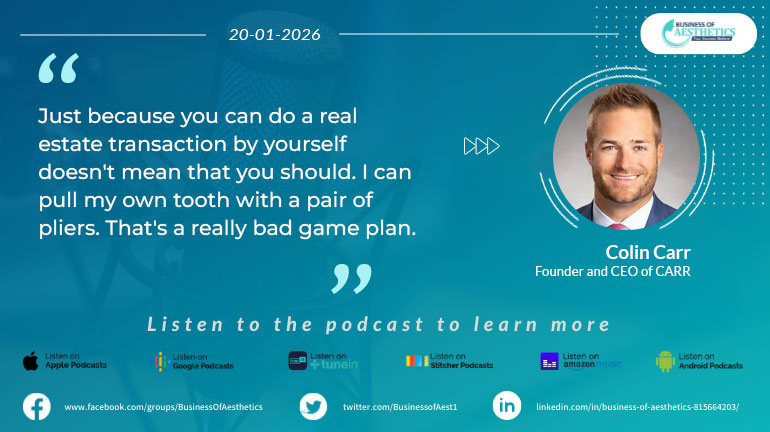
Colin Carr: Hire, hire expert representation. The same way that you’re not going to go, if you had a lawsuit filed against you, you’re not going to respond to the accusation. You’re going to have an attorney. You’re not going to do your own taxes. You’re going to have a really qualified CPA that understands tax law. Again, if you’re building a house, you’re not going to design the plans for your house. You’re going to have a great architect. It’s no different. just because you can do a real estate transaction by yourself doesn’t mean that you should. I can pull my own tooth with a pair of pliers. That’s a really bad game plan. I can try to do a lot of things. I can tell my kids to jump on my back and adjust my back. That’s not healthcare. Just because you can do something yourself doesn’t mean that you do it. If you hire a really good agent, a really good broker, They’re going to save you several times more than you could have ever saved yourself. They’re going to give you peace of mind. They’re going to save you time and energy. They’re going to give you a much stronger position in the market with landlords and sellers, and they’re going to make you much more successful. So it’s the same in everything. Hire a great marketing firm, hire a great consultant, hire a great architect, hire a great attorney, a great contractor, a great real estate broker. a great insurance company, surround yourself with the most successful people in every industry, and they’re going to make you very successful.
Don Adeesha: Wonderful. And that was a high value masterclass with Colin Carr. If you have a lease expiring in the next 24 months, if you are thinking of buying a building, I highly recommend you revisit your strategy after listening to this. Share this episode with your partners. It might be the most profitable 40 minutes you spent this year. Before we wrap up, don’t forget, Ekwa Marketing is giving our listeners a free 60-minute digital strategy session. All the info and the link to reserve your spot are in the show notes. I’m Don Adeesha, and this has been Business of Aesthetics Podcast. Thanks for listening.
GUEST – Colin Carr

Colin Carr is the founder and CEO of CARR, the nation’s leading provider of commercial real estate services dedicated exclusively to healthcare tenants and buyers. With a career spanning over a decade in high-stakes negotiations, Colin has facilitated thousands of commercial real estate transactions for medical, dental, veterinary, and optometry practices across the United States.
Colin built his firm on a singular, disruptive philosophy: ‘Tenant-Only Representation.’ Unlike traditional brokers who often represent both landlords and tenants, creating an inherent conflict of interest, Colin’s firm never represents landlords. This ‘No-Conflict’ approach ensures that the practice owner’s profitability is the only priority, allowing his team to secure lease terms, free rent periods, and Tenant Improvement (TI) allowances that generalist brokers often miss.
A frequent speaker at national healthcare conferences and a recognized educator in the industry, Colin specializes in turning real estate from a fixed overhead expense into a strategic financial asset that drives practice valuation.
HOST – Adeesha Pemananda

A seasoned marketing professional and a natural on-camera presence, Adeesha Pemananda is a skilled virtual event host and presenter. His extensive experience in brand building and project management provides a unique strategic advantage, allowing him to not only facilitate but also elevate virtual events.
Adeesha is known for his ability to captivate digital audiences, foster interaction, and ensure that the event’s core message resonates with every attendee. Whether you’re planning a global webinar, an interactive workshop, or a multi-session virtual conference, Adeesha brings the perfect blend of professionalism, energy, and technical savvy to guarantee a successful and impactful event.
Connect with Us:
Category: Business of Aesthetics Podcast