In this episode of the Business of Aesthetics Podcast, host Don Adeesha is joined by Alana Dzurek, Founder and CEO of Beverly Hills Hairfree, to challenge the limits of the industry’s gold standard: laser hair removal. They discuss the “laser ceiling” the frustration practice owners face when turning away patients with gray, white, blonde, or red hair. Alana argues that as the patient demographic ages, this untreatable segment is growing and represents a massive leak in potential revenue for clinics relying solely on lasers.
Alana introduces multi-probe galvanic electrolysis, a modernized technology that transforms the only FDA recognized method for permanent removal from a slow, tedious process into a high speed, scalable profit center. She breaks down the math, explaining how treating up to 5,700 follicles per hour allows clinics to generate significant revenue ($220/hour) with minimal consumables, effectively competing with laser room profitability while delivering the “permanent” results laser often promises but cannot legally guarantee.
A critical part of the conversation focuses on safety and ethics, specifically the rise of Paradoxical Hypertrichosis, where laser stimulates dormant follicles to grow, particularly in patients with hormonal imbalances like PCOS. Alana contends that for facial and upper arm areas, electrolysis shouldn’t just be an option, but a mandatory protocol to protect patients from worsening conditions. Finally, she advocates for a “Hybrid Protocol” using laser for bulk reduction and electrolysis to finish the final 20% or treat non candidates allowing clinics to capture the 50% of the market that laser misses and future proof their retention strategy.
Key Takeaways
- Capture the Untreatable 50% Don’t “age out” your patient base.
Integrate electrolysis to retain the nearly 50% of the population with gray, white, or red hair that laser cannot treat, effectively closing a massive leak in potential revenue. - Modernize the Revenue Model Ditch the stigma that electrolysis is slow.
Multi-probe technology treats up to 5,700 follicles per hour at roughly $220/hour, transforming the modality into a scalable, high-margin profit center with minimal overhead compared to laser. - Implement the Hybrid Protocol Stop viewing laser and electrolysis as competitors.
Leverage them as complementary tools by using laser for bulk reduction and electrolysis for the final 20% or permanent removal, creating a complete solution rather than an upsell. - Mandate Safety for Hormonal Cases
Prevent Paradoxical Hypertrichosis by making electrolysis the mandatory protocol for facial hair in high-androgen patients (such as those with PCOS), avoiding the risk of laser actually stimulating dormant follicles to grow. - Bridge the “Guarantee Gap”
Avoid patient dissatisfaction by clearly distinguishing between FDA-cleared “permanent reduction” (laser) and “permanent removal” (electrolysis). Managing this expectation upfront prevents the disappointment that occurs when laser-treated hair inevitably returns.
Podcast: Play in new window | Download
Alana highlighted that relying solely on laser leaves nearly half of your potential patient base unserved and creates a silent leak in your revenue. This session is your opportunity to build a precision roadmap that ensures you are the practice found, trusted, and chosen by this high-value demographic.

- Get a 1-on-1 diagnosis of your online presence & patient acquisition funnel
- Identify critical, untapped growth levers (SEO, Social, Referrals)
- Define a clear action plan to attract and convert your ideal patients
- Receive expert solutions for your most pressing marketing challenges
Subscribe To Our Podcast



Key Highlights:
- 00:00:12 – Introduction: The Laser Ceiling & The Untreatable Demographic
- Host Don Adeesha introduces the challenge of the "laser ceiling"—the frustration of turning away patients with gray, white, blonde, or red hair.
- The episode features Alana Dzurek, Founder and CEO of Beverly Hills Hairfree, discussing multi-probe galvanic electrolysis.
- Alana explains why permanent reduction is no longer enough and how to capture the 50% of the market that laser cannot treat.
- The episode is brought to you by Ekwa Marketing, the digital growth partner for aesthetic practices.
View TranscriptDon Adeesha: Welcome back to the Business of Aesthetics podcast. Today, we are challenging the limits of one of the most common treatments in the industry, laser hair removal. I’m your host, Don Adeesha, and it’s great to have you here. For years, laser has been the gold standard for speed and reduction. But every practice owner knows the frustration of hitting the laser ceiling. That moment you have to turn away a patient because their hair is gray, white, blonde or red. As our patient demographic ages, this untreatable segment is growing. And for many clinics, it represents a massive leak in potential revenue. To help us solve this, we are joined by Alana Dzurek. Founder and CEO of Beverly Hills Hairfree. Alana is a pioneer in multi-probe galvanic electrolysis. A technology that modernizes the only FDA recognized method for permanent removal. Today she explains why permanent reduction is no longer enough in a competitive market. We’re discussing the math behind modernizing electrolysis to be a high-speed profit center, the risks of laser-induced hair growth, and how to capture the 50% of the market that laser simply cannot touch. This episode is brought to you by Ekwa Marketing, the digital growth partner behind this podcast and a trusted source of aesthetic practices looking to dominate their local markets. So with that being said, welcome, Alana, to the Business of Aesthetics podcast. Thank you.
Alana Dzurek: Thank you so much for that wonderful introduction. I appreciate you.
Don Adeesha: Absolutely. So, Alana, the FDA specifically classifies laser as permanent reduction and electrolysis as permanent removal. For high-end practice, is there a guarantee gap where selling laser as a permanent solution actually opens you up to patient dissatisfaction?
Alana Dzurek: Yes. Definitely. Laser as a permanent solution definitely opens up the patient dissatisfaction gap. So when the laser hair removal market is sold as a permanent solution, it creates an expectation that the technology is FDA cleared for producing permanent results when in fact it is not and that the laser is only cleared for permanent reduction. which is very different. It’s a very different claim. It actually implies that the hair will return over time. So that discrepancy between the consumers, that basically leads you to believe that there’s a guarantee there that isn’t there. The consumer is smart and we are starting to see a turnaround because it’s come to the place where laser over-promised and under-delivered. So while the laser market definitely has its place, there certainly is a gap that misleads the consumer into, it’s basically sort of undermining the informed consent because when the clients are investing in a service under a false impression and it delivers something that isn’t really what the client’s looking for, definitely there is a gap for sure, a dissatisfaction gap.
Don Adeesha: Absolutely. Can you share perhaps a common scenario or story of a patient who came to you after being dissatisfied with their permanent laser results elsewhere?
Alana Dzurek: Absolutely. Yeah, we actually have several of those stories over the years. The one that really stands out in my mind is a poor person who spent over $13,000 in laser sessions and still came in with the same amount of hair that he basically started with. Very disappointing. And oftentimes what happens with the consumer when we get them after they’ve tried laser and they’ve spent all this money, they get mad at us because now they have to spend more money to get permanent results. And it’s unfortunate, but they start with laser first because the promise is that it’s a fast permanent solution, which we know now that it really is not.
- 00:05:00 – Modernizing Electrolysis: Speed, Revenue & Scalability
- Alana explains how multi-probe technology solves the historical slowness of electrolysis, allowing 2,800 to 5,700 follicles to be treated per hour.
- The math of the business model is discussed: treating more clients per hour with predictable outcomes and truly permanent results.
- The initial investment for a state-of-the-art multi-probe room is approximately $50,000.
- Training involves a hybrid model of online theory and a one-week hands-on clinic to master technique and consultation.
View TranscriptDon Adeesha: Absolutely. So historically speaking, business owners hated electrolysis because it was painfully slow. So you’ve modernized this with multiprobe technology. Can you break down the math? How does the revenue per hour of a modern electrolysis room compare to that of a laser room?
Alana Dzurek: Yeah, so the math is exactly why the multiprobe galvanic electrolysis has changed the way people look at electrolysis in general. So traditional electrolysis was often dismissed because it was one follicle at a time, which is very tedious. It’s meant for a long treatment times, low revenue per hour. And for the business owners with multiprobe technology, that limitation disappears. the average treatment per follicle for one single probe is 10 to 20 seconds, right? So this timeframe was never commercially even scalable for large areas or full body work for permanent results with 32 probes at a time. All the follicles are processing simultaneously. So because galvanic starts to react with the follicle immediately once the probe is inserted, the next probes as the technician is inserting them, the technician is always in motion. So there’s no wasted time. on average, we can treat between 2,800 and 5,700 follicles per hour. So that’s an increase of 10 to 30 times over single probe electrolysis, the traditional method. So this model is completely commercially scalable and favorable. And so for the business owner, We love this model. I love this model. I created this model. So we’re treating more clients per hour, more revenue per hour, more predictable outcomes, truly permanent results, unlike the laser. And it is truly a scalable alternative to the laser hair removal. So Multiprobe Galvanic finally allows the electrolysis operator with the speed of predictability and profitability that modern clinics need. without sacrificing the permanent results that electrolysis is known for. So we’ve basically sped up the process, increased productivity with the practitioner or the technician. And now instead of looking at body work and saying, no, there’s absolutely no way that we can treat that. It’s possible. It’s scalable. And the revenue shows that it works.
Don Adeesha: Could you give us a ballpark estimate of the initial investment required for practice to set up a state of the art multiprobe electrolysis room compared to that of perhaps a new laser?
Alana Dzurek: Yes, you’re looking at approximately $50,000 all in.
Don Adeesha: Okay. And what does that learning curve or staffing profile look like? Is this a skill, you know, a licensed institution can learn or does it require a dedicated electrologist?
Alana Dzurek: So anybody can learn electrolysis. And like I always say, there are people who shouldn’t be in any profession that they choose because they’re just either not passionate about it. They did it for reasons that they shouldn’t be practicing, correct? Anybody can learn anything. This is not rocket science. There is a learning curve. We offer training in our Dallas location that takes approximately one full week of clinic. And then it’s a hybrid program where we teach the theory online. So if you’re going to take advantage of this, you don’t even have to leave your home for three days while we’re doing the online theory. But then there is, in my opinion, no other way to really hone the technique that without having the hands-on experience of learning from somebody who knows what they’re doing and they’re able to teach you not just how to set up a clinic, because this is where I feel like most electrolysis schools fail. You spend time learning everything except what you actually need when you go and set up your practice. So we make sure that we take care of all of that. We teach them everything from positioning the patient to proper consultations because really what we’re doing is we want to know what the client’s issue is with their unwanted hair and how are we going to treat that. For example, if somebody is coming from out of town and they’re spending three days in the U.S. out of the country, you’re not going to say come in for an hour. That is the wrong approach. You want that person here for as long as they can possibly be here, because then they’re going to go back home and they might come back in two or three months to do another session. So this is how we approach it. It’s a case by case. Our consultations are very thorough. We do also offer pain management, which a lot of other clinics don’t offer. We partner with medical professionals, anesthesiologists, and clinics who can provide the kind of pain management that every client needs, whether it’s a topical or it’s an injectable. Those are the kinds of things that we really focus on because in order to get real permanent hair removal, You have to know what the client’s limitations are. So that’s one of the other things we teach when you go through the program. Speaking of which, this is ideal for laser clinics because they already have practitioners who can offer injectables. So this would be another revenue stream for them. We charge the clinics charge and we charge for injectables. And for topicals, this is all another revenue source and revenue stream. So when they’re looking at this as a business, it is so it’s so incredible how much revenue you can pull out of this. But it’s not just about the money. You’re actually giving the client permanent hair removal. And that’s what really matters.
- 00:11:29 – Paradoxical Hypertrichosis & Safety Protocols
- Discussion on "Paradoxical Hypertrichosis," where laser stimulates more hair growth, particularly in patients with hormonal imbalances like PCOS.
- Alana argues electrolysis is a mandatory protocol for facial and upper arm hair to prevent making a patient’s condition worse.
- The biological mechanism involves laser stimulating dormant follicles and stem cells.
- Protocols for treating laser-induced growth include a waiting period of at least six months if the hair is "detached" and not connected to the follicle.
- Alana highlights an education gap regarding laser approvals and findings.
View TranscriptDon Adeesha: That’s what really matters. Yes. Absolutely. So Alana, we are also seeing a rise in paradoxical hypertrichosis. Where a laser actually stimulates more hair growth, is it?
Alana Dzurek: Yes. So this is a phenomenon that we have discovered in only the last like 10 years or so, where what happens is clients, and this is what I’ve experienced, clients that suffer from hormonal imbalances, They have what’s called an overproduction of androgen hormones, which is the hormone responsible for growing hair. We know that the laser gets absorbed into our skin and our blood supply. And so what happens with these clients that have already a high androgen count, it will stimulate more production of that specific hormone. And so I’ve seen women with polycystic ovarian syndrome, PCOS, go to get laser and the technician doesn’t ask these questions or maybe overlooks them or they don’t know. And then the poor girl is left with more hair than she started with. And that’s what the phenomenon is. And it’s unfortunate. I’ve seen it mainly on the face, but I have also seen it on the upper arms, which is so unfortunate.
Don Adeesha: Yeah. So is electrolysis no longer just an option, but a mandatory protocol for facial or, you know, as well as upper arm hair to protect the practice from making a patient’s condition worse?
Alana Dzurek: I would definitely agree with that. I think that it is very unfortunate that this phenomenon happened. I’m sure that the laser companies were not aware of this. I think there is a lot of education happening right now because it’s not just one client. It’s been a phenomenon and that’s why they call it that. I think the only solution and the only option for anybody who suffers from any kind of hormonal imbalance is electrolysis. Risking laser would mean you’re taking the chance on whether it’s going to cause more hair growth or even eliminate any of your hair. We’ve had that happen as well. People with hormonal imbalances have gone to laser and it did nothing.
Don Adeesha: Okay, how can we find out if, you know, a patient qualifies or, you know, a client qualifies for this treatment during the consultation and before starting laser, perhaps?
Alana Dzurek: So I’m not a laser technician, but… So unfortunately, I don’t know what their protocol is. And I know that there are so many lasers on the market today. And that’s one of the other things is how do you even navigate with all of these new lasers coming out and everybody promising that this laser won’t cause the, you know, the hypertrichosis but paradoxical hypertrichosis but then others say yes absolutely it will it’s very difficult to navigate that landscape and so I always say that the consumer needs to be very cautious when they go and do something that hasn’t really been tested scientifically the way electrolysis has. And just so I can be clear with spa owners, electrolysis has been around since 1875. It has been scientifically proven, tested, i mean if you look at the results there it’s factual it is proven and time tested there is no way that this is going to produce something that it hasn’t already done in the last 150 years so people can take a breath and be certain that if you’re going to get multi-probe galvanic electrolysis done, and I speak of that because that’s what I practice, you’re going to get 100% result. It is going to be permanent, and you only need to spend 18 to 24 months doing the treatments.
Don Adeesha: Okay. And what is the protocol for a patient who has already developed paradoxical hypertrichosis and, you know, that condition? And do you have to wait for the stimulated hair to cycle out or can you treat it immediately with electrolysis?
Alana Dzurek: So unfortunately, there is no way to cycle the hair out. Once the hair is there, it is there. And when you have stimulated growth, what happens is that hair follicle was dormant until the laser actually stimulated a dormant follicle to grow a hair. And that’s what that means. So in scientific terms, and I’m not a doctor, but I’ve been doing electrolysis for 30 years. If you think about a hair transplant where they remove the hair and it’s encased in that sheath and those cells are in there, it’s that, you know, gooey kind of thing. That’s exactly what’s happening within that encasement are the stem cells that we as electrologists are destroying to render that follicle dormant. It will never grow again. So what the laser is doing in turn is it’s stimulating those cells and it’s growing a hair. So there’s no way to cycle the hair out. You actually have to do electrolysis to remove it. And yes, they can do it. Well, let me back up. They can treat it right away. But we’ve also noticed a different phenomenon when somebody goes through laser treatments, and then they come to us and let’s say their last treatment happened a month or two or even three months ago, the hair for some reason, is not even connected to anything. So we’ll start a treatment, but before we go into the follicle, we’ll test the hair and it just comes right out. It’s not even reconnected to the follicle. So in the last five or six years, we’ve been getting a lot of laser patients telling them, if you have had treatment within the last six months, you have to wait. We want you to wait at least six months. So if it’s been a month or two or three, we really want you to wait because we want to make sure that whatever that detachment was, that it’s back and attached so we can treat the follicle and get rid of all the stem cells.
Don Adeesha: wow okay that’s very interesting and do you see there being a education gap for the patients the consumers side of things you know they’re going in for laser for reduction but as i’m understanding it you’re almost stimulating the growth in itself right which lasers are predominantly known and used for so is there educational gap here
Alana Dzurek: I think there is. I don’t blame anybody necessarily for this because I think just like anything else on the market, when you try something new and you have so many nuances, right? Like we have so many people with hormonal issues today, things that they didn’t predict when they discovered that the laser can actually reduce hair. And now they’re finding all of these things. And so that brings me to an important point. So my company is in the process of developing our own technology for multi-probe. I can’t say exactly when that’s gonna come out, but we’ve been working on it for quite some time. In that process and trying to figure out what the patents are and how laser was approved, we learned that laser, and I know people are not gonna like me for saying this, was never really approved. They were given the green light and the go ahead to go out there and then report back their findings. Now, this was years ago when we pulled certain patents on certain lasers. Have they come out with new lasers and new approvals? I can’t speak to that. But to answer your question, there absolutely is an education gap because when they were cleared 30 years ago to go and do this, the clearance was go out, give us back what you find, which is typically the case when you’re trying anything new on the market. And then they discover… It’s just like a drug. You put a drug on the market and then you find that it doesn’t work for certain people and it causes certain things. So then you have to. walk it back. So absolutely, there is a gap, whether it’s educational, or just simply something that they missed, and they should have caught, I don’t know. But there are a lot of different aspects to lasers. And like I said, there’s so many that have flooded the market, I can’t keep up with them. And I don’t know if every single one of those lasers causes the paradoxical hypertrichosis or not.
- 00:20:30 – Ekwa Marketing Sponsor Break
- Ekwa Marketing offers a complimentary one-on-one marketing strategy meeting to audit visibility for high-value searches like "Botox near me" or "Hair removal near me".
- Listeners can reserve their spot at www.businessofaesthetics.org/msm.
View TranscriptDon Adeesha: Okay, got it. So before we continue, a quick message from our sponsor, Ekwa Marketing. To all our listeners, Ekwa Marketing has a gift for you, a complimentary one-on-one marketing strategy meeting. They’ll answer one question that really matters. When someone in your city searches for Botox near me, Morpheus 8 costs, cool sculpting near me, or even hair removal near me, Are you the practice that’s found trusted and chosen? Get yourself a live audit and a treatment level plan to drive qualified consults fast. You can check availability and reserve your spot in under two minutes at www.businessofaesthetics.org/msm. Grab your time now and make sure you show up when patients search the treatments you offer. Now, back to our discussion, Alana.
- 00:21:35 – The "Aging Out" Problem & Retention
- Clinics that rely solely on laser risk "aging out" their patient base, as nearly 50% of the population becomes ineligible due to gray, white, or red hair.
- Alana discusses the retention problem in laser clinics and the need to offer solutions for those who are not laser candidates to maintain revenue.
- Laser still has a place for temporary hair-free periods (e.g., vacations) or bulk reduction, but not as the sole solution.
View TranscriptDon Adeesha: So in your educational materials, you state that nearly 50% of the population eventually becomes ineligible for laser due to gray, white, or even red hair. If that data holds true, are clinics effectively aging out their own patient base?
Alana Dzurek: I think they are. Um, I do, uh, I think that there is a long-term revenue retention problem with laser clinics because they have to uh implement additional services in order to supplement that 50 loss with clients that are middle-aged uh men and women who have you know combination salt and pepper hair menopausal women that are absolutely gray um even redheads which are not even part of the 50 um Laser can’t treat red hair either or blondes. So I think it’s more than just aging people out. I think there’s a larger than 50% population that laser cannot capture because of the limitations of the laser. And how do they recapture that revenue as clients get older? Well, I think they have to go back to the drawing board and I think they have to reevaluate, you know, maybe it’s time for some hybrid laser electrolysis packages. And this is kind of what we’ve been saying because we’re picking up all of their clients that are no longer able to get laser treatments. Anybody who has gray hair is not a laser candidate. So they’re leaving all of those people out of their treatment plan. I think that laser clinics have to reevaluate where the retention is. And we all know this because it’s been there’s been a lot of growth in laser clinics and med spas in general. I mean, you can’t walk five feet without tripping over one. Right. We know that. I think to their own detriment, it was great when everything like that was exploding and people were going everywhere and learning how to do Botox. And then those injectors said, well, I can do this on my own. I don’t need to work for a med spa. And so I think… The turnover happens naturally anyway. It happens in my industry too, where I’ve taught several people and then they just open up their own clinics and that’s fine. But what about retaining the revenue? For example, we don’t implement anything in our clinic other than multi-probe galvanic electrolysis. And I teach technicians, you know, my training system. I do know that laser clinics are right now selling everything from laser hair removal to Botox to all kinds of things because they know that they can’t retain those clients that are not clients and the ones that get smart and understand that laser isn’t permanent, they’re also losing those clients. So I think laser clinics and the people that have bought into the laser clinics I call it a myth. They need to reevaluate how they’re promoting their services. I do. I was going to say, don’t get me wrong. I think laser has its place. So I don’t think people should throw away their laser devices and close up their shops. I don’t. I think that if you’re going on vacation, and you wanna be completely hair-free for a small amount of time or a shorter window, I think it’s a great alternative. Go in and laser, head to toe, go on your vacation, enjoy your hair free time. But just know when you get back, your hair is going to start to grow. I think it’s a great option. And we’ve had this happen for, you know, anyone who’s transitioning or transgender, and they don’t have the finances or the time to commit to a permanent hair removal method. And they just literally can’t stand to see body hair. Perfect solution. Go and get your laser treatments done. There is a place for it. Like, for example, if you’re, you know, a hairy person and you want some reduction, absolutely start there. But then know that you have to finish up with electrolysis, something permanent. So, yes, I do think that there is absolutely a place for laser. I don’t think you should get rid of it. I don’t.
- 00:26:43 – Lifetime Value & Consumables
- Electrolysis offers high lifetime value; charging per hour ($220/hr) with 18-24 sessions yields significant profitability.
- Consumables for electrolysis are minimal (probes, aftercare, pain management) compared to the high consumable costs of laser clinics.
- Injectables for pain management provide an additional revenue stream.
View TranscriptDon Adeesha: Absolutely. So can you talk about the lifetime value of an electrolysis patient?
Alana Dzurek: Yeah. So it’s a very interesting laser charges for packages. So it goes very quickly. The patient’s in and out and they charge package wise. So we charge per hour. So it’s irrelevant how small the area is or how big the area is. We try to clear up whatever hair is there. So our hourly rate is $220 per hour. When you’re talking about somebody who requires, let’s say, 18 to 24 sessions, you do the math. It’s incredibly profitable, but it’s also incredibly rewarding because it’s a win-win. The client ends up with permanent results. The owner of the clinic ends up with a great revenue stream. And in addition to, like we talked about, injectables for pain management, there are consumables, but the laser clinics and spas, med spas, they have to pay for all of the consumables that they’re going to sell or pass on to the client. Where for electrologists or electrolysis clinics, we have very minimal consumables you have the after treatment care and then you have your pain management options that you know you charge for and the probes because each probe we charge for either a set of 32 or if they want new ones each time they come in you can charge for that as well so the overhead if you compare electrolysis with laser we have minimal overhead And our technicians either work on an hourly rate or a salary rate or they’re independent contractors. And each spa owner and each laser clinic can make that determination.
- 00:28:51 – The Hybrid Protocol
- The ideal protocol is not an "upsell" but a hybrid approach from the start: use laser for bulk reduction or temporary needs, and electrolysis for permanent results.
- Treatment plans should be individualized; those with hormonal imbalances skip laser entirely, while others may mix modalities.
- Packaging these services together preserves revenue and builds brand loyalty.
View TranscriptDon Adeesha: So Alana, since you aren’t suggesting clinics throw away their lasers, what is the ideal hybrid protocol? Do you recommend starting with laser for perhaps, you know, immediate and even bulk reduction and then switching to electrolysis for the final 20 or permanent solution? And how do you price that transition so the patient doesn’t feel upsold?
Alana Dzurek: Yeah, that’s a great question. So I looked into this for a long period of time now. I think that people have very myopic views of how this can happen. And so it’s not a first start with laser and end with electrolysis. It’s more about the individual person, right? So laser operates, I find, as a one size fits all approach. And that never works because each one of us has individual needs and some of us have the money to spend and we want to do everything right. Some of us, we want to piecemeal things, some of us aren’t laser candidates, some of us We’ll want to start with laser. And then when we get to our end goal, we want a final permanent result and a solution. So I think that’s a much better way to approach it. But what is the hybrid method look like? And the client not feeling up. So I think that’s a very easy solution. I think when you offer laser. first primarily and then electrolysis as the final solution i think people react uh maybe as they’re being upsold because wait a minute you first said laser and now it’s not working so now you want me to do electrolysis I think rather than offering that option, it should be presented as a hybrid from the get-go. In other words, we will start you with laser to take the bulk down and then you would have to finish up with electrolysis because this is the permanent way to go. I think if you approach it that way, and again, The packaging, if it’s the right packaging and the right solution, and believe me, there is a solution for every client. After 30 years of doing this, there is the right solution for every client. Not all of us are the same. And like we were talking about, you know, anybody who has a hormonal imbalance, that laser goes right out the window because we’re not going to take a chance on a client who could possibly end up with paradoxical hypertrichosis. So for that particular individual, you definitely wouldn’t recommend the laser. You would go straight to multiprobe galvanic. right you have somebody who wants to go to the beach and wants to be hair free for three weeks and they’re traveling you know the world definitely suggest the laser and then if they wanted to come back and continue treatment and there are ways to blend that together as well if somebody wants permanent hair removal under their armpits i would start them with electrolysis if they want to do a hybrid and you know they want their back to be completely hair-free, I would definitely start with the laser and then end up with the electrolysis. So there are definitely packages that are hybrid from the get-go. So the patient doesn’t feel like you’re upselling them or you just want them there for the money. I think by packaging that and thinking about long-term, I think the clinics can preserve their revenue while also building their brand loyalty. I think consumers are very smart. I think they’re so smart. They don’t get enough credit.
- 00:32:53 – Key Takeaways & Conclusion
- The key takeaway is to stop viewing laser and electrolysis as competitors; they are complementary technologies.
- Closing the revenue loop involves future-proofing the practice against an aging patient base by offering both solutions.
- A final reminder for the Ekwa Marketing strategy session available in the show notes at www.businessofaesthetics.org/msm.
View TranscriptDon Adeesha: Wonderful. Absolutely. And Alana, we have just about reached the end of the podcast. I would like to get one key takeaway for our listeners, practice owners, perhaps listeners, What is the one key takeaway from this conversation if our listeners can only take one?
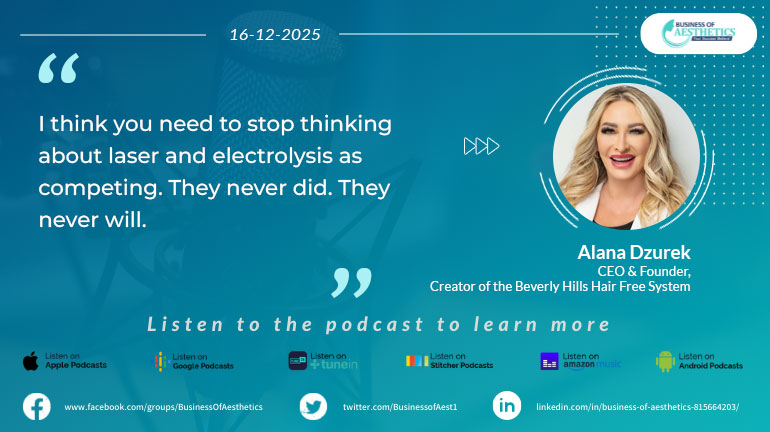
Alana Dzurek: I would say to business owners, spa owners and med spa owners and laser clinics, I think you need to stop thinking about laser and electrolysis as competing. They never did. They never will. I think complementary technologies or complementary technologies hair removal methods are the way we should be thinking about this. And I honestly believe that if two options were offered to the client, and proposed to them, the way we talked about there would be it’s a no brainer, there would be every client in the universe saying, I’d like to try one and finish with the other or Yes, that makes sense. I’m a blonde. I’m not a laser candidate, you know, or I have a hormonal imbalance. So I know that I can’t try the laser or I absolutely want to try the laser and then finish off with electrolysis. So I think that they complement each other. And that’s what I would urge every business owner to reconsider. In addition to the amazing revenue stream that they’re completely overlooking and bypassing.
Don Adeesha: Absolutely. So thank you very much, Alana Dzurek, for that fascinating look at the laser ceiling. And it highlights a massive opportunity gap in the market. If your practice relies solely on laser, you are effectively telling a huge demographic that you can’t help them. Alana’s approach to modernizing electrolysis isn’t just about clinical results. It’s about closing that revenue loop and future-proofing your practice against an aging patient base. If this conversation sparked a new idea for your service menu, share this episode with your clinical director or business partner. And as always, make sure you are following the Business of Aesthetics podcast so you never miss a conversation that drives the industry forward. Before we sign off, a quick reminder that growth is on your radar for 2026. Ekwa Marketing’s complimentary 60-minute digital strategy session is waiting for you in the show notes of this episode. With that being said, I’m Don Adeesha and this has been the Business of Aesthetics podcast. Thanks for listening and here’s to capturing every opportunity in your market.
GUEST – Alana Dzurek

With over 27 years of experience, Alana Dzurek is the Founder and CEO of Beverly Hills Hair Free, the globally recognized authority in permanent hair removal. A pioneer in the field of Multi-Probe Galvanic Electrolysis, Alana has revolutionized the industry by modernizing a 150-year-old modality into a high-speed, scalable business solution.
She is the creator of the proprietary EPX16 technology, which utilizes up to 32 probes simultaneously to deliver results 30x faster than traditional electrolysis methods. Unlike laser, which is limited by hair color, Alana’s protocol offers the only FDA-recognized ‘Permanent Removal’ for all hair types, closing the critical revenue gap for patients with gray, white, red, or hormonal hair that laser clinics are forced to turn away.
In addition to running her flagship locations in Beverly Hills and Dallas, Alana is the CEO of ElectrologyTech, where she focuses on equipping the next generation of aesthetic practices with the tools to treat the ‘untreatable’ patient and solve complex cases like Paradoxical Hypertrichosis.
HOST – Adeesha Pemananda

A seasoned marketing professional and a natural on-camera presence, Adeesha Pemananda is a skilled virtual event host and presenter. His extensive experience in brand building and project management provides a unique strategic advantage, allowing him to not only facilitate but also elevate virtual events.
Adeesha is known for his ability to captivate digital audiences, foster interaction, and ensure that the event’s core message resonates with every attendee. Whether you’re planning a global webinar, an interactive workshop, or a multi-session virtual conference, Adeesha brings the perfect blend of professionalism, energy, and technical savvy to guarantee a successful and impactful event.
Resources


Connect with Us:
Category: Business of Aesthetics Podcast