In this episode of the Business of Aesthetics Podcast, host Don Adeesha is joined by Rebecca Landriault, CEO of Apex Aesthetic Consulting, to tackle the reality of operating in a hyper-competitive, high-density market. As the industry shifts away from a “growth at all costs” mindset, Rebecca argues that 2026 will be defined by operational discipline and capital efficiency. She challenges owners to pivot from an “acquisition obsession” to a mastery of retention, warning that in a saturated landscape, differentiation comes not from the newest device, but from comprehensive, lifetime treatment planning.
A major focus is identifying the “silent capacity killers” that cause revenue plateaus. Rebecca reveals that the bottleneck is rarely marketing, but often lies in underutilized providers and an untrained front desk unable to credential services. She provides a strict financial framework for staffing, advising that no new revenue-generating hires should be made until existing providers are generating 5x their payroll and are booked 80% of the time. Furthermore, she dissects the “napkin math” of capital equipment sales, urging owners to calculate true ROI based on existing patient volume rather than hypothetical growth before signing any lease.
From a strategic perspective, Rebecca redefines the concept of scaling, asserting that “growth is not expansion, it is a duplication of excellence”. She cautions against the financial collapse often caused by premature scaling, advising that a practice must achieve a 25% net profit margin and hold six months of cash reserves before considering a second location. Finally, she offers a compelling analogy for membership models, positioning the provider as the “dentist” and the membership as the “toothbrush,” to ensure patients protect their investment in high-ticket regenerative procedures through consistent maintenance.
Key Takeaways
- Replace acquisition obsession with retention mastery
Stop chasing new patients and start prioritizing lifetime treatment planning. Convert one-off transactions into comprehensive treatment systems for your most profitable loyal clients, focusing on outcomes rather than a service menu. - Audit for silent capacity killers before spending on marketing
Fix internal revenue leaks like underutilized staff or untrained front desks first. Ensure every revenue-generating employee produces at least 5x their payroll and maintains 80% booking capacity before you even consider hiring additional staff. - Apply a strict financial stress test to new equipment
Ignore sales hype and calculate ROI based solely on your existing patient volume. Never purchase a device unless it fills a specific gap in your current menu and you have independently verified that your staff can legally and profitably operate it. - Structure memberships as maintenance, not discounts
Avoid discounting tight-margin items like toxins. Instead, use the “dentist and toothbrush” analogy where memberships provide the necessary maintenance to protect the patient’s investment in their high-ticket regenerative procedures. - Scale only by duplicating excellence
Never expand until your current location is operationally airtight with a 25% net profit margin and six months of cash reserves. Opening a second location without a strong foundation is like building a second floor on a house with no walls.
Podcast: Play in new window | Download
Rebecca emphasized that sustainable growth comes from securing high-value, loyal patients rather than simply chasing volume. This session is your opportunity to build a precision roadmap that aligns your patient acquisition strategy with the operational excellence you are building.

- Get a 1-on-1 diagnosis of your online presence & patient acquisition funnel
- Identify critical, untapped growth levers (SEO, Social, Referrals)
- Define a clear action plan to attract and convert your ideal patients
- Receive expert solutions for your most pressing marketing challenges
Subscribe To Our Podcast



Key Highlights:
- 00:00:11 – Introduction & The Shift to Operational Discipline
- The episode addresses the strategic evolution required to maintain profitability in a maturing, high-density aesthetic market.
- Host Don Adeesha introduces the guest, Rebecca Landriault, CEO of Apex Aesthetic Consulting, who specializes in guiding practice owners through scaling operations and refining team dynamics.
- The discussion centers on replacing the "growth at all costs" mindset with operational discipline and capital efficiency for 2026.
- The episode’s sponsor, Ekwa Marketing, offers a complimentary 60-minute digital strategy session to map a high-value patient acquisition roadmap.
View TranscriptAdeesha: Welcome back to the Business of Aesthetics podcast. Today, we are discussing the strategic evolution required to maintain profitability in a maturing, high-density market. I’m your host, Don Adeesha, and it’s great to have you here. As the aesthetic industry continues to expand, we are seeing a fundamental shift in how successful practices operate. In a landscape where patient options are abundant and competition is fierce, the growth at all costs mindset is being replaced by a focus on operational discipline and capital efficiency. 2026 isn’t just about acquiring more, it’s about optimizing what you have to protect your margins. To help us navigate this transition, we are joined by Rebecca Landriault, CEO of Apex Aesthetic Consulting. Rebecca is a highly respected strategist who acts as a Sherpa for practice owners, guiding them through the complexities of scaling operations, refining team dynamics, and building infrastructure that lasts. Today she is sharing her methodology on navigating a saturated market. We are discussing how to audit your practice for silent capacity leaks, the financial frameworks for evaluating expensive capital equipment, and the specific metrics that indicate a business is truly stable enough to scale.
So before we jump in, a quick thank you to our sponsor, Ekwa Marketing, the team behind this podcast and one of the most trusted names in digital growth for aesthetic practices. They’re offering our listeners a complimentary 60-minute digital strategy session, a one-on-one consultation with a senior strategist to help you map your 12-month high-value patient acquisition roadmap. You’ll get a personal diagnosis of your online presence and patient funnel, uncovering untapped growth levers across SEO, socials, and referrals. You will be walking away with a clear, actionable plan tailored just for your practice. It’s designed to give you clarity and direction from people who work with the aesthetic leaders every day. You can check availability and reserve your spot in under two minutes at www.businessofaesthetics.org/msm. That’s businessofaesthetics, one word, dot org forward slash msm. With that being said, Rebecca, welcome to the Business of Aesthetics podcast.
Rebecca Landriault: Thank you so much for having me back. I look forward to chatting with you tonight.
Adeesha: Absolutely. Let’s dive right in. So the market has shifted from demand-driven growth to a hyper-competitive environment. For an established practice, what is the single most critical strategic pivot required in 2026 to protect market share against the surge of new competitors?
- 00:03:17 – The Pivot: From Acquisition Obsession to Retention & Lifetime Planning
- The influx of new med spas and independent providers has saturated the market, making "new" patient acquisition more difficult and expensive.
- The critical strategic pivot is focusing on service differentiation and operational maturity.
- Differentiation is defined not by having the newest device, but by comprehensive consultations and lifetime treatment planning.
- Practices must shift from "acquisition obsession" to becoming obsessed with retention, treating patients holistically rather than as one-off transactions.
View TranscriptRebecca Landriault: Yeah, it’s really interesting, the shift that we’ve seen over the course of 2025. I mean, I think we’ve had some explosive growth in the industry post-COVID, especially with a lot of bedside providers looking to kind of leave traditional medicine after the COVID pandemic and looking at aesthetic medicine and cash-based medicine as a kind of way out of that burnout. And so because of that, we really have seen just an explosive amount of med spas opening in the last three years, and especially in 2025. I think a lot of that is some states are allowing more mid-level providers to have independent practice authority. And so we just have a larger number of providers that are able to go out on their own and begin these aesthetic practices.
So for my established practices, the ones who come to me and say, "What do I do now? When I opened my business, I was the only one in my town. Now there’s five on the same street as me. How do I compete?" The critical pivot to me is really service differentiation and operational maturity. And those are two very different things, but I think that they work very well together. And what I mean by service differentiation is not traditionally what we would say as being the person who’s the first to market with a new device, the first person to be doing the most recent treatment that is TikTok trending. That is not at all what I mean. I actually strongly advise against those types of behaviors driving your service menu. What I mean by differentiation is comprehensive consultations, lifetime treatment planning, and really working on becoming obsessed with your retention.
So I think the critical pivot is instead of asking yourself and being what I call "acquisition obsession"—how do I get more clients? how do I get more clients?—to instead look at your retention. Because new patients are expensive to acquire and your loyal patients are your most profitable. So for me, we stop acting like we have service menus and we have to start acting as if we have treatment systems with defined outcomes and continuity of treatment from one patient visit to the next. We want the patients that are coming in and sitting down and having a conversation with you about the overall look they are trying to achieve. They should be saying, "I’m looking for a lifetime plan where I can get to my aesthetic goals and I want to do them all with you."
- 00:11:42 – Silent Capacity Killers: Staff Utilization & Front Desk Leaks
- Revenue plateaus are rarely marketing problems; they are often caused by "cracks in the foundation" or silent capacity killers.
- A major leak is a lack of clinical confidence in "selling" comprehensive plans and complication management.
- Provider utilization is key: An injector should generate 5x their payroll and be booked 80% of the time before hiring additional staff.
- The number one bottleneck is often the front desk—staff unable to credential services, answer questions, or convert calls into consultations.
View TranscriptAdeesha: So when a mature practice hits a revenue plateau, right, it’s rarely a marketing problem. If you audit a clinic today, what specific internal system, be it utilization rates or intake workflow, do you usually identify as the silent capacity killer?
Rebecca Landriault: Yes. So this is probably the thing that I get most passionate about. Almost always people reach out to me because they are looking for new client acquisition or they’re concerned about their marketing. And I tell everyone… I won’t discuss marketing with you. Not for a very long time, because there is almost always a leak or like I like to call it a "crack in the foundation." The first is, of course, that clinical confidence of your providers. It’s not just clinically confident in the outcome. It’s clinically confident in complication management. It’s clinically confident in selling the procedure that you believe is going to give the patient the best outcome. If we’re not clinically confident, we’re not going to educate the patient for what else is good for them besides what they’re coming in for.
The other thing I see is… we’re often not looking at whether or not our employees are profitable. So that’s probably the number one revenue leak that I see. When I go in and run reports, I often find that many providers are probably only booked 50% of the time. The hill that I die on when it comes to adding employees is that your existing employees need to be making a gross revenue number of 5x their payroll at the very minimum and need to be booked 80% of the time for six weeks or more on a six-week rotation. Only then should we discuss if it’s the right time to bring on another employee.
And then of course, my absolute number one thing… it is almost always the front desk. If somebody calls and says, "I saw on your website that you offer health optimization services. What does that mean?" And your front desk person says, "You know, I don’t really know much about that, but I’d like to book you with our provider," we start to lose our credibility. At the very minimum, your front desk staff needs to know how to credential the procedures that you’re doing. They should be able to credential the service, credential the provider, discuss why a consultation is so important and close that call converted to a consultation.
- 00:28:13 – Capital Equipment: The Financial Stress Test
- Do not purchase a device just because a rep suggests it; ensure it fills a gap in your existing service menu.
- Verify scope of practice independently: Can you legally delegate this device in your state?
- Calculate true ROI: Monthly payment divided by average revenue equals the minimum treatments needed to break even.
- Consider the "Total Cost of Ownership," including consumables, maintenance plans (which can cost as much as a car), and insurance increases.
View TranscriptAdeesha: Now let’s get into another very interesting topic regarding expensive capital equipment. Before an owner signs a lease for a new device, what specific financial stress test or formula do you use to prove the ROI is real and not just sales hype?
Rebecca Landriault: So I love this question. I have been on the side of being a managing partner of a practice… and then I sold lasers as a capital equipment rep for three different laser companies over the course of 10 years. So I have seen the good, the bad and the very, very ugly. First things first, I would never ever purchase a device that someone else told me was the right fit for my practice. If you were a cardiologist and a rep came in and said, "You need this new device to scan the heart," but you already had a device that adequately scanned the heart, would you immediately sign a personal loan for a $350,000 device? I find this happens all too often in aesthetic medicine.
My first thing is before you even consider a device, does it fill a gap in your existing service menu? If whatever they’re selling you, you already have a solution for, we’re cannibalizing utilization. The other thing is… you need to do your own due diligence every time on whether you are able to properly run that device from a compliance standpoint in your practice, in your state. States vary wildly about who can fire certain devices.
And then my last question… Reps like to do a lot of napkin math. "You only need to see five patients a month." But if in your existing patient mix today, do you have five people a month who are going to buy this $3,000 treatment? If the answer is not yes, 100% every time, the answer is no. You really have to understand that it’s your monthly payment divided by your average revenue is the minimum number of treatments that you need to break even. But that’s the bare bones. You have to understand the overall cost of ownership. If you’re telling me that I have to use an entire bottle of ultrasound gel on every treatment… never mind the replacement hand pieces, the cost of the maintenance plans year over year. So the overall cost is so much higher than the numbers that they’re giving you.
- 00:42:09 – Regenerative Medicine & Membership Models
- Regenerative medicine has a longer timeline for results; keeping patients engaged requires a holistic "inside out" approach.
- Use the "Dentist and Toothbrush" analogy: The provider does the deep cleaning (regenerative treatment), the esthetician is the toothbrush (maintenance).
- Memberships should be structured to support the investment—avoid discounting low-margin items like toxins.
- Instead, memberships should offer complementary treatments (e.g., facials, laser packages) that protect the patient’s investment in higher-ticket procedures.
View TranscriptAdeesha: Let’s get a little bit brief into perhaps one particular side, a very growing side of treatment planning, right? Especially around regenerative medicine. Regen medicine has a longer results timeline than fillers. So how should a practice structure its pricing and membership models to ensure cash flow remains consistent during the three to six month period while the patient waits for results?
Rebecca Landriault: So if you are doing the comprehensive treatment planning… you are talking to the patient about reaching their aesthetic goal from the inside out. When you do that and you have treatments where there’s longer time, if they are bought into that lifetime treatment plan, that’s not the only thing that they’re doing. We have also advised that client, if they’re going to do things like regenerative medicine, the only way to sustain those results is to come in on a semi-regular basis and see our esthetician for maintenance treatments in between. For me when I was in practice, I used to tell people: I’m the dentist, they are your toothbrush. You come to me, you’re getting your deep cleaning. If you don’t brush your teeth in between, you’re not protecting your investment.
So we’re building up that coming in with some regularity by doing that lifetime treatment planning. But when we structure our pricing and we do things like memberships… it doesn’t hurt you to give a perk to that membership once someone has purchased a really big comprehensive treatment plan. But I’ve also seen a lot of practices where their memberships are a revenue leak. I see in most cases, somebody has a monthly fee and then that monthly fee gives you a discount on toxin filler. That wouldn’t be my advice. Those are treatments where our margins are extremely tight. I really like if you are heavy in one department… then our membership should be for a treatment that is going to be complementary. Maybe that is monthly aesthetic treatments to complement your injectables. Maybe it’s a discount on laser packages.
- 00:50:58 – Scaling: The Duplication of Excellence
- Premature scaling is the number one reason for financial collapse in aesthetic practices.
- Financial metrics for scaling: Existing business should have a 25% net profit margin and 6 months of cash reserves.
- Operational metrics: Every provider should be at 80% utilization and clinically confident in every treatment offered.
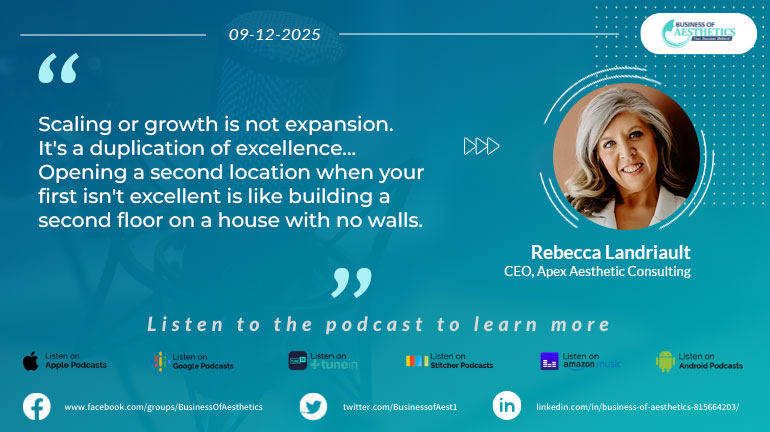
- Key Takeaway: "Scaling or growth is not expansion. It’s a duplication of excellence." Opening a second location without a strong foundation is like building a second floor on a house with no walls.
View TranscriptAdeesha: I cannot express enough that people have said to me, I think I’m ready for another location and don’t have the ability to print reports. And to me, that’s just… premature scaling is the number one reason for financial collapse.
Rebecca Landriault: Absolutely. When you talk about wanting to then go from one location to the next, your existing business should have a net profit margin of 25% or higher. That’s the bare minimum for me. And then at the very minimum… six months of cash reserves. But even if you could answer all of those financial metrics with two thumbs up, I still would not ever open a second location or attempt to scale in any way unless you can tell me every provider is clinically confident in every treatment that you currently offer 100% all of the time. Your front desk is dialed in, can convert a call to a consultation, can check in and check out patients with excellent workflows. If all of those things are not dialed in, today is not that day.
Adeesha: Rebecca, you’ve really done a wonderful job here providing everyone listening about what it will take to look at the operational reality of running an aesthetic practice in 2026. As we wrap up the podcast, I would love to give you a small moment to share one key takeaway for our audience members. If they could only take just one, what would it be?
Rebecca Landriault: I think my favorite phrase is: Scaling or growth is not expansion. It’s a duplication of excellence. So if what you have today isn’t excellent, then we can’t duplicate. So I think the best way to describe it is opening a second location when your first isn’t excellent is like building a second floor on a house with no walls. That to me, you have to be airtight in your existing practice… or else it’s expansion without intention.
Adeesha: With that being said, thank you, Rebecca, for joining us on the Business of Aesthetics podcast.
Rebecca Landriault: Thank you for having me again. I appreciate it.
Adeesha: So with that being said, thank you, Rebecca. And if today’s discussion gave our listeners a new perspective on your P&L or your expansion strategy, share this episode with a colleague or practice partner who needs to hear it. And before we wrap up, a quick reminder, Ekwa Marketing is offering a complimentary 60-minute digital strategy session to help you map your 12-month high-value patient acquisition roadmap. You can always find it at www.businessofaesthetics.org/msm. You can check the availability and reserve your spot in under two minutes. I’m Don Adeesha and this has been the Business of Aesthetics podcast. Thank you for listening in and here’s to building a stronger, more profitable practice in the year ahead.
GUEST – Rebecca Landriault

With nearly 20 years of experience in the aesthetic medicine industry, Rebecca Landriault is a recognized strategist and the CEO of Apex Aesthetic Consulting. She positions herself as a ‘Sherpa’ for practice owners, guiding them through the complex climb of scaling a business, from operational chaos to peak profitability.
Rebecca combines a deep background in Laser Physics and Biochemistry (holding a BS from Purdue University) with a Master’s in Medical Aesthetics, giving her a unique ability to bridge the gap between clinical excellence and business strategy.
Specializing in Medical Device ROI, Practice Operations, and Sales Training, Rebecca’s primary mission is to help practices eliminate profit leaks and build sustainable operating procedures. A vocal advocate for transparency in the industry, she acts as a trusted advisor for owners navigating the challenges of capital equipment purchasing and team dynamics in a saturated market.
HOST – Adeesha Pemananda
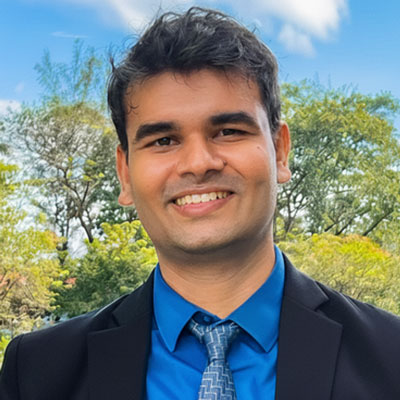
A seasoned marketing professional and a natural on-camera presence, Adeesha Pemananda is a skilled virtual event host and presenter. His extensive experience in brand building and project management provides a unique strategic advantage, allowing him to not only facilitate but also elevate virtual events.
Adeesha is known for his ability to captivate digital audiences, foster interaction, and ensure that the event’s core message resonates with every attendee. Whether you’re planning a global webinar, an interactive workshop, or a multi-session virtual conference, Adeesha brings the perfect blend of professionalism, energy, and technical savvy to guarantee a successful and impactful event.
Resources


Connect with Us:
Category: Business of Aesthetics Podcast