In this episode of the Business of Aesthetics Podcast, host Michael Walker sits down with Shannon Blake, Director of Partnerships Aesthetics at Podium, to talk about how clinics can grow their practice faster by replying to leads quicker and using smart tools like AI.
Shannon explains what “Speed to Lead” really means and why it matters more now than ever—especially with the aesthetics industry facing a dip in revenue. You’ll hear how using an AI Patient Coordinator can help practices respond to leads within minutes, keep in touch with patients after hours, and never miss another opportunity again.
This episode is full of practical tips on how to combine text messaging, automation, and smart follow-up systems to boost patient conversions, improve the front desk experience, and keep your schedule full.
Whether you’re new to AI or already using it, this conversation will give you a fresh look at how to level up your practice, stay ahead of the competition, and make every lead count.
Key Takeaways
Here are the main points your audience will walk away with:
- Speed matters – If your practice isn’t replying to leads within 5 minutes, you’re likely losing them to someone else.
- Use one system for all leads – Collecting leads from different platforms into one place helps you respond faster and stay organized.
- AI Patient Coordinators can help – Tools like Podium’s AI assistant can reply instantly, follow up automatically, and even book appointments—day or night.
- Missed calls don’t have to mean missed revenue – Some systems can now text back anyone who calls and doesn’t get through.
Podcast: Play in new window | Download
Subscribe To Our Podcast



Key Highlights:
- 00:00:00 – Welcome & Episode Introduction
- Michael Walker introduces the episode and expresses gratitude to the global audience.
- He thanks Ekwa Marketing for sponsoring and previews the topic: using AI and tech to respond to leads faster and boost conversions.
View TranscriptMichael Walker: Welcome to another segment of the Business of Aesthetics podcast. I’m Michael Walker, your host for this episode.
Before we get started, I want to thank all of our incredible listeners from the United States, Canada, and around the globe. We couldn’t do this without your continuous support.
A special thank you also goes out to our sponsor for this episode, Ekwa Marketing. With 20 years of experience, Ekwa Marketing is a leader in digital marketing services for aesthetic practices. As part of this podcast, they are offering our listeners a complimentary digital marketing consultation, which will include a tailor-made 12-month digital strategy for your practice.
You’ll be able to head over to Business of Aesthetics — all one word — businessofaesthetics.org/msm to book your consultation. I’ll have more on that and the opportunity a little later in the podcast.
So, without further delay, let’s dive into our theme for the day. I love the title Speed to Lead: How Podium is Revolutionizing Aesthetic Conversions with AI and Tech with Shannon Blake.
Shannon, it is great to have you here with us today.
- 00:01:19 – Guest Introduction: Shannon Blake from Podium
- Shannon shares her excitement about the global audience.
- Michael explains Podium’s mission to improve lead response, automate patient communication, and increase clinic revenue through tech.
View TranscriptShannon Blake: Thank you for having me, Michael, and I love that this is a global audience — that makes it even more fun.
Michael Walker: Excellent. Yes, it is. So, let me just share a little of your background with our listeners, Shannon.
Shannon is the Director of Partnerships, Aesthetics at Podium. Podium is a leading communication and payment platform that helps businesses enhance customer engagement, streamline operations, and drive revenue growth through AI and automation. In today’s highly competitive aesthetics market, speed is everything. Responding to leads quickly and effectively can mean the difference between securing a new patient or losing them to a competitor.
Podium’s technology enables aesthetic practices to improve response times, automate follow-ups, and enhance patient communication, ultimately increasing conversions and revenue. Shannon works closely with aesthetic practices to implement AI-driven tools, text-based communication, and automation strategies that simplify lead management and improve operational efficiency. By prioritizing speed to lead, Podium empowers clinics to stay ahead in a saturated market while creating a seamless and personalized patient experience.
In today’s episode, we’ll explore why lead response time is more crucial than ever, how AI and automation are transforming patient interactions, and what aesthetic practices can do today to convert more inquiries into loyal patients.
Shannon, as said, it is great to have you here, and let’s just start with the basics. So, why is speed to lead such a game changer for aesthetic practices, and how does Podium help clinics improve the response time and conversions?
- 00:03:04 – Why Speed to Lead Is a Game Changer
- Shannon highlights that aesthetic practices in the U.S. and Canada are seeing a 17% revenue drop.
- She explains how consolidating all incoming leads into one system helps clinics respond faster and convert more inquiries into appointments.
View TranscriptShannon Blake: Such a great question, Michael. And yes, speed to lead is the term that anyone who’s in the industry will be familiar with, but I will say it’s more important than ever now. Considering — and I’m gonna speak to the U.S. and Canada specifically — I know you’ve got a global audience, but we’re experiencing, for the first time ever, a step back in revenue year over year. I believe the industry is down about 17%, which is concerning, but also a wake-up call to say, you have to win in speed to lead.
Now, the industry has grown so quickly, it’s become a bit oversaturated, and the folks who are going to think strategically about what tech they can incorporate into their practice are gonna end up winning. So, speaking specifically about what Podium can do to help with speed to lead, I think the first piece of advice and guidance that I’ll share with folks that Podium offers is, number one: you need to have all of your communication and all of your leads funneling into a single place.
Shannon Blake: Because right now, if this resonates with you — that you’ve got maybe a “Contact Us” form on your website that sends leads into an email inbox somewhere, and then you’ve got your Google Ads or your Facebook ad leads going somewhere else, and maybe you have a website chat, like a widget on your website where those leads are going somewhere else — you can’t get back to leads fast enough if you do not consolidate them into one place. So, that would be my first advice: do you have a CRM that can do that for you, regardless of where the lead is coming from?
And then the next thing I would say that’s really fun, that some tech companies are starting to build — including Podium — is having an AI patient coordinator. Because here’s the reality: we know that there’s staffing issues too.
Shannon Blake: Finding good people to be as responsive as you need them to be with every lead is becoming more and more challenging. And so, looking into incorporating an AI patient coordinator into your practice will allow you to not only get all of your leads organized, but then have somebody get back to every single lead within two minutes — which is going to win.
If you think about the drop-off that happens, there’s some really cool data out there about how much improved conversion you get if you reply within five minutes. That’s the new expectation. So if you think you’re doing really good with one hour, I’m sorry to tell you — it’s actually not good enough anymore. It’s gotta be minutes.
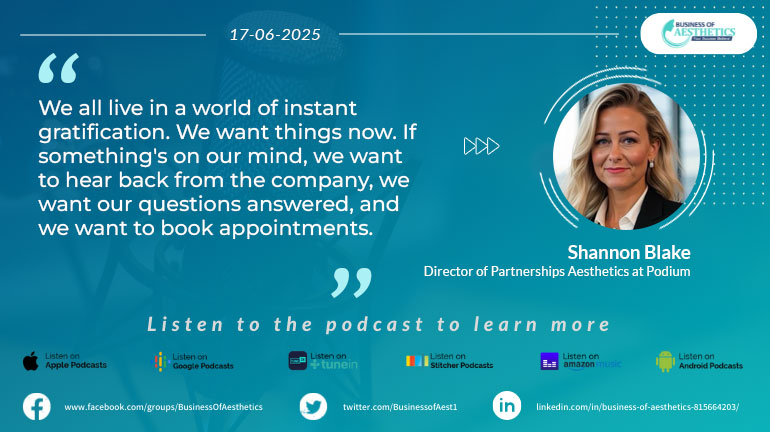
Because we all live in a world of instant gratification. We want things now. If something’s on our mind, we want to hear back from the company, we want our questions answered, and we want to book appointments.
So I would say, just to summarize it: winning in speed to lead is consolidating all your leads, and then leveraging messaging — like text and AI — to get back to all those leads faster than your competition.
Michael Walker: Wow. Consolidating and leveraging — you pulled that down to two words, all of that. Very well done. Thank you, Megan.
The, um, you know, I think this idea — I know with Ekwa Marketing, that’s the big thing — is they recognize, I mean, I think it’s like Google transforms the algorithm over 6,000 times last year. Like, it’s incredible. Everything moves just constantly.
And unless you’re an expert in a particular field like you are in your aesthetic practice, I think the one thing that you’ve just proven is that this is not a time to be a generalist. You really need to be really good at what you’re really good at, and know that — focus it in — and then bring in the supporting talent that will help elevate that. And to your point, turn that revenue decline around to a positive.
And I think you’re hitting the nail right on the fact — I mean, a decline is not necessarily a good thing, but it’s a great thing if it’s seen as a wake-up call to how you are approaching your business from the front of the house online, right through to the follow-up with a patient after they’ve left.
Michael Walker: And I am—
Shannon Blake: Yeah, it’s gonna force folks to become very efficient businesses now. Long gone are the days when, as long as you were a practice that was open, the leads would come flowing in and the revenue would come flowing in. So now, it’s gonna take some more strategic thinking, unfortunately — but there’s exciting tools out in the market to help folks that want to step up to the challenge.
- 00:07:14 – How AI Patient Coordinators Nurture Cold Leads
- AI can re-engage leads who go cold by sending automated follow-ups based on timeframes you set.
- Shannon shares how drip campaigns can keep non-converting leads warm for months with minimal staff involvement.
View TranscriptMichael Walker: And that’s where we’re gonna go next. Because AI is the topic, isn’t it? It’s the—I’ve heard so many incredibly interesting ways it’s being used in medical practices, whether it be in veterinary medicine, aesthetics, dental—it’s phenomenal. It’s just so interesting. And they all—every one of them—have an interrelationship, but the different communities haven’t necessarily talked yet. But AI and automation are transforming customer interaction for sure.
How is Podium leveraging AI to help clinics engage with leads more effectively?
Shannon Blake: Yeah, so I mentioned before: AI patient coordinators are absolutely something everyone should be looking into. Not only are they responding to leads quickly, but there’s really cool features where if a lead goes cold—maybe the prospect hasn’t replied back to the lead in the next 24, 48 hours, whatever timeline you want to set as a practice—AI can step in and re-engage with that lead automatically.
So if you are shopping for an AI patient coordinator, ask about things like that. Like, does it have the capability to follow up with leads that have gone cold for me without me having to do anything?
And then I would say—even though this is a bit outside of AI—but with regard to automations: if your CRM doesn’t offer you some type of drip campaign, where when you move a lead into a nurture status, text messages can start to automate, right?
Shannon Blake: Let’s say you say, “Hey, this lead is in nurture right now.” Maybe it wasn’t a good time—for funds, or for recovery time needed, whatever it might be—you move that into nurture, and automatically you could say, “Send these six text messages out over the next four months, spread out this often, and I want text one to say this, text two to say this, text three to say this,” and so on.
And then you can just sit back and know that, although that lead didn’t convert right now, you’ve got something in place where you don’t need to do anything, and it will just engage with that lead and keep trying to get that lead to communicate back with you. And once they respond, that drip campaign automatically cancels.
So that’s one thing that I would say is maybe available in CRMs, but folks haven’t taken the time to actually set it up strategically. Such a critical thing to take advantage of right now—knowing that not every lead, although you get back to them quickly, maybe they’re not going to convert right away. Right? Maybe your conversion rate’s 50%. What are you doing with the other 50% to make sure that those don’t slip through the cracks long-term?
Michael Walker: Yeah. You know, you’re using a lot of language that a lot of our listeners are gonna be familiar with—like the different categories of nurture and stuff.
And I’ll say what’s really interesting is that you probably, as a listener, you’re probably not an expert in marketing. And I know that Podium—that’s one of their focuses—is creating that seamless, personalized patient experience. That’s really important.
And that’s why this is one of those areas where, you know, there are things you’ve got to—it’s important to understand at some level—but to actually execute…
And the other thing I’ve noticed is people will think they’ve got it figured out, execute, and kind of check that box off. And of course, that’s not the way this digital world works. It requires a hands-on process. "AI watching AI" is what I’ve heard.
And like you said—how do we know that that nurture campaign is stopped and not carrying on and things like that? It’s fascinating how complex it’s getting. But beyond speed—I mean, that’s a huge deal—and as you say, you just can’t… a lead will only stay hot for a very short period of time.
What are other key factors that impact lead conversion, and how can technology optimize the patient journey?
- 00:11:13 – AI Turns Missed Calls Into Booking Opportunities
- Podium phones can automatically send a text after a missed call, opening up instant conversations.
- AI tools like Avery can jump in during off-hours, respond to questions, and even schedule appointments.
View TranscriptShannon Blake: Yeah, so one thing that I want to highlight is how AI can engage with missed phone calls—because we all have them. Whether it’s a busy front desk, an office manager that’s checking people out and can’t answer the phone, or—let’s face it—we all know we close around five or six in the evening, right?
But your strike-zone clients are of the age where they may be working 9-to-5s or they’re full-time moms, and the only time they get to themselves is after you’re closed. They’re on your website, they have a question about your treatment, they want to give you a call—you’re not going to answer because you’re closed. Or even if they do call you during business hours, you can’t answer every single phone call.
So something that’s really cool about Podium Phones—and if it’s not Podium Phones for you, do your research and find a phone system that does this—but this is gonna help you tremendously with conversion on your missed phone calls.
Shannon Blake: There are phone systems now where, if there is a missed call, it automatically texts the individual who just called and lets them know whatever message you want to say. Maybe it’s, “I’m so sorry we missed your call. We’re currently closed. We’ll text you back in the morning, but feel free to respond to this text message with any questions that you might have.”
And then, if you’ve got AI and your AI patient coordinator—we call her Avery at Podium—she can hop right in after hours and respond right then, when that service or treatment is on that lead’s mind, which is really powerful.
The last number I was looking at said that 40% of website traffic is coming in after your close time—like after a 6:00 PM close time—which is insane. Forty percent! That’s huge.
Shannon Blake: So you have to think: what are you doing to make it feasible for you to engage with those leads that are coming through to your website after hours? Because getting back to them the next day isn’t good enough anymore.
So again, it’s layering on: if you’ve got a missed call, it turns to text. Now you’ve got an AI patient coordinator that will answer questions and even book appointments for you—while you’re sleeping or spending time with your family.
That is one thing that I wanted to highlight. I think there hasn’t been a real good solution for missed calls, and the lost revenue and conversion on those missed calls.
Michael Walker: Yeah, I totally—it’s funny, I had that just the other day. I had a call come in—actually, I made the call, and it was after hours. It was a college of veterinarians, and the voice message said, “We’re closed,” but then a message popped up and said something like, “We’re closed, but we’d like to answer your question. You’ll get a text shortly. If you could give us an idea of what you’re looking for, we can direct you.”
So I thought, okay—and sure enough, I got a text. I clicked the link, now I’m on my phone looking at it, and it had a pre-populated Q&A. And I thought—huh, interesting.
Now, I was looking for somebody specific, so I wasn’t really the right audience, but in this case—if I was—you think of that 40%… that’s a new number to me, Shannon. But you think of that number, and you wonder—what’s their motivation? Is it to do due diligence, ask questions? Do they know it’s closed and they just want to get into the system, to go and click through and find something?
Michael Walker: Because how much of that 40%—that traffic—is all coming off of phones, not off of computers? And so what you’re looking for, and how you look for it, is different. I’m just thinking—I’m wondering if we’ve really adapted to how people are, what they’re looking for after hours specifically, and how they’re doing it.
And I love that. Yeah.
- 00:14:55 – After-Hours Traffic and Web Chat Strategy
- Shannon notes that 40% of website traffic happens after hours.
- A website chat widget connected to AI ensures practices can capture and convert leads around the clock.
View TranscriptShannon Blake: Yeah, for sure. And many of you probably have—if you don’t, you should absolutely go and get one today—but have like a web chat text widget on your website. So when people are looking at treatments on your website and it’s after hours, they can engage with you via text, right from your website.
Of course, again, you’re not—you shouldn’t be—working after hours, because I like to promote work-life balance. Mm-hmm. But having your AI patient coordinator responding to those website leads when they’re coming in through text is also a really good strategy.
And then, Michael, I wanted to also add a couple of additional strategies to be thinking about that I don’t think practices are good about today when it comes to conversion.
It’s about the individuals who are working that front desk. When somebody goes to check out, there’s generally—maybe they’re scheduling the next appointment, or even checking in, or even—like, let’s even just talk about a lead in general and how the front desk is managing those leads.
- 00:15:51 – The Power of Tagging Leads Based on Interest
- Shannon explains how front desk teams can tag patients based on interests or services mentioned.
- These tags help send more personalized and relevant text campaigns later on.
View TranscriptShannon Blake: When you’ve got somebody who’s asking questions about a particular service—going into the CRM—Podium has this capability, others may as well, but giving that contact, that lead, that patient, personas, or tags—we call them tags at Podium—of what services or treatments they’ve shown an interest in, whether it was an interest they brought up or one that came up in the consult.
So, this is a little bit of a front desk working also with the physician or the NP that’s performing the treatment, but it’s being hyper-aware of everything that’s discussed—anything that may be of interest for this client—and tagging them with those different personas or tags. So that when you go to do your text marketing, you’re being strategic about who you’re sending the promotion or the announcement to. Because otherwise, you’re just throwing everything at the wall and hoping it’s relevant for somebody.
Shannon Blake: And that’s not gonna sit well with your subscriber base for your text marketing if they’re getting stuff that they’ve never even shown an interest in. So just being very strategic about giving every single lead or client tags—and you can do indefinite amounts, right? Not everyone’s just going to have one that you have to pick from. You can give them nine different tags based on maybe the membership level that they are. Maybe they’re a VIP member of yours and tagging them appropriately so you can give them early access to specials, or whatever it might be.
But just in summary, it’s being very in tune with every client, every interest they have, and tagging them appropriately for future strategic text marketing.
Michael Walker: So we were talking on another chat we’re having on the podcast—we’re talking about the, uh, the client-patient or client concierge, like front lobby concierge.
And I’m thinking—so if I’m that concierge, and it’s a physical person as opposed to, we’re talking about AI—but if I’m having that conversation with somebody, as that physical front reference point, and I have a—and this, there’s gonna be an ethics issue in here—but if what we’re talking about is being recorded and AI is tracking it, it’s gonna categorize and pull all the things that are important to them into those very tags you’re talking about, and basically create a profile for me that we can then build out into—whatever—however we want to place that in the funnels to go after and reinforce their particular interest without mishitting in things that they aren’t interested in.
But I know that you just can’t go recording people without their knowledge.
I’m just curious—how do you see that playing out? I mean, this is kind of going off script a bit here, but…
- 00:18:27 – AI Call Summaries and Auto-Tagging Coming Soon
- Podium already transcribes and summarizes all calls using AI, allowing better team oversight and training.
- Future updates will allow the system to automatically tag leads based on conversations and prompt team members for review.
View TranscriptShannon Blake: No, I love it. I’m glad you brought it up actually. And I’m smiling so big because that is coming for Podium. That is something that we’re building right now.
One thing that I do want to highlight that we do already have today that is totally in the realm of conversion—and then I’ll come back to that—is AI call summaries. So if you are using Podium, for example, and you’re in a state where it’s illegal to record a call without their permission, we’ve already got that set up where it’s notifying them that the call’s being recorded upfront. Just a message comes on before it rings. So we’re covered there.
But with Podium Phones, every call’s recorded, every call’s transcribed, and then within seconds, AI comes in and summarizes that call right there. And why I bring that up is, not only is that cool, but for owners, you can easily go into Podium and look at all the phone calls that happened for the day, what were the call summaries, and do you feel like—based on the summary—was that an effective call? Did they bring up the event that you guys have coming up in two weeks that you’ve asked them to bring up? Did they give the right information about the treatment or procedure? Was it a robust conversation? Did they give enough detail?
So just that alone, you can use that as like a training mechanism with your team to see how effective those calls are. That’s one thing that I wanted to point out—is having better insight into: is your front desk doing a good job converting phone calls into consults for patients as well?
And then, Michael, what you said—I was gonna bring this up later ’cause I know we were gonna talk about like the future of AI—but that’s absolutely something that we are building right now. Even in text conversations, if it pulls out that, oh, you guys are chatting about this service or treatment—auto tag—and then it will just tag that contact automatically. So a human doesn’t have to do that.
Or if it was part of a phone conversation—auto tag. And I think where we’re gonna start is actually having a popup say, I noticed that you chatted about this treatment. Would you like to tag them with the treatment? In case for whatever reason it got it wrong or they didn’t want to tag it for whatever reason. But it will give them an option. It will notify somebody to say, hey, we noticed you talked about this, would you like to add it?
So really cool stuff coming with AI where it’s gonna take a lot of the human work out of it—because it is a lot of work right now. But I would say you can’t afford not to be doing that, even if it’s a lot of work.
Michael Walker: Yeah, I mean, a lot of work is maybe a mis-term. Like to me, this is like an annuity. You gotta make an investment now to get the return. But if you don’t—it’s like, I remember when we first built websites, we’d build these custom websites that would be totally useless in six months or a year. And now, you know, and because they didn’t—they weren’t designed with a future in mind. They were designed with the circumstances in front of us.
AI forces us to have to look at what the future is. And I think unless you have a platform that can actually engage you in that, you’re going to—you’re gonna find yourself noticing dinosaurs around that you didn’t notice before. Yeah. And I think this whole idea—my medical doctor actually, she said—I was in for a physical and she said, you know, I’m gonna record this if it’s okay with you, I’m using AI.
- 00:21:40 – Real Examples of AI Saving Time for Providers
- Shannon and Michael discuss real stories from doctors using AI to reduce admin time.
- Examples include AI writing better-targeted emails and helping providers spend more time with family.
View TranscriptMichael Walker: I said, yeah, sure. So she recorded. I said, how’s this working for you? She says—she’s got two young kids at home, nine and seven—and she said, this is the best thing ever. I actually go home at night now and spend time with my kids. I’m not writing up my reports.
And I said, really? So like, does it give you a summary? I’m really curious about this stuff, as you can tell. I said, so does it give you a summary that actually gives you all the things you need to follow up on? Does it give you any kind of thoughts on what might be wrong with me?
She says, well, it could, but that’s not what we use it for, Mike. We’re actually supposed to figure that out ourselves.
I said, well, one day, you know it. But I think another doc—a dentist—indicated that he was using it because he writes these emails he sends out, and they don’t meet the audience where they’re at. Again, they’re too technical. And there’s all these follow-up conversations—frustrating.
AI’s been writing his emails to match the age and the target audience they’re serving. And he said in the first two weeks of doing that, he saved seven billable hours.
Shannon Blake: Woo. Love that.
Michael Walker: And so there’s just—it’s—I think that the key with AI is not to be moved by its enormity, but be excited about its opportunity, and break that opportunity down to bite sizes like you’re doing here, Shannon.
What obviously what Podium does is it gives you—and actually Ekwa Marketing does the same thing—but this idea of breaking things down to practical, actionable steps that have integrable qualities. That can move forward with wherever AI takes you, without losing integrity and the fundamentals of what you do for a living.
- 00:23:19 – Where AI Helps Without Losing the Human Touch
- Despite concerns, Shannon emphasizes that AI can handle general Q&A while front desk staff focus on delivering great in-person service.
- Using AI the right way enhances—not replaces—the human experience.
View TranscriptShannon Blake: Right? Yeah. I think there’s a lot of folks—we actually just ran a survey to hundreds of aesthetic practices—and 90% agreed that AI is going to be critical to incorporate in your practice to be competitive. But yet only 40% were actively using AI in their practice.
And we also surveyed them on what the biggest barrier was for those that weren’t using AI today. And it was overwhelmingly the loss of human touch.
So I think it’s really important to be looking through the lens of: where could I use AI that’s not going to impact the patient experience? And the obvious answer is answering general Q&A that’s coming in through text. They don’t need a human. They won’t know that it’s not a human—because with OpenAI, they’ve made it so conversational that literally, they’re none the wiser. They’re just getting answers to their questions because your AI patient coordinator is trained on the backend.
Shannon Blake: But what that allows your front desk folks to do is be so present with the patient that’s in office—to really nail the check-in and checkout experience. So when people are there, when somebody’s in your practice, you’re not worrying about missing phone calls or messaging people back on their questions. You are present, and you are wowing that patient while they’re in your practice.
So by no means are we suggesting we let go of human touch. That all happens when people are live in your practice. All the messaging stuff—you should absolutely be leveraging AI for.
Michael Walker: Yeah. Wow. That’s—and the interesting thing is AI’s not new. I mean, I remember we built out, arguably, spreadsheets in Excel to actually track data that we applied to a CRM in a hotel. And when somebody was checking in, we would get comments and things that had happened, and we’d connect them up on the screen while we’re doing that. And we’d be able to talk to them—"So how’s Bob doing? Your son had his birthday last month, right?" You guys remembered that.
You know, we used a math-based system. We didn’t have the computer engineering that’s now available to us—but it worked. Like, it’s just about bringing more information to play that unexpectedly delights the customer.
I mean, how could you lose, you know?
It’s like that saying: "Have you ever been encouraged too much?" No.
If you don’t do it with authenticity, then that’s different. But to your point, you’ve already said that Podium works on making sure it’s human—it’s human relatable. And it’s not a machine talking to me—it’s a personal…
- 00:26:03 – How to Train Your AI Patient Coordinator Effectively
- Shannon walks through the importance of initial setup: from pricing and policies to memberships and tone.
- She reassures listeners that the AI will outperform staff in consistency and speed when trained properly.
View TranscriptShannon Blake: No, yeah, yeah. And AI patient coordinators—so if you are searching for one, one piece of advice I would give you is understand what LLM—large language model—it’s built off of. This tech company had to have built it off one, and you want to make sure it’s a reputable one.
OpenAI is probably the most well-known. ChatGPT is probably something everyone has heard of—that is OpenAI. But we’ve also got DeepSeek, the one that was created out of China, that’s getting a lot of attention. You’ve got Facebook with their own, Google has their own—so just asking the question, “Which model is it based off of?” Because if it’s off a reputable one, they literally are conversational. They’re human-like, and folks don’t know that they’re not AI.
So don’t worry about it seeming like a robot and not getting it right.
Shannon Blake: Because if you pick the right AI patient coordinator, there’s a lot of training. I would say probably three to four hours of training on the back-end front. Because you want your AI patient coordinator to know: What’s your new member special? What’s your cancellation fee? How much notice do you need on cancellations? What membership levels do you offer? What are the benefits of each membership?
It knows your treatments, it knows how you want to speak about your treatments, it knows the pricing—so don’t worry. She’s going to be better than your front desk when it comes to describing and sharing the benefits of each treatment. She’s going to be the fastest.
So don’t worry—take my word for it. They’re really good now. It literally was—once OpenAI came out and all the other companies quickly followed—it changed the game on what AI can do from a messaging perspective, is what I’m speaking about specifically.
Michael Walker: Absolutely. This is more just—it’s more like, we’ve all seen things evolve from robotized voices to something now that you just can’t tell. It’s just—it’s…
So, if you’re listening to this, I can’t imagine you’re not excited about AI right now—and that’s a good thing. And hopefully Shannon is breaking this down in a way that it’s not a big scary overwhelming thing. That there are bite-sized steps.
Always think—it’s not about trying to… man, we tend to do everything forever—but it’s just: this next season, what’s one thing you could do? What’s one right next step you could do to start moving towards this when you get off of this podcast?
Whether that’s reaching out to Shannon, connecting, whatever that looks like—but just: what’s that one right next step that you could start moving forward?
- 00:28:28 – Just Start: Breaking Big Changes into Small Steps
- Michael and Shannon encourage listeners to pick one improvement to start with.
- Change is hard, but the payoff in lead conversion and practice growth is worth the effort.
View TranscriptMichael Walker: ‘Cause that’s the thing—something new, we always tend to get a little overwhelmed, ’cause it’s too big and change feels too overwhelming. But change is a good thing. It’s the transition that’s the hard work.
You know, losing 50 pounds and having six-pack abs is an awesome change—I wouldn’t mind having that. I’m not so keen on the transition of having to give up chocolate chunk ice cream and the amount of sit-ups I’d have to do.
But the reality is, we actually do need to go through the transition. So just breaking this down…
But I want to be mindful of our time. Let’s talk about a couple of the common mistakes that aesthetic practices make with managing inbound. What have you seen? And then—obviously we’ve already talked about it—but let’s kind of reinforce how Podium’s tools could help solve them.
- 00:29:12 – Common Mistakes Clinics Make With Leads
- Not following up quickly enough (5 minutes or less is the new standard).
- Failing to consolidate all lead sources into one place.
- Not using automation or drip campaigns to nurture leads that don’t book right away.
View TranscriptShannon Blake: Yeah, to really just summarize some of the things I’ve already shared—so, number one: not following up fast enough. Not good enough if it’s not within five minutes. I want you to take that away.
Then, consolidating all your leads. So having a platform where every single lead—whether it’s a paid ad, a website lead, a phone call, or a text—is going into a single place. That will make you so much more efficient. Your front desk will love you.
And really leveraging text heavily as well. And by the way, with Podium, it also pulls in all your social media messages. So gone are the days when your front desk has to log into Instagram, log into Facebook, look at your DMs. That’s one—or a couple—less systems you have to log into because it’s all consolidated in one place.
Shannon Blake: And then I’d say another common mistake is the “one and done” mentality. If they don’t convert right then, it slips through the cracks, and you don’t even acknowledge that that’s potentially future revenue for your practice.
Not thinking strategically about, “Okay, it’s not now, but let’s move them into a nurture state. Let’s put them in a drip campaign. Let’s set up those templates so those texts go out automatically.” Not having those systems and processes in place is going to bite you in the ass—pardon my language—but it’s just… it really is a common mistake. People are just not taking the time to set those up. They want the revenue now, and they don’t think about the revenue later if it doesn’t convert right away.
Michael Walker: Excellent. Yeah, completely see that. So: follow up, consolidate, target, and then apply. There’s just so many…
And I think the big thing is, you don’t need to be an expert in all the applications and functions of this, but you have to have a vision for what it is you’re trying to do.
I always say, if here’s your practice today—what do you want your story to be in a year from now, as it relates to this particular conversation around AI?
And then bring in the partners that are going to help facilitate that vision you have and move you forward—so that the 7% decline in the industry is irrelevant, because you’re doing 35% more and taking market share.
- 00:31:17 – Don’t Let Missed Calls Cost You Revenue
- Shannon urges clinics to stop relying on voicemail.
- A smart phone system + AI can turn missed calls into booked consults—even after hours.
View TranscriptShannon Blake: Exactly. And one other thing that I will mention once again—’cause it’s so critical—is that practices have missed calls, and they don’t do anything about it. They hope people will leave a voicemail and that they’ll get back to them, but a lot of people are not doing that.
So having a phone system and process in place that will capture those missed calls and turn them into open, active text conversations—that AI can then jump in on, take over, and get booked for you—that’s a game-changer.
And just to make it simple: everything I’m talking about, Podium solves for. So everything I’m recommending, we have a solution for.
Michael Walker: Awesome. Well look, kind of—we touched on it a bit—but just as a wrap-up, looking ahead, we’ve talked some about where AI is going. Any other thoughts on that and where you see it?
You know, I’m still… I’m just waiting for my—you know, since we have these incredible printers and stuff—I’m waiting for the printer to be able to actually reproduce my caramel macchiato. I think that should be the next generation.
- 00:32:15 – The Future of AI: Voice-Driven Patient Coordination
- Podium is building AI that can make outbound calls and answer inbound calls in a natural, human-like way.
- This will allow clinics to manage phones better and cater to patients who prefer to talk.
View TranscriptShannon Blake: Oh, that will come sooner than you think, Michael. There’s a lot of really cool things happening with AI right now. In fact, I just went to a conference with one of the main EMRs in this space, and they held a whole session on AI. They had a really cool roadmap in place.
One thing that they have out in beta right now is AI scribing. If you haven’t heard about this already—think about the scribing process in any consult, and the work that goes into manually inputting notes, charting, all of that. There’s some really cool stuff coming, if not already out, for some of these EMRs around that—where it’s just audio, it’s listening, and then it places everything in the appropriate part of the form and the EMR.
And the list goes on and on. I would call your EMR—any tech stack that you have—and ask them what they’re doing about AI, because it’s on everyone’s mind.
For Podium specifically, our big focus next is AI voice. We want you to take Avery—who’s our AI patient coordinator—to the phones. Whether she’s outbound calling, reminding people of appointments, calling to let people know about an event you have coming up because you’re launching a new device, or just creating excitement around a new service or treatment that you’re offering—she’ll be very conversational.
It’s not just a voice recording and then it hangs up. She’ll ask a question, and the person can respond, and they can have a full-on conversation. So, outbound AI patient coordinator efforts.
And then next up for us will be inbound. We want Avery, our AI patient coordinator, to be able to answer phone calls. So if people prefer to talk on the phone—and maybe they’re calling you after hours or you’re too busy and can’t answer—she’ll be able to have a full-fledged conversation with the individual calling into your practice.
Michael Walker: I love it. And, you know, that’s one of those things—it’s that saying: the proof’s in the pudding. Like, until I hear it and see it, you know, somebody has to—there always has to be somebody innovating at the front edge of this.
But I just appreciate a statistic. Now, if you have Gen Zs working at your front desk—those aged 18 to 26—or millennials, who are 28 to 43, well, 60% of Gen Zs dread accepting a phone call, and 81% of millennials are anxious about making or accepting a call.
Now those facts just simply tell me that if that demographic is at the front of the house, phones aren’t really a great fit—but AI is. And it simply eliminates something that is a huge issue, one that would take hours to train others on—or worse, not even train them, but they just don’t have a passion for it.
So I mean, that’s a great example where AI is simply replacing trends and addressing modern-day phobias, if you will, that we’ve never had to navigate before.
Pretty cool stuff going on.
So, our time is coming to an end, and I thank you so much, Shannon, for joining us today and sharing your expertise on Speed to Lead: How Podium Is Revolutionizing Aesthetic Conversions with AI and Tech.
What’s the best way that people can reach you?
- 00:35:27 – How to Contact Shannon Blake
- Shannon gives her direct phone number and email for those who want to learn more or connect.
- She encourages listeners to reach out with ideas or questions.
View TranscriptShannon Blake: Yeah, I’m gonna be bold here, and I’m actually gonna give out my cell phone number. So feel free to text me if you’re interested in learning more—or I always just love connecting with people that are professionals in the industry and have thoughts, ideas.
But my cell phone number, if y’all want to whip out your phones, is (801) 979-8096. So for those of you that like calls or texts, that’s my cell. Or you can reach me at shannon.blake@podium.com.
Michael Walker: Perfect, Shannon. Nice and easy to remember. And I can tell you—that’s her actual number, ’cause I called it just a little while ago.
Well listen, your insights into how clinics can enhance patient outcomes while increasing profitability were incredibly valuable, and we really appreciate your time, Shannon.
I also want to take a moment to thank our amazing listeners, and the privilege of your time. We appreciate each and every one of you, and we couldn’t do what we do without your support.
If you enjoyed today’s episode, please share it with your colleagues and friends on social media and help us spread knowledge within the aesthetics community.
Also, don’t forget to leave us a review on your favorite podcast platform. We love reviews—just like you should love reviews. Your feedback helps other doctors and practice owners discover our podcast and gain valuable insights to grow their business, just like you are today.
Closing Thoughts
- 00:36:48 – Final Thoughts and Thank You Message
- Michael wraps up with a thank-you to Shannon and the audience.
- He reminds listeners to book their free consultation with Ekwa Marketing to get a custom 12-month digital strategy.
View TranscriptMichael Walker: And before we go, a special thank you again to Ekwa Marketing, our sponsor for this episode. As mentioned, with nearly 20 years of experience in digital marketing for aesthetic practices, Ekwa is offering our listeners a complimentary digital marketing consultation, including a custom 12-month strategy tailored to your practice.
Now, specifically—I’ve seen this—and it’s such a… if you’re already a marketing expert, and you’re an AI expert, and you’re a digital platform expert, then what Shannon and I have been talking about—you probably already know it all, and that’s awesome.
But if you don’t, and you’re looking to grow your business, and you’re looking to own a strong place in the market and truly own your market share, then whether it be Podium or Ekwa Marketing—these are powerful tools to get you there.
And if you’d like to, go ahead to businessofaesthetics.org/msm—you can book that consultation with them.
I can tell you the two questions I always ask myself. First one is: what’s at risk to reach out? Well—just your time. There’s no cost to it, as I’ve said, and I can assure you of that.
The second question is: what’s at risk not to? Well, that depends on how comfortable you are with where you are—and how much you want to grow and evolve your business.
And so, that applies to both myself and Ekwa Marketing, as well as Shannon and Podium.
And just—thank you again, Shannon, for your time. And until next time, keep striving for excellence, elevating patient care, and making a lasting impact in your industry.
On behalf of Shannon and Podium—wishing all of you an amazing week ahead.
Shannon Blake: Thanks.
GUEST – Shannon Blake

Shannon Blake is a dynamic and seasoned leader with over 14 years of people management experience and a passion for driving growth through strategic partnerships. Her leadership journey began at Discover Card, where she spent 12 years honing her skills before joining eBay, drawn by the company’s mission and purpose.
During her 9-year tenure at eBay, Shannon held multiple high-impact roles. Most notably, she led the Seller Health team, where she developed tailored 90-day partnership strategies that significantly boosted eBay’s revenue. Later, as a Channel Partner Manager in the Seller Growth organization, she managed key relationships with third-party listing providers, helping them scale online businesses and drive incremental year-over-year growth.
In her current role as Director of Partnerships at Podium, Shannon brings her expertise from the digital world into the brick-and-mortar space. She is passionate about helping businesses modernize how they connect with customers in today’s experience-driven market. Shannon manages strategic retail partnerships, empowering businesses across industries, especially aesthetics, to thrive by adopting Podium’s innovative customer engagement tools.
Her career reflects a consistent dedication to growth, innovation, and meaningful impact in both e-commerce and retail environments.
HOST – MICHAEL WALKER

Michael Walker is a seasoned leadership coach and analyst (Q.MED) who is passionate about adding value to individuals and helping them unlock their untapped potential. With over 35 years of diverse business experience, he specializes in organizational development, succession planning, conflict resolution, and mediation.
As a Qualified (Q.MED) mediator with the ADR Institute of Canada and an Analyst (WFA) with the Workplace Fairness Institute, Michael has a strong foundation in conflict resolution and workplace dynamics.
His expertise extends to providing workshops and seminars that equip participants with practical tools to apply immediately for improved relationships, fairness, innovation, productivity, and profitability.
Michael is dedicated to supporting personal and professional transformations and is committed to helping individuals achieve greater financial, relational, physical, spiritual, and emotional prosperity through his coaching and advisory services.
Resources


Connect with Us:
Category: Business of Aesthetics Podcast