In this episode of the Business of Aesthetics podcast, host Adeesha leads an expert panel: Rebecca Landiault (Apex Aesthetic Consulting), Sean Duncan (CPA and Strategist), Naren Arulrajah (Aesthetic Marketing Strategist), and Amy Ingle (Aesthetic Consultant) to deliver a full-spectrum guide on Optimizing and Maximizing Revenue with Next-Gen, Long-Lasting Injectables.
The discussion begins with Rebecca Landiault detailing the necessity of “lifetime treatment planning” and stacking modalities (injectables with energy devices) to secure superior clinical outcomes, while emphasizing the use of robust patient financing to overcome initial budget objections.
Financial strategist Sean Duncan reveals powerful sales psychology by explaining The Decoy Effect a technique for framing treatment choices to make high-value plans more appealing. He also stresses the critical importance of collaborating with legal and financial experts to select the proper business entity for major tax savings and asset protection.
Marketing expert Naren Arulrajah breaks down the most effective promotion strategies, focusing on creating authentic before-and-after content and positioning the provider as a subject matter expert on social media (Instagram and TikTok). He then instructs practices on how to set up dedicated tracking mechanisms to accurately measure marketing ROI, CPA, and LTV.Finally, Amy Ingle addresses the common operational pitfalls of launching new products, including managing expensive inventory, blocking appropriate time for comprehensive consultations in the EMR, and ensuring full team education. She concludes with strategies for value-based pricing and structuring patient loyalty programs, like the “cash and stash” concept, to drive long-term retention. This episode provides a complete, actionable roadmap spanning clinical, financial, operational, and marketing strategies to future-proof your aesthetics practice.
Key Takeaways
- Master Lifetime Treatment Planning and Modality Stacking
Always conduct a comprehensive consultation to offer a lifetime treatment plan, not just a single procedure. Stack treatment modalities (e.g., injectables and energy-based devices) to achieve the best clinical outcomes and maximize revenue per patient. Use a strong patient financing program to overcome budget objections to these higher-cost, customized plans. - Leverage The Decoy Effect in Sales
When presenting treatment options, use the “Decoy Effect” to guide patients toward the optimal, high-value plan. Offer three choices: the inexpensive option, the recommended and profitable option, and a very expensive “decoy” option that makes the recommended plan appear more reasonable and attractive. - Prioritize Full-Team Education and Clinical Confidence
Do not rely solely on vendor training. Budget for additional training and self-study, and schedule a high volume of patients (e.g., two dozen) immediately after training to build muscle memory and clinical confidence. Critically, include your entire team (front desk, estheticians) in the educational experience to ensure everyone can communicate intelligently about the new product. - Focus Marketing on Visuals and Provider Authority
The most effective marketing channels are social media (Instagram, TikTok) and email. Focus your messaging on natural before-and-after visuals and leverage the provider as the subject matter expert in short, engaging videos. Traditional marketing, if used, must be strategic and targeted (e.g., direct mail to high-income demographics). - Track ROI with Dedicated Mechanisms
Stop launching marketing campaigns without accountability. Track the ROI for a new injectable by using dedicated tracking mechanisms for every channel, such as unique phone numbers, landing pages, or offer codes. Measure key performance indicators like Cost Per Acquisition (CPA) and patient Lifetime Value (LTV). - Use Loyalty Programs for Long-Term Retention
Structure patient retention around the long-lasting nature of the injectables. Create a personalized maintenance follow-up schedule and use a tier-based membership program that features a “cash and stash” concept, allowing patients to save money monthly for future treatments and ensuring they return to your practice.
Podcast: Play in new window | Download

- Get a 1-on-1 diagnosis of your online presence & patient acquisition funnel
- Identify critical, untapped growth levers (SEO, Social, Referrals)
- Define a clear action plan to attract and convert your ideal patients
- Receive expert solutions for your most pressing marketing challenges
Subscribe To Our Podcast



Key Highlights:
- 00:00:12 – Introduction & Speaker/Topic Setup
- The episode focuses on optimizing and maximizing revenue with next-gen, long-lasting injectables.
- Host Adeesha introduces the sponsor, Ekwa Marketing, offering a complimentary patient growth plan session.
- Panelist Rebecca Landiault (CEO of Apex Aesthetic Consulting) is introduced to discuss treatment planning and operations.
View TranscriptAdeesha: Welcome back to the Business of Aesthetics podcast. Today, we are diving into our topic, optimizing and maximizing revenue with next-gen, long-lasting injectables. My name is Adeesha, and it is my pleasure to be your host. And before we jump in, a special thank you to our sponsor for this episode, Equimarketing. To help you build that roadmap for growth, they’re offering a complimentary high-value patient growth plan session. That’s a one-on-one dedicated 60-minute strategy call to build a tangible 12-month roadmap for attracting the high-value patients you want. If that’s a priority for your practice, you can find all the details at www.businessofaesthetics.org. The form to secure your spot is brief and takes about 90 seconds to fill up. With that being said, kicking us off is Rebecca Landiault. As the CEO of Apex Aesthetic Consulting, she brings a unique dual perspective on both client journey and complex operations behind a successful practice. She specializes in helping clinics scale profitably by identifying revenue gaps and implementing actionable, results-driven solution. Rebecca, thank you for being here with us.
Rebecca Landiault: Thank sociaux much. I’m excited to be here with such a great panel. Let’s do it.
- 00:02:11 – Rebecca Landiault: Lifetime Treatment Planning
- Providers must conduct a comprehensive consultation to perform lifetime treatment planning.
- Next-gen injectables are not the only solution; providers should stack modalities (such as energy-based treatments) to achieve the best results.
- Having deep, strong conversations sets the provider apart as the subject matter expert and ensures better clinical outcomes.
View TranscriptRebecca Landiault: Yeah, I think one thing that I touch on so often with my clients and in these webinars that I’ve done with the business of aesthetics before is really talking to providers themselves about what it means to do lifetime treatment planning and how to perform a really excellent comprehensive consultation. Because I think that especially with something like biostimulatory fillers or next-gen injectables, they are not the only solution to the concerns that the patients are coming to our providers with. And so I think it’s important when somebody books a consultation for something like a biostimulatory filler or the other next-gen injectables that are out there is to really sit down and have conversations with those patients about what it is that you’re looking to achieve. Because injectables are not the only tool in our toolbox, right? So I think sitting down and having a really comprehensive consultation list of questions that you’ve prepared in advance that you go through with every single one of your patients so that it becomes muscle memory. And then you’re able to really articulate why, you know, as the provider, I know you’ve come to me, you know, you’ve booked a consultation for this service. But as the provider assessing your skin and asking these questions, what I think that we should do is, and it can certainly include that injectable that they came to you for that treatment, but we may need to address the skin in other ways. We may need to address, you know, stacking modalities with an energy-based treatment to provide the best results. And when you have a really deep conversation with the client about what their, their treatment outcome expectations are, you’re really able to handle, you know, the discussions of, we do need to combine this with this, or we do need to, um, you know, maybe start off with this specific treatment and build ourself up to this specific treatment, or yes, you really are a great candidate for a biostimulatory filler and but we might want to also do a little touch-up with a traditional HA. So I think when you have those conversations with a client, you really talk about how one single syringe that you’ve come in or one single vial of something that you’ve come in for a consultation may not meet the treatment outcome expectations of that patient. So when you have those really strong conversations that set you apart as a subject matter expert and you’re giving them a lifetime treatment plan, I think we can ensure much better clinical outcomes because we’re not just doing what the patient has asked us to do. We are actually providing them with a comprehensive treatment plan, a lifetime treatment plan that will build upon, y’know, both patient loyalty and, of course, leading to more successful outcomes.
- 00:05:01 – Rebecca Landiault: Handling Budget & Financing
- Lifetime treatment planning helps flesh out budgetary concerns and objections early on.
- If a patient receives an underwhelming result due to a budget limit, they will still return if the provider was honest and explained the full scope of treatment needed.
- Practices must implement a strong patient financing program to overcome the cost objection for customizable, high-cost treatment plans.
View TranscriptAdeesha: Okay. Can you give us an example of where you have done both, right? Given a comprehensive lifetime plan versus just having that singular treatment plan for that day, perhaps.
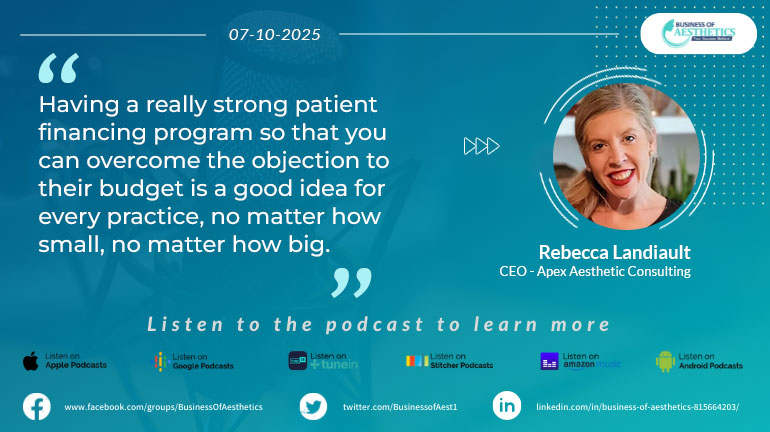
Rebecca Landiault: Sure. I think what the the lifetime treatment planning step is really just the first step to set yourself up as the expert in their care. And the reason why I think that is so important is that often and I’ve already seen one of the questions that’s come up is is that they are concerned that often what the patient is looking to achieve doesn’t align with the their budgetary concerns. And I think when you set yourself up as the subject matter expert that this is everything that we need to do, you can start to flesh out what some of their objection will be early on. And of course, there’s always going to be the objection that something might be outside of the patient’s initial budget, especially if your prices are online, they see one vial of Sculptra is X amount or one syringe of Radiesse is X amount. They’ve come in to that consultation thinking that’s the most that they’re going to spend. But if you do a really good job of setting yourself up as that expert. If you end up just doing the one thing that they came in and asked you for as a jumping off point, you will still have driven, hopefully, some patient loyalty. So that one patient’s budget… might meet up with what, you know, what the treatment recommendations are. They’re able to, they’re going to come back to you, right? Because you didn’t just have them come in, answer a couple of their questions about whatever injectable, inject them and send them on their way. If they are then disappointed in the result after we’ve just talked to them about that one treatment, we’ve done it, we’ve sent them on their way. They’re going to be disappointed in you not knowing that it’s possible that they just didn’t get enough because they let their budget get in the way. But if you explain to achieve the results that you’re looking to achieve, we need to do this energy modality. We need to do this many units of toxin. We need to do this many syringes or vials of oxygen. The biostimulatory filler. I understand we’re not going to be able to do all of that today. We can start with the thing that’s going to make the most impact or we can start with the thing that you are looking to do. Just understand. I want to let you know ahead of time that your result might be a little underwhelming because these are the types of treatments we have to do. kind of stuck on top of one another. You know, one syringe is never enough. One vial is never enough. And if you have that honest conversation with them and they come back and they are a little underwhelmed with that initial treatment result, they’re still going to come back to you because they’re going to say, you know what? She was right. He was right. I got to figure out a way to pull that budget together. And get that treatment plan she discussed. And I’m certain that Sean’s going to talk a lot about the different things with finances. The one thing that I think is really important, because when we do talk about next-gen injectables and stacking treatments and doing customizable treatment plans, we are presenting the patient with something that is probably outside of most people’s budget when it comes to just writing the check that day or running their card. So I think having a really strong patient financing program so that you can overcome the That, that objection to their budget is a good idea for every practice, no matter how small, no matter how big, having a strong patient financing program is very important with these types of treatments.
- 00:08:48 – Rebecca Landiault: Team Education and Training
- Practices must budget for additional training and self-study beyond what the companies provide, as clinical training alone is often insufficient.
- To maximize training, providers should get the didactic materials in advance and schedule two dozen patients immediately after the training week to build muscle memory.
- The entire team (including front desk and estheticians) must be included in the educational experience to ensure everyone hears the patient questions and knows the treatment process.
View TranscriptAdeesha: So thank you. Now, Rebecca, what are the steps a practice should take to ensure that all injectors and team members are properly educated on both the clinical protocols and patient communication strategies for these next gen products?
Rebecca Landiault: So I know I said the last question was my favorite one, but this is the one I’ve most been looking forward to. I think one thing that all of these companies, and this is not just injectables, this is the skincare companies, this is device companies. The unfortunate truth is that they alone, whether it’s their clinical team or their reps, they’re not setting any providers up to succeed, unfortunately. So I think one of the things, you know, there just is a gap between where people need to be to launch these treatments successfully and what tools they’re given when they make their purchase. So the first thing that I recommend is not to bring any treatment on at all. If you do not feel like you can launch it successfully on your own without promises from whatever rep, you know, they say, we’ll do a launch party. I’ll come in and I’ll sell them. of vials for you. More often than not, unfortunately, it isn’t true. There are great reps out there. I think I was a great rep. I was very supportive of my customers, but there’s just been a shift in the industry and the companies are not supporting the reps. So the reps are not supporting the end user. So don’t Implement a procedure if you cannot after the clinical training that they’re going to provide to you, if you are not going to budget for additional trainings to make yourself that subject matter expert, if you’re not going to take the time to study and research these techniques on your own, if you’re not going to have a way to communicate all of these things to your staff. I mean, I think the most important thing I tell everyone when they’re setting up for their clinical training is Reach out to the trainer from whatever company is going to come out. Ask them in advance for whatever didactic portion they plan to run through in that short couple of hour window where they’re going to be doing your clinical training. Get that out of the way. Have the questions that you’re going to have ready to ask. When they come in, say, I’ve been through the didactic. Here’s a couple of questions I have. My models are here. I want to do hands on. And make sure you follow what the providers tell you or the clinical trainers tell you is a good candidate. So the candidate that’s in your chair on the day of that training, we can train them. But going back a few weeks prior to that, you need to have, in my opinion, at least two candidates. I’d say two dozen people already booked in that first week after your clinical training, whether you do a model call, whether you’re giving complimentary treatments, whatever it might be, that the day after your clinical training with that trainer, you are now treating patients and you are creating a muscle memory for these treatments because that’s where your clinical confidence is going to come. And it will never come just from whatever trainer they’ve sent out to you to do that training for that three hours. The trainer’s there. So knowing in advance, I’m going to book all of these, I’m going to book 12 or 13 patients. I’m going to have, you know, and you can ask the rep to support you with additional product. You can, you know, potentially place an order so that you’re, you’re pre-selling these models and you’re getting, you’re, you know, recouping some revenue from bringing these treatments on and you’re becoming really clinically confident. When you’re in that room with those 13 patients over the course of that week, have your front desk sit in on a consultation. Have your esthetician watch you inject. Have anyone else, because the whole team collaboratively will hear what questions our patients are asking, how we’re responding to them as a provider. building educational experience around launching these services. And I think that’s where we won’t see as much of a disconnect between what our front desk staff knows, because maybe we didn’t invite them to the clinical training with the trainer. And I know everybody’s rooms are small. We’ve got a clinical trainer. We’ve got a model. We’ve got the injector. We can’t have the whole team in there watching clinical training. But that’s why I really like that whole week to be dedicated to everyone honing their skills with that specific treatment.
- 00:17:14 – Sean Duncan: Financial Strategy & The Decoy Effect
- The segment introduces Sean Duncan (CPA and strategist) to discuss proactive business and financial strategy.
- Sean recommends using The Decoy Effect (a sales psychology concept) when presenting treatment choices.
- Offering three options—the inexpensive one, the recommended one, and a very expensive "decoy"—makes the recommended treatment plan appear more attractive.
View TranscriptAdeesha: Now we are going to move on to the financial side of things. And we would like to welcome Sean Duncan for this segment. Sean is a nationally known strategist and CPA whose passion centers around educating business owners on proactive businesses, tax and financial strategy, helping them achieve both their professional and personal goals. Sean, thank you for being here with us.
Sean Duncan: Thanks for having me. All right. I’m the curveball, guys. Now we’re going to talk tax and accounting nerd. You weren’t thinking that was coming. But we’re going to make it fun and exciting, aren’t we, Sean?
Sean Duncan: Oh, heck yeah. In fact, actually, before we dive into tax nerd stuff, I actually want to double down on something that Rebecca was talking about. We’re talking about sales and sales choices. Right. I encourage you guys to go out and look at the concept called the decoy effect. Go Google it. You’ll learn it. It’s essentially the psychology between the choices of three. So when she was talking about patient comes in and they just want this injection and really we need to do a treatment plan and There’s actually a lot of psychology around choices of two create stress and anxiety, but choices of three create comfort. And so what you do is she’s spot on. But if treatment one they came in was for 20 bucks and what she really recommends is something that’s 75, 75 sounds expensive. Have a third choice that’s 350, the decoy, that makes the thing that you really know they need at 75 much more attractive. And so when you’re trying to get into that sales psychology piece of it, when you’re giving those choices, you know the better treatment plan is actually going to make you more profitable, but also better serve their needs, which will create greater client fulfillment and happiness. That’s the way to go. You can leverage the psychology of the decoy effect to your advantage. So just a little trick there. I thought I’d share just since it was jumping out of my brain as she was talking.
- 00:19:26 – Sean Duncan: Entity Choice and Tax Planning
- The type of business entity chosen has both legal and tax ramifications.
- The wrong entity (e.g., a general partnership) can expose personal assets (car, house) to liability from the actions of any single partner.
- Practices must collaborate with a CPA and an attorney to select the proper entity structure, which can save tens of thousands of dollars annually in taxes.
View TranscriptAdeesha: So, Sean, as a practice grows, how should a practice owner go about choosing an entity type and why should they care?
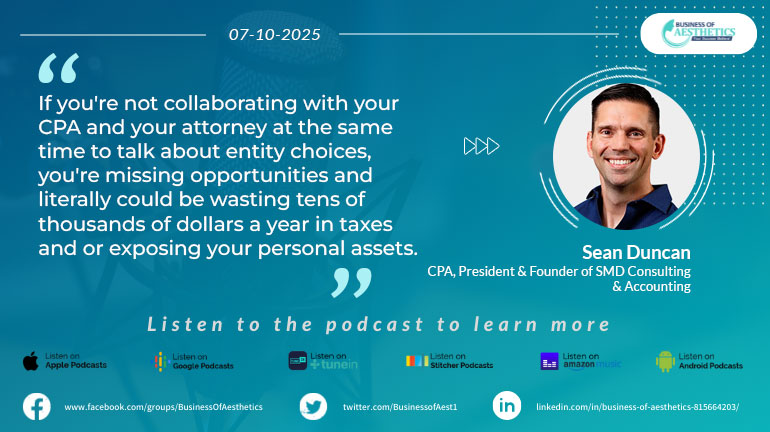
Sean Duncan: But why they should care is actually it has a whole bunch of effects. There’s a bunch of different entity types. I’m not going to go through a whole lesson on it. But just know that the type of entity you choose has both a legal and a tax ramification. Different ones have different levels of protection. And think about it this way. If somebody sues your business, can they punch through and take your car, your cat, and your dog? Can they take your personal stuff because of some action or activity of the practice. But then the tax ramifications, there are structures that are actually more tax advantaged. You can actually save money simply by the choice of the entity you make. Here’s the dilemma. There is so much crummy information out there on social media telling you this is the one to do. It’s not true. It’s just like medical treatment. Everybody’s biology is different. So you can’t give them everybody the same treatment. The same is true on entity choices and tax strategies. The fact pattern matters. And so I literally gave a proposal to a client today that had a practice with three different owners with different ownership percentages. And I have, I’ve structured it kind of complex, but two of the owners, I’m doing an entity structure differently than I’m doing for the third. And so it’s because of the dollars and cents, it didn’t make sense for that third owner. So if you’re not collaborating with your CPA and your attorney at the same time to talk about entity choices, you’re missing opportunities and literally could be wasting tens of thousands of dollars a year in taxes and or exposing your personal assets. So it’s boring stuff. Nobody wants to talk about it. But it is so vital because it’s also the foundation to everything else you can do. When you want the cool little tax deductions, some of them we simply can’t do depending on what entity type you have.
- 00:26:38 – Amy Ingle: Operational Challenges & Workflow
- Amy Ingle identifies common operational challenges as a disconnect in team education and poor inventory management of expensive, expiring products.
- Practices must block out appropriate, longer time in the EMR for the new service to accommodate comprehensive consultations, the injection, and aftercare.
- It may be best for practices to have patients come in for a consultation first and book the treatment for a later date to avoid rushing the process.
View TranscriptAdeesha: We’re going to dive right into your segment over here. So, what are the most common operational challenges that you see when practices introduce a new or a next-gen injectable, and what actionable steps can they take to overcome these?
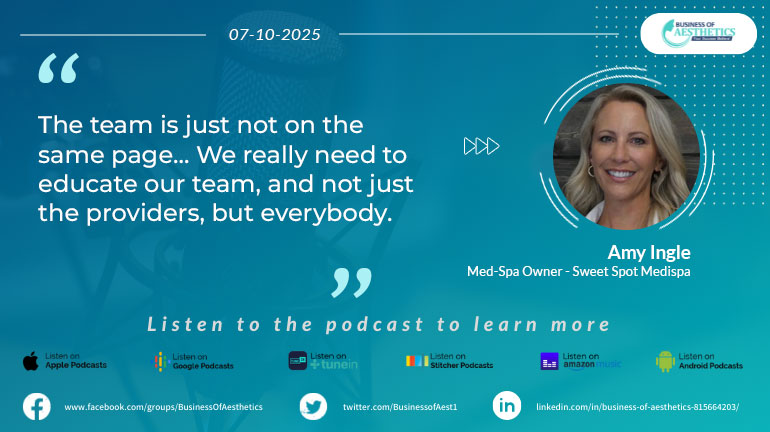
Amy Ingle: You know, I think we’re seeing a lot of the same challenges that we see when we introduce any new product, especially in aesthetic practice. The team is just not on the same page. So, if we introduce a new injectable, the front desk team may not know the difference between the next-gen injectable and the traditional HA filler. And if they don’t know the difference, they can’t speak to it intelligently. And so, that patient that Rebecca was talking about that comes in for one thing, but maybe needs a larger treatment plan, we really need to educate our team, and not just the providers, but everybody. Everyone needs to understand the new product. Everyone needs to understand the cost, the appointment time, the aftercare, and the expected results. We really need to include the whole team on the education and not just the providers, because they’re the people that are communicating with the patients, whether it’s through phone calls, emails, or in-office. And so, the patient’s walking in the door, not only knowing what they came in for, but maybe they’ve been introduced to some of the other services that are going to be beneficial to them. So, I think having that initial training is really, really crucial. And, you know, Rebecca touched on this too, but having that training with the whole team is really important. Even if the front desk isn’t in the room with the trainer, the providers need to take the time to bring that information back to the team. You can do a quick 15-minute training in the morning huddle and just go over the key benefits and the key talking points about the new injectable, so that everybody is on the same page. And, you know, another operational challenge that I see when we launch a new injectable is just the inventory management. You know, these products are expensive. They’re often, they have expiration dates. And so, we need to make sure that we’re properly stocking them, but not overstocking them. We need to look at our sales data. We need to look at how much we’re moving out every month and make sure that we’re ordering appropriately so that we don’t have expiration dates, you know, in two or three months. So, I think those are the two biggest operational challenges that I see. The team is not educated, and we’re not properly managing our inventory.
Adeesha: Okay. And how can a practice manage the appointment scheduling and workflow to accommodate these potentially longer, more complex next-gen injectable procedures, especially with a busy practice?
Amy Ingle: Well, I think this is where we need to look at our whole schedule and make sure that we are not booking these new injectables at the same time as, say, a toxin patient. We need to, we need to block out time in the schedule. We need to have a new service in our EMR that is for this specific injectable. We need to make sure we’re leaving enough time for the provider to have a really good comprehensive consultation, not just the injection, but also the aftercare instructions. And we need to make sure that we’re communicating this with the front desk team because they are the people that are booking the appointments. So, they need to know what the time allotted is for each of these appointments. So, I think having those new services on the EMR with the appropriate time blocked out is really important. We also need to look at, you know, are we having the patient come in for just a consultation? Or are we doing the consultation and the injection at the same time? You know, for these longer appointments, sometimes it’s best to have the patient come in for a consultation, get all their questions answered, and then book their treatment for a later date. That way, we’re not rushing the patient, we’re not rushing the provider, and we’re ensuring that the whole process is smooth and efficient.
- 00:32:38 – Naren Arulrajah: Marketing Channels & ROI Tracking
- Naren Arulrajah recommends focusing on before and afters and leveraging the provider as a subject matter expert on social media (Instagram and TikTok).
- Traditional marketing should be strategic and targeted (e.g., direct mail campaigns to a specific demographic or partnership with local businesses).
- Practices must track ROI using a dedicated tracking mechanism (unique phone numbers, landing pages, or offer codes) and measure KPIs like Cost Per Acquisition (CPA) and Lifetime Value (LTV).
View TranscriptAdeesha: Now we move on to our next segment over here, where we have Naren ready to talk about the marketing side of things. Naren is an aesthetic marketing strategist specializing in patient acquisition and conversion. He focuses on developing data-driven, multi-channel marketing campaigns that directly translate into revenue growth for aesthetic practices. Naren, thank you for being with us here tonight.
Naren Arulrajah: Happy to be here. Awesome.
Adeesha: All right, Naren. What marketing channels and messaging strategies do you recommend for effectively promoting these new long-lasting injectables to a target audience?
Naren Arulrajah: Well, I think, you know, the first thing is, is we got to go back to what Rebecca said. I think Rebecca said it really well. The patients are savvy. They know what’s out there. They’re looking for natural results. So, when we’re talking about next-gen injectables, they’re probably already familiar with them. They’re seeing it on social media. They’re seeing it on the news. They’re seeing all the information that’s out there. So, we’re not introducing a brand new product to them. So, the first thing we want to do is, is we want to focus on the before and afters. That is the best way to promote any injectable. We want to show the results that are possible with this new injectable. We want to make sure that they are natural, and we want to make sure that we’re using high-quality photography and videography. And then, the second thing that I would say is, is we want to really leverage the provider as the subject matter expert. Just like Rebecca was talking about, the provider needs to be the one talking about these injectables, talking about why they’re different, talking about why they’re better, and why the practice chose to bring them on. So, we want to use social media, specifically Instagram and TikTok, to create short, engaging videos of the provider talking about the injectables. We want to do a mix of educational and promotional content. And then, the third thing is, is we want to leverage email marketing. We want to make sure that we are sending out regular emails to our existing patient base about the new injectable. We want to offer a special promotion or a launch event for them to come in and try it out. So, I think those three things—before and afters, leveraging the provider as the subject matter expert on social media, and email marketing—are the best ways to promote these new injectables.
Adeesha: Okay, Naren. And what about the traditional marketing? Should we completely let go of it, or should we continue to use it for our target audience?
Naren Arulrajah: You know, I think traditional marketing still has a place, but it needs to be targeted. So, if we’re doing a direct mail campaign, we want to make sure that we’re targeting a specific demographic that we know is interested in these types of injectables. So, maybe we’re targeting a higher-income demographic that lives within a certain radius of the practice. We want to make sure that the message is clear, and we want to make sure that we’re driving them to a landing page where they can learn more and book a consultation. I think the other thing that we can do with traditional marketing is, is we can partner with local businesses that cater to our target audience. So, maybe we partner with a high-end gym or a spa to do a cross-promotion where we offer their clients a discount on the new injectable. So, I think traditional marketing still has a place, but it needs to be very strategic and targeted.
Adeesha: Okay. And as a final question, Naren, how can a practice effectively track the ROI of their marketing efforts for a specific next-gen injectable launch?
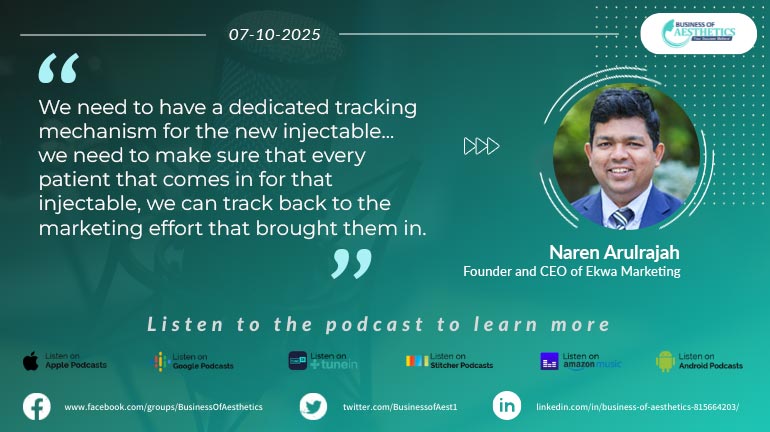
Naren Arulrajah: Yeah, that’s a great question. And I think this is where a lot of practices fall short. They launch a new injectable, and they do all these marketing efforts, but they don’t track the ROI. So, the first thing is, is we need to have a dedicated tracking mechanism for the new injectable. So, whether that’s a unique phone number, a unique landing page, or a unique offer code, we need to make sure that every patient that comes in for that injectable, we can track back to the marketing effort that brought them in. And then, the second thing is, is we need to look at the key metrics for the launch. So, we want to look at the cost per acquisition (CPA), the lifetime value (LTV) of those patients, and the conversion rate of the consultations. And then, the third thing is, is we need to look at the patient feedback. We want to make sure that the patients are happy with the results, and we want to make sure that they are coming back for more. So, we can do a post-treatment survey to gather that feedback. So, I think those three things—dedicated tracking, looking at the key metrics, and gathering patient feedback—are the best ways to track the ROI for a new injectable launch.
- 00:48:26 – Amy Ingle: Pricing, Loyalty, and Retention
- Amy Ingle recommends using a value-based pricing strategy after conducting a cost analysis and competitive review, justifying a higher price if the injectable lasts longer.
- Amy Ingle suggests practices incorporate next-gen injectables into a tier-based membership program that offers discounts and allow for "cash and stash" savings.
- Amy Ingle advises using the long-lasting nature to set a clear maintenance follow-up schedule and create opportunities to upsell the patient to complementary services like laser treatments.
View TranscriptAdeesha: Now we’re going to move on to our next segment here with Amy. Welcome back, Amy. Thank you for being here with us.
Amy Ingle: Thank you. I’m excited to be here.
Adeesha: All right, Amy. We are going to dive into the pricing side of things. So, Amy, what strategies do you recommend for pricing next-gen injectables to ensure both profitability and patient value perception?
Amy Ingle: Yeah, I think this is a great question. And this is where we need to look at the cost of goods (COG) for the new injectable. We need to make sure that we are pricing it appropriately to cover our costs and make a profit. So, the first thing is, is we need to do a cost analysis of the injectable. We need to look at the cost of the product, the time of the provider, and the overhead costs. And then, the second thing is, is we need to look at the competitive landscape. We need to see what other practices in our area are charging for the same injectable. And then, the third thing is, is we need to use a value-based pricing strategy. We need to price the injectable based on the perceived value to the patient. So, for example, if the injectable lasts longer, we can justify a higher price because the patient is getting more value. So, I think those three things—cost analysis, competitive analysis, and value-based pricing—are the best ways to price next-gen injectables.
Adeesha: Okay, thank you very much, Amy. And Amy, how can a practice structure their patient loyalty and membership programs to effectively incorporate these next-gen, long-lasting injectables?
Amy Ingle: Yeah, I think this is a great question. And this is where we can get really creative. So, the first thing is, is we need to have a tier-based membership program. We need to have different levels of membership that offer different discounts and benefits for the next-gen injectable. So, for example, we can have a gold-tier membership that offers a 15% discount on the new injectable, and a silver-tier membership that offers a 10% discount. And then, the second thing is, is we need to incorporate the "cash and stash" concept that [we] mentioned earlier. We need to allow the patients to put a certain amount of money into their account every month, and then use that money for the new injectable when they’re ready to get the treatment. And then, the third thing is, is we need to have a referral program that incentivizes existing patients to refer new patients for the next-gen injectable. So, I think those three things—tier-based membership, cash and stash, and a referral program—are the best ways to incorporate these next-gen injectables into a loyalty program.
Adeesha: Okay. Amy, a final question for you. How can a practice use the long-lasting nature of these injectables to create a compelling patient retention strategy?
Amy Ingle: Yeah, I think this is a great question. And this is where the treatment planning comes in. So, the first thing is, is we need to use the long-lasting nature to set a clear follow-up schedule with the patient. We need to explain to them that even though the injectable lasts a year or two, they still need to come in for a maintenance appointment to maintain the results. And then, the second thing is, is we need to use the long-lasting nature to upsell the patient to other services. We can explain to them that now that their volume loss is corrected, they can focus on their skin quality with a laser treatment or a peel. And then, the third thing is, is we need to use the long-lasting nature to create a personalized communication plan with the patient. We can send them an email at the six-month mark to remind them to book their maintenance appointment or to try a complementary service. So, I think those three things—clear follow-up schedule, upselling to other services, and personalized communication—are the best ways to use the long-lasting nature for patient retention.
- 00:53:19 – Final Wrap-up
- The host thanks all panelists: Rebecca, Sean, Naren, and Amy.
- A final reminder is given for the Ekwa Marketing complimentary consultation.
View TranscriptAdeesha: Now we move on to our final wrap-up. Thank you once again to all our panelists. That wraps up our deep dive into optimizing outcomes and maximizing revenue with next-gen long-lasting injectables. A heartfelt thank you goes to our incredible panel, Rebecca, Sean, Naren, and Amy for sharing their expertise with us tonight. And to all of y’all in the audience, we hope this session has provided valuable insights and inspiration to elevate your practice. And just a final reminder, our sponsors at Equimarketing are offering that complimentary consultation. This is your chance to get a customized roadmap for your practices grow. The link is businessofaesthetics.org forward slash MSM. Until next time, keep learning, keep growing and keep building the kind of business that truly sets the standard in aesthetic medicine. Thank you.
GUEST – Rebecca Landiault

Rebecca Landiault is the CEO of Apex Aesthetic Consulting, bringing nearly 20 years of dedicated and dynamic experience in the aesthetic medicine industry.
She specializes in helping clinics scale profitably by identifying revenue gaps and implementing actionable, results-driven solutions, with the main goal of quickly boosting practice revenue and creating sustainable operating procedures. Rebecca offers a unique dual perspective on both the client journey and the complex operations behind a successful practice, making her a trusted advisor in enhancing profitability and operational efficiency for aesthetic practices.
Rebecca is skilled in Medical Devices, Sales, Spa, Laser Physics, and Laser Safety. She holds a BS in Biochemistry from Purdue University and an M.Ae focused in Medical Aesthetician from the University of Aesthetics-Chicago.
GUEST – Sean Duncan

Sean Duncan is a nationally known strategist and CPA who serves as the President and Founder of SMD Consulting & Accounting.
With over 25 years of experience, Sean has built a reputation as a thought leader in the accounting industry by focusing on proactive strategy and planning, rather than just tax preparation. He founded SMD Consulting & Accounting on the belief that business owners need advice more than tax return preparation.
Sean specializes in advising on proactive business, tax, and financial strategy, helping clients achieve both their professional and personal goals. He shares his knowledge through speaking at conferences, private seminars, and with clients, and his passion revolves around helping others achieve success through minimizing taxes, building wealth, protecting assets, and providing legacy planning. He is recognized as a strategic expert in the medical, real estate, and financial industries.
GUEST – Naren Arulrajah

Naren Arulrajah is the President and CEO of Ekwa Marketing, a leading digital marketing agency serving medical, dental, and aesthetic practices. With more than 15 years of experience, he has helped thousands of doctors and practice owners build thriving businesses through customized strategies in SEO, social media, online reputation management, and content marketing. Leading a team of over 180 full-time marketers, Naren has become a trusted authority in practice growth and has spoken extensively on marketing trends and business development. His passion lies in helping practitioners focus on patient care while his team drives sustainable growth in an increasingly digital marketplace.
GUEST – Amy Ingle

Amy Ingle, BSN, MSN, APRN, FNP-C, is an Advanced Registered Nurse Practitioner and the owner of Sweet Spot Medispa, which she opened with the intention of improving the well-being of men and women in Fort Myers and throughout Southwest Florida.
She began her career by obtaining a bachelor’s degree in nursing from the University of Missouri, Columbia, and further cultivated her expertise by receiving a master’s degree in nursing from South University in Savannah, Georgia, in 2016. Amy is licensed to practice in Florida with certification from the American Association of Nurse Practitioners.
Amy is a certified expert in a wide range of injectable treatments, including Botox, Dysport, Radiesse, Kybella, RHA, and Juvederm, as well as the latest platelet-rich plasma (PRP) therapies and weight-loss treatments. She is dedicated to staying current with the latest technologies and developments in aesthetic science to provide her clients with lasting results.
HOST – Adeesha Pemananda

A seasoned marketing professional and a natural on-camera presence, Adeesha Pemananda is a skilled virtual event host and presenter. His extensive experience in brand building and project management provides a unique strategic advantage, allowing him to not only facilitate but also elevate virtual events.
Adeesha is known for his ability to captivate digital audiences, foster interaction, and ensure that the event’s core message resonates with every attendee. Whether you’re planning a global webinar, an interactive workshop, or a multi-session virtual conference, Adeesha brings the perfect blend of professionalism, energy, and technical savvy to guarantee a successful and impactful event.
Resources


Connect with Us:
Category: Business of Aesthetics Podcast