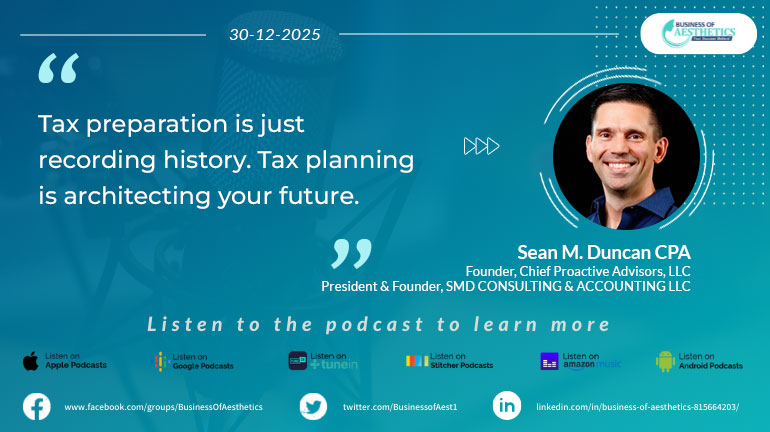
In this episode, host Don Adeesha joins Sean Duncan, founder of Chief Proactive Advisors, to distinguish between tax preparation and tax planning. Sean argues that relying solely on historical filing is a costly error, sharing how reactive financial structuring can waste tens of thousands in unnecessary taxes.
Sean breaks down the math of entity selection, identifying the $50,000 net income threshold where switching to an S-Corp becomes viable. He highlights the hidden benefits of this structure, including ultra-low audit risk, and details a reasonable compensation methodology that satisfies the IRS without overpaying payroll taxes.
Finally, Sean shares his “Big Three A’s” framework for year-end reductions: Accelerate expenses, acquire Assets, and leverage Altruism. He warns against panic-buying unnecessary vehicles and urges owners to treat their CPA as a strategic partner, conducting mid-year reviews to actively architect wealth.
Key Takeaways
- Tax preparation reports history, but tax planning architects your wealth. Relying solely on compliance is a costly mistake that can waste tens of thousands in unnecessary taxes.
- Don’t switch to an S-Corp until your net income justifies the administrative costs. Start running the math at $50,000 in net profit, and treat it as essential once you clear six figures.
- Arbitrary salary splits and zero-wage strategies are red flags for IRS audits. Protect your practice by using a formal compensation study to determine a defensible salary based on your actual administrative role.
- Stop panic-buying unnecessary vehicles just to lower your tax bill. Instead, use the “Big Three A’s” strategy: accelerate upcoming expenses, acquire legitimate medical assets, and leverage tax-efficient charitable giving.
- If your CPA only communicates during tax season, you are missing out on vital strategy. Demand a financial partner who understands medical aesthetics and offers proactive advice throughout the year.
Podcast: Play in new window | Download
Sean emphasized that true wealth retention relies on proactive architecture rather than reactive compliance. Apply that same strategic rigor to your revenue engine by building a precision roadmap designed to attract the high-value patients that fuel your financial growth.

- Get a 1-on-1 diagnosis of your online presence & patient acquisition funnel
- Identify critical, untapped growth levers (SEO, Social, Referrals)
- Define a clear action plan to attract and convert your ideal patients
- Receive expert solutions for your most pressing marketing challenges
Subscribe To Our Podcast



Key Highlights:
- 00:00:11 – Introduction & The Difference Between Tax Preparation and Planning
- The episode focuses on the technical side of wealth retention: distinguishing between tax preparation (compliance) and tax planning (strategy).
- Host Don Adeesha introduces the guest, Sean Duncan, a CPA with over 25 years of experience and the founder of Chief Proactive Advisors.
- Duncan argues that relying solely on tax preparation is a costly mistake, citing an example of a physician who wasted $60,000 in taxes due to improper structuring.
- The segment highlights early warning signs that a CPA is only doing compliance, such as a lack of scheduled meetings outside of tax season.
View TranscriptDon Adeesha: Welcome back to the Business of Aesthetics podcast. Today, we are discussing the technical side of wealth retention, tax strategy. I’m your host, Don Adeesha, and it’s great to have you here. Now, many practice owners confuse tax preparation with tax planning. Preparation is a compliance activity filing forms based on history. Planning is a strategic activity structuring your entities and compensation to control the outcome. Today’s guest argues that relying solely on preparation is a costly mistake. We are joined by Sean Duncan, a CPA with over 25 years of experience and the founder of Chief Proactive Advisors. He specializes in helping business owners move beyond the basic tax return to focus on long-term wealth architecture. Today, we are going to dive into the math. We are discussing the specific income thresholds for switching to an S-corp, how to calculate reasonable compensation to satisfy the IRS, and the safe hardware rules for estimated tax payments. This episode is brought to you by Ekwa Marketing, the digital growth partner behind this podcast and a trusted resource for aesthetic practices looking to dominate their local markets. With that being said, Sean, welcome to the Business of Aesthetics podcast.
Sean Duncan: Thank you for having me. And you know, that bio that you read, it’s actually outdated because we forgot the author of the book too. Just saying, because I did write a book for the medical profession. So if you really want to nerd out, that’s the way to go.
Don Adeesha: So I should have added that my mistake, but I’m so still happy to be here. Absolutely. No worries. No worries. Perhaps we will get a little bit, you know, uh, of a spoiler from the book itself down the line.
Sean Duncan: Yeah. I’ll be shameless about it. Don’t worry.
Don Adeesha: All right, Sean. Thank you very much. So with that being said, you distinguish tax preparation versus tax planning. Why is compliance only no longer sufficient for a high margin aesthetic practice building wealth?
Sean Duncan: So preparation is really just running the reports on how the results happened. And it’s like doing blood work. You can do blood work and say, look, that’s what happened. Look at what happened. You’ve been high sodium diet for your entire life and all you eat is ding-dongs for breakfast. It’s gonna show in the blood work. Now you can just stop or you can do something about it. And so in the world of tax, it’s about that advice as you go along so that that report is more favorable. So the tax return is simply the summary of your activities. Tax planning is the conversations and the activities to improve those results. It’s that simple. If you’re just wanting to say, yep, I’m going to have diabetes. Yep, I’m going to have diabetes. By all means, do nothing. In our world, it’s like, yep, I want to spend an extra $50,000. Yep, I want to spend an extra $50,000. Sure, don’t do any planning. It’s literally costing people retirement funds. I’m not just saying $1,000 here, $500 there. Earlier this week, so this is now technically Wednesday. So Monday, so it depends on when you send the podcast out. Monday, I had a physician that we found last year’s tax returns because they were structured the wrong way. And there’s a whole bunch of details. S Corp is actually part of it. She spent $60,000 on taxes that she did not have to just because she didn’t know what to do. Now, most of those things are irreparable. We can’t go back and make an entity exist that didn’t happen. We can’t go set up a retirement account that didn’t happen. We can’t create expenses because On April 15th, we can’t go back in time and create deductions. We can find things that you already spent money on, but we can’t create those. Now, I don’t know about you. She’s an ER doc, this particular one. It’s not in the aesthetic space, just wouldn’t happen to be an ER doc. But I don’t know anyone that wants to waste $60,000. That’s the difference between just reporting and failing to plan to create a better report. And, you know, that’s $60,000 on taxes at that too. That’s literally just money in her. That was the result. That’s not the deduction. That’s the actual taxes she wasted. So her deductions were three times that that she could have taken and other things that come with it. It’s a lot of mathy math.
Don Adeesha: Okay, love it. And what are some of the early warning signs that someone’s accountant is only doing compliance? What do owners not hear in those meetings?
Sean Duncan: If you don’t have meetings, it is most taxpayers, and this is… Not really a fault. It’s a misunderstanding. When you drop $500, $800, $1,500 to do a tax return, whatever the number is, many of them are $2,500 and $5,000. It depends on the size of your practice and what’s going on. So I can give you price points, what are average in a lot of spaces. If you’re spending money once a year, and that once a year happens to be around the time the tax return is being filed, you’re not getting planning. Because planning is an activity, it’s a service. You have to do that outside of the preparation time. Now, when I first started doing prep, even if a client didn’t pay us for planning, I was trying to find things while preparing the return. But again, there’s only so much I can do. I can’t go back in time. If you’re not spending money and having scheduled meetings at a time other than the tax return, I promise you, you’re wasting money. There’s just no two bones about it. If you are having the meetings, and they’re not leading to suggestions. If you’re saying, hey, what about this? And then the CPA responds. If the CPA is not making a suggestion, or you’re having those structured meetings that lead to an action, you’re probably also wasting money because again, we’re supposed to be telling you, did you know that the big, beautiful bill changed this rule and you can get that deduction? Like we should be making suggestions. We have a ton of our clients that invest in real estate. And so how does real estate tie into their practice? Sometimes it helps, sometimes it doesn’t. And then that’s also, don’t rely on social media for your tax strategy. It’s usually lying to you, but it’s having that relationship and it needs to happen multiple times a year. One time a year, think about it, your life doesn’t just happen once a year. Life is happening. And when you buy that new vehicle or you wanna hire your kids in your practice or you wanna set up a retirement account or you wanna find a way to turn that Maui into a CME deduction, That dialogue has to happen proactively, not reactively.
- 00:07:30 – S-Corp Thresholds & Hidden Benefits
- Running an S-Corp typically costs between $3,000 and $10,000 more annually than a sole proprietorship,
so the tax savings must outweigh this administrative cost. - Sean outlines the "net income" thresholds for consideration:
at $30k, watch and monitor; at $50k, run the comparative math; and at six figures ($100k+), an S-Corp is almost certainly necessary. - Beyond tax savings, S-Corps offer "hidden benefits" including significantly lower audit risks (less than 0.4%)
and higher asset protection compared to sole proprietorships. - Caution is advised against switching too early,
as incurring S-Corp costs without sufficient revenue only benefits the CPA.
View TranscriptDon Adeesha: Not that I have an opinion on it. Now, for entity selection, moving from sole prop to S-corp to mitigate self-employment tax, at what net income threshold does the tax saving justify the admin cost?
Sean Duncan: So, okay, this is where we’re going to get a little bit of math. So bear with me. First, if you’re listening, write this down. On average, an S corporation costs between three to $10,000 more per year to run than a sole proprietorship. And it’s a pretty wide range. And this is an annual cost. So it’s every year this is going to come up. So you need to really be sure this is creating a value. And it’s not just creating a value for your accountant so they can charge you more fees. It’s actually creating a value for you. If you’re interested in the math, this is where the shameless plug will come in. In my book, it’s called TaxRx. It’s the tax guide for self-employed physicians. If you type tax space Rx on Amazon, it’s there. I do a mathematical breakdown of all of this. So I’m not gonna bore you with it because nobody wants to listen to this many numbers, but just remember three to 10. Now to your heart of your question, You use the right term of net income. A lot of practitioners lose track of sales or revenue. We’re talking about net income, net income being revenue minus expenses equals net income. So that’s really, really important for these numbers I’m about to give you. If you’re looking at revenue numbers, it’s all out of whack. At $30,000 of net income, we watch. We don’t do anything. We watch and say to our client, okay, what’s the trend? Where are we going? What’s happening? And it depends. Is this happening in December? Are we looking at this number in June? That’s when we’ve just turned the light switch on to say, okay, are we gonna do something here? At 50,000, we do actual comparative math. where in that three to ten thousand are you so are you going to spend an extra six thousand can we save you six thousand and we start to do the math now there’s some hidden benefits of escorts that’d be in the math the math is based on the self-employment tax also not going to dive into super nerd here but again I will make like seven bucks if you buy the book. I’m gonna get super rich on it, right? But there’s a breakdown on some of these details. I can go into more now if you like, but at 50, we do the hard math. As you keep growing, That’s when it becomes more and more obvious. When you clear six figures, most of the time, I’m like, you have to do this. You have to. Have to is a weak statement. Nothing in life you have to do. You might still say, this is too much of a hassle and I’m not interested. The other thing is if you have a huge year and then are not going to have a huge year again, maybe there’s something. You’re in this plastic surgery space and you have, oh my gosh, everybody you’ve ever known decides they want procedures and you’re getting a lot of these one-offs and you made $350,000, $800,000 of just one-offs. And then the next year you’re closing your practice because you’re retiring. Maybe we do the S Corp, maybe we don’t, because again, there’s a multi-year thing. But we’ve had people that have had spikes and then dropped off. In order to keep the S Corp, we’re planning for the every year thing. We can turn it off, but you can’t do an S Corp this year, not next year, then next year, then not next year. You can’t do that. They let you do it and then turn it off, but then you have to have five year waiting period. So short reminder, 30,000, we turn the light switch on and go, are we sure? Let’s take a peek. 50,000 of net income is when we start doing the math. Once you get to six figures, if you are not an S corporation, I’m really disappointed. Now, the other warning sign, when the CPA tells you, you need to be an S corp now because you’re going to get there, That is just making the CPA more money and not helping you. You still get to incur the $3,000 to $10,000. I see people turning on the S-Corp switch too early and wasting the money. And look, the CPA is probably not malicious. They probably have good intention. There’s a beauty to these things where if you do a PLLC or an LLC or some sort of an LLC, it can change into an S-Corp and you can play the game the right way. There’s a lot of math. But look, I love making money. but I don’t want you upset that you just dropped $7,000 on us this year and your tax savings was two. I want to make sure that we take that in the right years that you create a deduction. So there is hard math. And what you do is say, show me the self-employment savings and show me the incremental increase in cost. And that’s what you’re comparing. Now, two other benefits that are S-corps are really, really cool that are not quantifiable. They are the lowest audited entity type of all types. A study back in around 2016 or so, so while we’re talking a decade, showed that they were audited less than 0.4% of the time. Not 1%, 0.4 of 1%. And greater than 50% of those audits were because the reasonable compensation was zero, which we’re about to talk about. So if you want an entity with a less than 0.2% of audit risk, now, can you screw stuff up and get audited? Absolutely. Don’t commit fraud. But if you want to be cute and aggressive, that’s pretty freaking powerful. Second is the S corporation has higher asset protection rules than the sole proprietorship. Now, medicine’s unique and there’s obviously a lot of personal liability to it, but It gives you more. Now, I’m not an attorney, so I’m technically not going to give you any legal advice. Please consult your attorney. But generally, it gives you a higher degree of asset protection. So tax savings, asset protection and low audit risk in the right circumstances. Is it worth? And that’s when if I save you six and it costs you six, you might still do it because I’m going to get those other hidden benefits.
Don Adeesha: OK. Now, as we move on, I would also like to give a little disclaimer. We’re discussing education and frameworks, so listeners should confirm specifics with their own CPA because facts and circumstances matter.
Sean Duncan: Heck yes. I’m not telling you to do anything other than call your CPA. And if your CPA won’t answer your phone call… Find a new CPA. Fantastic.
- Running an S-Corp typically costs between $3,000 and $10,000 more annually than a sole proprietorship,
- 00:14:23 – Reasonable Compensation & Audit Dangers
- The IRS requires S-Corp owners to pay themselves "reasonable compensation,"
but they do not publish specific guidance numbers to avoid setting a universal standard. - Using a fixed ratio (like 50/50) is a guessing game;
the correct method is a "compensation analysis" based on a job description that accounts for administrative vs. clinical roles. - Paying zero salary to avoid employment taxes is highly risky;
50% of S-Corp audits focus on zero compensation, and an audit can result in the entire net income being reclassified as wages subject to 15.3% tax. - Correcting past mistakes involves a discussion with a CPA about whether to amend returns or wait,
given the IRS’s current understaffing issues.
View TranscriptDon Adeesha: Now let’s get into that reasonable compensation bit. For S-Corp owners, IRS requires this reasonable compensation. What methodology sets salaries that satisfy the IRS without killing tax efficiency?
Sean Duncan: What’s really interesting is the IRS refuses to publish guidance because the moment they say this is a reasonable number, that’s what everybody’s gonna do. So if I say, Reasonable compensation has to be $150,000. Look, if you’re a plastic surgeon making $900,000, you’re more than happy. Let’s do that. If you’re an esthetician that it’s your side hustle and you only make $20,000 a year, you’re going to be mad you have to do $150,000, right? So there’s a big gap there. And it is not a ratio. A lot of CPAs go out there and say, I split it 50-50. I split it 40-60. That’s guessing, guys. The appropriate methodology, and this is what we do, and actually we build this into our programs, and this is not a sales pitch. I encourage you to look into how your CPA does this. The onus is on them in a lot of ways on how their methodology works. What we do is we do a job description for that practitioner. In other words, you own a med spa. Now, maybe you are actually a licensed esthetician and you’re going and working with your patients. But is that 100% of your time? No. You’re also doing billing and you’re cleaning the bathroom and you’re going to Office Depot and you’re, what are those roles? Those are admin roles. What we do is we build a job description model and we build an average salary based on that. So I’m gonna use my plastic surgeon example just to give it. So let’s just say a typical plastic surgeon makes half a million dollars, nice round number. I don’t need to set my reasonable comp at half a million. if the plastic surgeon is spending 50% of her time going to Office Depot? Well, that’s normally what you’d give to your admin. So what if you paid your admin 50,000? If the role is 50-50, I just split them in half. Now, it’s obviously more complicated than that, but we build a methodology and then we document how we came up with that math. And then that way, if the IRS ever asked, we just send them the file. So it’s called a compensation analysis. And what’s really, really cool, there’s lots of tools out there. What you can do is find job descriptions and you build a percentage of what your job is. This sounds like a pain in the rear. If you’re trying to do it yourself, it’s a pain in the rear. Make your CPA do it. Now, if your CPA says, I’m erring on the side of caution, I’d rather you pay a higher amount to make sure you don’t get audited. Well, yeah, you might not get audited, but you also might waste another $10,000 you didn’t have to. There’s a cost-effective way to do these studies to make sure that you’re not wasting $10,000. I mean, would you spend $1,000 on a study to save $10,000 in taxes? I hope so. While we build it into our programs, other CPAs will charge $500 to $1,500 to do the studies. Totally worth it. Look for people that do an analytical approach, not a guessing approach. Probably more details than you wanted, but it is the silver bullet to making an S corporation work. If you get reasonable comp wrong. Oh, by the way, in reasonable comp, a lot of people think I’m just going to do zero so that I pay no employment taxes. Remember that 50% of the audits? So a story. I had a former employee, was an intern. He went and became an IRS agent. So he went to the dark side. I now refer to him as Darth Vader. So Darth Vader works for the Empire and the Empire does their audits of people. They have a standard report. When they do a complex audit and they want a break, they go to the auto report that says, show me all the S-Corps in my area that had zero salary. That’s their palate cleanse. That’s their easy caseload when they need a break because they know they will win. Now, you want me to scare you a little bit on some stuff or just stop there? I’ll scare you. If they audit you and you paid zero or unreasonable salary, the consequence, they go all the way down to your net income and they go, you did it wrong. So I’m going to make that entire net income subject to employment tax, which is pious as an additional 15.3%. For every year you did it, So if you’ve been in practice for five years and you understated your incomes, your wages substantially, and you made $200,000 a year, imagine 200,000 times five, that’s a million dollars that’s gonna get popped plus penalties and interest. And then if you get an angry auditor, they’re gonna tell you, you also falsely and incorrectly reported your payroll reports. Payroll reports are quarterly tax filings. That means you now have 20 tax returns that have to be amended and have penalties and interest associated with it. So does anybody, show of hands, who wants 25 tax returns, five business returns? Oh, by the way, your personal return is now wrong too. So that’s 30 tax returns if a five-year period plus all the… They can be horrendous. Look, I’m not scared of the IRS, but I also don’t want to poke the bear when I know we have an easy path of resistance. We just do a reasonable comp study and then there it is and you’re good and it’s defensible. Like too many people try to get too cute with this stuff. It’s like trying to buy your new car at the end of the year thinking that’s a tax deduction. It’s not.
Don Adeesha: Sean, I was just curious, what’s the clean correction path for our owners who are… paying themselves a bit too low
Sean Duncan: it’s just communication and documentation it’s really just go work with your cpa if you made them you can you can go back and amend a lot of times we don’t want to draw attention to it now here’s i’m not saying take advantage of this i’m just saying it’s a fact pattern surmise what you like is everybody listening now choose to surmise what i’m about to say The IRS over the last five to 10 years has been woefully understaffed and under budgeted. Under budgeted to the point to where they can’t buy new computers and many of their computers still use floppy disks and they have to buy replacements on eBay. Let’s digest a bit. At the beginning of this year, when the Trump administration came in, they put a hiring freeze on all new employees, which included all of the seasonal IRS people that are normally there to process tax returns. and they laid off 6,000 employees and they halted most of the technology developments. Now, why am I pointing this out? If you are understaffed and under budgeted and way understaffed now, how many people are actually looking? If you made a boo-boo, Discuss with your CPA about, should I amend or should I wait to see if this low staffed and low budgeted department catches me? And then you ask forgiveness versus permission. I, of course, would never advise that. I would, of course, tell you, let’s be 100% correct. But I can’t force you to do anything. So in this window of time, now, are they investing in new tech and AI? And did they do some hiring to try to staff up? Yes, they did. but we’re a couple of years away. So as you’re driving off into the sunset, more stuff is moving into the horizon of your history. Maybe discuss with your CPA if we just let that sleeping dog lie. And if it pops up, then you deal with it because the consequence is almost the same. Yes, you’ll accumulate more interest, but the consequences are not the same. So please discuss with your CPA the strategy. Is it worth it? Is it not? What’s the risk? What’s the reward? And then you make an educated decision.
Don Adeesha: Wow. Thank you very much for that, Sean. Now, before we continue, a quick message from our sponsor, Ekwa Marketing. Ekwa Marketing are offering our listeners a complimentary 60-minute digital strategy session. This is a one-on-one consultation with a senior strategist to help you map your 12-month high-value patient acquisition roadmap. You will get a personal diagnosis of your online presence and patient funnel, uncover untapped growth levers across SEO, social, and even AI search. Walking away with a clear, actionable plan tailored just for your practice. You can check the availability and reserve your spot in under two minutes at www.businessofaesthetics.org/msm. Now.
- The IRS requires S-Corp owners to pay themselves "reasonable compensation,"
- 00:23:09 – Estimated Tax Payments & Safe Harbor
- Quarterly tax payments are designed so the IRS can fund government activities throughout the year;
failing to pay them results in penalties for disrupting their cash flow. - To meet "safe harbor" rules and avoid penalties,
owners should pay 90% of the current year’s estimated tax liability throughout the year. - Alternatively, owners can pay 100% (or 110% for high earners) of the previous year’s tax liability to avoid penalties,
even if they owe more at the end of the year. - Seasonal income fluctuations can justify lower quarterly payments,
but this may require writing a letter to the IRS to explain the variance and remove automatic penalties.
View TranscriptDon Adeesha: Sean, estimated tax payments. They create cash flow friction, right? So how can owners calculate quarterlies to meet IRS safe harbor without tying up operating capital?
Sean Duncan: My first answer is this should be something you’re clear in your communication with your CPA is will they be doing it for you? It is not an assumed service. This comes back to, did you pay for it or not? If it is not explicitly in their program to give you the advice, you then either hire them to do it, which is what I really recommend because this is what they do all day, every day, or you’re going to do it yourself, which is what we’re about to chat about. So that’s the first thing check. Is it already being done? And by the way, if you are paying for it, it’s not being done. Go give a big smack of somebody’s hand because they should be taking care of you. So the general rule essentially says that you have these four tax payments, the quarterly estimated tax payments. They do not fall on logical quarterly dates. So if you look at the schedule, I’m not going to go into the details. It’s kind of absurd, but we’re just going to say quarterly. You look at your net income, you look at your bracket, and you send a check in. It’s pretty simple, right? It’s not that difficult. The goal is for the IRS to have your money as the year is going so they can fund the government activities that they want to fund. If you choose to pay all of it on April 15th, as opposed to paying the estimated tax payments, they will penalize you because they did not get to enjoy your money as the year is going. That’s why they penalize you. It messes up their cash flow. So they’re going to recoup that from you. It’s like slow paying patients, right? You’re gonna might attach an instant or collection fee to it. The safe harbor rule has a couple general rules to it. You can do one of two things. You can pay as the year goes up to 90% of what you estimate your current tax to be. So let’s just say you owe $100,000 in taxes for the year. If you send in $90,000 by January 15th, because there’s the four payments, we’re not talking about April. We’re talking about the quarterlies. You will not be subject to penalties and interest for failure to properly pay. Doesn’t mean you don’t owe the rest of the tax. You still owe the other 10,000. You just won’t be penalized on late payments of the other 90. And that’s where people get messed up. They’ll pay everything on the January 15th and they’re like, what? I got penalized. The safe harbor says I can do 90%. Yeah, spread throughout the year. They want your money. I mean, they’re going to find a way. The other thing is, is you can look at last year’s numbers and depending on your AGI, pay 100% of that number or 110% of that number. For the audience, assume it’s 110%, it’s a conservative bet. So if last year you owed 50 and this year you’re gonna owe 100, if you paid 55, 110% of 50, you won’t be subject to the penalties and interest. but you will still owe the other 45. It doesn’t change the tax. It only changes the penalties and interest. Now, every business owner has a different level of cashflow. You’re gonna have different seasonality. There are moments. How many of y’all experience a huge influx of procedures in November and December because people are trying to, they’ve met their deductibles? It is appropriate to pay less in the quarter that has less income. It does not mean the IRS won’t penalize you. You just have to write a letter back explaining. So if you open your practice on January 1, but then the construction is garbage, the guys are messing you up and the city’s holding back license, and you can’t perform a single procedure until November, and you’re mad because you couldn’t make money for 11 months, but then you perform a bunch of procedures in November and December because that’s the way it happens, you actually technically owe only the January payment. But the IRS will still send you a penalty notice. You have reasonable cause to say, no, no, no, no, no. Look at my revenue. And you literally just send them a P&L. Look, I made nothing. And they’ll waive the penalty. That is reasonable cause for not. So just this is education that the CPA should help you with. Nobody wants to pay a CPA. But sometimes we’re actually kind of worth it, especially in those moments when, oh, my gosh, my penalty is thirty five hundred and it takes us a couple hundred bucks to write a letter. Is that helpful?
- Quarterly tax payments are designed so the IRS can fund government activities throughout the year;
- 00:27:43 – Year-End Tax Strategies: The Big Three A’s
- Sean introduces the "Big Three A’s" for year-end tax planning:
Accelerate expenses, buy Assets, and Altruism (charity). - Accelerating expenses involves paying for future costs (like CMEs or equipment) in December to claim the deduction in the current year,
though caution is needed for those in lower tax brackets expecting to jump higher. - Buying assets focuses on legitimate large purchases (e.g., surgical monitors, tables) that can be fully deducted via Section 179 or bonus depreciation,
rather than buying unnecessary "junk" or luxury cars. - Altruism involves charitable contributions,
such as setting up a donor-advised fund to create an immediate deduction while distributing funds over time.
View TranscriptDon Adeesha: Definitely helpful. And of course, you know, with December 31 approaching beyond spend cash for a deduction, what are the most effective year end strategies to reduce current year liability?
Sean Duncan: It does depend if we’re having the conversation October, November, December, right? We’re now having this conversation with a couple of weeks left in the year. So what I’ve tell people is I have my big three, the big three A’s. So think of triple A. So it’s an emergency truck is going to come up and tow you out of some tax issues. Accelerate, assets, altruism. And I’ll explain all of these. So accelerate, assets, altruism. Accelerate, that is accelerating your expenses. Here’s a very simple rule. If you know for sure you’re going to be spending money in January, February, March of next year on something, You’re gonna book that trip for a CME. You know you’re buying a new laptop. You know you’re going to have to pay your accountant for their tax return, whatever, like anything. If you pay for it in December, it pulls that expense and accelerates it into the current year. Yes, you’re stealing from next year, but would you rather have a tax savings this year or next year? Now there’s strategy. If you’re a startup practice and you’re in a 22% bracket now and next year you’re going to be at 37, I might not want to do this. So keep this in mind. There’s some numbers that go with it. But generally, if you know you’re going to spend money, do it. Now, the opposite to that is don’t buy crap you don’t need. Good grief. You don’t need 92 paintings for your office. You don’t need new exam tables if they’re a year old already. Please don’t buy new furniture if it’s only a year old. please don’t go buy a new expedition just because it gets you a full tax deduction. Because did you know there’s actually so many things that can go so wrong with the vehicle purchase thing? Why did I bring it up twice? Literally yesterday, a client informed us that they bought two new vehicles so they can get the $190,000 of deductions. Now, think about how costly these vehicles are, right? $190,000. And it is a deduction if… If it’s a 100% business use vehicle, I promise you their Tesla, it’s not an emergency vehicle. That’s not the vehicle they’re driving just for work. They don’t park it at the office. They’re taking their kids places. If you buy the vehicle and try to accelerate the expense of a vehicle into the current year, you’re probably actually increasing your taxes if the IRS catches you, which actually flows into the second one, assets. Assets are big purchases. So we are gonna accelerate the purchase of big stuff. Cars is the one everybody gets excited about. What I usually look at is, Do we need new surgical monitors? Do I need new beds? Do I need new exam tables? Legitimate assets. Is it time because there was an amazing Black Friday deal to buy five new laptops because your staff is screaming at you about how slow they are? Yes. If you’re familiar with the rule of assets, assets are supposed to be depreciated, spread out over a period of time. Okay, bear with me on some numbers. I know these sessions can get technical, so I’m going to give you the simplest one. A laptop is considered a five-year asset by the IRS, which means if you buy a $2,000 laptop, that’s a $400 deduction every year for five years. Simple math, right? But you reserve the right to take all $2,000 this year. That’s accelerating the deduction. That’s the section 179. It’s the bonus depreciation. It’s whatever you call it. So on these big purchases, even though you are supposed to depreciate them, some of them give you rules where you can take them all right now. I do have one doctor buying an airplane right now, and he’s trying to hurry up and close on it so he can get a $600,000 deduction. Believe it or not, an airplane is a more legitimate deduction than a freaking car. I’m not making that up. He’s going to get… He’s a, this guy happens to be an ER doctor. He makes about three to 350. He’s going to buy a $600,000 airplane. Whoosh. We’re going to fly into the negative quarter million. But then what we’re going to do is we’re going to go into his retirement account and we’re going to do a Roth conversion. We’re going to take about $400,000 of his retirement account, convert it to Roths, which will then make him at $150,000 of income. which is a lower tax bracket than his 350. And he was already sending in estimated payments. But what we just did is we turned his $400,000 into Roth, which will make it non-taxable when he retires. So there’s interrelationships. So when on my second one, assets, dream big, y’all. Now you have to have time. The calendar is against you. So it’s a big deal. And under the asset category, I also sometimes include the retirement account in that conversation. If you have a 401k and you want to build assets and buy securities, retirement accounts are phenomenal. But thanks to recent tax laws that were a couple of years ago, the Secure Act 2.0 under the Biden administration, you don’t have to set up and do your retirement accounts by 1231. It’s why I’m kind of leaving it out to my big three. We get to have that conversation in January, February now. So if you’re like, oh my gosh, I got to do a 401k. No, no, no, no. Hold on. It’s cool. Chat with your financial advisor. Focus on accelerating expenses, buying the assets, which is another version of accelerating. And third, altruism. Charitable contributions. Donate to charity. Set up a donor advised fund. There are limitations on what can count. But I have a lot of very high earning physicians that we look at our altruism and they’ll set up, say, a donor advice fund and put $100,000 in now, but then they’ll take five years to give it away, but it creates a $100,000 deduction. There’s a lot of advanced strategies. The IRS fully supports charitable contribution. There are so many cool strategies for my very, very wealthy. I have clients that arrange, right? There’s not everybody makes 10 million bucks and not everybody makes 2,000 bucks. But there are really advanced strategies. The more money you make, the better we can do these deductions for you. So accelerate basic expenses, purchasing of assets that are legitimate, don’t buy junk, and altruism, charity. And I leave off of their retirement accounts because it used to be there. It used to be a big four. I just could never come up with an A for it, so I’m glad it’s gone. I move it into January as part of our January planning conversations. Okay.
- Sean introduces the "Big Three A’s" for year-end tax planning:
- 00:34:35 – Selecting a CPA & Defining Self-Employment
- Choosing a CPA requires a personal interview to determine compatibility, similar to choosing a doctor;
you must like them and they must understand your specific field (e.g., medicine, real estate). - Look for a CPA who offers recurring support throughout the year
rather than just a one-time tax filing service. - Sean emphasizes that "self-employed" is a broad term;
any physician with side income (locums, coaching, speaking, real estate) qualifies for business owner benefits, even if they have a primary W-2 job. - Geographic location should not be a barrier;
modern CPAs can effectively serve clients nationwide via Zoom.
View TranscriptDon Adeesha: Now, Sean, we have arrived almost at the end of the podcast here. I would love to ask you an interesting sort of question, which is, what is one question you wished that I had asked you during our conversation today?
Sean Duncan: I wish you had said, Sean, how do I purchase 7,000 books for myself? No, I’m just kidding. I’m kidding. Oh, that’s a great question. You know, I actually teach a webinar sometimes to clients about how to pick a CPA. And I think we’ve had this conversation through the business of aesthetics before as well. You should, just like picking a doctor, any medical professional, you don’t just look for their technical expertise and their Google rating. You need to meet with them and see if you actually like them. Do you need a big firm or a small firm? There’s a lot of criteria in choosing the right CPA. When you’re looking for the right person, take the time to interview them. If they do a 15 minute meeting and then you got to decide if you just need a tax return done. Cool. That’s all you need. If you do what we do, we do subscription based work. And so it’s really becomes this longstanding relationship. Look, I need to invest to see if I like you. You need to invest and not just like, but understand that we can accomplish what you want to accomplish. Believe it or not, not every CPA understands medicine. Not every CPA understands real estate. And that’s extremely important because y’all love your real estate. I happen to be a real estate investor. I have lots of CPA friends that are real estate investors. We know it. And so understanding the difference between multifamily and single family and short-term rentals, all those markets move different. We need to know what the hell’s going on with those. And Real estate does not always offset your practice income. Even though social media says the negative K-1 for mere multifamily syndication is a deduction. No, it’s not. It’s not, I promise you. Even though social media tells you that your short-term rental qualifies as hotel losses, It is not. Work with somebody that doesn’t get your rear end audited. So interview, do they have experience? Are they a big firm or a small firm? What is their procedures and protocols for helping you as the year goes? What do you actually need? I have plenty of people I tell not to hire us because they don’t need recurring help throughout the year. They have two W-2s in a house. And you can be a W-2 physician in a house In 2016, 2018, they stole all the tax deductions for the individual. Darn near all of them are gone. I’m getting ready to speak at potentially at an orthopedic society conference. And many of their attendees are W-2 physicians. And they’re asking me, what can you do for them? Well, very little. And last but not least, when I wrote the book, and this is not the shameless plug part, this is very intentional. When I wrote the book, I specifically titled it, The Tax Guide for the Self-Employed Physician. Now, physician is a loose term. Estheticians, nurse practitioners, they all count. Self-employed is the key. You do not have to own a practice to be self-employed. you have real estate you’re self-employed if you have a side gig where you just do a little extra contract work if you’re a locums if you do anything coaching speaking teaching that generates a second income that is not a w-2 you get to enjoy all of the benefits of a business owner does your cpa know that so if you there’s one thing is how to pick a cpa i really have done an hour-long seminar on these before Do you like them? Have they done it before exactly what you do? And do you feel like the services match what your needs are? They do not have to be in your neighborhood. I do this. I have clients all over the nation. And what’s so funny is clients that are 30 miles away, I’m too far. But my clients in Portland are perfectly fine. So Zoom meetings does work fine in our relationship. So I have a lot of other things, but you caught me off guard. That’s the one that popped into my head.
Don Adeesha: No, that was great. Thank you so much, Sean. Thank you.
Sean Duncan: Absolutely.
Don Adeesha: So that was a highly technical and valuable session with Sean Duncan. Now, before we sign off, a quick reminder, Ekwa Marketing’s complimentary 60-minute digital strategy session is waiting for you in this episode’s show notes. So if growth is on your radar for 2026, I recommend you check it out. That being said, I’m Don Adeesha, and this has been the Business of Aesthetics podcast. Thanks for listening, and here’s to a profitable interview.
- Choosing a CPA requires a personal interview to determine compatibility, similar to choosing a doctor;
GUEST – Sean M. Duncan CPA

Sean M. Duncan is a CPA and the Founder of SMD Consulting & Accounting, LLC. With over 25 years of experience, Sean has built a reputation for shifting the focus of accounting from retrospective compliance to prospective strategy.
Known as ‘The Chief Proactive Advisor,’ Sean specializes in comprehensive tax planning and wealth architecture. He advises business owners on the complexities of entity structuring, asset protection, and tax mitigation, helping them navigate the transition from simple tax filing to strategic financial management.
HOST – Adeesha Pemananda

A seasoned marketing professional and a natural on-camera presence, Adeesha Pemananda is a skilled virtual event host and presenter. His extensive experience in brand building and project management provides a unique strategic advantage, allowing him to not only facilitate but also elevate virtual events.
Adeesha is known for his ability to captivate digital audiences, foster interaction, and ensure that the event’s core message resonates with every attendee. Whether you’re planning a global webinar, an interactive workshop, or a multi-session virtual conference, Adeesha brings the perfect blend of professionalism, energy, and technical savvy to guarantee a successful and impactful event.
Resources


Connect with Us:
Category: Business of Aesthetics Podcast