Welcome to Episode 238 of the Business of Aesthetics Podcast!
In this episode, host Michael Walker sits down with Brittany Perez—an inspiring business owner, aesthetic injector, and national trainer. Brittany shares how she built a thriving culture at Mela Medical Spa where team trust, strong values, and personal growth come first.
You’ll hear how Brittany went from being a nursing instructor to opening her own practice and training academy. She opens up about the power of patient care plans, building confidence, and leading a team with love, not fear. From enneagram tests to positivity boards and four-day workweeks, Brittany explains exactly how she inspires her team and keeps them connected to the mission.
Whether you’re just starting your aesthetics journey or looking to grow your practice culture, this episode is packed with real advice, honest stories, and practical tools you can use right away.
Key Takeaways
- Confidence is the heart of aesthetics.
Brittany’s passion began with her own treatment—helping people feel good again is her mission. - Patients want to feel better, not just look better.
Most clients come in for emotional healing as much as physical transformation. - Culture starts with leadership.
Brittany builds a positive team environment with open communication and mutual respect. - Tools like the Enneagram build understanding.
Personality tests help her team appreciate differences and handle conflict wel
Podcast: Play in new window | Download
Subscribe To Our Podcast



Key Highlights:
- 00:00:07 – Welcome & Introduction
- Michael introduces the podcast and guest Brittany Perez.
- Shout-out to Ekwa Marketing and details about their digital marketing offer.
View TranscriptMichael Walker: Welcome to another segment of the Business of Aesthetics podcast. I’m Michael Walker, your host for this episode. Before we get started, I want to thank all of our incredible listeners from the United States, Canada, and around the globe. We couldn’t do this without your continuous support. A special thank you also goes out to our sponsors for this episode, Ekwa Marketing. With nearly 20 years of experience, Ekwa Marketing is a leader in digital marketing services for aesthetic practices. They are offering today listeners a complimentary digital marketing consultation, which will include a tailor-made 12-month digital strategy for your practice. And I’ll mention that again as we get closer to the end, but you’ll be able to head over to the website, which would be www.businessofaesthetics.org/msm. And that will also be on the page you’re picking up this podcast from as well.
So without further delay, let’s dive into our theme for today. I love it. I love this theme. I love these words. I love the word: from hire to inspire, nurturing team growth and culture. And joining us today is Brittany Perez. It is great to have you with us today, Brittany.
- 00:01:18 – Meet Brittany Perez
- Brittany is a national trainer, injector, and owner of Mela Medical Spa.
- Her spa focuses on personalized care, confidence, and holistic wellness.
View TranscriptBrittany Perez: Thank you so much. I’m so excited to be here.
Michael Walker: Well, I’m gonna go ahead and share a little bit of your background with our listeners and set the tone for today. I’m gonna start out—Brittany is a national speaker, trainer, and aesthetic medicine injector. She holds a Doctor of Nursing Practice degree, along with a Master of Science in Nursing Education, and is a certified Family Nurse Practitioner.
Brittany is also the owner of Mela Medical Spa, a premier destination for medical aesthetic treatments. At Mela, their philosophy is centered on personalized care, working closely with clients to develop treatment strategies aligned with their unique goals and areas of focus. The spa’s core values resonate with empowering individuals to look and feel their best. I see where that word "inspiring" is coming in—recognizing the transformative impact this has on confidence and well-being, and unlocking a client’s full potential in both appearance and overall wellness.
And Brittany extends her expertise through Mela Method Aesthetics Academy, where she trains and mentors aspiring practitioners—something to keep in mind if you’re looking for that type of training—and equips them with the skills and knowledge to excel in aesthetic medicine.
So I’m gonna go ahead and jump right into some questions with you, Brittany, if you’re good to go?
Brittany Perez: Absolutely.
Michael Walker: Excellent. Okay. Well, the first question—it’s always my… I just, I think it’s always—so we just like to know the word "passion." It’s a word that we don’t probably use enough, but in your industry, it’s used a lot, along with "inspire" and "wellness" and "holistic." But can you share with us what was the genesis of your passion for aesthetics and medicine itself?
- 00:03:09 – How Brittany Got Started in Aesthetics
- She had her own chin filler before her wedding.
- That treatment sparked her passion for helping others feel confident.
View TranscriptBrittany Perez: My passion came from treatment to myself. I got married and I was looking at my wedding photos, and I couldn’t figure out what it was about my profile, but I wasn’t happy with it. And ultimately, I ended up getting a chin augmentation with dermal filler, and it gave me so much more confidence. And I fell in love with the industry.
At the time, I was a clinical instructor for a nursing program, and one of my students—I told her I was kind of looking to get into the industry—and her job had an opening. I interviewed, and I got the job the same day. After that, I worked in plastic surgery, mostly as a post-op care nurse. And then the surgeon that I worked with had free Botox—every time that a patient would get a breast augmentation, they would get 50 units of free Botox. And it was my job to inject the 50 units of Botox.
And it was so exciting for me to see the patients at their two-week follow-up and see what an improvement I could make in their appearance. And again, everything that we do in our industry, for me, is for confidence. And being able to see that for myself, and then see it in patients, was really inspiring.
Michael Walker: That—and that word "confidence." Thank you for sharing that. I think that’s… I’ve heard that a lot. It’s like a… it’s usually from a grassroots experience of, you know… I remember, was it Remington? Like the guy that owned the—"I liked the razor so much, I bought the company." That kind of an idea. You know, I totally get that. Exactly.
Brittany Perez: Yes, exactly.
Michael Walker: So, I’d love to hear from you a favorite story you have from a client—obviously confidentially—on how aesthetic treatments have impacted them. And specifically, we’re talking about confidence. I’m sure that’s where we’re gonna land as well.
- 00:04:58 – A Common Story: Postpartum Confidence Boost
- Brittany shares stories of moms regaining confidence through treatments.
- Treatments help with physical changes and mental wellbeing.
View TranscriptBrittany Perez: I think in general—because I have a lot of patients that have a similar story—a lot of my patients are in their late twenties to early forties. They have a baby, they get pregnant, and they’re just not feeling quite like themselves afterward. They’re having these hormonal shifts. And again, going back to the confidence, they just don’t look familiar to themselves. Their body doesn’t look familiar. Their face has changed. They’re not sleeping as much, so they’re seeing dark circles.
These patients come in and they’re just desperate to feel good again. They mentally want to feel good again. They physically want to feel good again. And they come in just saying, "How can you help me?" And being able to give them a care plan that is now both regenerative—right, we’re moving into a lot of regenerative medicine—but also those quick fixes with Botox, with neuromodulators, that they can see almost instantly, helps pick them back up and get them back into going to the gym, back into personal care.
And just really moving from being a mom and only focusing on your family to taking care of yourself again. Because we know when we take care of ourselves that we show up better in the world, right? We show up better with our family and in our jobs. And no matter what we’re doing, if we have that little bit of self-care, we’re gonna be happier and more positive—and be nicer.
Michael Walker: That’s beautiful. And as you’re saying it, I’m thinking about… I’m a leadership coach, and I deal with confidence issues a lot—not through… in a more… in a different vein—but you know, the one thing: if you look in the mirror every morning, you get up and look at yourself and you say, "You’re a stupid son of a gun, and you’re not worth anything," how long will it be till you believe that?
And I think in this case, you’re here, you’re giving somebody… they’ve looked in the mirror—I love that term—they’re not familiar. They don’t look familiar to themselves. They look in the mirror and say, "Who is that? I’m not sure I like that person." And it’s interesting looking at that through a medical standpoint, where I’m dealing with emotional and relational.
It just really speaks to the concept of what I hear a lot, which is holistic wellness. And really, it’s the wellness of the mind, body, and spirit, you know? And in your industry, you guys get that. You guys at Mela, you get that. And a lot of industries haven’t figured that out yet. But there’s an expectation now that people don’t just want some specific thing. They want that whole list—that wellness that touches all aspects of their life.
- 00:07:28 – People Come for a Feeling, Not Just Looks
- Clients are looking to feel better, not just change appearance.
- Mela’s focus is giving great experiences—not just sales.
View TranscriptBrittany Perez: Or do they—sometimes they don’t realize it—but they’re coming to us for a feeling. They’re not even coming to us for the way that they look. They just want something to grab onto and feel good about. And that is what we represent at Mela. And that is what I have built my team to do.
And when we talk about culture and team building, everything that my girls represent is making the patient experience everything else. Sales are important to run a business, but that is not our priority. Our priority is to give the patient the best experience. And my priority is to give my team the best experience working for me. I want them to enjoy coming to work. I want it to be a good team environment where we’re working together. And I just—that’s what I want to represent.
Michael Walker: Well, you’ve set—thank you. You’ve set that up beautifully for where I want to take the questions next. Thank you, Brittany. You know, our theme today is From Hire to Inspire: Nurturing Team Growth and Culture. So can you unpack for us kind of what that theme means to you and for our listeners?
- 00:08:35 – From Hire to Inspire: What Culture Means to Brittany
- She avoids toxic competition and focuses on collaboration.
- Enneagram tests help her team understand each other.
View TranscriptBrittany Perez: I can. It is so near and dear to me because I think we’ve all worked in environments where there was some toxicity. And I think that that can be really rampant in the aesthetics industry, unfortunately. I came from an environment where it was kind of competitive—even within the same business. It was like, even though we’re all working for a shared purpose, we’re all fighting for patients. And whenever I opened my business, I didn’t want it to be like that. I wanted to try to foster a collaborative environment, both inside the practice and with other injectors locally.
And luckily, I’ve been able to foster relationships with injectors by training and doing all those things. But it’s a little bit more difficult with the staff in your building—especially when it’s a lot of women, right? There can be a lot of emotions involved. And so, this may be a little controversial, but one of my favorite things that I’ve ever done to foster a sense of community in the building here is an Enneagram test.
Brittany Perez: Have you ever heard of an Enneagram test? Mm-hmm. You might do that with your leadership. I actually have all of these books here—it’s called The Path Between Us—and I got them all for Valentine’s Day from the girls because it helps us appreciate why our brains… what motivates us, why does our brain work this way? And it helps us appreciate the differences.
And anytime someone has any type of concern with another staff member, they know that we are going to ask them to talk together and not talk behind their back. And I think from leadership—if that starts in leadership—and they know that they can’t just come and complain every time they have something going on, that we want them to have interpersonal relationships and talk it out, that’s just how things work here. And it’s an expectation. And we make it a point to say good things about each other.
- 00:10:13 – Positive Environment and Accountability
- Staff are encouraged to talk to each other, not behind backs.
- A positivity board celebrates each team member weekly.
View TranscriptBrittany Perez: We have a positivity board in our break room, and we leave notes. We leave notes that say, “Thank you so much for helping me with this,” “You did a great job with that patient”—no matter what it is. We try to find something with our staff every week, and we put it on a positivity board, so we just get to see little notes about ourselves there.
It’s just… it’s really built from the top down. I think in businesses, when you have leaders that are not self-aware themselves, how are they supposed to lead other people? They become bosses instead of leaders. And you could probably speak on that better than anyone. I didn’t want to be a boss. I didn’t want to have my finger on people. I wanted them to have autonomy. I wanted them to be proud of their work, and I wanted them to come to me if they need help. And I’m always here. But I wanted them to feel empowered. And I think that’s what we’ve created.
Michael Walker: Beautiful. Yeah, I can… you know, I can hear your passion in that. And you know, you’re absolutely right—you can’t give away what you don’t have. You know, if you’re not living the example, if you’re not loving the example, if you’re not engaged in it in a way that people can follow you, then it’s just a policy.
We always talk about—our whole thing is about helping leaders lead themselves well so they can lead others well. And the philosophy—and we… interesting—we use a model where we use different personality profiles. We use one that we’ve customized called The Four Animals, ’cause it’s so sticky. People can identify with them, and it interacts.
Michael Walker: And so we’ve introduced the four animals, your conflict management style, your appreciation language, and your learning style. And so everybody in the organization that we work with—they all know that. So everybody knows each other. So how quickly do you have this incredible mechanism to, to your point, to value and hear each other, to celebrate the wins together, but also to have a self-help conflict resolution model that you can just catch stuff.
And then not just the… and then actually empower healthy conflict, where people can passionately disagree and not take it personally. And you get these crazy outside-the-box ideas, courageous conversations, all that stuff, right? Right. And so I love that you’re—that’s exactly what you’re modeling. And I love what you’re saying. That idea though, of saying good things.
You know, where I always say—somebody said to me, I said one time, I said, “I’m just curious. Like, have you ever been encouraged too much in person?” “Well, no.” I said, “Yeah, why do we ration it out?” You know? Literally, you’re right. I love what you’re doing there. That is beautiful.
So listen, let’s go into—let’s talk a little more about your team, because I think that’s really an important area that we want to focus on today. And specifically, talk a little bit about trust. And we’re going to talk a bit about building… you know, in your business, long-term relationships are king—not only for them coming back and the healthy wellness lifestyle they’re looking at—but they also will bring their friends.
So it’s so true. A qualified lead every time. So yes—what are the ways that you empower your team to build trust with your patients and foster long-term relationships?
- 00:13:17 – Building Trust with Patients Through Education
- Care plans help patients feel heard and cared for long-term.
- The team works together for a holistic treatment experience.
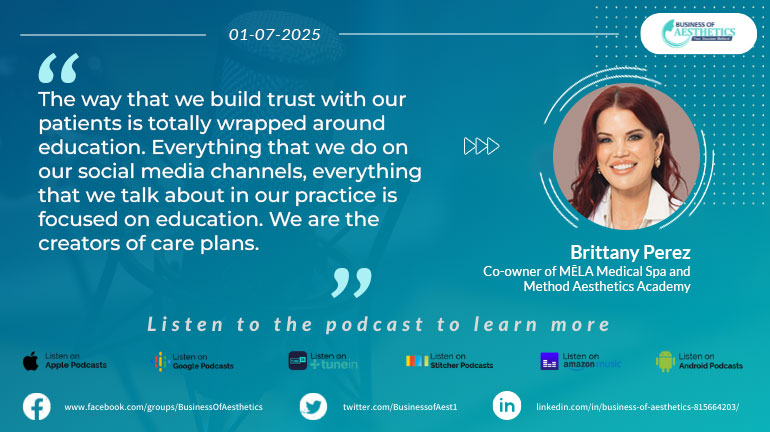
View TranscriptBrittany Perez: The way that we build trust with our patients is totally wrapped around education. Everything that we do on our social media channels, everything that we talk about in our practice is focused on education. We are the creators of care plans. That’s what we do for our patients. We expect you to be with us forever. So we’re not just doing this for today—what are we doing today and what are we doing next time we see you?
We’re making a care plan—everybody—from the estheticians to the injectors. No matter who is taking care of the patient, we have collaborative care plans. If you are seeing me for injectables, I’m also writing on your care plan when you come in to see the esthetician for your microneedling. It’s cohesive and it’s holistic, like we talked about before.
And then we also have nurse practitioners that do functional wellness. So, hey—you know, you have some skin concerns, you’re losing collagen and elastin—I can help you with some Sculptra and Radiesse, but I would love for you to see our hormone specialist. And we just have everything here. And that builds trust because we are educating them.
I think that the root of distrust is from just doing sales. This can seem like a sales industry, but it’s really like a soft sell. I’m not wanting my staff to do treatments on patients that they don’t need. I’m wanting them to educate the patients and help them come up with solutions together. It’s a team effort—even with provider and patient. And of course, the provider’s going to make the final decision. But that’s how we build trust—just by teaching them everything we know.
Michael Walker: Yeah. I was trained—my coach, when I was in the online world in coaching as well—he said, you know, the whole mandate of what we did was about… and at first it made no sense to me at all. But then he said, the whole goal here is to—you give away your very best, so you earn the right to ask for implementation.
And it’s that idea—it’s not giving away your very best in terms… you’re not giving your… you’re a for-profit business, I’m not suggesting that. But it’s not the business… you said it—it’s not the business side, it’s the relational side. You’re giving them your very best.
- 00:15:21 – Leading with Love and Encouragement
- Brittany gives positive feedback often, so critiques are well-received.
- She wants staff to feel safe, supported, and appreciated.
View TranscriptBrittany Perez: Exactly. I care so much about relationships with my staff that I do—like, I write them love notes and books. And I know that that could be an HR thing, right? But like, I’m like, "This is why I think that you’re doing such a great job." And if I ever do have any negative feedback, the staff takes it okay, because I’ve given them so much positive reinforcement every single day.
So they feel comfortable and they trust me, and they know that I have their best interest in mind. And if I’m giving them some type of tough love, they know it’s coming from a place of care because I’ve given them so many positive things that they do. We don’t want to just go to our staff when we’re upset with them. We don’t want to just go to them when they haven’t done something right, because then every time they just associate you with negativity.
And I don’t want them to associate me with negativity. I want them to associate me with trying to help them. And that’s just a mutual understanding that we have.
Michael Walker: Yeah. And I think you’re actually—as you’re talking—you’re leading me into the question I’m going to ask you next, which is about employee retention. But I think, you know, when you… this whole idea of, you know—there was a… Johnny comes home from school and is failing all his classes. Okay, he’s grounded, he’s not going out, no girlfriend, no Xbox, whatever it is.
And we say, “Johnny, we’re getting a tutor.” Well, a) Johnny owns the problem, and b) Johnny has just learned that performance equals love. And you know, we do that in business. And what you’re saying is—you are being very intentional not doing that, by putting value…
There’s a saying, “Be careful where you put your ‘but.’” You know, I’d say to my daughter, who’s an amazing basketball player—college and all that, on scholarship—and I played as well, and then somewhere along the way I’d say, “But if you’d just done this and moved this…” She says, “Always, all I ever heard was that but.”
Brittany Perez: Has to be in there sometimes. Yeah. I do that with my son. I have a 10-year-old too. And I try to be very mindful—you know, like, pick your battles, right? Pick your battles at home, pick your battles at work. Like, is it something that you really need to nitpick about? Or is it, you know, maybe figuring out their why—like, what’s motivating you? What can we do a little bit different?
Usually, most of the time, it’s a miscommunication or it’s a process problem—almost every time.
Michael Walker: I… I’m a professional mediator as well. And so one of the things—whatever’s coming at me—I just look at it through the lens that that’s their best expressed cry for help in the moment. How can I help? That’s my job.
And that takes all… I don’t have to jump into the emotional train ride that is already on a very high point usually. But I get it.
But listen, let’s start—the question I have though is: finding and retaining great team members is a big challenge. We hear that all the time from aesthetic practice owners. So can you share how you’re approaching this challenge?
You kind of already let us in—opened up that door a little bit already. Thank you very much. And by the way—listen, before Brittany answers that—I hope you’re taking notes. Like, she’s giving you little nuggets that you can take away and apply immediately. That’s the power of these podcasts. You get a best-practice nugget that you can go and try out yourself. And I just really encourage you in that.
Sorry, Brittany—go ahead.
- 00:18:35 – Retaining Great Team Members
- Open communication and clear career paths keep people loyal.
- Pay helps, but respect and purpose matter more.
View TranscriptBrittany Perez: No, you’re good. I think that building trust with your team and openly communicating with them, and, you know, just providing some clear pathways for what their time here at your company is going to look like—I think sometimes we hire team members and they don’t know what the next steps are. They don’t know what your vision for your company is. They don’t know your growth plans.
So we have a lot of really open communication. We actually do—every Friday—we do a weekly wrap-up, and it’s via text, ’cause our girls, you know, are twenties to forties, and they prefer text messages instead of emails. And we say, “This is what we’re doing well,” “These are the events coming up,” just everything. And so it keeps us in open dialogue.
I think open dialogue is really important. And pay is such an interesting thing because we know pay in this industry is all over the place. But we do kind of stay at the top of the pay scale. And a lot of times, pay does retain talent—but not always. If you pay someone really well, but you don’t treat them with respect, and you don’t give them a clear path, and you don’t do all the other things that go with it…
Because I was being paid really, really well where I was, but still, I didn’t have that feeling. It’s that feeling of fulfillment that you get in a company. And I think that is probably one of the biggest things. You know, the ways that we’re reaching our staff is by getting them to buy in—getting them to buy into the company’s mission and helping them see their purpose within the company.
Michael Walker: I think of the Apple experience. You know, Dell created a company that sold computers and different elements supporting that, and they said, “We’re selling computers and stuff—would you like to buy one?” Where Apple said, “We’re going to create a community that’s uniquely different in how we live and do things—and would you like to come join us?” And, by the way, “We’re going to sell computers and a bunch of other stuff.”
But it’s that idea—because they put the why in front, you know? And I think that’s what I’m hearing you say. You’re putting the value of that relationship… and you know, the pay—I don’t know if you saw, Gallup just came out, it would’ve been December now, year-end, with their report on employee engagement levels specifically in the United States.
And the disengagement level has gone down again—it’s higher again. And what was interesting is the number one reason for that this time around wasn’t pay—it was respect, lack of respect. And you just said that. It makes sense to me—you just said that. And it’s respect. And respect isn’t a thing—it’s a relationship.
Brittany Perez: That’s—it is. And, you know, I have so many roles within the company because I kind of have this huge umbrella that I’m trying to wrap around. But I hire people because I trust them in that role. So when I have something, say, at the front desk that isn’t quite flowing, I go to those three girls and I’m like, “Let’s talk this out. Give me your opinion—you’re in this every day.”
And again, it’s not me coming in and pointing my fingers and saying, “This is what we’re going to do, this is what’s going to work.” I like their feedback. They feel like they own the company sometimes, you know? It’s just like we all have a little piece of it, because they all care so much about Mela as well—probably just as much as we do. And it’s because we want them to feel that. We want them to really be engaged.
Michael Walker: Yeah. I can see how people will only approach you and receive what you’re saying—the way you’re describing it—if you’ve built the trust. But the trust isn’t built on necessarily more money or the highest pay. It’s about that you genuinely care and value them as a person—and we do—and how they are part of the vision and the passion for the organization and are integral to it.
- 00:22:28 – Avoiding Burnout with Balance
- Everyone works 4 days a week max.
- Brittany uses a detailed calendar and delegates based on strengths.
View TranscriptBrittany Perez: And they are. And we also—just little things—like, no one works more than four days a week here. Everyone works a four-day week, or less, because we want them to have some balance in their life. And we’ve just found that, you know, personally for my partner and I, anytime we would work more than four days, it would just feel chaotic.
So we have a four-day workweek so that we can avoid burnout. We do lots of mentorship and training with every single employee. Whenever we have a new injector—we actually have one that just came in—they do 80 shadow hours. And then, with my partner and I, they have six months of training—like close, close training. And they have a skills checklist, and they have to do 10 of each skill before they can do it on their own.
And that gives them confidence. And they, you know, they want to stay with us forever because we have really built them from the ground up. We want them to know all the skills that we do, and we want them to be confident.
Michael Walker: Now I just want to grab onto what you said there. With all that orientation that goes on in the practice, you also—we talked a little bit about this—you’ve got a training institute that you’re offering as well.
And I’ve got to believe that if somebody is in that, going through that, they’re kind of setting themselves up for a great opportunity to work with you. It’s not a guarantee, but it certainly helps a lot. Because you have a culture, and you have a system, and you have a process, and that’s like… it’s like in football—I’m a big football guy—you know, if you go into a team that has a completely different strategy and approach to the game—run-heavy vs. pass-heavy—it takes you forever to get up to speed.
But if you’re already halfway there, then what a great opportunity. So… I’m gonna come to your school and I’m gonna come get a job. I want to work with you. I like—
- 00:24:15 – Why Training Matters
- New injectors get 80 shadow hours and 6 months of mentorship.
- Brittany also trains others through her academy.
View TranscriptBrittany Perez: Hey.
Michael Walker: Come on, I’m in. I’ve never—I love learning. That sounds like a treat. Hey, I want to go to something that we talked about before we got started. The fact that you own this company—you know, you’re with a… I know you have a partner. And by the way, if you haven’t been on, you need to go—and I apologize for mispronouncing the name of your practice at the outset. I said Mela—it’s Mela. And you need to check that website. I’ll give you the address a little later, but if you want inspiration, and you want to see a theme that reflects everything you’re hearing Brittany share, that will connect the dots for you.
But the question I have for you is: how do you balance the unique and very different demands of the medical/surgical side of what you do and the business aspects?
Brittany Perez: How do I manage the hands-on time versus doing the business? Yeah? Is that what you mean?
Michael Walker: Yes.
Brittany Perez: I delegate. I’m such a good delegator. I have a great team that I trust, and I have had to realize—because I’m very type A—I’ve had to realize that the saying is, even if they can only do 80%, that allows you to do the things that you specialize in.
So I really focus in on what each team member is great at. And I have no problem moving people around. If someone is not excelling in their role—I know that I hired them for a reason—and if they’re in the front, I’ll try them in the back. I’ll move them to a different position. I find what really speaks to them.
And then ultimately, if I move them a few times and it doesn’t work out, then that’s a different conversation. But I have all these women that love being here and love the mission. And I’m good at giving paths to other people. I think that’s what’s helped me balance everything.
And I have a calendar that I plan six months out. I know what trainings I have. I know what days I’m injecting. I know what days I’m doing my admin tasks. And it took me about two weeks in December to really finesse all of the dates. But that has given me relief—because I know, can I schedule a rec dinner? Whatever it is that I need to do—I can quickly look at my calendar and I know exactly how much time I have available. So organization, I think, is really important.
Michael Walker: Beautiful. Yeah, I hear the… the key word there—delegation. What’s interesting is that a lot of us tend to delegate from a transactional perspective of what we do and how we do it. And what we’ve heard everything Brittany talk about—she’s talking about that it’s about, when you’re building trust and communication with clients—with patients as well as the team—you can’t do delegation without that being established.
Because it’ll fall short on you. Delegating won’t work if you haven’t done the heavy lifting that she’s done leading into that of building relationships. So I always talk—there are three spaces in an organization: the transactional (what you do and how you do it), the relational (who you are and why you matter), and when those two spaces aren’t working well together, that’s where the third space called conflict is. And that’s where stuff goes south on you. That’s where people fight about who didn’t make the coffee. It’s just… that’s the crazy place.
Brittany Perez: Didn’t make the spa water.
Michael Walker: Yeah! But when those two spaces are working well together, that’s the creative space. That’s where outside-the-box ideas happen, that’s where people have courageous conversations. They can talk about what they’re dealing with, you can bring it to the table. And best of all, you become the first-choice employer. And you keep everybody—and all the customers want to come to you. It’s a powerful place.
And I love the way you’re crafting that—but you’re doing it. And we haven’t talked about it, I know, but you and your partner obviously have great chemistry together. Because otherwise, a lot of what you’re talking about—I see a lot of times in a practice—they’re stuck in the transaction, trying to do systems differently. And in the journey, they’re losing sight of their people. And that’s when I usually come in to sort out conflict.
But I think in this case, you guys obviously have something working well together. And working with a team of women—I actually, I used to own a chain of flower shops and I had all women working for me. That was an experience. We don’t have time to unpack that—but…
Brittany Perez: I need to sit down with you and know like your whole experience. Like I feel like you’re so interesting—you have so—
Michael Walker: Many careers! Oh, it was amazing. Career was amazing. You know, just quickly—I had… so, we looked at in our business… my things go south with flowers—they’re perishables. So people are always disappointed. Something… there’s always going to be somebody who didn’t get them, they didn’t last long enough, they didn’t smell right—whatever. There’s always something.
So we just know we’re going to have that, and we’re going to have near-misses too. So I empowered all the team and said, “Listen—for every problem we have, every complaint we have—you have latitude to fix the problem how you see fit. And every time, when you solve that—if they bring in two new customers—you’ll get a weekend spa.”
Brittany Perez: I love that.
Michael Walker: I had to stop it. They were so… they were fixing all the problems! People would say, “How come everyone…?” You never probably said, “Well, it’s not me, it’s a…” The emotional bonding that happened in that was so powerful. And I just—I learned so much about the difference between men and women, how we process stuff. It was just so clear. It requires a different set of tools.
Anyway, I want to go to something. We’ve probably got some folks that are maybe thinking about getting into the business—maybe thinking about, whether they’re just getting into the business itself, or maybe starting their own practice, or maybe even going into a partnership with somebody or looking at that…
What advice or encouragement would you share for somebody in that situation? You can kind of pick how you’d like to frame that.
- 00:30:08 – Advice for New Business Owners
- Start with your “why”—not just to make money.
- Use free community business resources and invest in quality training.
View TranscriptBrittany Perez: Yeah, I think that is such a huge, broad topic. And for me, it really first starts with your own personal why. Like, why am I opening a business? Because if you’re opening it just to make money, you’re not going to be happy. You need to go work for someone else and make money—because it has to be a love and a passion.
I think that probably the spas that open up and close within a year are people that saw it as quick cash, and they didn’t do it because they wanted to instill confidence in people. They didn’t want to build a team—they just saw dollar signs. So if that’s you and you’re listening, I would say this probably is not going to be the quick moneymaker you think it is.
And the business side—I think one of the best resources for me was, number one, our Chamber of Commerce. And number two, we have a Small Business Development Center at our college, at UWF. And I think most communities have a small business center that can really help. They do it for free. They really helped us finalize our business plan. Any questions that we had business-related—if they didn’t have the answer, they would give us resources to reach out to.
If you’re going to work in the industry or own your own business, please get good training. And I’m not just saying that because I own a training academy. But you don’t want to just watch YouTube videos and go and inject, because you’re going to end up having a complication. And then you’re going to not want to continue pursuing it, because if you don’t instill confidence from the beginning, it’s going to make you nervous for the rest of your career. And I think that is so important.
I think that the lack of standards in our industry is really disappointing. You know, there are some states where you don’t need any type of degree—we don’t have to name them out—but I think that’s probably one of the priorities. And that’s why I prioritize it in my own practice. Everyone that I hire that’s an injector has gone through our program. Most—that’s how we hire our injectors.
But that’s not where we stop. I don’t want anyone to think they can come take a two-day Method class and then they’re ready to go and open their own business. It is a stepping stone. So you start there, and then you go and take other trainings, and you go do cadaver labs. It just—you have to start with a love for the industry.
Michael Walker: So maybe just speak a bit to the—you know, the transactional/relational space—but specifically, like, just knowing… getting training and learning the science and the art of what you do on the technical side is critical, obviously. But equally so, from what we’ve been talking about, is also how you build and develop your own self-awareness—how you lead yourself well, how you lead others—the very things you’ve been talking about, what you do and what you empower in your organization.
Brittany Perez: And I think that is so difficult because there’s no class for that, right? Unless you go and get an MBA, there’s not really anything in nurse practitioner school or MD school that teaches you how to be a business owner.
I think that it’s really just from life experiences—what you’ve had, what experiences you’ve had in other businesses—and you kind of take all of that. And I think that it sounds like you would probably be a really good resource as well for people. Obviously, like, groups like the Business of Aesthetics—Facebook groups to follow and ask advice.
I read a lot of business books. I read Profit First because I wanted to make sure that I was able to have revenue that could keep cash flowing through my business. Again, any of your small business communities that can help give you information and resources, I think, is really important.
And like you said—focus on your own self-awareness. Because if you want to eventually grow, not only do you need self-awareness to have a team, but also to handle patient complaints. Because you’re going to get them. And if you have someone come at you and you’re so ego-driven that you fight back and you can’t just listen to them and take their constructive criticism toward you…
If a patient comes to you and they say, “You know, I wasn’t really happy with this. I felt like this could have been better,” and you instantly go into defense mode—you’re not going to be able to build a business that way. So I think having your own internal self-awareness is really important in business as well.
Michael Walker: Really good. Yeah, and you kind of alluded to it—business acumen, life experience, formal training—all those elements. One of the things that I think is important too, and a lot of folks I know… I spent a lot of my life not having it—was a mentor. Having someone…
I didn’t really… as a coach, I mean, my clients have been with me a long time, and today they would say the greatest benefit of the relationship is—nowhere else do they have this beautiful, agenda-free space that they can talk about whatever needs to be talked about and explore what needs to be explored.
And it really ties into the word you used earlier—confidence—because it’s a confidence builder.
Brittany Perez: Yes.
- 00:35:03 – Importance of Self-Awareness in Leadership
- You must take feedback and lead without ego.
- Business owners should focus on their strengths and delegate the rest.
View TranscriptMichael Walker: And your business is built on confidence. I don’t want a nervous—I don’t want a nervous injector.
Brittany Perez: No. And interestingly, I have learned since I’ve been open that actually—like Galderma, Allergan—the bigger companies for injectables, they have business development coaches. And they’re like $750 a year. They’re not even expensive. The only reason that they even charge is from a legal standpoint—they can’t give you advice otherwise—but it’s actually non-biased.
I’m working with one from each of the two companies right now. And I do digital consulting and I do business consulting with two different people from each company. And it’s very inexpensive. And surprisingly, I’m being genuine—it is non-biased. They are just giving you general strategy. They will look at your P&Ls, they look at your business strategies, they ask you what you want to work on.
They actually just did a… the word is escaping me—we had a patient call, like pretend to be a patient. What is that called?
Michael Walker: A role-playing, like…
Brittany Perez: A secret shopper.
Michael Walker: A secret shopper.
Brittany Perez: Yep, yep! They do things like that—just to really help give a full assessment of our business and what we could do better. Because ultimately, even though I feel like we’re doing a really great job, there’s always ways to improve.
Michael Walker: Yeah. And it’s looking for the resources. I mean, just being smart about you. I always say—in my life, I’ve kind of narrowed down the 20% of what I’m great at. But I used to spend 80% of my time doing a lot of other stuff. And I just really… but that’s life. That takes time. That’s not a mistake—it’s a journey. It’s part of the adventure.
But I think it’s so important that you be—being curious. That’s really the word. As a leader, you’ve had to be curious. And we talk about unconditional curiosity, which is curiosity without opinion, expectation, or judgment. Starting with myself.
And it’s this idea of, what is it I need? What am I not great at?
You know, I mentioned Ekwa Marketing—that’s what they do. That offer I’m going to talk about—it’s just simply giving you a marketing platform. Unless you’re a marketing expert, then maybe you wouldn’t need it—but actually, even if you are, you could probably add value to what you already know.
But it’s this idea of just being curious, just being willing to look outside the box. I always say, when we’re exploring something, there are two questions:
One: What’s the risk to take the next step?—whether that’s reaching out to the company or starting a conversation with someone. Usually, it’s just your time. Maybe your pride, if someone says no, or it’s not the right fit. But really, it’s just your time.
And two: What’s the risk not to?
Brittany Perez: Absolutely.
Michael Walker: Well, if you really want to have that joy and that freedom… You know, I have a saying that I use in my coaching—and my whole platform is built around this idea: Making my ceiling somebody else’s floor. And I just love that. That’s what I get to do. I just love doing that.
Even today—just talking to you—this idea, how can we inspire and encourage each other in a way that helps us both do that better, love what we do, run our businesses, and at the same time, have great families and friends.
- 00:38:21 – Training the Competition? Yes!
- Brittany believes better injectors raise the whole industry.
- Helping others builds a stronger, safer community.
View TranscriptBrittany Perez: I love, I love that so much. And I actually get asked all the time—and I’m sure other providers that have training academies get asked this—but they’re like, “Why do you train your competition?” Because locally in our area, we have 60, 70 injectors within a five-mile radius. And people say, “Aren’t you afraid that it’s going to affect your business?”
But what I find is that there’s so much room in the aesthetic space for growth. And if I am helping the local community produce great results, then their friends are going to want aesthetic treatments. Whereas if we have injectors locally that are doing overfilled lips or they have Tyndall under the eyes—it’s going to scare their friends, and they’re just going to think aesthetics is bad: “I don’t want to get any treatments done.”
And I think for me, it really does build a community as well. And I learn from injectors a lot of times just as much as they learn from me.
Michael Walker: Yeah. And again—what’s the risk? I mean, your business is not built… unless you’re in a commodity and it’s all price-driven—this business is relationship first and then it’s service second.
And it’s the ones that set themselves apart… You know, I noticed lately American hospitals being more proactive with the relational space because it’s more competitive. They want to generate market share. And so, “Dr. Smith—patient surveys say he’s perfect, he was just the best doctor in the world”—that’s what that’s all about.
And that’s awesome. But you guys—yes, you guys invented that. So it’s…
Closing Thoughts
- 00:39:52 – Enhancing the Patient Experience
- Mela has a patient experience director offering snacks, blankets, and more.
- Feedback calls and surveys help keep care personal.
- Final thanks, podcast wrap-up, and reminder to check out Ekwa’s free consultation.
- Visit Mela Med Spa: melamedspa.com
- Book your free marketing strategy session with Ekwa: businessofaesthetics.org/msm
View TranscriptBrittany Perez: You know, we actually even now have a patient experience director at Mela, and her entire job is to get patient snacks and beverages. And then she gives them a service menu—“Do you need a phone charger? Are you cold? Do you need a blanket?” It has all of these different options. And she just floats throughout the office and makes sure the staff is happy—do they need anything? Are the patients happy—do they need anything?
She sends out surveys to patients, she’ll do post-op calls depending on the type of treatment. She’ll call them and say, “Hey, just checking in. Do you have any questions? Do you need anything?” That’s her whole role, and it’s been incredible.
Michael Walker: Beautiful. Yeah. Well, and with a dominant customer base of women, and women working for you—and women being just so much better at processing and dealing with emotions than we are—it behooves you to take that on. That’s just the sweet spot on the racket. It’s beautiful.
So I’m gonna—our time’s coming to an end, Brittany. I know we need to wrap up here. So I just want to thank you so much for joining us today and sharing your insight and your infectious passion for what you do, and who you are, and your team.
I’ve got this picture of you all in your team photo—everybody’s in the brown shirt that, not only that, Brittany actually has on right now—t-shirt and jeans. And it just—it’s such a collegial message. It’s beautiful. I gotta figure out how to do that with my team.
So I just want to let everyone know—you can reach Brittany for both her training school and the spa through the website, right?
Brittany Perez: Yeah.
Michael Walker: So the med spa is: melamedspa.com. That’s M-E-L-A-M-E-D-S-P-A dot com. So you can reach her there. And I encourage you to have a look at that.
You just might want to think about how you can take advantage of what you’ve heard—don’t try everything, just try one thing. Just one thing you can actually do differently today when you get off this podcast, that can help take you where you want to go—what success looks like for you.
But I do want to take a moment to thank our listeners. We appreciate every one of you.
Big thank you also goes out to our sponsor, Ekwa Marketing, who, as I mentioned, are experts in digital marketing for aesthetic practices.
And speaking of marketing, here’s a marketing moment today from Ekwa: Are you helping people choose you online? It’s been proven—short 45-second videos created a certain way help potential patients choose you. And that would certainly be an opportunity Ekwa could help you with.
And as I mentioned before—and I won’t belabor the point—Ekwa is offering you a free digital marketing consultation. You can sign up for that at www.businessofaesthetics.org/msm. I really encourage you to take advantage of that opportunity.
Because as I said before—two questions: What’s the risk to do it? Just your time—there’s no cost. What’s the risk not to? Well, that’s up to you.
I’ll leave that with you. If you do like our podcast, we encourage you to share it with your friends and colleagues—because in my mind, that’s a great way to set somebody else up for success.
Also, please don’t forget to leave us a review—we love reviews, don’t we, Brittany? Reviews are awesome.
Brittany Perez: Yeah, we love reviews. Five star reviews!
Michael Walker: Please. We love reviews. They are powerful for us—they’re powerful for all of us. And that’s a whole other conversation we could have about how Mela does their work with their online platform.
But we’re going to wrap up today. Thank you for the privilege of your time today. And I want to wish all of you, on behalf of myself and Brittany, an amazing and thriving week ahead.
GUEST – BRITTANY PEREZ
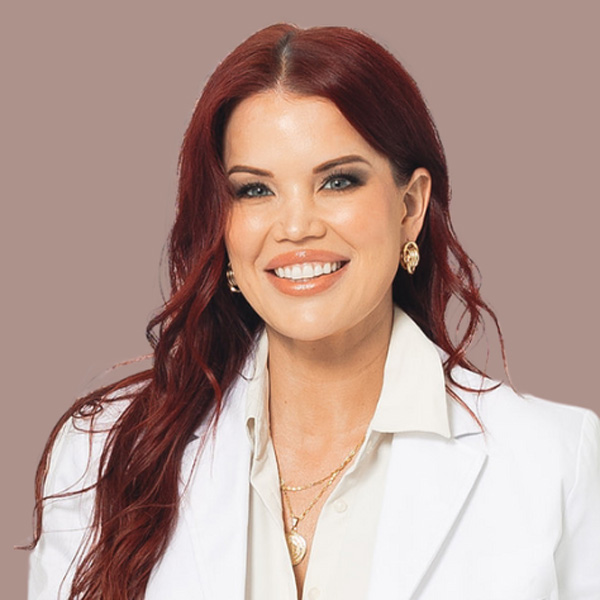
Brittany Perez is a nationally recognized aesthetic injector, educator, and entrepreneur. She is the co-owner of MĒLA Medical Spa in Northwest Florida and Method Aesthetics Academy, where she trains aspiring injectors through hands-on and didactic programs. As a platform trainer for top companies like MERZ, Galderma, and Allergan, Brittany travels nationwide sharing her expertise in advanced injection techniques and patient care. She also co-hosts the Elevating Aesthetics podcast, offering industry insights and mentorship. Passionate about education, innovation, and community, Brittany is a true leader shaping the future of medical aesthetics.
HOST – MICHAEL WALKER

Michael Walker is a seasoned leadership coach and analyst (Q.MED) who is passionate about adding value to individuals and helping them unlock their untapped potential. With over 35 years of diverse business experience, he specializes in organizational development, succession planning, conflict resolution, and mediation.
As a Qualified (Q.MED) mediator with the ADR Institute of Canada and an Analyst (WFA) with the Workplace Fairness Institute, Michael has a strong foundation in conflict resolution and workplace dynamics.
His expertise extends to providing workshops and seminars that equip participants with practical tools to apply immediately for improved relationships, fairness, innovation, productivity, and profitability.
Michael is dedicated to supporting personal and professional transformations and is committed to helping individuals achieve greater financial, relational, physical, spiritual, and emotional prosperity through his coaching and advisory services.
Resources


Connect with Us:
Category: Business of Aesthetics Podcast