In this episode of the Business of Aesthetics Podcast, host Michael Walker talks with Mary Ford, the founder of Smiley Aesthetics. Mary shares how she turned a personal turning point into one of the fastest-growing aesthetics brands in the country.
You’ll hear how she balances top-tier clinical care with smart business systems, and how she’s built a culture of consistency across multiple locations. Mary also opens up about her journey from anesthesia to aesthetics, and why radio frequency microneedling is a top ROI treatment in her practice.
From protocols and patient safety to training new injectors and making smart investments, this episode is full of real-life lessons for growing a successful medical aesthetics business.
Key Takeaways
- Radio Frequency Microneedling Offers Top ROI
Mary explains that RF microneedling gives great results, low cost per use, and strong patient satisfaction, making it the best return on investment across her locations. - Start with Your “Why” Before Buying New Equipment
She stresses the importance of critical thinking and knowing your clinical purpose before investing in expensive machines. Sales pitches aren’t enough. - Smiley Aesthetics Grew From a Personal Journey
Mary shares how a pause in her anesthesia career led her into aesthetics, eventually sparking the creation of Smiley Aesthetics. - Training and Standards Are Non-Negotiable
From new injectors to experienced staff, Mary makes training a top priority. She believes ongoing learning is essential for safety, consistency, and great patient outcomes.
Podcast: Play in new window | Download
Subscribe To Our Podcast



Key Highlights:
- 00:00:06 – Introduction & Sponsor Message
- Michael welcomes listeners and thanks Ekwa Marketing for sponsoring.
- Book your free marketing strategy session at businessofaesthetics.org/msm
View TranscriptMichael Walker: Welcome to another episode of The Business of Aesthetics podcast. I’m Michael Walker, your host for today’s conversation. And as always, a big thank you to all our listeners tuning in from across the country, across Canada, and around the world. We appreciate your continued support and your enthusiasm for all things aesthetics.
A special thank you also goes out to our sponsor for this episode, Ekwa Marketing. With nearly 20 years of experience, Ekwa is a leader in digital marketing services for aesthetic practices. They’re offering our listeners a complimentary digital marketing consultation, including a tailor-made 12-month strategy built around your goals. And you can go ahead and visitwww.businessofaesthetics.org/msm to book your free session today.
Where you pick this podcast up, there should be a hot link there for you to click on as well. But if it’s not, that’s what you’ll need to go to: www.businessofaesthetics.org/msm. I can tell you, it is a worthwhile investment. There’s no tricks or hooks to that. It’s just a great opportunity to get some in-depth understanding of your digital footprint and how it’s working for you, or perhaps not as well as you’d like.
So, let’s get into today’s episode. It’s clinical precision and practice growth inside the multi-location strategy with Mary Ford.
Mary, it is great to have you with us.
- 00:01:37 – Introduction to our Guest; Mary Ford
- Michael introduces Mary as founder of Smiley Aesthetics, a fast-growing multi-location practice.
- Highlights her success combining clinical care and scalable business systems.
View TranscriptMary Ford: Thank you. Thank you for having me.
Michael Walker: Now, Mary—let me give you a little background with Mary. She’s an entrepreneur and the founder of Smiley Aesthetics. Mary has built one of the fastest-growing medical aesthetics brands in the country, combining top-tier clinical care with smart, scalable business systems. I love that term. That’s a great term.
Mary Ford: Yeah, I love that. Yeah.
Michael Walker: From launching successful treatments across multiple locations to creating a training and mentorship pipeline for injectors, Mary brings a wealth of practical insights.
In this episode, we’ll explore what clinical modalities deliver the strongest ROI, how to vet new procedures, train providers across multiple sites, and the protocols that protect both patients and practices.
Mary, as I said, it’s a pleasure to have you here. And to kick things off, I’m gonna hit you right away with a question, and that is: What clinical treatment or modality has delivered the strongest ROI across your practices, and what makes it so effective?
- 00:02:42 – Top ROI Treatment: RF Microneedling
- Mary shares that RF microneedling brings the best return.
- She values results, low consumables, and strong patient outcomes.
View TranscriptMary Ford: Yeah, so that’s—it’s funny. As I think, you know, we’re divided into two clinical providers, if you will, right? One that uses devices and one that uses injectables across the med spa space. And so I think, depending on who you ask—which I guess I am both—but which one you ask might give a different answer.
So I think the treatment that provides the most ROI would most likely be an RF microneedling treatment. That pains me to say because my specialty is in injecting, and it’s something that I love and I’m super passionate about and trained for—the injecting.
But if I had to look at numbers and truly pick one, it would be radiofrequency microneedling because the consumable, pretty much across the board, is very low. And then what we’re able to charge for it is pretty high.
And then, you know, always bring it back to clinical—the results from even just one treatment, which to me is the most important, is results and how well it does for the client—are exceptional.
And so all of those together make for the perfect, you know, kind of the perfect thing. And something that we at Smiley are always encouraging people—in terms of device and stuff—it’s just such a great treatment. It really does have a great ROI.
Michael Walker: Thanks, Mary, for the very to-the-fact response. But I’m gonna go off script, ’cause I can. Yeah. I’m allowed to.
Mary Ford: So that’s good.
- 00:04:08 – Why Mary Started Smiley Aesthetics
- Her journey began after stepping away from anesthesia.
- A personal recovery story led her to aesthetics, and eventually, entrepreneurship.
View TranscriptMichael Walker: I gotta—I wanna hear just a little bit, that kind of just sets the tone of what—you know, you’ve introduced Smiley, introduced what you—what that looks like. You started—we’re talking about some specifics around treatments, but just kind of a—what was your passion? What was the passion behind starting Smiley?
What drove you to—and being an entrepreneur is not for the faint at heart. I’m in that club too, and it’s challenging at the best of times. What was your passion that drove you to launch Smiley?
Mary Ford: Well, you know, I’m probably gonna have a little bit of a unique answer to that question. It wasn’t so much a passion for aesthetics in general. I mean, obviously, being in healthcare with my original—I went to school for anesthesia, and I’m a CRNA—and it came after all of that, which would then beg the question: why?
Which is what most, I think, CRNAs get—why would you do something else if you’re already doing anesthesia? You know, which is both lucrative and very rewarding, and time-wise is a really great career.
But my journey kind of started with why I got interested in aesthetics, which actually had to do with a recovery story and needing to be out of the OR temporarily for what was best for me personally.
And part of some of the requirements behind that. So enter in doing something else. And you don’t have that many options, really, when you’re trying to look—trying to find something that has, you know, really surrounding controlled substances and stuff—and you’re trying to move away from that for some meaningful amount of time.
There are a lot of medical providers who have to experience this, but it’s just not talked about very often, which I’m definitely trying to flip the script.
So aesthetics—enter aesthetics, where we don’t use—you know, yes, Botox might be a controlled substance, but not the kind of controlled substance I’m talking about. And that’s how I got into the world.
That was almost seven years ago. Started in traditional med spa, just working as an injector.
And then I’ve always kind of had this entrepreneurial, I guess, brain. My twin sister—my business partner—and I, she’s clinically a nurse, and she has all sorts of other—her MBA and her doctorate and all this other stuff as well.
You know, we’ve always just done little things together—just little businesses, side businesses, side hustles.
And so when I decided to go into this and was like, "I can do this myself," of course I dragged her along with me. She said no at first, I like to say. And then she—and then we kind of got going.
So Smiley was born out of both a need, and then it very quickly revealed all sorts of needs—training, lack of training, lack of compliance, lack of just everything.
And I’m not—I don’t—I’m too type A to do something halfway. So that’s kind of what started it.
Didn’t know it would evolve quickly into what it is now, but yeah, so that’s kind of—and then I like making people happy. All the normal answers.
I enjoy this. I enjoy people coming in, in their self-care, and making them feel better about the way they look. And of course, I love all of that. I really do, which is why I still practice in the clinics.
But that was really the real reason behind Smiley. So—a little bit different answer, maybe.
- 00:07:24 – From Side Hustle to Multi-Location Business
- Mary explains how she and her twin sister grew Smiley from mobile Botox to full clinics.
- They started small but quickly filled unmet needs in training and compliance.
View TranscriptMichael Walker: That’s a great answer. And it doesn’t surprise me—being someone who’s energized by people—that it comes across quite clearly. And I think, so you went from a—here’s the translation I heard—it went from a side hustle to a Smiley hustle.
Mary Ford: That’s, that is true. The mobile Botox—it really did start out as a side hustle. Yeah. And I know some people in the industry get a little up in arms about it. It was not, you know, a side hustle in the wrong way—it was a side hustle in the right way. Not just a "I don’t really care that much about it," which is how it landed into Smiley. ‘Cause you just can’t half-do anything. So, no—start, do one training, and I’m already interested in what’s the next, what’s the next, what’s the next—like, what else can I learn? And so then, yes, it evolved that way clinically for me, and then on the business side a lot for Carla.
Michael Walker: Yeah. Well, that’s so cool too, with Carla, and that you guys were doing it together and having that partnership. In my world, I have a coaching company. Our full focus is on influential leadership coaching. And we define an influential leader as a leader who gives somebody something they didn’t even know they need or want, but once they have it, they can’t imagine living without it. And then—they can’t wait to give it away.
Mary Ford: That’s—
Michael Walker: That’s what you just described yourself as.
Mary Ford: To achieve that—yeah, that is a very accurate, accurate way to put it. Yes. And still holds true—even to, you know, only been three years—but those three years, that statement couldn’t be more true now. So yes.
Michael Walker: Well, it looks—as I always say—you know, look in the mirror and say, "I’m doing good," ’cause you are. And I look at the website and—very impressive. Love what you’ve done up there. But hey, I better get into some questions that we’re responding to. But I can’t—I had to know a little more about you. Thank you for sharing that, Mary. When evaluating new procedures, what criteria do you and your team use to ensure both safety and efficacy before implementation?
- 00:09:22 – Evaluating New Treatments and Equipment
- Mary emphasizes clinical research, patient safety, and ROI before buying.
- Warns against being swayed by good sales pitches alone.
View TranscriptMary Ford: Yeah, that’s a great question. You know, the efficacy thing—the safety—I mean, they go hand in hand for sure. I think the very first thing I look at is: does it work? So, you know, efficacy. And then, what risks does the patient have in order to get the result that I want or that it says it gives?
I’m very—we are very cautious. You know, there’s a lot of noise. A lot of noise about: this is the latest and greatest, this is the latest and best, this is safer, this is… and so, as a provider or a med spa owner, or the person making the decisions for what’s coming in clinically, being able to sift through the noise—
Mary Ford: It goes back to our days of learning how to research. Which is why I am—well, on a little tangent—why I’m very big on medical providers being the ones providing medical treatments, such as medicine, because we learned how to sift through noise like that and how to read research papers and identify a paper that’s not from a third party, that’s just paid for, and stuff like that.
All that is super important. And all of it goes into choosing something. It shouldn’t just be a before-and-after picture, you know, or a really good sales rep. Those are really nice things to have, but there should be some science behind it. There should be a "why" behind it.
There should be a "why" behind everything we do in medicine, because we’re affecting people’s bodies and faces.
And so it’s one step deeper than just the rep coming in and the before-and-afters. They say, "Here’s all the resources." How many people click on those resources and read each one and make sure they’re not just, you know, studies done by the company who produces whatever you’re looking to bring in?
So just taking it a step further—going back to how we would research a new medication or research a new treatment we did in the hospital, or wherever we started. Assuming most providers have done some sort of clinical practice before aesthetics—and going back to our basics. And not leaving that behind, because that’s how we were trained.
Michael Walker: Thank you. And as soon as you’re talking about the why—I hear a lot of… we had a conversation, just—I think it was last week—at a webinar, just talking about how much equipment gets purchased and then never gets used.
‘Cause a really good sales rep came in who just built a relationship with you that you couldn’t say no to.
And that goes to your point of “why,” you know. I like to—people say, “What do you mean by why?”
So to me, the why looks like this: if I ask somebody the why, I say, “Here’s the first question—what do you want your story to be, in terms of whatever we’re talking about, in 10 years from now?”
Mary Ford: Mm-hmm.
Michael Walker: And how are we gonna reverse-engineer that today and apply the due diligence necessary to acid test that in real cost today, ongoing maintenance costs tomorrow, and upgrade and replacement costs in the future?
And it really becomes—without doing that, without really looking at that—but we just go, “Well, I need it, ’cause I think we do this, we’re gonna do all—oh yeah, we’re gonna do all this.”
And we’re going to… and if it’s not part of your why, or your vision of who you are and why you matter, then what’s the likelihood of it getting adopted into the culture?
Mary Ford: Mm-hmm. Yeah, 100%. And the last piece you just said is everything. What’s the odds of it getting adopted in culture?
What’s the odds of you following through? What’s the odds of you actually utilizing the machine? What’s the odds of you actually learning more about the treatment and becoming more advanced or keeping up to date with it? Slim to none.
The only reason you bought it was because the sales rep pitched you a good deal, and you never went a step further. That stuff is, in my opinion, the reason those machines—that stuff is the reason that so many—unfortunately, I think we’re up to 67% of med spas failing within the first year.
Because it’s just—it’s not knowing who you truly are as a medical provider from the clinical side. But the why, to your point, belongs behind the business as well—the compliance and the clinical.
If all three of those whys are not known, then yeah—it’s gonna sit on the shelf and collect dust, or sit in a room and collect dust and be a debt that ends up sinking you, potentially—or worse—hurting somebody or worse.
Michael Walker: Yeah, excellent. Yeah. And I think that’s—you know, the whole idea of, I would imagine you might be familiar with it—but the book by Simon Sinek on the why. Start With Why, I think it’s called.
If anyone’s listening to this and they’re trying to say, “Okay, well I’ve never really thought about that”—
‘Cause, you know, every organization has three spaces: the transactional space, which is what you do and how you do it. That’s the what. That’s not the why. That’s what you do and how you do it.
Then there’s the relational space about who you are and why you matter—that’s the why.
And then when those two are working well together, there’s the creative space. And that is the bridge between what you do and who you are.
And when those aren’t working well together, that’s when I get hired as a mediator and deal with the conflict that arises.
But the reality is to take that time to really think. And so I just encourage that. I don’t get any royalties or anything from that book, but I think it’s a great book.
It paints a really good picture. One of them being, you know—Dell computers: they sell computers. “Do you want to buy one?”
That’s what they do. They sell all the peripherals that go with that.
Where Apple came along and said, “We’re going to create a culture and a community that’s going to revolutionize the way we do life, how we connect with each other, how we interact.”
And oh by the way, we’re going to sell iPads and iPhones and all that.
So their why came before the what. And I think that’s really what you’re saying, Mary.
And it’s not necessarily—and nothing wrong with a great sales rep—but a great question to ask them is, “If this was your piece of equipment you’re bringing in, how would you help? How would you answer the why to the reason we’re looking at this?”
Make them do some work.
Mary Ford: Mm-hmm. Yeah. Make them do a step beyond. Yep. Yeah. Yeah—a step beyond. “Well, all you need is two clients for this to make the payment.” You know, that wonderful line. And it’s just like, okay, well, are you gonna give me those two clients every month for the next five years just to be safe? Because if we can do that, then—okay, then I’ll figure out my why a little after.
But no, that’s not realistic. And I really loved what you said earlier—it’s the difference in utilizing the machine and becoming great at it. Which is where business and clinical—as always, clinical being the forefront of all of this stuff—because patient safety goes into that.
You know you’re going to stay up with the times, stay safe with it, but you’re not going to do all that. You’re going to look at it one day, get some random client six months after you brought it in, get it on your schedule, and—“Okay, I’m going to go IPL their face.”
And I haven’t used it. I mean, that stuff—that’s how that translates clinically. So yeah.
Michael Walker: Yeah. Thanks, Mary. It’s great.
And obviously, to be a successful entrepreneur like you are, you have to be really good at managing your cash drivers. Otherwise, you wouldn’t be sitting here talking to me.
And the reality is—this is a neighborhood where we go and buy stuff that uses cash. Just like—well, you shouldn’t have any—but accounts receivable. But inventory—they’re big factors in our cash drivers.
And we just bought—“Well, we’ll just get that ’cause it’s a great deal” or whatever.
And I just—I know we won’t go digging into the entrepreneurial style ’cause that’s really not the focus here today. But I know that you would say to me, “We had to be very intentional with our cash management. And we established priorities and where we’re going to invest in.
There are some things we wanted to do—we had to wait and do that part two or part three.”
Mary Ford: Mm-hmm. For sure.
Michael Walker: That’s what an entrepreneur does. And just because there’s money in the bank too doesn’t mean that’s actually money available. That’s another story.
Mary Ford: Oh my gosh. Yeah.
Michael Walker: So let’s go to another—
Can you walk us through a few clinical protocols you’ve standardized to ensure consistent outcomes regardless of the provider or the location?
- 00:17:24 – Clinical Protocols & Patient Safety
- She avoids one-size-fits-all plans. Protocols are flexible and personalized.
- Emphasizes critical thinking for safe treatment.
View TranscriptMary Ford: Yeah, so, you know, this one’s twofold for me because on one end, my mind jumps to standard packages, standard ways of doing things—and stuff—when everything we do clinically, and I’m super passionate about this, because A) it is what is compliant, everything we do clinically is so unique to each individual. So we’re very careful with things like a package or, you know—yes, we do sell things in packages of three—but then the conversation surrounding it is extremely important, because three is not right for everybody. That’s one example. Or, you know, if you have a neck rejuvenation package, and everything in that package is assumed to be applicable—assuming they’re all medical treatments, which, for the most part in med spas, they are—not all of those are going to be applicable to everybody. We can’t just sell those types of packages to people.
So back to protocols—it’s kind of similar to that. A protocol, for us, is more surrounding: what do you do if something goes wrong? That’s how ours are structured. Or maybe it’s just guidelines to avoid worst-case scenarios. I’m trying to figure out how to articulate what I’m saying. Our protocols are very—we recognize that each individual is an individual. And so the protocol fits around that, if that makes sense. So it’s standard, but it’s still individualized. Trying to figure out how I say that. I want to make sure that our providers—especially our advanced practice providers, which are the only ones who can make treatment plans, right? Super compliant over here. Love our registered nurses and stuff, but they’re not able to make their treatment plans. And so our protocols are very advanced-practice focused. And our registered nurses are still looking to our advanced practice providers to actually guide them on their treatment plan, because they can’t make their own treatment plans in any state. There’s no state that you’re allowed to do that.
And so I hate the word standard—I think that’s what I’m saying. I hate the word standard. It’s more of just—we have protocols and guidelines for sure, on how we use things and how we’re trained. And we get those from our trainings, and we expand upon them based on our clinical experience—especially after we’ve been using them for years. But I struggle with the word standard when it surrounds anything clinical because of the individual client aspect. So I’m struggling with that question more than I thought I would, but I hope some of that makes a little bit of sense.
Michael Walker: Well, you know, I was thinking about this as you’re answering that—we’re talking about protocols. An interesting conversation came up the other day. So you think about a protocol—traditionally, protocols are transactional. They’re structural.
Mary Ford: Mm-hmm.
Michael Walker: And that’s what you’re saying—that’s the standardized nature of it, right?
Mary Ford: Yes.
Michael Walker: But there’s another side of it—and that’s the relational side. And the example would be: somebody comes into you and they want to have some treatment, and you’re looking at them and thinking, “What they want is really not what’s best for them.”
Mary Ford: Mm-hmm.
Michael Walker: It might be something you’re going, “You’re going too far,” or “You’re not going to get the outcome you’re hoping for, or expecting.” That would be a protocol, to your point, that’s very relational. So we don’t just say no because we say no, or say yes. We actually engage the relationship. There’s a saying that comes with this that I think would be very appropriate: People don’t care how much you know until they know how much you care.
Mary Ford: Yep. Yep, yep. Yes.
Michael Walker: So what I hear you saying is—we do both.
Mary Ford: Yes.
Michael Walker: We know what we’re doing, and we have protocols that keep it safe and make sure we’re cutting edge when it comes to safety and the regulatory aspects of the business. But then we also know you well enough that we’re okay saying, “You know what, Mary, I don’t think this is the right treatment for you.”
Mary Ford: Exactly.
Michael Walker: That makes sense.
Mary Ford: It does make sense. And also—you know, we have these policies and protocols, we have this standard of care. That’s what our protocols meet: the standard of care. But it has to allow for—if I’m doing a radio frequency microneedling treatment, for example, and the patient’s tissue doesn’t respond the way that the protocol assumes, or there’s something unique—something we’ve never seen before. This is a new industry. Like, relative to medicine, this is brand new. So something is going on that doesn’t fall within a standard—I need my providers to be able to think through and deviate away from that, and use their critical thinking, and use what they went to school for. Their ability to be a medical provider—which is the difference between a medical provider and a non-medical provider—is critical thinking to be able to adjust and treat them accordingly. And that won’t fall into any type of standard protocol. That’s kind of what I’m getting at. It’s this ability to prescribe the treatment—because RF, for example, or injectables—it’s medicine in every state. Or the delegation of the practice of medicine in every state. So, you’re prescribing these things, and in order to do that, you have to be able to adjust. So, a lot of discussion for—I think the point got across. I like the way you put it. It’s just keeping it standard to make sure it’s safe, for sure, to meet a standard of care, but ensuring providers are trained well enough to deviate away from it when necessary.
Michael Walker: No, that’s good. I like—I was thinking about this. You caught me on critical thinking, ’cause I love that term. But it’s a term that—critical thinking, to me, the corollary of critical thinking is unconditional curiosity.
Mary Ford: Mm-hmm.
Michael Walker: Curiosity without opinion, expectation, and judgment—starting with yourself.
Mary Ford: Mm-hmm.
Michael Walker: That would be helpful when you’re looking at buying a piece of equipment too. But the idea here is saying—the critical thinking is: you don’t have bias. You’re able to look at the process, the person, and the questions. In my business, I spend most of my time not on the issue where the friction is—I speak to the underlying interests, which are their needs, desires, concerns, and fears.
Mary Ford: Yep.
Michael Walker: You guys do the same thing.
Mary Ford: Yep.
Michael Walker: So critical thinking has to engage that, not just the science and structure.
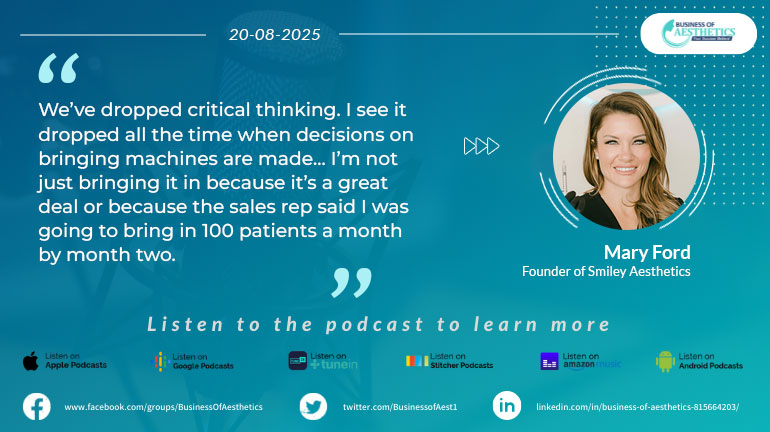
Mary Ford: Yes. And I just feel like in medical aesthetics, we’ve moved—it just started away from that. And maybe it’s because it’s a newer industry and we haven’t quite gotten back to it, but we just do. We follow and do. And now you have to deal with—we do based off what we see on social media. It’s even worse than just new medicine back in the 1940s. You’re seeing—and at least in practice, you were following what’s done where you practice—versus someone on social media that you can’t even tell what’s AI-generated or not, to the point of our conversation earlier. So, you know, we’ve dropped critical thinking. I see it dropped all the time—when I train people, when decisions on bringing machines are made. We’re not critically thinking through. That is a treatment that I’m going to prescribe to my patients. So then—why, all the things we’ve talked about. If I think about it like that, I’m not just bringing it in because it’s a great deal or because the sales rep said I was going to bring in 100 patients a month by month two. But we do that. I see it all the time in the medical aesthetic space and with med spas. Using your critical thinking will avoid that purchase. Or maybe it’s the right purchase. Maybe it is absolutely the right purchase—because you’ve seen 25 of your last patients that need almost an IPL, or an RF microneedling treatment. That’s what you need. They need it. You would have prescribed it. You would have recommended it. It’s not a suggestion—you would’ve given that medical advice. Then, hell yeah—go buy your device. And then start using your business brain to shop. But the critical thinking piece, and the treatment planning, and the why—that’s got to come first. It’ll save a lot of money too. It’ll save so much money.
Michael Walker: Yeah, and that becomes—when you don’t have—I’ve seen a lot in the medical… I spend time in the aesthetics field, the dental field, plastic surgery, the veterinary field—across the board, the consistent piece I see is the majority of the leaders are accidental entrepreneurs.
Mary Ford: Mm-hmm.
Michael Walker: They’re not you. You have a passion for it. And when you have a passion for entrepreneurship—you’re comfortable going up in the balloon and looking at things at 30,000 feet, and then being able to execute and bring it back down. That’s vision. And vision is not necessarily—it’s not a given. Everyone’s not really comfortable with it. People that are energized by stuff—they’re good with their vision of the stuff. Not the people. And so it’s important to remember: if this is your art—I always say to my clients, “We’re going to take 80% of your time and focus on the 20% of what you’re great at.” Is it injecting? Then you’re going to be Olympic level. That sort of attitude. And I think that’s the thing—make sure you’ve got the right fit. And also, we don’t have to play every instrument in the orchestra. We just need to understand the process and hire great players. And I think that’s the other thing—finding that balance. It’s like bringing in specialists that can support you, that can help you take it to the next level. It’s kind of like—it’s an unhealthy example, but I’ll use it—being an ex-football player. Not saying I ever used steroids… however—
Mary Ford:
Michael Walker: It’s hard to get to the next level. There is a tipping point—and it pushes you to that next level. If you stay on it, it becomes a problem. But it’s a help. Sometimes you need a person—somebody like a Mary—to come along. Somebody to help, encourage you. I don’t know what areas you get into on that coaching side of it, Mary, but you’d be a great coach and a great support. I’m sure you have enough on your plate, but I’ll just throw it out there.
Mary Ford: Well, I appreciate that.
Michael Walker: So let me throw you another question. This is on team training. I like this. How do you approach team training to maintain clinical competency—so that’s that transactional space we’re talking about—for sure. And patient trust—that’s the relational space we’re talking about—across multiple practices? Now, you’ve got multiple sites. In fact, you’ve got a lot of things going on, right? And that’s the biggest challenge—and if there’s anyone here who has multiple sites, the greatest challenge is consistency across the different groups.
Mary Ford: For sure.
Michael Walker: So how do you approach that training—in both clinical competency and patient trust—when looking at multiple practices?
- 00:28:28 – Training Across Multiple Locations
- Mary shares how consistent experience across clinics builds trust.
- Sets high expectations for provider training and continued education.
- She is strict about proof of learning and upholding care standards.
View TranscriptMary Ford: Yeah. So I think it, you know, to back up a little bit, or before we get straight to the training, it starts with—we start ours—what is consistent throughout our med spas, all of them, is the experience. So the experience that they go in, our reviews and stuff reflect kind of the same thing—a warm, kind of inviting environment that’s not so doctor-officey. What it is doesn’t really matter. It’s just—because it doesn’t matter if it goes the opposite direction—it’s clean and professional. However, that is what we kind of focused on first, is that every Smiley location that we opened, the experience was very similar. And that helped with the rapport.
And so once that patient rapport is at least started and goes in a positive direction, then the outcome is—if a provider is not as sharp at one med spa as another—which, our providers are amazing, but still, it’s going to come up when we bring in someone new—we’re not opposed to newer injectors anywhere. That’s kind of the mission of Smiley, in fact. And we have some great experience in our med spas, but still, if a new injector were to come in there, of course it stands to reason that her injection may not be the exact same as somebody else’s.
But if you start with that experience and establish that rapport, and some of that stuff is done first, then the outcome matters a little bit less. Or there’s a little more wiggle room, I think. And of course, there are always extremes. I’m talking about things like—you know, a provider touches up her Botox, or enhances her Botox, as I like to say, pretty much every patient—because she’s still learning faces and how to get it right, where maybe that doesn’t have to happen. That doesn’t become such a big deal to clients and stuff when that first part is done.
So I think that’s really important to speak to first. And then training-wise, it’s just establishing a level of expectation that I don’t budge on. Training is probably my number one thing, passion-wise—which speaks to the coaching side, just that whole thing. I definitely have a level of expectation for the amount of training that should be done, the quality of training that should be done, and I’ve never really given on it. I’ve never budged on it.
When it comes to online resources, when it comes to what you’re doing in your downtime, if you are a clinician, if that is your main focus—if you’re an injector in one of our med spas—if you are not treating clients, then you’re reviewing what you should be doing to treat clients. There’s just not a lot of wiggle room. Of course, there’s some marketing and patient follow-up and those kinds of things you could be helping with, but the majority of your time is focused on making yourself a better clinician.
And so budgeting for that—as a business owner, or as your clinic manager, or whoever manages your money—for those providers to continue to be trained and to find opportunities to learn new things and never rest on one training they had is imperative.
And then knowing what training and who you’re being trained by—can you tell I’m on my TED Talk now? Not all training is created equal, and not all trainers are created equal. In this day and age, everyone’s a trainer on social media. They’ve been injecting for all of five seconds and they’re, "Oh, I privately train." And if they get an Instagram following, then they’re definitely a trainer.
And once again, we lose our minds as medical providers and everything that we know, and we don’t research anybody. We’re just like, "Oh, I believe her because she looks great on Instagram." And I’m not going to see if that person’s even a nurse or a real provider. I’m not going to check any of their credentials. I’m just going to train with them because they have a bunch of followers and maybe I can do an Instagram collab with them and gain followers. It’s just—it’s mind-boggling.
So, back to your original question—standardizing the level of training that is received or sought out or what I say, “This is what I want you to do”—the expectation is high. And then QC-ing it, making sure it’s done, ensuring it’s done. Not just saying, "Hey, go do this webinar." It’s following up. They usually give you something afterward—proof that it was done. I’m a stickler. I’m a stickler for stuff like that. But it shows, because our providers do provide exceptional levels of care.
They’re not all perfectly equal—but they’re dang close. And if they’re not, we allocate more time and attention to that particular provider until we can get them to a comfort level that’s more acceptable. That’s a long answer, but you tapped into—
Michael Walker: It’s a good thing you’re not passionate about that.
Mary Ford: You tapped into my passion, if you will.
Michael Walker: Exactly. Yeah. That’s the first question I ask a new coaching client. I coach coaches nowadays. First question is, “What are you passionate about?” And, “What are the values that are non-negotiable that underpin that?” And often we haven’t really thought that through. In this world with Instagram and everything, people are chasing dreams that don’t reflect their identity, and they find themselves at a dead end and wonder what happened.
Mary Ford: Mm-hmm.
Michael Walker: I like to tie training to vision and values. When I think about vision, that’s who you are and why you matter—that’s the relational piece. So, in this conversation, my vision might be, "We will be known worldwide as the people that unexpectedly delight customers in ways they’ve never experienced before." That would be a vision.
The values are—whatever: integrity, truth, honesty, excellence, professionalism—whatever values we’re going to hold. There’s no wiggle room on those. That’s what holds the vessel.
And then the mission is what we’re going to do and how we’re going to do it. That’s goals and objectives. That’s KPIs. And then I also try and include celebrating the wins into that. But the wins are both transactional and relational—both who we are and why we matter, and what we do and how we do it.
A lot of companies lose the relational piece because they focus on the KPIs, because they’re driven by the bottom line and the measurements expected by the bank, etc. So to me, I think it’s that idea—you talk about experience. The advantage of having that kind of structure is you can test any training module against it.
If it doesn’t run through it—if we say, “Well, we do train like that, but sometimes we do it this way,” or, “Did you want something different?”—well, if we’ve got integrity as a core value, that might not line up.
Mary Ford: Mm-hmm. Yeah. And that’s important what you just said, because that’s exactly what we did. We’ve had some newer injectors—not necessarily newer anymore—but when they came on, they were. Which was a little uncomfortable for me at first, but not really, because A) I was confident in what we were already wanting people to do on the training front, and B) we were enforcing it and had no problem with it not being optional.
And then, you know, having—not a backup plan—but just having a, "If she’s not where I need her to be in this amount of time, I’m not just going to say, well, she’s good enough. We’re just going to fly."
And I’ll say this for people listening—there’s varying opinions on these mentorships and year-long internships and some of the stuff people are doing. Sure, I’m not going to say that watching somebody for a year couldn’t be valuable. But do I think it’s necessary? No, I don’t. I think some of these programs are really money grabs.
Shadowing someone 57 times over a year for $10,000 a month is just ridiculous. Yay for those who can afford it, but I don’t think that’s necessary.
It comes down to—what kind of injector do you want to be? If you want to ride the wave and just be safe and standard and go to a training every couple years, okay. You can probably do that.
Or do you want to excel at your craft and be known as an artist in the injecting world? That’s very different.
So it comes from both sides—investing from the owner side and budgeting that in from day one. Continuing education should be built in just like we do in the hospital. In the hospital, we continue education every year, no matter what. It’s budgeted in.
But in med spas, it’s like, “Ooh, can’t afford training this year—maybe next.” How did that become the standard in the medical industry? It’s mind-boggling.
So if anything, look back on that. Ask, “What did I do to take care of patients before I did medical aesthetics?” And, “Am I doing that now?” Most people will find they’re not. And they’ll see that clearly and know they need to do something about it.
Michael Walker: That’s a great answer, Mary. I think bringing it back—it is a medical field. Like, this is medical. When I first started doing webinars or podcasts in this area, I was like, “These people stick needles in people’s faces.” That’s super high risk.
I really want to know that they’re trained. You might be the greatest person with the highest marks, and that’s important—but also, I don’t want the neurosurgeon who’s just my best friend. I want the one who’s top of his class.
And I think in aesthetics, chasing whims and chasing market share will always lead to that moment when someone says, “How was your day?” and you can’t answer the question.
Mary Ford: Mm-hmm.
Michael Walker: When you go home after a great day, you’ll say, “We had a great day. We did…” There’ll be transactional stuff, sure. But there will also be something personal—something relational. Whether it’s time at the gym or time with your kids—whatever that is.
And I think that’s important. People say, “I just have to manage my time better.” That’s nonsense. Unless you’ve got more than 24 hours in a day—because that’s how many I’ve got.
It’s not about time management. It’s about time prioritization.
So how are you prioritizing yourself in this model? Because you mentioned the failure rate—and the failure rate is a blend of the stuff we’re talking about.
It’s also burnout. And there’s a reason that you’ve kept yourself healthy and vibrant in how you approach this—and it wasn’t by accident.
Mary Ford: Yeah. And I love what you just said. I might have to steal that a little—the “time prioritization” versus “time management”—because the number one question I get asked is, “How do you have time for all of it?”
And you know, I love that answer instead. I don’t usually say time management—I say I’m efficient with my time.
Because while every minute of my day is not planned—and I have a 3- and a 5-year-old, I’m getting my MBA, I have this company, I stay fit and play volleyball—it’s time efficiency or time prioritization.
Because that matters.
How do I find time to train? Or to get trained? I’m in a little bit different situation—I do train-the-trainer, I get different opportunities. But I don’t have to do those things. I build them into my schedule.
So it’s not about managing the hours—it’s prioritizing them. And that’s the same whether you’re an injector or a business owner or both.
Michael Walker: Yes. And now you pull that into your pitch when you’re sharing that at train-the-trainer.
Mary Ford: Yep. I’m going to. I like it.
Michael Walker: Alright, let’s hit a question here about some red flags. What are some red flags for you? And by the way, I’m a race marshal—I marshal Formula One races and stuff. So red flags mean—oh, that’s—
Mary Ford: That’s cool.
- 00:41:49 – Spotting Red Flags During Treatment
- Teaches staff to notice clinical and patient behavior red flags.
- Monthly team meetings used to talk through and learn from situations.
View TranscriptMichael Walker: Red flags mean that we’ve got a full stop on the course. That’s not a good thing. So, what are some of the red flags you teach your staff to always take seriously during treatments? And how do those protocols protect patients and providers alike? And you know, I think it’s important that we’re talking about patients and providers, but I think we’re also talking about the team.
Mary Ford: Yeah, yeah. Because yeah, it’ll trickle down—or it’ll trickle up, down, whatever—it’ll trickle out of that room if you’re not being aware of the red flags. And the red flags, you know, it’s all clinical, client, it’s the patient in general. My mind goes to a few places. It goes to: what clinical red flags am I looking for during a treatment—which, that’s treatment-based and comes down to clinical training. And then it’s red flags that are patient-specific, or like, them as a person. That can start on the phone with the front desk person, you know, when they’re just giving you hell just to schedule the appointment. Or you get in the room and there’s certain trigger things that are said.
We should always be aware of body dysmorphia—something that’s not talked about enough. We’re trying to talk about it more. That’s a huge red flag, before you ever treat the patient—or sometimes it’s after the first treatment. I mean, there’s business flags too—like money stuff they hint at before you even touch them. There are a lot of red flags.
I think just talking—we have, you know, entirely too many monthly or weekly meetings. I’m mostly kidding, but we have clinical team meetings across Smiley, every provider that provides any type of clinical service, esthetician or medicine. We have one for that—to talk about things that have happened. Both clinical things to look for, as well as how we as providers speak to patients and what to avoid.
Some of that stuff, even simple things like the patient you’ve asked three times to stop touching their face and they just keep touching—it’s small but it matters. There are so many facets to that question that my mind runs through that I have a hard time putting it down to something specific. But I guess my general answer would be: address them, talk about them.
Don’t let it just be like, “Yeah, make sure you watch out for body dysmorphia.” Like, okay—what does that mean? So it’s about training on them. And once again, not necessarily standardizing, because yes, we can have common signs and symptoms for red flags, but they still look different from each individual. So, addressing them, taking the time to have monthly meetings and review what’s gone on.
Did we have a conversation that made it all the way up to me? Like, this patient made it all the way up the ladder—why did it start here, go to the next provider, then one of our VPs, and then to me? What can we do to learn from that and address it? So again, it’s about talking, training, and learning.
Whether it’s business—like the front desk red flags—or all the way to clinical signs and symptoms of a VO, because those are red flags too. My mind went all over the place on that one.
Michael Walker: That was good. Hey, no, I followed you. If I followed you, then we’re probably doing okay. It’s interesting—I always make a joke that in life, we’re told there are two things that are inevitable: death and taxes, right?
Mary Ford: Mm-hmm.
Michael Walker: Somebody lied to us. That’s a big old fat lie. There are actually four things: death, taxes, change, and conflict. The last two don’t have to be deadly and costly. What’s interesting is most of us want to avoid conflict or avoid having that difficult conversation, or addressing an issue we’re not sure how it’s being received. So we apply the Sleeping Dog Theory—"I’ll just let that lie." Or "Time heals all wounds," which are both lies from the pit of hell.
But at the end of the day, it’s about being able to step up and ask a question. One of the things I’ve found is that the reason things don’t get talked through is the fear of conflict. That’s usually one of the issues. So I use, “Help me understand…” That’s how I start so many conversations. It’s that unconditional curiosity I was talking about earlier.
And the other side of that is also the idea of asking, “What do you think is happening?” Sometimes we avoid asking that because we think whatever they say, we have to do something about. But no—we can just receive it. We can move that energy wherever we want. We don’t have to own it.
Mary Ford: Sure. Mm-hmm.
Michael Walker: So I think as leaders, that’s really important—what you’re saying—and how you’ve developed that confidence in yourself to present that. But you clearly make it available to others in a way that they can trust, where they can say, “Oh, I can do that. I can see that.”
- 00:46:42 – Setting Expectations and Leaning Into Difficult Conversations
- Mary believes in confidence, honesty, and clear patient communication.
- She empowers providers to speak up and lead with care.
View TranscriptMary Ford: Oh, I try. Go ahead. I mean, what you’re saying is… the number one thing I think I say when I’m training or coaching or talking to anybody is: the way that you deliver something is everything. And the confidence with which you deliver it in the medical aesthetic space, as a provider in the room, is everything. It’s everything to recommend—not upsell—but recommend that next syringe, that next treatment. It’s everything.
But if it’s meek, and, you know, hesitant, and your mind is in their wallet—number one, get your mind out of their wallet. It’s none of your business. That’s not what we’re doing as medical providers. And you truly can’t, in the room, do that—because it’s illegal. I cannot base my treatments on that.
Setting expectations—and to your point—leaning into the conflict that might happen, which is: “You might not like your result,” or, “This could happen…” If you set expectations and start it right there, you’ve already quelled some fears—both your own and theirs—because you did talk about it.
So then, if it happens—and it’s a matter of when, not if, a red flag turns into a problem—even if you did everything you could to mitigate it, aside from just pushing the patient out the door, like, “Nope, you’re not my client”—and we try not to do that, obviously—even if you did everything right, there’s going to be a vascular occlusion. There’s going to be a patient who doesn’t pay. There’s going to be a bad outcome, or an outcome that requires further intervention in some way.
Knowing that “when,” not “if,” and not letting that drive you into anxiety—but instead using it to prepare—that’s the key. Having a plan, having protocols, knowing what to do when something goes wrong—that gives you the confidence to address it.
All of those things can happen in a short window. It’s not hard. In two minutes, you can set expectations, deliver with confidence, and address what could happen. But you do have to have that confidence to do it. And that’s something that’s hard to give to people. I think you’re probably better at that than me.
Michael Walker: No, you’re pretty darn good at it. But I see a pattern, especially with doctors or high-level professionals—they feel like they have to know everything, be right, and be perfect. And it’s not okay to say, “I don’t know.” But it is okay. That’s part of the journey of leadership.
Mark Twain said, “If you think you’re a leader, every once in a while look behind you to see if anyone’s following.” That’s the challenge in this field. Because by sheer demand and structure—and the science, the theory, the need for services—it pushes the business forward. But it often pushes forward a transactional structure. And you can leave people behind. Or you’re constantly replacing people. Or they don’t feel empowered.
Also—smileyaesthetics.com—that’s their website. You have to check it out. It’s awesome. It is so well done. I really like what I see.
I look forward to visiting one of your clinics one day.
But our time is getting to an end, Mary, so thank you so much for joining us today and sharing your clinical and your business experience, your passion, and your insights on running a successful multi-location aesthetic practice.
It’s a lot of work. But there’s a reason you’re being successful—and it’s not one reason. It’s a collection of them.
And I just encourage you—if you’ve been listening to this—think about going back over it and identifying four or five things you’ve heard from Mary that have set her up for success. Not just financial success—but relational, physical, emotional… arguably even spiritual. Whatever that looks like for you.
But that’s prosperity. It’s the wholeness of a person—not just the financial dimension on its own. So I just leave that thought with you and love that again.
- 00:50:52 – Closing Thoughts
- Michael thanks Mary and encourages listeners to reflect on key lessons.
- Book your free marketing strategy session at businessofaesthetics.org/msm
View TranscriptMichael Walker: I hope that we’ve left our audience with some great takeaways. Well, I don’t have to hope—I know we have. You’ve been a rock star, Mary. It’s been just a lot of fun.
So to our amazing audience, thank you for listening. We appreciate your continued support of the Business of Aesthetics podcast. If you enjoyed this podcast, be sure to share it with your colleagues and tag us on social media. Help us spread knowledge and elevate the industry together. I like to say if we do that together, we set each other up for success. And that’s a good idea, isn’t it? That’s nice.
So don’t forget to leave us a review—we love reviews, and so should you. Not just reviews that say, “You did a great service,” but ones that say how you unexpectedly delighted them. That’s what you’re looking for.
Love that. Leave us a review on your favorite podcast platform. Your feedback helps others discover the show and benefit from these important conversations. And boy, this has been really important, Mary—thank you.
A final thank you to Ekwa Marketing for sponsoring today’s episode. Don’t miss your opportunity to receive a free customized digital marketing strategy for your aesthetic practice. As I said before, you can visit www.businessofaesthetics.org/msm to schedule your consultation.
As I mentioned, this is a completely free thing. And actually, they do about a four- to five-hour deep dive into your digital footprint. And if you’re an expert on digital stuff, then maybe this isn’t for you—you’ve probably already done that. But if you haven’t, there are no hooks or tricks here. No one trying to do anything shady. I encourage you to jump in and just go see what you can find there.
I always try to look at these kinds of things through two questions. The first question is: What’s at risk if you do it? Well, your time—which is super valuable, and I appreciate that—but there’s no financial implication.
The second question is probably more relevant: What’s at risk if you don’t? Yeah. Right?
I’ll leave that for each person to consider.
So, until next time—and on behalf of Mary and her whole team at Smiley—keep innovating, stay focused on patient care, and continue to build a practice that thrives.
Again, thank you, Mary, for joining us. Mike Walker—thank you.
GUEST – IGNACIO FANLO
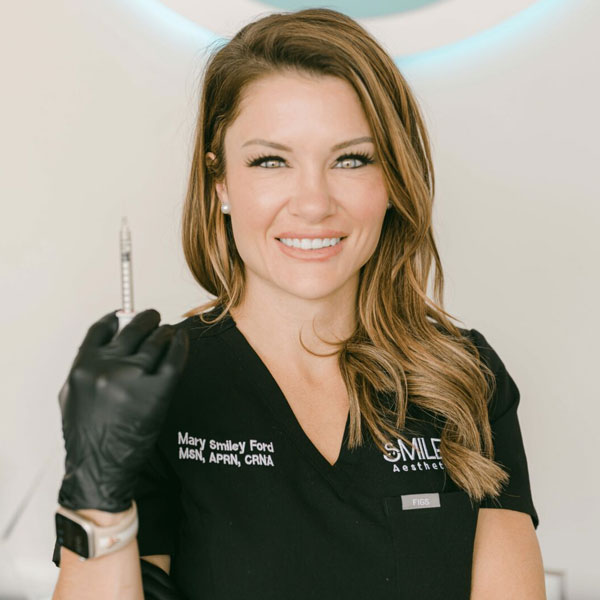
Mary Ford is a leading voice in aesthetic medicine, renowned for her expertise as an accredited injectables trainer and educator. Her credentials place her in the top tier of the industry, serving as one of only 500 faculty trainers for the Allergan Medical Institute, the world’s largest manufacturer of products like Botox and Juvéderm.
Mary has relentlessly pursued mastery, receiving private training from international experts in highly specialized techniques, including ultrasound-guided injections and advanced lip artistry in masterclasses and cadaver courses.
As an entrepreneur, she founded the Smiley Aesthetics training facility in Nashville, which hosts nationally recognized trainers and offers courses accredited by the American Association of Nurse Anesthetists. A sought-after speaker, Mary shares her insights at major industry events, including Aesthetic Next and The Medical Spa Show, and is committed to elevating the standards of practice and education daily.
HOST – MICHAEL WALKER

Michael Walker is a seasoned leadership coach and analyst (Q.MED) who is passionate about adding value to individuals and helping them unlock their untapped potential. With over 35 years of diverse business experience, he specializes in organizational development, succession planning, conflict resolution, and mediation.
As a Qualified (Q.MED) mediator with the ADR Institute of Canada and an Analyst (WFA) with the Workplace Fairness Institute, Michael has a strong foundation in conflict resolution and workplace dynamics.
His expertise extends to providing workshops and seminars that equip participants with practical tools to apply immediately for improved relationships, fairness, innovation, productivity, and profitability.
Michael is dedicated to supporting personal and professional transformations and is committed to helping individuals achieve greater financial, relational, physical, spiritual, and emotional prosperity through his coaching and advisory services.
Resources


Connect with Us:
Category: Business of Aesthetics Podcast