In this inspiring episode of the Business of Aesthetics Show, host Lauren Umstattd chats with Nurse Practitioner Aimee Kryger about her exciting journey into the world of aesthetics. Aimee shares her background in critical care and ENT, how she discovered her passion for aesthetic medicine, and the steps she took to transition into a thriving private practice.
You’ll hear about the challenges and rewards of working in aesthetics, the value of mentorship, and tips for nurses and practitioners looking to enter this growing field. Aimee also opens up about her favorite treatments, how she balances work and family life, and her big career goals for the future.
If you’re curious about a career in aesthetic medicine or want to hear honest insights from a rising star in the field, this episode is for you!
Key Takeaways
- Breaking into the aesthetics field takes patience, persistence, and a willingness to learn. Aimee shares how she built her career step by step and how staying patient helped her find the right opportunity.
- Real-world experience and strong mentors are more valuable than taking just one class. Learning hands-on and building relationships with experienced providers made a big difference in Aimee’s journey.
- There’s no “one-size-fits-all” path in aesthetics. It’s okay to try different practice settings—Aimee explored mobile therapy, med spas, and surgery centers before finding her best fit.
- CO2 laser treatments are a favorite for skin rejuvenation. Aimee loves using CO2 lasers to give patients long-lasting, natural-looking results.
Podcast: Play in new window | Download
Subscribe To Our Podcast



Key Highlights:
- 00:00:07 – Welcome & Guest Intro
- Lauren introduces NP Aimee Kryger, calling her the “missing puzzle piece” of the team.
- Aimee shares her background in ICU, ENT surgery, and how she transitioned into the aesthetic field.
View TranscriptDr. Lauren Umstattd: Well, welcome back to the Business of Aesthetic Show. I’m your host, Lauren Umstattd, and today I have a super special guest. She is the puzzle piece that we didn’t know we needed in our office. Ms. Aimee Kryger, thank you for being on the show today. Aimee.
Aimee Kryger: Thank you for having me.
Dr. Lauren Umstattd: So Aimee is a nurse practitioner who joined our team within the last year, and she’s really been a great asset for our team, our patients, our practice. Aimee, why don’t you take a few minutes and kind of tell the listeners your background, how you got into nursing, your transition as a nurse practitioner, and then kind of what led you to our practice here.
Aimee Kryger: Yeah, so I’ve been a nurse now for 12 years. That first five years I worked in med surg and then moved on to working in critical care, so in medical trauma ICU. At that point, I went back to school. I completed my master’s in nursing in 2018 and then received my certified family nurse practitioner. From there, I started working in an ENT head and neck surgery clinic. I was initially just doing clinic work and learning how to become a provider. At some point along the way, the team asked me if I wanted to work in the operating room and assist in surgery. That was completely foreign to me at the time; I had never worked in surgery as a registered nurse. I received a certificate as a first assist and started assisting in the operating room during cases.
Aimee Kryger: A few of those happened to be facial plastic surgery cases, and I just fell in love with the operating room, the vibes, working closely with the surgeons that I already was learning so much from, but being hands-on with the patients during the case and then seeing them throughout their entire course—pre-surgery, during surgery, and postoperatively. From there, I spoke with some colleagues who were plastic surgeons and became interested in aesthetics. I went and took a CME course for Botox and fillers, like, is this something we could potentially do in our clinic? So it was kind of part of my plan, and we were just trying to figure out how to get that puzzle piece. Luckily, Lauren took me in. I feel like I kinda weaseled my way in and was persistent to try to get here, but I’m really happy that I’m here.
Dr. Lauren Umstattd: Okay. Aimee’s not giving herself any credit. I would not say weaseled yourself in. I would say that, as a young business, I just didn’t have the capacity to bring on another provider. So when the time was right, I knew who it was gonna be because we had the opportunity to meet several times. You even came in and hung out with our team for a full day. Now, what drew you in towards the aesthetic world? You mentioned that you did a CME course. What was your first intro into even thinking about all that?
Aimee Kryger: Yeah, I think it’s similar to a lot of us that work in aesthetics now, but when I was 26 years young, I decided to go into a plastic surgery office and get Botox. I got Botox in my glabella and I feel like it changed my life. I no longer had my frowny face and couldn’t believe this whole other world that I didn’t know really existed. When I became an NP and was making a little bit of money, I decided to get lip filler. I got lip filler from a nurse practitioner, and that happened to be my sister, who’s an aesthetic injector. I just saw kind of the gateway to this new world of aesthetics and the possibilities that nurse practitioners could provide. It’s really something from there that catapulted me into researching my options as a nurse practitioner in the aesthetics field.
- 00:04:33 – First Botox Experience & Career Spark
- Aimee’s first personal Botox treatment at 26 sparked her curiosity about aesthetics.
- This led her to explore career options in aesthetic medicine.
View TranscriptDr. Lauren Umstattd: Yeah, for sure. And I would say I get a lot of messages from nurses, NPs, PAs who are doing more, I would say, non-cosmetic surgery, non-cosmetic clinic, and they’re interested in jumping into this field, but they don’t know where to start. What advice would you give them?
Aimee Kryger: Yeah, I think that’s the hardest question. This is a competitive field. How do you get into it? And I would say that once I found out my passion for it and started researching—and I’ll be honest, before I worked in an ENT clinic, I did not know what facial plastic surgery was. You know, I knew what plastic surgeons were, but I found this niche little world of cosmetic surgery and aesthetics, and it felt really close to home to me. From there, I just started researching, primarily surgeons in our area, other nurse practitioners that did the job that I saw myself doing—almost like a manifestation in some way—reaching out, asking to shadow, asking them, you know, if you hired a nurse practitioner, what would you want her to do? How could I assist in your practice? I know you have registered nurses, but how could a nurse practitioner benefit you? And also just being intentional in those connections that I made. I know you and I have talked about it, but I made three words for 2025 as my goals. One was humility, one was patience, and one was growth. And I think just being patient in the process and trying to find the perfect spot for me. I feel like I tried a couple different avenues in aesthetics before I found this position with you that felt right for me.
Dr. Lauren Umstattd: Let’s talk about—let’s spend some time and talk about those other environments that you kind of tested out and what that looked like. Was it full-time, was it part-time? What were some differences that you saw in those practices versus our practice here?
- 00:06:48 – Early Training & Building Confidence
- Aimee took CME courses and practiced on friends and family to develop her skills.
- She soon realized the importance of working in a structured, supportive practice.
View TranscriptAimee Kryger: Yeah, so I took the CME course, and that’s a one-day course of "this is what Botox is and this is where it can be injected." It was very cookie-cutter, and it made me excited to learn, but it also made me fearful of what I didn’t know. I was able to practice on friends and family. Graciously, a friend had opened up a mobile IV therapy business, and she said, "Hey, I know you’re interested in this. I trust you. You can kind of get started with injecting some friends and family." I started doing that and quickly learned that I needed a controlled environment. My personality, of course, loving the operating room, there’s kind of a protocol, there’s checklists, and there’s consistency. That’s what I was looking for in my aesthetic journey.
From there, I researched working in a medical spa, and I did that briefly, and it was great. I worked alongside nurse practitioners and registered nurses and estheticians, and everyone was very knowledgeable in that area. But for me personally, I loved surgery, and I didn’t want to leave that behind. I felt like with my past experiences in my career—working in ENT and head and neck surgery, anatomy, procedures—that I would work best in a surgical practice. That’s kind of where I took my sights from there. The aesthetic industry is just interesting because there’s not a one-size-fits-all for anybody. I think we all kind of, like you said, find that puzzle piece of where we fit in. Maybe you try different things that don’t work for you, and that’s okay. But for me, it was just finding what am I good at and what would align with my goals.
Dr. Lauren Umstattd: Yeah, for sure. And I think it’s this—because there is so much diversity within the world of aesthetics, whether you’re at a med spa or working under a physician or a surgeon—it’s a little bit of a trust fall when you decide to join somebody’s team.
What are some things that attracted you—besides the surgical component, because there are other surgeons in town—what are some other things that attracted you to our team here?
- 00:09:26 – Why Private Practice Was the Right Fit
- Aimee explains why a small, flexible private practice aligned with her career goals.
- She appreciates the team’s openness to new ideas and lack of hospital “red tape.”
View TranscriptAimee Kryger: So I’ve always worked in a hospital-based system as an RN and as a nurse practitioner. Moving into the cosmetic aesthetic world, I have just found, by listening to my mentors and podcasts and shadowing you, that private practice was where I would thrive. I’ve found that more of an intimate group like we have—and we have a fully female team—that we’re able to collaborate with each other very well. We don’t have the red tape that you would have in a large organization. You can present your new ideas, and I feel like those new ideas are heard. In the aesthetic industry, it’s just evolving every day, and we can do our own research and decide if that’s something that’s appropriate for our patient population.
Honestly, like I said, I shadowed a lot of different surgeons, I worked with surgeons, I shadowed you, and the vibes were just right. I mean, the people that you work with are the people that you spend the majority of your time with, so you want your personalities to line up. And I feel like I found that.
Dr. Lauren Umstattd: Yeah. One thing that I was worried about when I decided to pursue facial plastic surgery was, am I gonna miss traditional medicine, in the sense of that warm, fuzzy feeling that you get when you definitively cure disease? You know, we land on one end of the spectrum. We are certainly not saving lives or curing cancer here, but I do think we’re somewhat underestimated as a field. You and I see it every day with how happy people are and the confidence it instills in them or restores in them.
Do you miss any aspects from traditional medicine, so to speak, your time specifically with the head and neck surgery office that you worked in before cosmetic?
- 00:11:36 – Transition from Traditional Medicine
- Aimee reflects on moving away from hospital-based care into aesthetics.
- She now enjoys more personal patient relationships and greater autonomy.
View TranscriptAimee Kryger: Yeah. Am I allowed to say that not much do I miss from hospital-based medicine? But I say that in the sense that the folks that I worked with—my mentors, the surgeons, my colleagues—were absolutely wonderful. I feel like they got me to where I’m at now. But the difference, like I said, between working in traditional medicine and what we have now in private practice is the autonomy and more opportunity for growth. Believe it or not, I have more time with my patients, and I make deeper connections.
It’s probably hard for someone to hear who’s not used to doing this every day how rewarding this career path has been and seeing how grateful our patients are. But there are challenges that come with it. The biggest thing is, when you work in the hospital and you work in the ICU or in surgery, the patients come to you. They may not choose to be in the hospital. They can do research and choose you as their provider, but the patients come through—it’s a revolving door.
In the aesthetic industry, I will say that’s one of the bigger challenges that I’ve had as a new provider in aesthetics: marketing yourself. Just trying to find that balance of sharing your personal life with your work life, which is something that I didn’t do in traditional medicine.
Dr. Lauren Umstattd: Yeah. You know, in growing the business here, I look at the marketing aspect as part of my job. I talk to friends and they’re like, "Oh, I hate social media." And I’m like, "Well, I hate writing notes too." I think marketing is just part of my job, is how I look at it. Some days I do more, some days I don’t do any. Similar to note writing or charts—some days you have to do a lot, some days it’s very minimal.
I think that’s a struggle that a lot of us face: how much do you put out there? One of your goals for 2025—or words—was humility. You never want to seem braggy on social media. But I do think we have such a unique knowledge base that it’s so easy for us to hop on, create a video or a post that’s very educational and accessible for patients. I think you’ve done an excellent job with talking through what is microneedling, what is lasering.
Walk us through what your normal week is like here. What do you do on Mondays versus Wednesdays? What’s your mix in terms of Botox, filler, office skin treatments, skincare consultations, surgery?
- 00:14:38 – A Typical Week in the Practice
- Aimee shares how she splits her time between surgery, injectables, lasers, and skin consults.
- She loves the variety of treatments and the flexibility of her schedule.
View TranscriptAimee Kryger: Yeah, I have quite the range of roles here, which just makes it more exciting. We have surgery a couple days a week, and on one of those days I get to see the patient from start to finish—assist in the OR, see the patients postoperatively, help the nurses in the operating room, also while checking in with our previous surgery patients.
I do clinic the majority of the time—I’d say 75%. That clinic ranges in spectrum from seeing new patient consults to performing skin treatments like microneedling, CO2 laser (which I’ve really come to love), and chemical peels. We do skincare consults for our patients, which I really enjoy—the education aspect of that. And then we also have injectables, which is a big part of my practice, especially neurotoxin.
Again, I have that time to spend with these patients and get to know them. It’s similar to traditional medicine in the fact that I’m seeing a new patient, making an assessment, we’re coming up with a plan, and then we have a diagnosis and then we treat, depending on what’s the best option for that patient. So it’s very collaborative, and I like the different roles that I get to do here at the practice. And you’ve allowed it to be pretty flexible for me, which is also another pro.
Dr. Lauren Umstattd: And I think for younger individuals who are looking to get into this, it can seem almost kind of daunting. Like when you sit down with a patient and the patient says, "Well, I don’t know, just make me look better," how do you approach those patients? How do you decide how to take the conversation in which directions—when you decide to treat them versus just educate them and have them come back for a treatment? Kind of walk us through how you’ve grown professionally in some of those more nuanced areas.
- 00:16:59 – Working with Patients & Setting Expectations
- Aimee listens carefully to patient goals to create personalized treatment plans.
- She stresses the importance of managing expectations to build lasting trust.
View TranscriptAimee Kryger: Yeah. When our patients come to see us, they’re coming to us, spending their hard-earned cash to get a treatment, and they expect that treatment to make them look better or feel better in a sense. That is another challenge within cosmetic surgery and aesthetic medicine in and of itself.
When I spend time with a patient, I like to really find out: what do they do for work? Do they have a forward-facing job? Is this something where they don’t have downtime? Because that’s going to change our plan. What are their biggest concerns, and how can we address that?
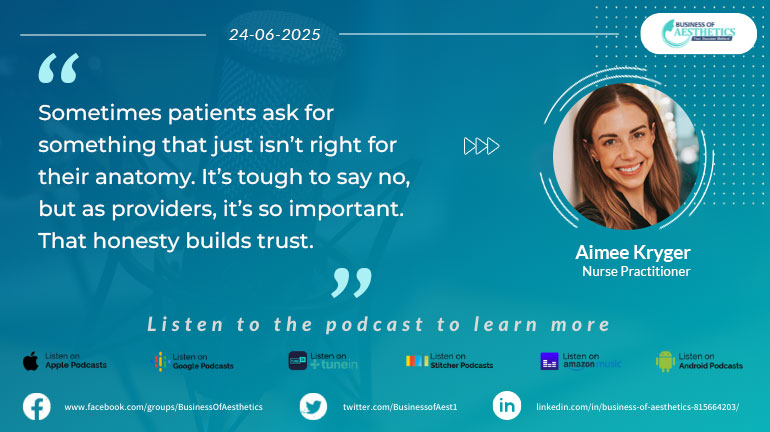
In this field, I think managing and explaining expectations to our patients is the best thing that we can do to provide the best service. There’s going to be times when, unfortunately, a patient asks for something that’s just not appropriate with their anatomy. It’s hard to say no, but I think as providers, it’s very important—and it just gains our patients’ trust. I will say that’s a challenge. Sometimes some patients take it better than others. You have to be tactful in your response and your descriptions.
But just having six years of experience working in a clinic, seeing patients, doing assessments, telling them no, making recommendations, and creating a treatment plan has made me a better—and I think will make me a better—aesthetic nurse practitioner.
Dr. Lauren Umstattd: Yeah. I think expectations are everything in life. So, you underpromise and overdeliver—typically, you get a happy patient out of that.
What are some of—you mentioned you like the laser. Why did you mention that specifically?
- 00:19:02 – CO2 Laser: A Favorite Treatment
- Aimee describes why she loves using CO2 lasers for skin rejuvenation.
- She values its precision, flexibility, and strong patient outcomes.
View TranscriptAimee Kryger: Well, when I wanted to get into this, I got Botox and I got lip filler. I feel like that’s kind of what we see on social media. I was young, in my twenties, and that’s what we see. I’ve just found that regenerative skin treatments—making your skin work for you—has given the patients the best outcomes. The ability to use a CO2 device, which is so powerful and customizable and precise, has just been so exciting for me in my practice.
When I was working at a medical spa, for example, or mobile, I had no access to the device—or this was something done by an aesthetician. So, being in this somewhat higher level of care, working in a surgical center and having access to an ablative laser, it just kind of ups the ante. I like the ability to offer that treatment to patients, which not a lot of offices have CO2. There are so many benefits to it.
Dr. Lauren Umstattd: Yeah, for sure. When we opened the business, I told myself that would be my first big purchase because carbon dioxide lasers have been around forever. They have a huge amount of data. A lot of people consider them the gold standard for skin resurfacing, especially in lighter skin. I think buying our laser has been a huge bonus for our patients. I love the versatility—particularly because we can go super aggressively, we can do a medium setting, or we can do some really light treatments for patients who either can only tolerate minimal downtime or really just want to see minimal improvements in their skin.
Aimee Kryger: Yeah, I think there’s so much to learn out there. Being new in my practice—like I said, growth for this year—I want to continue to learn more about the laser and what I can do, along with the other treatments that we offer. Being able to really customize each and every treatment, no matter what modality we’re using in our office, is important to me. There’s just something new to learn in this field every day, and it’s evolving.
The fact that I get to have all those tools in my toolbox—starting from a skincare consult to potentially saying, "I’m sorry, you need surgery" (not sorry, it’s a great thing), but I can’t do a treatment for you in the office, but here’s Dr. Umstattd, the surgeon that I work with, and the great work that she does—and you’re next door. It just makes the whole practice collaborative and a great spot for our patients.
Dr. Lauren Umstattd: Yeah, for sure. Let’s switch to a trickier topic—that being complications. I know, as an early career surgeon, I really perseverate on a lot of the different things that can happen with patients. I ruminate about things that happen if we have complications or hiccups or however you want to call them. I think, being early in your career, complications can be a real challenge to deal with professionally and emotionally.
I also think that, being a woman, perhaps we develop a closer connection with our patients, and so that can lead to us having a harder time dealing with complications. Would you mind talking a little bit about how you approach that with patients when something does come up unanticipated when we do a treatment with them?
- 00:22:57 – Managing Complications with Care
- Aimee shares how she handles complications openly and honestly.
- She focuses on supporting patients through any challenges that arise.
View TranscriptAimee Kryger: Yeah. I mean, as a provider in any field, you want to choose the right treatment for the right patient and strive for the best outcome. Like I mentioned, in our field of plastic surgery and aesthetics, if we don’t meet that mark of what our patient was looking for, or if we develop a complication, it’s devastating to me. I want the best for my patients. We can explain all the risks and benefits and our goals to them, but if a patient results in, you know, a hyperpigmented spot and we were trying to treat one specifically—that’s not the outcome either of us desired.
I think just being honest with our patients, listening to their concerns, being supportive, definitely not gaslighting anyone. And again, my three words: humility—just being honest and taking it on the chin and saying, "I made a mistake, but here are some things that we can try." I think honesty and, again, going back to setting expectations—that’s hard, especially as a new provider, because people do come in really excited. They want to make changes, they want to look better, feel better, and I want that for them as well. We get excited together, but I have to be realistic in what we can actually achieve with the tools that we have.
So, just taking that time and really realizing I don’t have to do everything today. We can do one thing at a time. We can go slow and build a relationship and build a rapport. You’ve been a great mentor to me in this field of navigating those things. Overall, just being a new injector—whether that’s a nurse practitioner, RN, PA, whatever it may be—you need to have a good mentor and people you can collaborate with, to ask questions when you have a complication or you don’t have the outcome that you desired. That’s helpful: to have a community.
Dr. Lauren Umstattd: Yeah. One thing I tell myself is, I’m a human. The patient is this physiologic human that is somewhat unpredictable. You could do the same exact treatment on two very similar individuals and have two different outcomes, which is tricky. Then we also live in this world that is imperfect. Sometimes you could do everything right, the patient could have done everything right, but mother nature had different plans.
I think we have to allow ourselves to be more forgiving when little things come up and say, statistically, I will have hiccups with some patients and treatments. As long as you, like you mentioned, have a good relationship, you’ve built that trust with your patient, keeping them close at times when they’re going through a little bit of a rough patch—I think our office does a really good job of that.
Aimee Kryger: Yeah. In today’s day and age, there’s so much on social media, and there’s filters and unrealistic before and afters, and patients see that. They might have something different in their minds of what they want to achieve. I think it’s just tricky in this arena—you’re not critiquing someone, but our patients are coming in and, like you said, it’s hard: "How can you fix me?" And I don’t think that I’m in the business of fixing. I think we’re in the business of augmenting and enhancing your natural attributes. So, it’s interesting—but it’s a lot of fun.
Dr. Lauren Umstattd: Yeah. Well, what are some things that you’re excited for, for the future? We’ve talked about your 2025 goals, but let’s look further ahead. What are some of your bigger career goals?
- 00:27:22 – Mentoring & Career Growth
- Aimee enjoys mentoring new nurses and injectors entering aesthetics.
- She remains excited about continuing to learn and grow in the field.
View TranscriptAimee Kryger: Yeah. I love—previously, as a charge nurse, and then when I was a nurse practitioner in the clinic, and even now—I’ve had a couple people reach out to shadow me. And like me, you know, I’m new to this, but I have to give myself some credit that I have been a nurse practitioner for seven years. I can mentor some of these younger nurses or even high school students that are kind of questioning what they want to do. That’s really exciting to me, to just be a mentor or be a collaborator with other injectors or future nurses, PAs who are interested in this field.
I mean, when I was in nursing school, the thought of even working in a plastic surgery or dermatology clinic was far-fetched. So to even think that I’d be working in a private practice facial plastic surgery center full-time was just not even thought of at that time. It’s just become much more sought after. I think it’s exciting that you asked me to be here today because people ask me all the time on social media—and I’m sure you—how do you get here, and where do you start?
Dr. Lauren Umstattd: Yeah. I think it’s a tricky question. When I get it from students or practicing nurses, they often ask, what is the best course to take? I’m like, well, really, it’s not like a course. It’s, like you mentioned, finding mentors, studying things, doing some CME courses, yes, but it’s much more than that.
What are some things that you see on the horizon in our industry that you’re excited about? Opportunities for our practice to grow?
Aimee Kryger: Yeah. I am definitely interested in the laser device world—seeing what’s out there and what we can do for our patients. I think they get phenomenal results, and the downtime is just lessening as new devices come out. That kind of goes along with regenerative medicine like PRP and PRF, and using our own body to benefit our skin. I’m excited to see where that’s going. In aesthetics, I’m optimistic and hesitant. I want to see where these things go. I don’t want to be the first person to do it, but I want to follow the research, and I think a lot of research is happening in this field right now.
Dr. Lauren Umstattd: Yeah, it’s definitely a great field to be in because every day you turn around, there’s something new and exciting. Which comes with—you’ve got to be a little bit of a skeptic when it comes to some of the studies you read: who’s funding them, what companies are behind all that.
Aimee Kryger: Yeah, I think definitely too, being new, it can be very exciting and overwhelming to hear: "This is the best new product on the market," "This is the best new device," "This is what it can do." But just realizing that it’s really not a race, and stepping back, looking at the research, looking at the studies, giving some things some time to see how they evolve—that’s not a bad thing.
You know, our tried and true Dysport is still around, and it’s still one of my favorite treatments besides the laser. But I do think it’s exciting to see new treatments coming up all the time.
Dr. Lauren Umstattd: Yeah. And then—you are a mother in the world of medicine. Tell us a little bit about you personally and how you juggle being a full-time nurse practitioner and a full-time mom.
- 00:31:34 – Balancing Career and Family Life
- Aimee talks about balancing her full-time role as a nurse practitioner with life as a mom of a toddler. She shares how finding joy and fulfillment in her work helps her achieve a better work-life balance.
View TranscriptAimee Kryger: Yeah, I’ve got a little three-and-a-half-year-old boy at home, and he keeps me on my toes. He is rambunctious. But I’ve found that I enjoy my work, and finding a career that’s fulfilling definitely makes a happy mom and a happy wife. My husband and I do a good job of a balancing act with our son. It’s hard not to take work home, especially like we talked about—if a patient isn’t happy with their outcome or, you know, being a new injector, I did lip filler… oh my gosh, are they going to get a vascular occlusion? I sit on that for 48 hours just hoping I don’t get any calls. But it takes balance.
Right now I’m in a good place, and on the weekends I separate work and just enjoy my family time with a toddler.
Dr. Lauren Umstattd: I can’t tell our audience how much I’ve enjoyed working with you for the past—has it been eight months now?
Aimee Kryger: Yeah, it’s just—time’s flying by.
Dr. Lauren Umstattd: Yeah. I feel like Aimee has brought so many great things to our practice. She’s constantly improving upon things, she’s always got ideas and kind of implementing those as you get more confident in your skill set and your knowledge base. I can’t thank you enough for everything that you do for our office, our team, our patients, our practice.
Closing Thoughts
- 00:33:09 – Growth, Mentorship & Moving Forward
- Aimee reflects on her journey and offers advice to her younger self and others: be patient, set clear goals, embrace growth, and never be afraid to try something new.
- She encourages continuous learning and mentoring in the evolving world of aesthetic medicine.
View TranscriptDr. Lauren Umstattd: Let’s leave the listeners with a few words of advice. Specifically, let’s think about you five years ago. What advice would you give yourself?
Aimee Kryger: Five years ago, I would give myself the advice to be patient, to think about what your goals are, and just know it takes time to achieve them. And be persistent. You know, as a new baby nurse practitioner, I felt like I didn’t know anything. Here I am, more confident as a nurse practitioner and a provider, but I’m starting slightly fresh in a new field. There are always new things to learn, but I think learning is growth and learning is power.
It’s sometimes good to not know everything and know that you need to keep up with your skills. That’s another reason why I like mentoring. So—don’t be afraid to try something new.
Dr. Lauren Umstattd: Yeah, that’s such good advice. I think we could all use a little bit more patience—I know I certainly could most days.
Well, if you’re interested in following Aimee, she’s on Instagram—it’s @np_aimee. Our practice is called Face Leawood. We’re in the Kansas City area. The practice is called Face Leawood.
Thank you guys so much for listening, and thanks again, Aimee, for joining us today.
Aimee Kryger: Thank you. See ya.
GUEST – AIMEE KRYGER
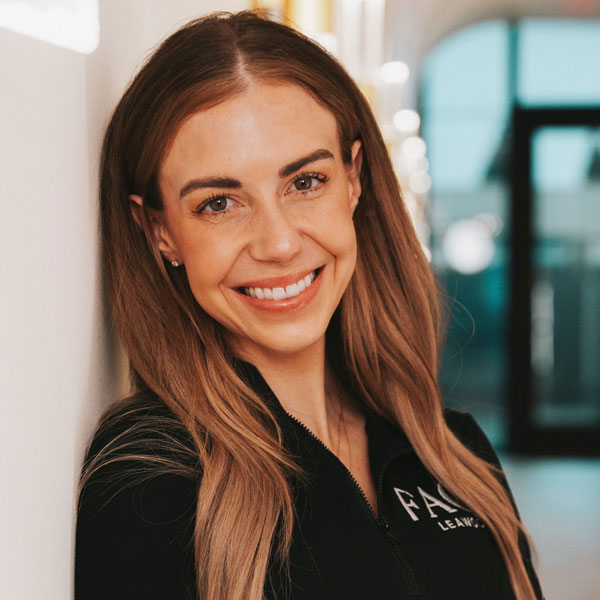
With over six years of experience as a Registered Nurse and five years as a Nurse Practitioner, Aimee Kryger brings a deep commitment to delivering high-quality, compassionate care across diverse clinical settings. Currently serving as a Nurse Practitioner at Saint Luke’s Health System, she specializes in ENT and holds certifications including CORLN, BLS, ACLS, and is a Certified Surgical First Assist.
Aimee is highly skilled in patient assessment, diagnosis and treatment of both acute and chronic conditions, prescribing medications, and interpreting diagnostic tests. She is proficient with EMR systems like Epic and Cerner and plays a leadership role in her current position by providing training and education to fellow clinicians.
Passionate about evidence-based practice and lifelong learning, Aimee is dedicated to advancing patient care while fostering collaboration across the healthcare team. She looks forward to contributing her insights to conversations that align with her values of excellence, respect, and community wellness.
HOST – MICHAEL WALKER

Michael Walker is a seasoned leadership coach and analyst (Q.MED) who is passionate about adding value to individuals and helping them unlock their untapped potential. With over 35 years of diverse business experience, he specializes in organizational development, succession planning, conflict resolution, and mediation.
As a Qualified (Q.MED) mediator with the ADR Institute of Canada and an Analyst (WFA) with the Workplace Fairness Institute, Michael has a strong foundation in conflict resolution and workplace dynamics.
His expertise extends to providing workshops and seminars that equip participants with practical tools to apply immediately for improved relationships, fairness, innovation, productivity, and profitability.
Michael is dedicated to supporting personal and professional transformations and is committed to helping individuals achieve greater financial, relational, physical, spiritual, and emotional prosperity through his coaching and advisory services.
Resources


Connect with Us:
Category: Business of Aesthetics Podcast