In this episode of the Business of Aesthetics podcast, host Michael Walker talks with leadership coach Kelcy Heringer about burnout, toxic workplaces, and why working harder doesn’t always lead to success. Kelcy brings fresh, honest advice to help professionals rethink how they grow their careers.
She explains how being the “get stuff done” person can actually hold you back. When you’re always the one people rely on, it’s easy to be seen as a helper—not a leader. Kelcy shares how to shift your focus from just doing tasks to building influence and value.
They also talk about how to spot toxic work cultures, why it’s okay to speak up, and how setting boundaries is key. Kelcy encourages listeners to stop waiting for permission and start taking charge of their own career path.
If you’ve ever felt overworked or stuck, this episode will help you take back your power and move toward a career that feels right for you.
Key Takeaways
- Working harder doesn’t always get you promoted
Being the “get stuff done” person can lead to being overused and overlooked. - You need to lead, not just execute
High-level leaders are clear, focused, and strategic—not just busy. - Setting boundaries builds respect
Saying “no” and being direct shows confidence and helps you grow as a leader. - Don’t wait for permission to grow
Take charge of your career with regular check-ins and clear goals.
Podcast: Play in new window | Download
Subscribe To Our Podcast



Key Highlights:
- 00:00:00 – Welcome + Sponsor Message
- Michael introduces the show and thanks listeners.
- Ekwa Marketing offers a free 12-month digital strategy session.
- Claim your free strategy session here
View TranscriptMichael Walker: Welcome to another episode of The Business of Aesthetics podcast. I’m Michael Walker, your host for this episode. And before we get started, I want to thank all of our incredible listeners from the United States, Canada, and around the globe. Your continuous support means everything to us.
A special thank you also goes out to our sponsor for this episode, Ekwa Marketing. With nearly 20 years of experience, Ekwa Marketing is a leader in digital marketing services for aesthetic practices. They are offering our listeners — that’s you — a complimentary digital marketing consultation, which will include a tailor-made 12-month digital strategy for your practice.
This is something that they really believe in. Just like this podcast, it’s about how they can support the industry. How can they support you by offering things like this? So you can head over to businessofaesthetics.org/msm/ and you can go ahead and book your consultation.
I can tell you it’s free. It’s super powerful. And if you’re a digital wizard already, then this might not be valuable. If this is an area that’s not your specialty and it pulls you away from your specialty, then you want to take advantage of this offer.
But let’s go ahead and jump into today’s topic: Beyond Burnout — Breaking Free from Toxic Workplaces and Outdated Career Myths with Kelcy Heringer. Welcome, Kelcy. It’s awesome to have you here today.
Kelcy Heringer: Thank you. Thank you for having me.
- 00:01:40 – Meet Kelcy Heringer
- Kelcy is a bold leadership coach.
- She speaks up about toxic workplaces and outdated career advice.
View TranscriptMichael Walker: I am having Kelcy here is something that—we’ve met before—and Kelcy brings a bold and refreshing voice into the medical aesthetics world. She brings a no-nonsense approach to career development, leadership, and workplace culture, calling out the outdated norms that too many professionals still feel pressured to follow.
In this episode, we’ll explore why overworking yourself doesn’t lead to promotions, how toxic work cultures disguise themselves as high-performing teams, and what it really takes to own your worth and advocate for your growth. Kelcy’s experience as both a clinician and leader gives her a unique perspective on how to navigate and challenge the system from inside.
Kelcy also has taken on new initiatives as a leadership coach and has taken on a very interesting perspective with that, and I’m sure we’ll get into some of that today as well.
Kelcy, thrilled to have you here, and let’s kick things off with this powerful topic that you have raised: Being the busiest person at work can actually backfire. I love that statement. We know that’s probably true, but can you break that down for us and explain why this belief does more harm than good?
- 00:02:59 – Being Busy Can Backfire
- Doing “everything” at work can actually hurt your career.
- When you’re too helpful, people want to keep you in that role.
View TranscriptKelcy Heringer: Definitely. It’s really interesting. I have been guilty of this myself—being coined as the “get shit done” person. But I’d say in working with my clients over the last year, it’s the theme that I see to be the most common, which is high performers are wondering: why am I not getting promoted? Why am I underpaid? Why am I feeling undervalued? And I’m the one that’s crushing in results, doing all the things, raising my hand all the time.
And really, the hidden downsides of being that person is—let’s just think about it from other people’s perspective who are perceiving them that way. People love to have people under them who they can rely on and who make their lives easier. And so, when you become the fixer and the saver and the doer, it can stunt where you’re at because people like to keep you there.
You are making their lives easier, and you’re the easy go-to that’s always up to do it. So you become their crutch, and they don’t want to lose you.
And then the second thing, if you think about it from—I always like to say—from a math perspective, let’s just say it’s somebody in a practice and they’re doing the job of multiple people. They’re relied on for being that person that gets the stuff done. And so you’ve become too valuable to promote, because then they would suddenly need to go hire a couple people or three people to do your job. And that’s expensive and really rare.
So, oftentimes when I say being the “get shit done” person backfires, it’s because you corner yourself into that brand versus the strategic leader.
- 00:04:54 – Why Promotions Don’t Happen
- You might be seen as too valuable to move up.
- Doing multiple jobs can work against you.
View TranscriptMichael Walker: I love the way you—I love that saying, “get shit done.” And the idea, it’s an interesting concept when you think about it. If you’re always, as you say, the go-to person, people will go to you.
But in my coaching world, my philosophy is to take 80% of a person and focus it on the 20% of what they’re great at. And most people don’t know what that 20% is. That’s what you do as a leadership coach.
That’s what your clients come to you for—to figure that out, to get shit done, yes, but in a focused way.
Most organizations, when somebody’s the go-to person, they tend to be very—you know—they tend to get focused on being the transactional person. It’s about what they do and how they do it within the context of the organization. But one of the greatest values that gets missed in that is the relational side of who they are and why they matter.
And so they just—you know, “Well, just get Bob, he’ll do it.” Remember there was a cereal? Life cereal? “Give it to Mikey, he’ll eat anything,” right? Like, it’s that idea—okay, well, he can eat it.
But that’s not what people want today. They want to know they’re valued and heard. They want to know they are part of something. And if you’re so busy doing shit, who’s gonna hear you? How do they know to follow?
- 00:06:20 – Executors vs. Leaders
- “Get stuff done” people are seen as followers.
- Real leaders are strategic and set direction.
View TranscriptKelcy Heringer: Completely. And I think oftentimes—I don’t know about the clients that you work with—but the clients who I am working with or in consulting projects, what I see the most with people is they’re typically wanting to not be the “get shit done” person. They’re typically wanting to be viewed as a high-level leader.
And I think that it’s really hard when you step back, though, and be pretty objective about it. It’s not as hard when you think, “Authority sets direction,” and you have to be looked at as an authority to earn the positioning as a leader. And executors follow direction.
So I think that’s always a helpful, objective way to look at it: executors get the stuff done, and authorities hold power and control—and hopefully influence—to get to what they’re doing. And then the executors take the handoff.
And when you say that to them, they’re like, “Oh, that’s not what I want to be. I want to be that person.” And so you have to go through—and before the call, it was so interesting to hear the framework you take your clients through—you have to take them through what brand do you want to be known for, and help them see that vision, and then work through, “Well, what transformations do we need to make in order to get you there?”
But this is often a very clear one, which is: you gotta stop raising your hand, you gotta stop, you gotta set boundaries, and you gotta start working smarter, not harder—which is, like, so easy to say, but—
Michael Walker: Yes, very easy to say. I was thinking of acronyms as we’re talking—GSD, right? Get shit done. So what we have to do is move from a GSD mindset to what I’m gonna call an AGQ.
- 00:08:09 – Shift to Asking Great Questions (AGQ)
- Good leaders ask great questions, not just give answers.
- Clarity matters more than busyness.
View TranscriptKelcy Heringer: Yes.
Michael Walker: And an AGQ is asking great questions—starting with yourself. You know, that’s the thing: unconditional curiosity. Curiosity without opinion, expectation, and judgment. We’ve lost the art of doing that in a lot of medical practices because everything is theory, structure, and science. We already have the answers—so here’s what you need to do, here are the treatments, these are your options, here you go.
So we overlook that relational piece. And we do that both with our patients as well as with our staff. And that’s where the breakdown usually happens. Wouldn’t you agree, Kelcy? It’s in that space. It’s the communication. It’s the part where most of us go home at night thinking, “Well geez, that didn’t turn out so good.”
And I know from you, as a leadership coach, that’s the whole idea: how can I help you? How can I help you do that in a way that you can own? I love to say, “Own your true north. Own you.” Yes—own your identity.
And there’s a lot of these nice sayings and stuff, but at the end of the day—do you? Or is everything else driving the path? You know, we see a lot of this when we get into insurance-based businesses, where the insurance companies really drive their destiny, and they’ve lost sight of the passion, the why they’re doing it—all these different dimensions. So, I think—
Kelcy Heringer: Go ahead. Yeah. Yeah, I think there’s a couple things that you said there, which is like driving themselves and their vision. But then there’s another part to it, which is when you say they’re asking questions—I look at it as like, leaders. If we think about the leaders we respect the most, they’re usually not the busiest ones, right?
Like, they’re the people who are the clearest, and who are always seeking clarity, and then very simply stating it. And so I think the leaders often that we’re helping people get to, and that people aspire to be—they have to be incredibly strategic with their time and energy.
And so I think there’s something big around the definition of success between a “get shit done” person and a valued leader. It’s productivity versus valuing themselves, and thinking every day, “Who’s the leader I want to be?” and then setting their operating schedule around that.
So I think the high five is not on how much they can do, but how well they can do the right things to get to the place where they want to be. So that really was a light bulb for me when you said question-asking, ’cause you’re excellent at it. But it’s also something I think really great leaders do well—they seek clarity versus being busy.
Michael Walker: Yeah, exactly. And you summed that up beautifully. I mean, if you think—when you’re a child at five, six years old—I don’t know if you’re a mom or not, but if you have—
Kelcy Heringer: I’m—I have an 11-year-old.
Michael Walker: Oh, well there you go. So, you know. A child, five, six years old, will ask 300 questions a day on average. Do you remember that?
- 00:11:22 – Curiosity is Often Lost Over Time
- Kids ask tons of questions, adults don’t.
- Being curious helps you grow and connect better at work.
View TranscriptKelcy Heringer: Oh, I still—I think I’m at 150. “Mom! Mom!”
Michael Walker: Yeah. But what’s interesting is, by the time they’re 12 years old, they’re down to 14 questions. Our culture actually strips out curiosity. It puts us into slots and boxes and structure. And there’s the odd one that gets away—and I think that’s the key.
The idea of unconditional curiosity is this idea of being curious without opinion, expectation, and judgment—but starting with yourself. If you haven’t looked at yourself, if you don’t have enough self-awareness, then how could you possibly have other-awareness? Then how can you possibly have a curious conversation?
And it’s just a hard truth. In aesthetics practices, and whenever there’s a high degree of science or engineering, the theory tends to drive the ship—which, I mean, I want my neurosurgeon to be the best neurosurgeon. I don’t need him to be a friend. I want that expertise.
But even with that, we were never meant to do life as a lone ranger sport. We need this. And it’s a challenge.
And I think it’s—you know, I know you know that from your background. And I have a question here that I’m going to throw out to you. It says: You used to believe that promotions come from simply working hard and waiting for annual reviews. You know, that was the philosophy. What really changed your philosophy? What was the turning point for you with that?
- 00:12:43 – Don’t Wait for Annual Reviews
- You need a personal career strategy, not just yearly feedback.
- Run your career like a program with regular check-ins.
View TranscriptKelcy Heringer: Yeah, I think—to be honest—somebody told me, “You’re doing this wrong,” after I’d been thinking about it all wrong. And so I’m super grateful for that person because I used to not be in the driver’s seat of my career at all.
And I oftentimes find—and I’d be curious to hear too, with your clients—I oftentimes hear, “I can’t ask for a raise or promotion. I’m just supposed to wait until it’s annual review time,” or, “I have to wait because we’re waiting for a raise.”
So I think for me, what really shifted is that you have to run your career development like a program. And programs do not get built by saying something once or doing something twice. It is something that has to be constantly managed, and you need to have a communication strategy around it. You need to have feedback built in around it.
And so for me, that has been one of the biggest shifts—but also one of the hard learnings—in my career. But it’s one of those things we talked about before we hit play on this: you get to help people unlock something that somebody taught you, and then you’re just so happy that you learned it, that you want to pass it on to people.
This is one of those for me, that I love helping people simplify—and having a very simple, simple playbook for how to drive their careers.
Michael Walker: Yeah, that’s beautiful. And you know, life’s complicated enough. Let’s not add to the complexity just because that’s the way it’s been done. I mean, I think—I know that you love to be a disruptor.
So the idea here—if you think about the context to me—is celebrating the wins. And as I shared before, a question I ask all of my new coaching clients is threefold:
First question: What are they passionate about? Most people can’t really answer that question well.
Second question: What core values are non-negotiable and will underpin that?
And third: What do you want your story to be in 10 years?
And once you know what you want your story to be, we basically reverse-engineer that while introducing wins along the way. And so you are the author of your wins—not somebody else.
Like in my work cultures and where I coach, you’ll never hear anyone talking about annual reviews or performance reviews. What you’ll hear is success conversations. And there’s no schedule for them. It’s like a huddle—anybody can call one. If you call one every Thursday, that could become problematic, but generally, we talk about what the wins look like.
Because it’s not just about what they do and how they do it—it’s who they are, and why they matter, and how they add value to the overall vision and values that we’ve established as the brand—the essence, the fragrance of why we matter.
It’s just a different philosophy. But the reality is, you have to establish a culture that looks like that. And there aren’t a lot of cultures like that. I have to admit, that’s an area that’s lacking, I think, in some regards. Not necessarily in aesthetics—I see a lot of it in the aesthetics field—but still, you can just take the reins on that and run yourself.
Hey, you’re from Montana. You can take the reins on that horse and run. You get to drive.
Kelcy Heringer: And you can drive! Used to be no speed limit. Now there is—85. But—
Michael Walker: Because you do have cars. People always think—
Kelcy Heringer: Right?
Michael Walker: Does that make sense though, Kelcy?
Kelcy Heringer: Yeah, absolutely.
Michael Walker: You get to be the driver of your destiny, your choices. So many people don’t realize that. And you don’t have to wait for the bus to pick you up. You can just—why don’t you go ahead and craft your own bus route?
- 00:16:48 – Shift from Helping to Leading
- Stop waiting to be noticed—start guiding your own path.
- Ask yourself: “Why do I care more about the business than myself?”
View TranscriptKelcy Heringer: Totally. And I think there’s a few things that come to mind when you say that.
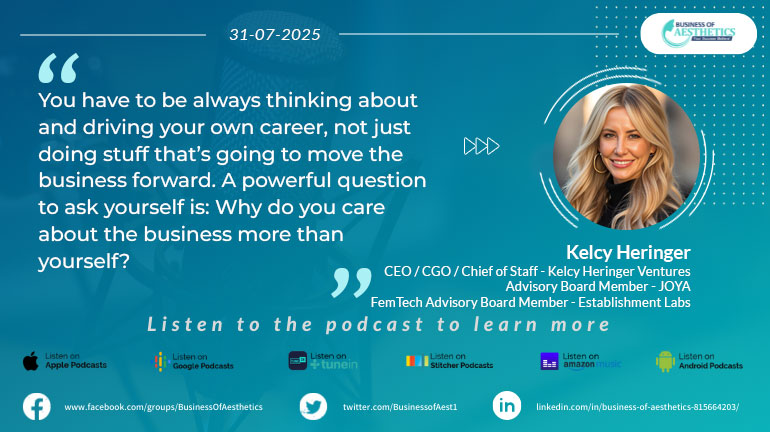
I think number one—going back to the “get shit done” person—I think so often I see people thinking, “Hey, if I just put my head down and work hard, I’ll get promoted.” That, I think, is an insight that backfires on people. You have to be always thinking about and driving your own career—not just doing stuff that’s going to move the business forward.
And a powerful question that I got asked one time was: Why do you care about the business more than yourself? And I was like, oh my gosh, I can’t believe I’m getting asked that. But I ask it to my clients when I see it too—which is, they’re over-indexing on doing all the things and putting their head down and trying to hit results. But often, that’s not what’s required. That is definitely not all that’s required.
There’s this whole other piece—what you said—sharing your impact and playing chess, to an extent, but in an honest way about driving your career.
And then I think oftentimes, mistake number two is people wait for their time. And this is where it’s about being in the driver’s seat. It’s like—don’t wait for HR. Don’t wait for your boss. You have to do it.
So I always tell my clients: if you are not having a check-in with your boss every 8 to 10 weeks, with a very simple framework—and it can be something as simple as:
- What’s motivating?
- What’s not motivating?
- What is it that I need to work on over the next 6 to 8 weeks in order to hit the success we’ve laid out?
And then also, if you do this every 8 weeks, look back on the previous 6 to 8 weeks and say: Scale of 1 to 10, how did I do on the things we laid out to work on?
That way, you’re always driving the conversation. And back to driving this programmatically—then there’s never any awkward discussion around, “Hey, when am I going to get a promotion?” or “What’s next for me?” or “When can I develop this skill?”
People oftentimes feel like it’s awkward and that there’s not really a place to bring it up. So build the place. You put the invite on the calendar and take the reins. That’s an actionable way to do it.
And I have a third one, which is outsized impact. I also think it’s something that is majorly overworked and underlooked, but it’s something that I think is a fast-track way to speed up a promotion or a development discussion.
And I can go into that in a minute, but it’s basically: how do I sign myself up for something extra that isn’t going to take a ton of my time, but helps move the business forward—and that’s going to fast-track where I need to go? Whether it’s financially, getting investment for a coach, or getting the next title or promotion.
So those would be the three things I see as the most common reasons why people feel awkward advocating for themselves—or why they’re not advocating for themselves at all.
- 00:20:05 – Why Coaching Matters
- A coach gives you a safe space to grow and explore.
- Coaching helps you move past feeling stuck.
View TranscriptMichael Walker: I love it. I love it, Kelcy. And I think—you just said something—investment for a coach. That’s interesting. You know, it’s an interesting thing. I’ve been coaching for quite a while, and I have clients who’ve been with me for a long time.
The only reason they’re still with me is because at some point, coaching changes from kind of—it’s like a journey of life, right? It’s like The Lion King. But the idea though is, what happens now is—if you ask my clients who’ve been with me for quite a long time—if you ask them what the greatest value I bring to them as a coach is, they would say, “Well, it’s that you create an agenda-free space. A space where we can explore what needs to be explored in a way that I could never do on my own—or not nearly as efficiently or quickly, or get to the chase, if you will.”
And so I think, as we’re talking about that and looking at what you’re describing—different steps, doing all these things—often what I hear is a professional say, “Well, I’m just too busy. I don’t know where to start.” And they get paralyzed by volume. And it doesn’t get going.
So it’s: what’s the next right step? What’s one thing, one soundbite you’ve heard here? Say, “Okay, what if I did that? How would I start that?”
So I think there’s—I get it. Am I selling coaching? Probably. But I’m really not selling coaching. I’m selling what I like to call the idea that brand is not executable—it’s a relationship. But we try to make it something that we have to do, or a thing. And we are—you are—the brand in your business, your practice, whatever that looks like.
And it’s really hard unless you have something alongside you to help. And, you know, who has an agenda-free space? If you don’t have a coach—at home, your marriage—that’s a unique space, but it’s not agenda-free.
And so I really think it’s important. And you said something about using the word success. One thing I see a lot is that we assume we all define a word like that the same—and we don’t.
Like, you and I define success, Kelcy—and I would guess just from our conversations—we probably are more likely to look at success not just through a financial lens or how many likes or how many followers. We would look at success more through the lens of prosperity, which is wholeness or wellness of one. We’d look at success as being financial, relational, spiritual, physical, emotional. It’d be very holistic.
And I would guess most of our listeners would be as well. But we never ask that question. So when we start to set up wins, we’re just assuming we know. And you can’t ask that question unless you’ve already asked it for yourself—and know what’s you.
And I know you’re really good at that. And you know, in a workplace, people are trying to keep everything nice and not say what they need to say. In fact, I’m gonna talk about boundaries a little bit here, but you’ve shared that people should stop sugarcoating things—again, I like that term—and stop taking unnecessary criticism from others.
So I love it. But how can professionals start setting healthy boundaries at work? And keep in mind, Kelcy—what’s that starting point for them? Like, if somebody’s saying, “I’m with you on this,” how do they start?
- 00:23:33 – How to Set Boundaries at Work
- Speak clearly and directly—don’t sugarcoat.
- People respect you when you respect yourself.
View TranscriptKelcy Heringer: Yeah, this one is a challenging one. I would say for me, if I looked at my entire career—though I’d love to actually hear what yours is—but I will answer the question.
This one, for me, changed the career trajectory more than any other skill I had to change in myself, which was learning to be direct. And I think because I wanted to be a respected executive, I knew that people respect people who respect themselves. And when you give somebody clear and honest feedback—especially when it’s hard—you’re signaling to them, one, that you’re confident in your own opinion and your own voice, and two, that you really care about the relationship or the outcome, because you’re saying what needs to be said.
And I think the shift that is not talked about the most is that the minute you give somebody really, really direct feedback and get yourself out of the tiptoeing phase, they stop seeing you as beneath them. There’s this interesting shift in the playing field, and they start seeing you as a peer—or maybe even somebody that is an authority they look up to.
So I think going back to when people want to stop being seen as the doer or the helper and start being seen as a leader—they need to build trust. And trust is what builds authority.
Leadership isn’t about being liked by everybody or being the nice one. It’s about being respected—by the right people too. And respect is, as you know, built in micro moments of building people’s trust over time, and telling the truth where it really counts. It really, really matters.
But it’s a hard one. So I’ll say that in terms of the why it’s really important—and I’m happy to get into any tips for it. But I’d love your reaction.
Michael Walker: Yeah. Well—respect. You know, Gallup just came out last month, I think it was, with an updated survey on employee engagement. And number one—the biggest thing in the last one, last year—was that people leave organizations where they don’t feel valued and heard. And we know that. That’s not unusual. Anyone in business can feel that.
But the problem is, we just don’t know what to do with those two words, because they’re not transactional—they’re relational. And we’re not usually focused very well relationally in our organizations.
Having said that though, this new one came out with a more narrow perspective—and you hit the nail on the head: respect.
People—if they don’t feel respected—that’s deeper. That’s at a higher pay grade than just “valued and heard.”
- 00:26:40 – Respect Builds Trust
- Gallup says feeling respected is key to staying at work.
- Be brave and speak the truth, even when it’s hard.
View TranscriptMichael Walker: And so people are getting more and more—I think—really more attuned to how they’re going to spend their time, and they’re not going to put up with stuff as much as they maybe used to. So I think that’s where that word’s coming from. It’s interesting.
I try and look at what’s coming at me. I’m a professional mediator—I deal with lots of messy stuff. I used to be the poster boy for the fear of conflict. But when I discovered the power of curiosity and forgiveness, that’s pretty much it. What’s coming at me is that person’s best expressed cry for help. So the question becomes: what do I need? How can I help? Not how can I push back, how can I run away, how can I avoid it.
And I’ve discovered that when something’s going on or something’s happening, I try and find my part in the problem. So I would come to you:
“Hey Kelcy, can we just have a conversation about a couple of things today?”
“Sure.”
“Well, I wanted to start—I think I’d like to ask you for forgiveness.”
“Say what? For what?”
“Well, I think that we set you up for success in some areas, but not so much in this particular area. This, this, and this. Does that make any sense to you?”
“Yeah, yeah it does. I hadn’t really thought of it that way. I’ve just been trying to…”
And you know, it’s like we just have to be—and to your point—where people just feel they can.
What’s going to come out of that? What’s the power? It’s trust. And trust builds courageous conversations. It builds outside-the-box ideas and innovative thinking. It makes you one of the top ten employers in the world. It does all that stuff.
But it’s that idea. And I think those are words we don’t usually use—we don’t use passion or forgiveness in the workplace. We say we’re sorry ’cause we got caught. But forgiveness in this context of respect—that’s my challenge. There’s no textbook on this.
Kelcy Heringer: No. No. And—
Michael Walker: But there are leaders. There are leaders that want to become—we become the textbook. Because the only way this works is by leading by example.
Kelcy Heringer: Yes. And right when you said that, there’s another word with respect and—I’ll try to be the yin to your yang, I’ll be the cynical one here.
Like, the positive side is earning trust and respect. But when you were just talking, I’m like—the cost of not doing that is, you lose credibility.
And I think so often, I find people trying to—even the sorry message that you gave—you just came out and said it. But I see so often people are wrapping it in disclaimers and softening it to be vague. And then you’re not going to be taken seriously.
So I think, also, as people look at: what’s my motivation to be direct?
One—you hope that people have empathy and really want to care. But if you are trying to become a respected leader, and that is the brand that you’re going for—wishy-washy equals uncertainty. And over time, that kind of creates career drag. People second-guess your instincts, and they’re going to pass you over for high-stakes conversations, because you’re not really confident and don’t speak with conviction around what you’re talking about.
So I think—again—we talked about how clarity builds confidence, and I think this is full circle, coming back to that again, which is: credibility is incredibly important to be respected and trusted. And if you’re over-fluffing the feedback, and you aren’t being direct—it’s at risk.
Michael Walker: Absolutely. Yeah. I love the way you just—you’re pulling that into a place where: okay, so what can I do differently?
But I think to finish the sentence: what can I do differently, starting with myself? That’s what it really comes down to.
You know, one of the things that we’ve talked about—there’s a moment when I really learned the difference between validation and agreement. And that was a game changer.
Yes—you know, I can validate the fact that you want to go rob a bank, but I don’t have to agree with you or go and do it with you.
Kelcy Heringer: Totally. Yes.
Michael Walker: And validation creates space for you to be able to identify with something. I can validate—“Hey, I just appreciate you being part of the team, Kelcy, and doing this, this, this, and this…”
- 00:31:18 – Practice Hard Conversations
- Role-play or write it out before giving feedback.
- You can even use ChatGPT to help craft your message.
View TranscriptMichael Walker: I can identify—you’ve got a lot on your plate and everything—but here’s the “C.” We call it V-I-C-H-F. Here’s the “C,” the issue: we’ve got this, this, and this going on. And then the “H” is—at the end of the day, I’m just glad you’re part of the team. I’m pretty honored to be in the mix, and I’m going to follow up with you in a couple weeks to see how things are going.
And I think what happens is—and I don’t want to give parents a bad rap, I’m a parent as you are—but we kind of bring being Mom and Dad into the workplace. And we just say, “Tell John—well, just stop doing that. You know, we’re gonna do this, this, and this. You can’t do that anymore.”
Now, who owns the problem? We do.And I think that’s the challenge—trying to let it go and just validate.
“Hey, listen…”—I joke—I say, “So I hear you’re going to rob a bank, Kelcy. That’s really interesting. Thanks for sharing. That’s a little crazy talk—I mean, it’s kind of high-risk. So I’m just curious, why are you so passionate about potentially going to jail and robbing a bank? Unless you know something I don’t know.”
And you say, “Well, I don’t want to do it, but I’m so far in debt and so overwhelmed, I don’t know what else to do.”
Well—I would never get that information if I just said, “You can’t do it,” or disagreed.
And that’s where these conversations have to start. But we have to be confident enough in ourselves to have those conversations in a way that allows space for that to foster. That’s really all I do in mediation—I create a space to hold something that didn’t exist a minute before. And that’s what we do.
Kelcy Heringer: And I think you have to—by creating space for them—you also model it for them. So I think when people say, “Where should I start on being able to give hard feedback?” Practice is a big part of it.
So start with low-risk conversations or situations and build your confidence over time. It’s just like we talked about with managing your promotions and career development like a program—you kind of have to manage feedback like a program too. That it’s always on.
Cultures I love to help people build—and cultures I love to be a part of—are ones where transparency is the all-day, every-day. And you get that through curiosity, like you said, but also through saying hard things. Not always just leading through questioning or compliments. Sometimes, you’ve got to say the hard thing.
The second tip is: prepare for those discussions. Find somebody who can help you prepare. Write down three bullets of what you need to say, which should answer:
- Why you’re bringing it to them
- What example you can give
- What needs to change because of the impact it’s having
Then have someone look at it. Over time, you build more confidence in your ability to do this on demand. But it’s unnatural for many folks to be super direct.
Michael Walker: Yeah, exactly. You’ve hit the nail on the head.
I mean, for professionals—we do all this testing: marketing A/B testing, science, all these things. But we don’t do any testing on conversations—which is kind of crazy, because we’re not really good at it.
So what I have my clients do is script out what they’re going to say. And depending on the person—we haven’t even talked about personality types—but for a certain group, this is like nails on a chalkboard. So I have them script it out, we work through it, we talk through it.
And then I say, “Can I just have your notes?” And I take their notes and rip them up in front of them. They freak out the first time—then they don’t give them to me the next time.
But the whole idea is: I say, “You’ve got it now. You’re smart enough. Trust me. You’re not 12 years old—you’ve got this.”
It’s like going out at the beginning of winter and intentionally skidding your car in a parking lot. Why? So that when you’re on the road driving and feel the skid, you don’t react to it—you think about the strategy to stay on the road.
This is the test. It’s just like an A/B test. But this is the hard part—and in a lot of businesses, who are you going to do that with? You can do it with your team.
Everyone hates the word “role-playing,” but you can make it fun. It’s not going to be fun for some people ever—but it’s just scripting it and running it, just like you would in any other business practice.
Kelcy Heringer: Totally. And this is where you can use ChatGPT too, right?
Michael Walker: Yeah—it’s huge.
Kelcy Heringer: If you’re like, “I don’t know who to ask,” throw it in and say, “Give me three scenarios for how you’d handle this. Here’s what I’m thinking.” And it’s amazing what you’ll get back. You might say, “Eh, I wouldn’t do it that way,” but here are three alternatives. It can be so helpful.
Michael Walker: Even today, I would say to a client, “We’ve scripted it out. All right—let’s just throw it in ChatGPT and see what it comes back with.”
And they go, “Oh, I like that.”
I say, “All right, but—is that you or is that…?”
Kelcy Heringer: Exactly.
Michael Walker: And it’s interesting—by putting it into AI, it brings a credible partner into the conversation that makes it easier for them to say yes to doing it.
Kelcy Heringer: Totally. And I think the point—whether it’s you, me, ChatGPT, a mentor—the point is: ask somebody you respect, who delivers great feedback, and who you admire, how they deliver feedback. And have them look at it.
I think it’s amazing that your clients get that from you—that they play “drafter.” And I bet over time, your editing gets less and less.
And it’s fun to see someone go from, “Oh my gosh, why would you ever say that? How are you going to lead with that?”—and that’s what I’m thinking as a coach but don’t say out loud—to them getting those at-bats under their belt. And you’re so impressed by the presence and confidence they gain. They’re okay with delivering the hard feedback. It starts to become natural.
Then you watch them build cultures of transparency and trust with their departments and teams. It’s really cool.
Michael Walker: Yeah—and that’s the gift. That’s why we do what we do.
It’s interesting—what happens with my clients is, we start in a business setting with scripting. But where it ends up going is into the family—where there’s underlying tension or issues. And they start applying that at home.
Or sometimes we start at home, because that’s an area where they don’t feel safe enough in the workplace yet. So we start with something simple, and we do some personality preferences to show differences and unpack just little pieces.
But it’s the idea of being—one of my favorite words—intentional. Not just planning to do this “sometime in the future.” I’m going to do something different when I get off this podcast and move forward with it.
So—I’ve got a question for you. We are watching our time, but:
Toxic work cultures.
This is a real issue. It’s a big deal.
Breaking free from toxic work cultures—how do you recognize when a workplace has become toxic?
And what are the first steps to getting out? - 00:39:19 – Signs of a Toxic Workplace
- Gossip, lack of trust, and emotional dread are big signs.
- Don’t try to “fix” it if it’s broken—know when it’s time to leave.
View TranscriptKelcy Heringer: Ooh. Yeah, great question. I think there’s like probably, what, 50 you and I could easily come up with for what the signals are that you’re in a toxic work culture. But maybe what I’ll do is just talk through some of the ones that I see most common in the spaces that I am working in. I’d love to hear yours.
But I’d say oftentimes it’s:
- Manager or colleagues or leadership are backstabbing and gossiping. That is a common one. So there is drama and gossip.
- Number two: people feeling—if you are feeling unheard or constantly shut down when you bring up feedback or your ideas.
- And then I’d say a third one is, like, you feel super stressed, anxious, emotionally—you dread… like, yeah, the Sunday scaries are like every day.
And you should feel the opposite. If you’re in a healthy work environment, you should feel—of course, sometimes we don’t always love going to work—but you should feel psychological safety. And so when those three things… I’d say those are some of the three most common. What do you see?
Michael Walker: Yeah. Well, I think that you’ve hit the biggies on there.
One of the biggest things that I tend to see is that a culture where there’s a toxic workplace will be being driven by unhealthy conflict. And unhealthy conflict is where people are passionately disagreeing with each other and taking it personally. Where in a healthy culture, what you’ll see is healthy conflict—people are passionately disagreeing, yes—and because they can trust each other, because they have, your word, transparency and openness, they don’t take it personally.
That’s the game changer. But in unhealthy conflict—and third-party conversations around the coffee machine or wherever, the photocopier—that’s gossip. And just to be clear, gossip is bullying.
Kelcy Heringer: Mm-hmm.
Michael Walker: So if it’s okay for people to be bullied, then let it go. If it isn’t, then cut it out. But it has to be crafted into your vision in terms of a value that you point to. So you don’t take it personally. You just—we just don’t do that, because one of our core values is integrity. So whatever that looks like.
So that’s really it for me. And when we start to unpack unhealthy conflict, it’s totally fixable. That’s what I do for a living. What’s more fun is when you get to empower healthy conflict, and you build exactly what you’re talking about and how you’ve approached the workplace—giving people space to be the best version of themselves, but at the same time, to actually be curious and invest in each other in a way that… why would they ever want to leave?
And, you know, money is a factor, but it doesn’t drive the bus.
So we gotta watch our time. And I gotta kind of hit you with one last question, Kelcy.
So let’s just talk—this is good—because everybody… if somebody’s in an environment now, they’re, “Well, I’m in one of those places, and I feel undervalued, perhaps, or I feel overworked, or, you know, my confidence is just kind of being eroded, or I just don’t know which way to turn or where to go.”
What would you like to leave them with as a thought for how to look at the situation they’re in—and be intentional with a change?
Kelcy Heringer: Yeah, I think… it’s a really good question. Because you’re also wondering, like—you know, we kind of listed what are the signals—but I think it’s important to ask yourself: is it time to stay or go?
And part of the question there is: is this an actual toxic work environment?
And I think: if you aren’t feeling respected, if you see value misalignment between your values and your integrity and the company’s, and if you don’t trust or respect leadership, and you see good people—who you do feel like share your values—leaving, those are signs like: okay, check, check, check, I’m in a toxic work environment.
And so I think making sure you understand it. And I would say: find a new home, because your job is not to fix a toxic culture.
And so I wish—as I look back—I wish I would’ve never accepted and made excuses for toxic behavior and gotten out sooner.
So find a place—and this goes back to, you know, let’s talk about you and advocate for you, and figure out where you wanna go and what pieces for you and fulfillment is for you. I can’t imagine it’s in a toxic work environment.
So I would say, I would do two things:
Once you’ve decided, “Hey, it’s time to go,”
- You start setting boundaries. If you know you need to stay at the workplace for a certain amount of time, you take your power back as much as you can until you can find something new.
- If you have the ability to quit sooner than later—great. But don’t try to make it better while you’re still there. Don’t try to make it better.
And then do an exercise with me and you on how to figure out what’s next and find, like, the right home.
Which I think is another hour that we need—for me and you to talk about that.
Closing Thoughts
- 00:44:56 – Final Thoughts
- You deserve a career and culture that feels right.
- Give yourself permission to leave if needed and find what fits you.
- Book your free consultation with Ekwa now
View TranscriptMichael Walker: We’d have no problem filling up several hours, Kelcy—we would not. As we said, we knew coming out of starting this that we had kindred souls on this. So yes.
But with time—thank you so much, Kelcy, for joining us today and sharing your raw and refreshing insights on Beyond Burnout: Breaking Free from Toxic Workplaces and Outdated Career Myths. We certainly have touched on all those, and I think we brought to the table some interesting ways to look at it.
Different move—that like, I would like to say—you’ve got a plate of fruit sitting on a table, and you have lights on it, you see it a certain way. And if you move those lights, you’ll see that differently. And that’s really what a coach does—helps you move the lights. And sometimes that’s all you need to do to get unstuck from being in a situation.
But as Kelcy says, sometimes it’s just time to go. And that’s okay. Give yourself permission to do that.
To our amazing listeners, thank you once again for spending your time with us. We so appreciate each and every one of you, and certainly, we couldn’t do this without your support.
If today’s episode has resonated with you, please share it with a friend or colleague in the aesthetics community. Let’s keep spreading awareness and inspiring change.
And if you enjoyed this conversation, please don’t forget to leave us a review or a like on your favorite podcast platform. We love reviews and likes—and so should you. Your feedback helps other professionals find us and grow with us. And guess what? It sets each of us—and all of us—up for success.
Before we do wrap up though, a special thank you to Ekwa Marketing—as I mentioned earlier, our sponsor for this episode. And as I mentioned earlier, Ekwa is offering a free digital marketing consultation to our listeners, which includes a personalized 12-month strategy tailored to your practice.
Again, this is just a great tool—to get somebody to have a look at your digital footprint in a way that they basically move the lights on that fruit and allow you to see it in a different way and bring value added to that. And it’s completely free. This is just something that Ekwa Marketing wants to support you with.
You can go ahead over to Business of Aesthetics—all one word—businessofaesthetics.org/msm/ and you can go ahead and schedule yours today.
I really encourage you to do it—unless you’re an expert in this. It’s super valuable from what I’ve seen already.
So until next time—and I think there’ll be a next time, Kelcy—until next time, keep challenging the norms, protecting your peace, and building the career and culture you truly deserve.
Wishing all of you, on behalf of Kelcy and myself, an amazing, insightful, and empowerful week ahead.
GUEST – KELCY HERINGER

Kelcy Heringer is a 20-year veteran and trailblazer in the aesthetics industry, recognized for incubating, launching, and scaling over 40 products across skincare, pharmaceuticals, medical devices, and digital platforms. As CEO of Kelcy Heringer Ventures, she partners with CEOs and executive teams to solve high-impact revenue challenges, ignite healthcare provider product adoption, and deploy disruptive growth strategies. Kelcy is known for her relentless drive to challenge the status quo, unify marketing and sales into powerful revenue engines, and build high-performing teams that consistently exceed ambitious goals.
Before launching Apex Aesthetic Consulting, Rebecca served in pivotal leadership roles at top aesthetic practices and industry platforms, architecting high-impact initiatives in business development, client experience design, and laser equipment procurement. Her hands-on approach blends consumer-centric marketing with rigorous financial analysis, empowering practice owners to boost average treatment value, reduce overhead, and exceed industry benchmarks for client retention and lifetime value.
Throughout her career, including leadership roles at RealSelf and Allergan, she’s driven revenue from $5M to $250M annually, led transformative go-to-market initiatives, and pioneered innovative solutions that expanded company footprints and profitability. Kelcy’s passion lies in helping organizations and leaders break out of career ruts, amplify their impact, and create bold differentiation in crowded markets. Her approach blends deep commercial expertise, cross-functional alignment, and a proven track record of maximizing financial and human potential, making her a sought-after voice for anyone seeking growth, change, and industry-leading success.
HOST – MICHAEL WALKER

Michael Walker is a seasoned leadership coach and analyst (Q.MED) who is passionate about adding value to individuals and helping them unlock their untapped potential. With over 35 years of diverse business experience, he specializes in organizational development, succession planning, conflict resolution, and mediation.
As a Qualified (Q.MED) mediator with the ADR Institute of Canada and an Analyst (WFA) with the Workplace Fairness Institute, Michael has a strong foundation in conflict resolution and workplace dynamics.
His expertise extends to providing workshops and seminars that equip participants with practical tools to apply immediately for improved relationships, fairness, innovation, productivity, and profitability.
Michael is dedicated to supporting personal and professional transformations and is committed to helping individuals achieve greater financial, relational, physical, spiritual, and emotional prosperity through his coaching and advisory services.
Resources


Connect with Us:
Category: Business of Aesthetics Podcast