In this thought-provoking episode of the Business of Aesthetics podcast, Michael Walker sits down with Ignacio Fanlo, Silicon Valley entrepreneur and founder of Cloud Medspas, to explore a radical shift in how aesthetic practices could operate in the future. Fanlo unpacks the concept of “aesthetic solo-entrepreneurship,” inspired by the evolution of the haircare and fitness industries, and explains why a decentralized, injector-led model might be the path forward for medical aesthetics.
From business model breakdowns and HR myths to the psychology of fear holding back new injectors, this episode is a must-listen for nurses, injectors, and med spa owners looking to build a more autonomous, profitable future.
Key Takeaways
- The Shift from W2 to Solo Models
Traditional W2 employment models in aesthetics are increasingly outdated. Like haircare and personal training, patients are loyal to individual providers—not brands. - HR Isn’t the Problem—The Business Model Is
What’s seen as an HR issue is often a flawed business structure. Empowering passionate injectors creates better client experiences and retention. - Fear is the True Barrier
Most nurses don’t go solo due to fear—not lack of money or opportunity. The top 20% thrive with the right mindset and tools. - “Business-in-a-Box” Platform
Cloud Medspas offers injectors a flexible, low-risk entry into solo practice—without the overhead, thanks to resources like group purchasing, payment processing, legal guidance, and an AI-enabled EMR. - A New Path for New Injectors
For those just starting, part-time solo entrepreneurship allows gradual growth while maintaining job security.
Podcast: Play in new window | Download
Subscribe To Our Podcast



Key Highlights:
- 00:00:07 – Intro & Sponsor Message
- Michael introduces Ignacio and thanks Ekwa Marketing for their sponsorship.
- To book a marketing strategy meeting: businessofaesthetics.org/msm
View TranscriptMichael Walker: Welcome to another episode of The Business of Aesthetics podcast. I’m Michael Walker, your host for this episode. Before we get started, I want to thank all of our incredible listeners from the United States, Canada, and around the globe. Your continued support means everything to us. A special thank you also goes out to our sponsor for this episode, Ekwa Marketing. With nearly 20 years of experience, Ekwa Marketing is a leader in digital marketing services for aesthetic practices. They are offering our listeners, you, a complimentary digital marketing consultation, which includes a tailor-made 12-month digital strategy for your practice. You’ll be able to head over to www.businessofaesthetics.org/msm to book your consultation. You’ll find that that link will also be where you picked up this podcast, and you’ll be able to click on that as well.
But without further delay, let’s dive into our topic for today: aesthetics, solo entrepreneurship, rethinking the business model of medical aesthetics with Ignacio Fanlo. And it’s great to have you with us, Ignacio.
Ignacio Fanlo: Great to be here, Michael.
Michael Walker: Well, I’m gonna share just a couple things about you, if that’s okay. And I promise not to tell any lies today. I’m certainly excited to welcome Ignacio. He’s a seasoned entrepreneur and innovator who’s challenging the traditional frameworks of how aesthetic practices operate. Looking forward to hearing more about that.
While many clinics follow a conventional W2 employee model, Ignacio believes the future of aesthetics may lie in a more decentralized, flexible approach—what he calls, as we just said, aesthetic solo entrepreneurship. In this episode, we’ll explore why so many talented providers feel held back by current structures, why business model friction—not HR—is often the real issue, and how regulations and professional fear are slowing down a natural shift that’s already happening in similar industries like haircare.
Ignacio, it is great to have you here, and let’s start by setting the stage. Why do you think the aesthetic industry has been slow to embrace solo entrepreneurship, especially when other service industries have already made the leap?
- 00:02:24 – From Silicon Valley to Aesthetics
- Ignacio shares his inspiration from the haircare industry’s evolution.
- Loyalty lies with the provider, not the brand.
View TranscriptIgnacio Fanlo: I’m 100% sure why, uh, I could tell why individual providers and why that side hasn’t happened. But the truth is, there are other business models like ours out there. Um, it was five or six years ago when I literally, when I ended up starting this company, and I’ve been part or founding or starting team member, uh, for five startups now, uh, most in Silicon Valley. And, um, I, I saw this problem, this statistic, really, uh, that kind of astounded me. And that was in haircare in the early nineties. It was traditional W2 and before that, and that by 2020 or so, uh, it had transitioned to 95% of hair salons in the US were actually no W2 employees. They were just rent-a-chair model. I don’t know if that’s the way it is in Canada. I know it’s this way in a variety of other countries around the world.
Ignacio Fanlo: Um, and the reason for that is simple. Uh, I, I, I found out about it. I went out and spoke to almost two dozen, uh, hair salon owners. And one female owner in particular was crystal clear about it. She really simplified it for me. She said, well, I have a question for you. She said, uh, do you have a hair stylist or a hairdresser that you are loyal to and go to all the time? And I said, yeah, as a matter of fact, her name’s Jeanie, and I’ve been seeing her at least 15 years now. And she said, well, the follow-up question is, have you seen her at one place or two or three places? And I said, I can’t recall, but it’s at least two or three. Uh, you know, she’s moved around a few times. And she said, well, you’ve answered your own question. You’re loyal to her, not to the salon.
Ignacio Fanlo: So the salon, since it has no loyalty from the customer, it really has no customer. You know, it’s not, uh, you know, it is not like a Dunkin’ Donuts or a Home Depot or a Starbucks, or you don’t go because of the employee. You go because of the brand and the products. Um, but with hairstyling, you go because of the individual doing it. So, hair salons figured out over the course of 20 or 30 years, this is complete insanity. Uh, we are feathering the nest of someone else’s business. And so we should just be a landlord and, you know, help, you know, with basic platform stuff—a hairdresser’s chair, sinks, supplies perhaps on a group basis. Um, and I said, hey, let me find another vertical that has a similar profile, customer profile, and let’s see if it’s been disrupted.
- 00:05:16 – Why Med Spas Struggle
- Med spas often face talent loss because top injectors seek independence.
- HR problems are symptoms of misaligned incentives.
View TranscriptIgnacio Fanlo: And I found two right away. The one that maybe is obvious was personal trainers, because you’re very loyal to your personal trainer. I know my—I don’t have one, but my wife does. She—she found him in California, and now she does virtual trainings with him. So you don’t need a physical location. So that’s an easy one for disrupting. It’s harder on a geographic-specific basis.
Then the other one that was not quite as big as haircare, but was growing—instead of 1 or 2%, close to 15 or 20%. And I could talk about that for a long time, but more importantly, it was growing super fast. And I went and started asking med spas why they didn’t do it, and then at conferences. And what they told me was, well, I have an HR problem.
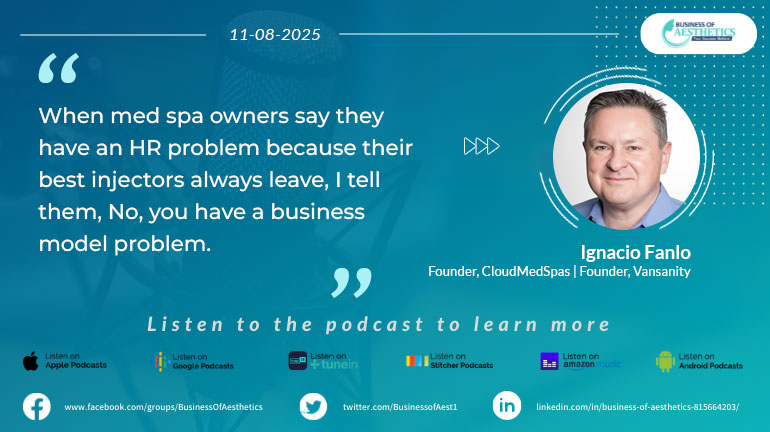
Ignacio Fanlo: I hired 10 injectors over X period of time, and eight are mediocre or bad, and two are really good—and not necessarily really good injecting technically, but they’re really good at customer service, really good at customer follow-up and retention, good at creating a positive atmosphere. And so those two do great. They’re a huge boon to the business. And sure enough, they leave. And they say, I have an HR problem. I said, no, you have a business model problem.
You have no customers. They’re just highly skewed. Like almost everything’s 80/20 to the 20% that are good. And you are just—you know, the other 80% that are there hanging around, they view this as just a chore, a job. The other ones are like, this is a career. I’m motivated by it. I love this field. I love this happy nursing. And they can do a lot better on their own.
- 00:07:05 – Building the Platform
- Ignacio’s company provides everything needed to go solo—except the clients.
- Top injectors can earn $250–$300/hour with higher margins and flexibility.
View TranscriptIgnacio Fanlo: So let’s create a model. It’s much more complicated than hair care, but let’s create a model that is a platform for them to get products. And these are—you know, some of these are controlled substances like neurotoxins, so it takes time and energy—the regulatory, the legal. Create the platform for the payment processing, for the inventory management, for the scheduling. Now we’re building an AI-enabled EMR that we’re gonna offer for free. Group purchasing. Create all the tools for someone to create a fantastic business.
And I can say confidently, the top 20%—not half, but not 1 or 2%—top 20% of our renters, either at our places or our third-party places (and we have 44 locations), are earning upwards of $250–$300 an hour. It’s that high a margin business. It’s that lucrative. And it’s three to five times what they would make as an employee. So it’s a very clear jump for an established injector—not so much for a new one. We can get to that, I think, in some follow-up, if you’d like. But let me stop there for a second.
Michael Walker: Yeah, you explained that really well, Ignacio. For me, as an outsider looking in, I was thinking—my own experience with my hairstylist, you’re right. I would answer the question the same way you did. And sure enough, yeah, I remember following him around to different locations.
But it’s interesting though. I remember him—he, at one point, he bought a building.
Ignacio Fanlo: Oh, okay.
Michael Walker: And he had—and it had two or three stylists in there working. And then he—he sold it, and he converted his house, the lower level of his home—this beautiful—into his studio.
Ignacio Fanlo: Yeah.
Michael Walker: And yeah, it didn’t make any difference. But I asked him—I remember asking him, why’d you do that? Like, what happened? He says, well, it was exactly what you said. I said, well, I had no cust—you’re my customer. The building’s not my customer. I didn’t want to have a relationship with the building owner. I have a relationship with you.
And so I—and this—I’m trying to, by extension, have these relations with all these people, but there’s no loyalty. It was like exactly what you described. I’ve literally watched that. And that guy—he just retired last year. I have a new guy. But it’s, um, I say, the loyalty to the brand—who’s the stylist is the brand. Or do you have a commitment to the building, the shop?
Ignacio Fanlo: No, it’s to the stylist. Like, you know, at our place in Boston’s a good example. That was our flagship initial location. We have a board outside also, so it’s clear from a legal perspective—we’re not the business. You hear the list of our top—we have like 60, 70 injectors there—and we rotate it every quarter or so. And we hear the top 10 providers listed there, right on the board, in a really nice, beautiful way.
Our brand is on the inside. But you know, you can think of it as like "Powered by Intel" or something. That’s what we are. We’re the platform behind it. Or Marriott. That was my initial business model that I wanted to follow.
So most people think of Marriott as a hotel company, and that’s not what they are. They’re a managed services organization. They split off into two—you probably know this—they split off into two 30, 40 years ago. Half was a REIT with the real estate, and half was this MSO. And that’s the way I like to think of MSO—not the legal structure in aesthetics, but anyway. And now, that’s a multi-$10 billion organization. It’s a monster with 30 or 40,000 managed hotels, including Ritz-Carltons and W and all those.
- 00:10:58 – The Marriott Analogy
- Cloud Medspas functions like Marriott or Airbnb for medical space.
- They power the backend; the injector is the brand.
View TranscriptMichael Walker: Yeah. That’s my, uh—that’s my brand, actually. The way we—I, my background is—I went to Cornell. My background is the hotel, food, and business in luxury brands. So I’m very intimate with what you’re talking about. But you know, to me, they were in the—we—I was helping position a Canadian, which is now an international brand. And what we were trying to do was really position it—our whole mission and vision was to unexpectedly delight the client in a way that they can’t wait to come back with their friends.
Ignacio Fanlo: There you go. There you go.
Michael Walker: And "unexpectedly delighted" meant that we empowered different people to be the face of the organization—not the ones that are traditionally. And in that case, it was the housekeepers, who actually would see the Mars bar wrapper in the garbage and the empty Coke can. And the next night, when the guests would arrive, they’d find a Mars bar and a Coke on their counter.
Ignacio Fanlo: Wow. That’s smart.
Michael Walker: And we just—we shifted the entire industry in the luxury brand by doing simple things like that. And we did some pretty exotic stuff. But having said that, though, I think—I mean, but that—that is—that—the house—in that case, the housekeeper is the stylist.
Ignacio Fanlo: That’s right. That’s right.
Michael Walker: And you can do that. Now, in the Marriott brand, they created a community, a culture of that. And it was empowered from the top down. It wasn’t just—it was actually inculcated its way up, but it was powered from the top down.
The question is, there could be salons that—some of these really passionate—creating a community and then bringing everybody in, and you become part of that community. You love being part of that, and you’re engaged. And you’re not looking to take your clients and go somewhere else. That’s very—there’s a scenario that makes sense of that, where that works for people.
But if you didn’t have that, then what are the—and this is a question, I think, to you—so what are the things that, if I’m—let’s just say I’m thinking, okay, I like what you’re saying. So what does that look like for me? I’m an injector, and I want to come in. Like, what’s at risk for me to do this? And then what is it that you’re doing for me that I won’t have to do for myself?
Ignacio Fanlo: Yeah. Well, first of all, I want to complete one thought on the hotel thing. It’s super interesting you brought it up—or riffed on Marriott when I mentioned it. I actually describe us to most people in the beginning as an Airbnb for medical space now, because some of the space that we’re using for rent—we have one of our owned and operated locations, 43 third parties using our platform, and we’ll probably add another 100 or 200 because of a couple of large deals we’re working on before the end of the year.
But anyway, we have dentists, orthodontists on the supply side of space, as well as med spas. And we have, on the buy side—that’s almost exclusively injectors, but we have a couple wellness providers, like concierge medicine, who want to rent the space.
So what do we bring to the table that you couldn’t bring for yourself?
- 00:14:13 – Value for Injectors
- Injectors benefit from hourly rentals, group pricing, logistics, and medical support.
- Flexibility, freedom, and autonomy are emphasized.
View TranscriptIgnacio Fanlo: Well, ours is complete marginal cost. You don’t have to do a lease for a year—seven years. You can rent ours by the hour. That’s it. And you don’t have any minimum hours. It can be zero. You know, it’s like an Airbnb in that way, right?
Second of all, we have a really attractive product pricer. So if you were Jane Doe or John Smith, injector, putting out your own shingle, you would either have to buy tens of thousands of product every single month or quarter to be able to get decent prices. We can get you—because we buy millions a year—we can get you our price. That’s what we do. We give you our invoice price. You get it for buying one vial for one product. And you’re taking advantage of our group purchasing power.
Ignacio Fanlo: We give you payment processing. We give you scheduling for your rooms as well as scheduling for patients. We’re giving you visibility into your accounting and financial systems and a repository, as well as a place where we can direct you to medical directors if you need a supervising physician and state insurance. So we’re providing soup to nuts.
What you gotta bring is your passion and your clients. If you bring those two things, pretty much everything else is taken care of for you. It’s a business in a box. But again, I think the marginal piece and also the flexibility—if you worked as a W2 employee as opposed to putting out your own shingle, you’ve got certain hours. Here, it’s like: work when you want. If you’re making $250 an hour, working 10 hours a week, take a few weeks off and, you know, go to Italy in the summer.
Michael Walker: Yeah, exactly. Yeah. Well, I mean, I can see the economy of scale easily in this and the pricing thing. And yeah. Tell me a little more about what—what does the front-of-the-house support look like? I mean, to me, we’re just talking about customer experience and the concierge side of things and the unexpectedly delighting and all that. What does that look like in your model?
Ignacio Fanlo: Well, in the one we have in Boston, we have a full-time person there who’s been there five years, can work with each of the providers getting training for either the injectables or each of the devices. So ours is a little special.
The front of the house doesn’t really matter—anything—like I thought it did, because I experienced it with our owned and operated. A lot of times the client, because they have such a tight relationship—the client and the injector—texting right up to the minute. They come to the front door, they greet them, they take them back to the room and treatment area. They don’t really need us for much.
You know, we’ve supplied some Poland Spring and some mints, and we clean the bathrooms and the spaces, keep everything neat and tidy, take care of the medical waste. But that’s after they’re set up. You know, a lot of people are daunted, like, oh, I gotta create an LLC. And here’s a checklist. I gotta get a medical director. Well, here’s an intro to two or three with a couple organizations. Where do I get insurance, etc., etc., etc. What are the different products? Well, we’ll connect you with—our rep can talk to you about the pros and cons, get really granular.
I mean, you can do it all on your own—except for the group purchasing. You can’t do that on your own. But all the other things—you know, it’s—people like having guidance because it’s like anything else. I mean, even if it doesn’t do anything different for you, it validates that you’re on the right path.
Michael Walker: Yeah. And with this—when we’re talking about the, um—obviously the injectors—what would it look like if I had a med spa? And I’m kind of wondering what—I, you know, like, I have empty space. I’m busy. I’m not having to replace people. Of course, that makes HR the—as you said right at the outset—HR is my problem, which is not what it is, but that’s where you’re thinking. Like, how do I keep people? How do I do this? What’s your advice to somebody in a situation like that? What are their options? What does that look like?
- 00:18:39 – Advice to Med Spa Owners
- Med spas must stop clinging to outdated HR-driven models.
- Innovation is blocked by emotional attachment to tradition.
View TranscriptIgnacio Fanlo: Yeah. Well, I tell ’em to stop the insanity. I mean—
Michael Walker: [Laughs]
Ignacio Fanlo: Well, I’m just saying—that is literally the definition.
Michael Walker: I hear you. Yeah.
Ignacio Fanlo: Insanity—doing the same thing and expecting a different result. You know, that’s just insanity. I don’t know what else to say. Like, you explain it to them, they get it. They don’t want to believe it, you know, in some cases, because they’ve made an emotional commitment to the idea of doing it the old-fashioned way, right? And we all know that.
Listen, I mean, whether it’s marriages or friendships or relationships or organizations you’re involved in—you know, maybe the classic one might be the Catholic Church. I’m a lapsed Catholic, I’ll admit it. But I was a dedicated one through high school for sure. And, you know, some of the things that have happened there certainly haven’t helped their reputation. But a lot of people still go—there’s a billion people going, or a billion and a half—because that’s the way they do it. They—they can’t do it another way.
Michael Walker: Yeah. Well, that’s a good example. Now that we have an American-based Pope, you’re gonna have to go get your membership renewed.
Ignacio Fanlo: Yeah, I don’t think so.
Michael Walker: So let’s, uh, let’s talk a little on a couple of technical things here. And I know 34 states now grant nurse practitioners full practice authority. What’s keeping the remaining 16 states from doing the same, and how is that impacting innovation in aesthetics?
- 00:20:11 – Regulatory Realities
- 34 states now grant full practice authority to NPs.
- Barriers in other states are due to protectionist medical lobbies.
View TranscriptIgnacio Fanlo: Uh, well, probably gonna get my wrist slapped for this one a little bit, but it’s always the same. It’s the doctors’ lobby. You know, that’s money outta their pocket. The more people that can inject, the less the people who are already in the club want you in, right? I mean, that’s the classic. There’s good money by restricting supply. And if you open up supply, there’s a lot of arguments about risk and fears of bad injectors.
And I’m not saying they’re not completely founded, but what I can say definitively is that that risk isn’t there—mathematically, actually. And I’ll give you two great examples. I don’t know what it’s like in Canada, but in the U.S., you have to go—certainly young people—through behind-the-wheel training. You take a test that you have to get a certain score on in most states.
Ignacio Fanlo: And your insurance—if you’re a beginning driver—is hundreds of dollars a month. Two, three, even four, $500 for young men in some states per month. And while driving can be dangerous—big fan of autonomous driving—but while driving can be dangerous, hundreds of millions of people do it in North America, right? So how dangerous can it be? If it were that dangerous, you know, it’d be like everyone has seven guns and we’re shooting all the time. So it’s not.
So you go to aesthetics, and just neurotoxin training is a one-day, four-to-six-hour training. And insurance for a mid-level—a RN, for example—in many cases, it’s under or about $100 a month. So it’s less training than driving, for a nurse anyway, and less expensive than car insurance.
Ignacio Fanlo: So the math is, to me, black and white—that it’s not really that dangerous. Certainly that a nurse practitioner should be able to. They’re gonna be allowed to do it, but can they have the practice authority of their own? So they don’t need someone to supervise them, and they don’t need someone to sign off on their procedures?
In Massachusetts, it changed during COVID. They had a shortage of manpower—woman power at least—so they said, hey, we’re gonna do a temporary, during COVID, NPs have full practice authority. Well, they—you had two or three years of that, and they go, well, what the heck? Nothing crazy happened. What the hell? Oh, well, we don’t need it now. They kept it.
You know, the nursing lobby got involved and said, hey, this is kind of baloney. So, you know, that’s—I hate to be so cynical, but it’s hard to argue with the math.
Michael Walker: Yeah. And again, as you say, in our world, there are different dimensions of parts moving that have different mandates and different owners, if you will. So yeah, without going any further and deeper into that—we’re seeing that on the political level between our countries, for goodness’ sake.
Ignacio Fanlo: Yeah. God—for—hopefully that works out.
Michael Walker: Yeah. So, um, let’s just talk a bit about, you know, this whole idea—for a nurse. Like, obviously there’s a reason that nurses have objectively gone to join a clinic or a med spa and be part of that. And either they’re hesitant or resistant to the idea of working on their own, or the inherent risks attached to that, or the fear of not making enough, or having to invest too much—you know, we could—the list goes on and on.
But when you think of that, that kind of—and we’re talking about starting your own practice, is basically what you’re saying—what do you think is the real barrier? What can you say to those doctors?
- 00:24:22 – Fear is the Real Obstacle
- New injectors fear rejection more than failure.
- Ignacio advises starting slowly, building reputation, and maintaining a job while transitioning.
View TranscriptIgnacio Fanlo: Yeah. After six years of talking to hundreds, if not over a thousand nurses, and talking to dozens of med spa owners, I’m pretty sure the answer is fear. I would give that a 90% probability.
So if you’re an established injector and you’ve gone—there’s a term for it in the industry called “spa hopping”—going from one to the other, you already have done it. Go. So hop a little over to our side. And by the way, it’s not a commitment. You don’t have to do it all the time. Stay where you are if you want, and start using ours.
If you’re a new nurse, it’s even simpler. I tell them, don’t quit your day job. Start small. Start slowly. Build up your social media presence. Build up your reputation. Build up your reviews—whatever it happens to be—to get your business going. From a standing start with no clients, it’s going to take you a full nine to 15, 16 months to get a full-time job. And most RNs in the U.S. have three shifts of 12 hours. Do this on your spare time or your extra time. And then as you build a client base, maybe peel a shift off over time and you can transition if you want.
Ignacio Fanlo: And I can say again, with the experience and having seen so many—in the U.S. at least—I mean, there’s millions of mid-level nurses, PAs, etc., I can honestly say close to 20% of them want to be aesthetic nurses. That’s an insane number. It’s probably not a great thing for the nursing or healthcare industry, but it speaks volumes. I mean, I’ve heard this said by dozens of them: “I want to leave sad nursing,” which is bedside nursing, “and go to happy nursing,” which is aesthetic nursing.
And that’s easy to see. Being a bedside nurse is young woman’s work. I mean, it’s the bedpans, the dying, the blood, the anger, the emotions, the grief. I mean, there’s just so many difficult things that you have to do and process, that it wears and tears. I mean, burnout is very common. And that’s for like a normal—you imagine being in a burn unit, or oncology, or pediatric oncology, or a NICU. I mean, just crazy.
Ignacio Fanlo: And then you go to a place which is beautiful, well-lit, kind of bougie, and you have beautiful people, and you’re making them look better and making them happy and establishing a relationship. And that’s gotta be uplifting. And that’s a big plus.
Now, why don’t those 20% make it? And I can say single digits make it. Because they’re—I honestly believe—they’re scared of rejection. That they don’t have the self-confidence that “my clients will leave with me” or “my clients will stay with me.” Or, “I don’t want to make 10 sales pitches to clients and have nine of them tell me no.” I mean, that’s sales. If you’ve been in sales, you know—it’s 90% about getting nos. You don’t get 50% yeses.
So it’s—you gotta have a resilient, sort of ever-optimistic attitude. And you have to not be—it’s funny, I say you have to be a self-starter, and they think that’s taking a list of actions and doing them fast or doing them in the right order. That’s not a self-starter. A self-starter means you start from a blank slate. That’s entrepreneurship.
A lot of “wannapreneurs,” not a lot of entrepreneurs. And that’s the difference. I think it’s fear. I mean, I’m pretty sure it’s fear. I mean, I get it. It’s not easy to put yourself out there in any regard, right? For relationships, or friendships, or—it’s taking risks. And people—even though there’s no evidence in the recorded history that taking no risk is not actually the biggest risk, and that things are constantly changing—but people, you know, inertia is a powerful force.
Michael Walker: Yeah. Well, you—you know, you’ve—my daughter actually is a nurse. And, you know, that happy versus sad nursing—it’s interesting. We’ve had the conversation. And she grew up around me, so she can answer the question to what she’s passionate about. And she has a vision for herself. She has set—she loves working with—she loves hospice.
Ignacio Fanlo: Oh, that’s good.
Michael Walker: Which is—I couldn’t do that. I just—but she has such a gift in that. But she’s seen that. But it’s interesting, though—what I’m hearing you say—when I think about these folks with the fear of the prac—“Am I going to make enough money?” or—it’s almost like, what is your—what are you passionate for?
It kind of goes back to the core. It’s kind of like the original thinking of, what are you passionate about when it came to nursing or whatever that was? Well, it wasn’t about—it was about helping, adding value to people’s lives. And okay, and so—so you are—and you’re not getting that now because of this, this, and this—whatever. But this—what are the options?
- 00:30:06 – The Courage to Transition
- Insightful discussion on passion, faith, and fear in entrepreneurship.
- Encouragement to take small, confident steps toward solo success.
View TranscriptMichael Walker: What are your options of what you could do? Oh, this could be one—what we’re talking about here could be this. I could leave, I could—whatever. But it’s almost like, when you use the word fear, like we—in our culture—we turn fear into a noun, into a thing. It’s, “Oh my God, it’s fear.” Like it’s a thing.
There’s healthy conflict and there’s unhealthy conflict. Unhealthy conflict is when you passionately disagree and take it personally. And healthy conflict is when you passionately disagree and don’t take it personally. And that really—that’s the part that most of us don’t do—is to actually really contemplate what it is we really mean by “we’re not happy” or “sad” or whatever that is. What is the real mechanism behind that? Which is the essence of entrepreneurship.
And then we look at an opportunity and say, “What’s at risk to do this? What’s at risk not to?”
Ignacio Fanlo: Yeah.
Michael Walker: Does that make sense?
Ignacio Fanlo: Oh, totally. Totally. There’s a risk in not doing anything. But no, it’s funny you said, “Am I gonna make enough money?” That’s complete nonsense. That is not the real fear, because I tell them to keep their job. I don’t know if you’re gonna succeed. I tell them the stats—20% do great, 80% not so great. Maybe 40 or 50 are kind of muddling by, and 20 fail at it—25%. So there’s no guarantee.
I don’t want you to quit your job. I want you to ease into it, right? So that thing about, “I’m not gonna make any money,” that’s a made-up thing. Because you’re not willing to face the fear or admit to yourself it’s your insecurity and fear of rejection that’s stopping you.
Michael Walker: Yeah. Well, it’s actually—put it into the simplest terms—it’s not having enough faith in yourself that you can pull this off. And the definition of faith is believing what you cannot see will come to pass. And what’s the definition of fear? Believing what you cannot see will come to pass.
Ignacio Fanlo: I guess that’s true, yeah.
Michael Walker: Pick one. Pick one. You can’t live in both. They’re like matching polarized magnets—for a season you can push them together, but eventually you can’t hold it. They’re gonna come apart. So you gotta pick one. And I think that’s what I mean by breaking fear—really looking at this thing.
So let’s just say—I love where we’re going with this—and I think it’s this idea, though, of: alright, if somebody was—okay, you remind me kind of like an A/B test here, right? Keep the job, keep your clients, and then build this other piece and see what happens. And then design, with partnerships like with you guys, what a migration model looks like—to moving new, or however we move that.
And I think that’s the—that’s—I just put my hand up long enough I saw it went up.
Ignacio Fanlo: I was like, that wasn’t me. [Laughs]
Michael Walker: That’s me. So how would somebody—how would you recommend they start this process? Let’s take it right to the—they’re thinking about it. What are kind of the first—because a lot of people just get overwhelmed by too much, Ignacio.
- 00:33:03 – Getting Started
- Cloud Medspas offers checklists, mentors, and turnkey services.
- Passion + clients = everything else can be provided.
View TranscriptIgnacio Fanlo: That’s why we provide the checklist. That’s why we provide all these services. Because otherwise it is a lot—I’m not gonna lie. It’s like starting—I mean, starting this company—the first six, eight months I did it alone. It was little pieces, you know? Like, it’s daunting. I’m not saying it’s simple. I mean, if it were simple, everybody would do it and be wildly successful. It’s not. You know, I try not—I mean, if you can tell—I try not to sugarcoat it too much.
Michael Walker: Very, very realistic.
Ignacio Fanlo: Yeah. But you know, in the end, it’s: do you think you can get people as clients? And they say to me they will, they can, but in the end I think they either know, down deep, that’s not who they are—and that’s okay. I don’t think being an entrepreneur or being able to sell yourself makes you a better human. That’s not the point.
But if you want to be in this industry, this is going to be the only path. So when I—I put ads for ourselves for injectors all over the country, in our locations or some of our partners. And I talk to these people and I know there are no entry-levels. We’re literally the only ad—’cause I can look at the other places. There’s no other ads.
They say, “We want you. We want a minimum of two, three years’ experience.” That’s what med spas say. And I say, that is a white lie. What they’re saying is, “We need you to bring your customers with you.” Because that’s the only way it works—because they’re your customers, and we’re just rent—we’re just basically underpaying you for your customer list on an ongoing basis.
Ignacio Fanlo: Again, I’m not sugarcoating it. That’s why they go, “Well, I can’t get a job. It’s crazy. I got trained. I’m a nurse. I’ve been doing this 10 years. I’m blah, blah, blah. I did injections—regular injections—I know about the face.” I go, that’s all awesome. That’s just tremendous. I’m so happy you did all those things.
However—that’s irrelevant. Or, you know, it’s 5% of it. Ninety, ninety-five percent of it is getting the clients. It’s all that matters in this industry. It’s all that is important in the end.
And, you know, I feel sometimes like I’m telling nurses like this that there’s no Santa Claus.
Michael Walker: Yeah, I—well, I could see that. Yeah, it definitely could be.
Ignacio Fanlo: But—
Michael Walker: But I think the—I think the message I’m hearing is that there’s an entry point that is uniquely different than the one that has been—the status quo, we’ll call it. The standard. And you’re offering a variation to that entry point.
And then the—and I come back to those two ques—I mentioned it before, the two questions: well…
- 00:36:13 – No Other Entry Point
- Traditional entry paths are disappearing.
- Today, injectors must bring clients to get hired.
- Thinking about making a move or just need more clarity? Ignacio Fanlo encourages you to take that next step, learn more and connect at cloudmedspas.com.
View TranscriptIgnacio Fanlo: Let me take—if I can interrupt for a second. It’s not even a variation. The other entry point no longer exists. This is your way in, whether you like it or not. And if you don’t like it, that’s okay. But there is no other way.
I mean, obviously, there are exceptions. My mother has a business—she’s going to transition it to me. A really close friend will hire me or use me. But the reality is—I say to them—if somebody hired you to do this, you should be paying them. You’re like an apprentice. They’re not gonna pay you. It’s like me being paid to go to college. Makes no sense.
Michael Walker: Yeah. That’s a good way of looking at it. That it’s—it’s the new normal.
Ignacio Fanlo: I mean, they all tell me—I’ve talked to hundreds—I can’t find a job. There’s no one out there to take me as a newbie. And then I explain it. And I think at an intellectual level now—I can honestly say, instead of two years ago, when 20 or 30% would like it (some would get angry with me, honestly—and sometimes hang up)—now, 80% I say intellectually understand it. But the next step is the emotional step. And that’s the tough one.
Michael Walker: Yeah. And I think—so there’s—I always look at every organization, arguably every person, as a collection of three spaces: the transactional space (what we do and how we do it), and the relational space (who we are and why we matter). And when those two spaces are not working well together, that’s where conflict exists. That’s where all the unhealthy conflict is. That’s where the tension and all the things that go bump in the night happen.
But when those two spaces are working well together, then that’s where the creative space is. That’s where you have courageous conversation, outside-the-box ideas. That’s where you have people that can’t wait to work for you, never want to leave, and bring all their friends and customers—and you don’t know what to do with all the money.
But the whole idea, though, is that—I think what you’re saying, what I’m hearing—is that the model has changed. You can’t just look at anything in one dimension or the other. If you just look at it transactionally—like GM did—build all these silos of empires, eventually they’ll crash down and kill the people. Or you make all these relationally-driven great ideas, and eventually you just run out of money.
So how do you bring those two spaces together? I think that’s the secret sauce. That’s almost part of solo entrepreneurship—what you’re talking about. The art of relationships blended with the passion of the art that you’re applying. And how do you do that?
So from that standpoint, you know, that’s where Ekwa Marketing—that’s a huge part of what they do with your whole online presence. They build all those pieces out and do all the things that you don’t need to be an expert in.
But with what I just shared, does that make sense, Ignacio, in this field?
Ignacio Fanlo: It makes a ton of sense. A ton of sense, what you’re saying.
I mean, the reality is, I would say—not just in this field—you’re saying you have the passion. “Why am I doing this? Why am I here?” It’s so good, it doesn’t even feel like a job.
If you are like that, and you have even a modicum of extroversion, you’re going to be wildly successful in this industry. But if you don’t like it or don’t like what you’re doing and don’t have the passion, people see that.
That’s why the 80% at a traditional med spa stay, and the 20% that are good leave. Again—gross generalization—but the 80% that aren’t doing well, they really don’t want to be there. They really don’t want to be there. I’m not saying they should be there. Maybe they have a lot of other commitments—family, friends, or who knows—other jobs, because they have real, difficult financial needs. Not judging. I’m really not.
But if you don’t want to be there, that will show through to the customer.
Michael Walker: Mm-hmm. Yeah, absolutely. Well—you’ve got—people don’t care how much you know, until they know how much you care.
Ignacio Fanlo: There you go.
Michael Walker: So we need to be—that’s that part—we have to be authentic and genuine and meet people where they’re at, not where we think they should be. And that’s the challenge.
Well, you know, as we kind of pull this together, I just—yeah, what would you like to leave with our audience? I think you’ve given them some great ideas, some great—like, if you’re listening to this, first of all, if you’re trying—if you’re thinking about making a decision, or you need more information, obviously now you know that cloudmedspas.com —that’s where you’re gonna find Ignacio.
But it’s this idea of just—what’s the question you need answered? But what is the next right step? Not trying to figure the whole thing out. What is the one thing? If you’re gonna make a decision—“I want to start doing, I want to take some action”—so the question to you, Ignacio: your best, widest-based next step for that audience?
Ignacio Fanlo: Yeah. I mean, the first step—and I’ve said this to a bunch of people—is: How much do you really want to be in this industry? Do you really want to be in? Don’t do it because you want to leave something else. Do it because you want to be here.
And if you really want to be here, we make it pretty darn easy to be here. But this includes certain—certain requirements to be successful. And, you know, you can judge better than I can whether you meet those requirements.
But if you really want to be here, I tell people: You can be here. Because in my experience, being in the top 20% of something is really just about trying.
I know that sounds slightly arrogant, but I’m gonna quote the very first senior executive I ever met. I was very fortunate—my junior summer in college—to score an internship at IBM being an engineer…
- 00:42:47 – Final Thoughts & Advice
- “Show up, on time, ready to work”—success is about consistency.
- Cloud Medspas simplifies the launch, but motivation must come from within.
View TranscriptIgnacio Fanlo: And somewhere in the middle of the 12 weeks, one of the heads of Northeast—or North American Sales—at IBM, very senior guy, comes in and he says, “I have a very short speech to give you. I give it everywhere I go. And after 30 years of being at IBM, I know it’s true. I don’t believe it’s true—I know it’s true.”
And, you know, we all took our notepads out—this was the ’80s—we’re gonna write down the pearls of wisdom coming from this fella. And he says, “Number one—it’s three things you gotta remember: Number one, show up.” [Laughs] We’re like, okay, do I need to write that down? Seems pretty easy.
He said, “Okay, number two—show up on time.”
I was like, what? Okay…
He goes, “Number three—show up on time ready to work.”
And he says, “If you do those three things every day during your career, you’ll be better than 95% of your peers.”
And he goes, “I’ve seen thousands. Trust me. The top 5% do that every day. And they don’t have to be rocket scientists. They don’t have to be geniuses. They don’t have to…” It’s consistency. It’s effort. It’s elbow grease. It’s commitment. You know, it’s not some magic trick.
And, you know, 35 years later, I agree with him. That’s been my experience too. The guy was dead right. So he’s saying 5%—I’m quadrupling that—just be in the top 20%. So don’t tell me it’s hard. I don’t wanna be like a Navy SEAL instructor—that’s like one in 10,000. Come on. It’s not hard to be in the top 20%. You’re just not trying. I don’t believe it—unless you have some serious deficiency that’s biological. You’re not trying.
Michael Walker: That is a great place for us to land this today, Ignacio. And I think, you know, Gallup just recently released another poll on employee engagement—it’s lower than it’s ever been. Now it’s down to like 30–36%. And that speaks to what you’re saying—about those people. There’s only—arguably—that percent of the world that’s ready to work.
Ignacio Fanlo: Maybe they want to speak to that job. You know, maybe they want to do something else. And, you know, I hope—and to leave on a positive note—I do believe wildly in the future that we have in front of us. Not just AI and robotics. I believe—and I believe in basic income—I believe we need to shift our paradigm psychologically, that work is our purpose, that work is our north star. It’s not. It never should have been. It never will be again in the future, I hope—for my children and grandchildren and others.
But that—the future—is unbelievably bright. And the beauty of that, I think, of the end result, is we’ll be able to focus almost all our energies—if we choose—on something we love. And that’s still what you do now, but—beautiful—you’ll be able to do anything you want.
Michael Walker: Ignacio, thank you so much. You know, you remind me of words my dad said—he passed away last year at 91. He said, “Son, you never want to retire.”
And I said, “Oh, okay, tell me more.”
He said, “Well, I tried four times. Three times your mother sent me back to work. But the fourth time, I realized I was doing it all wrong—because every time I thought retiring meant planning to die. What I wanted to do was transition to continue to dream.”
And, you know, that’s the message I grew up on—to transition. So, keep dreaming. And Ignacio—what a dreamer. And translating your dreams into tangible things that have the potential to change people’s lives dramatically.
Just thank you so much for joining us today, sharing your thought-provoking insights on aesthetic solo entrepreneurship and the evolving business models in our industry. It’s just fascinating the way you’ve broken this down and created opportunity for people to look at this differently.
You’ve taken on decentralization, regulatory challenges, and opportunities for providers to gain more autonomy—which was certainly timely, critical, and eye-opening. We truly appreciate your time and perspective.
I also want to take a moment to thank our amazing listeners. We appreciate each and every one of you. We couldn’t do what we do without your support.
If you enjoyed today’s episode, please share it with your colleagues and friends on social media and help us spread valuable knowledge throughout the aesthetics community. It’s up to us to make the difference—let’s not wait for someone else to do it.
And don’t forget to leave us a review on your favorite podcast platform. We love reviews and likes. Your feedback helps another aesthetic professional and practice owner discover our show and gain, obviously, actionable insights to grow and elevate their business.
- 00:48:03 – Closing & Free Offer
- Ekwa Marketing offers a free digital marketing consultation to help solo injectors get started.
- Visit businessofaesthetics.org/msm to claim.
View TranscriptMichael Walker: And just before we wrap up, a special thank you again to Ekwa Marketing, who are the sponsor of this episode—and I mentioned them earlier. With nearly 20 years of experience in digital marketing, specifically for aesthetic practices, Ekwa is offering our listeners—you guys—a complimentary digital marketing consultation, including a custom 12-month strategy tailored to your practice.
This is one of the pieces that we’re talking about—that you’re going to want when you set your sights on making this solo entrepreneurship move. You’re going to want to have a marketing platform that reflects that. At some level, you may have some knowledge of it, but imagine having professionals who are going to pour into it for you and give you a strategy that you’ll be able to use to start building your plan and your practice on.
Michael Walker: So you can go ahead and visit businessofaesthetics.org/msm and book your consultation with them. As I said, it’s an hour they’re going to spend with you, but I know they spend five or six hours just digging into your digital footprint—or what you’re planning to do and how you’re looking at it—and helping set up a plan that will set you up for success.
So until next time, keep nurturing client relationships, driving retention, and building long-term success for your practice. Keep in mind, Ignacio has shared with us a vision that’s not just for today, but for tomorrow. And it’s a wonderful message of opportunity and hope.
And on behalf of Ignacio and all of the teams at both of our operations, wishing you all an amazing week ahead.
GUEST – IGNACIO FANLO

Ignacio Fanlo is a pioneering serial entrepreneur and C-level executive with decades of experience creating and scaling disruptive companies at the intersection of technology and healthcare. As the Founder of CloudMedspas, Ignacio leads a company revolutionizing the aesthetic medicine industry with a Silicon Valley-inspired “network effects” business model. His vision empowers independent practitioners with access to state-of-the-art technology and operational frameworks, fundamentally changing the economics of private practice.
Before launching his current ventures, Ignacio built an extensive track record of success across five different startups. He guided one such company from its initial stages through a successful IPO led by Goldman Sachs and its eventual acquisition by eBay. His strategic acumen was further honed as a management consultant at the Boston Consulting Group (BCG) and as a Board Director for Cytrellis Biosystems, Inc. His unique methodology blends rigorous scientific analysis with a deep understanding of market dynamics, enabling him to architect ventures that consistently deliver both clinical and commercial value.
Ignacio holds an M.D. from Yale School of Medicine, an M.B.A. from Harvard Business School, and a B.S. in Biology from Duke University. A respected innovator, he was named a “Distinguished Corporate Inventor” by the American Society of Patent Holders. He is a frequent guest on leading industry podcasts, where he shares his expert insights on the future of aesthetic healthcare, the impact of new technology, and the evolution of clinical business models.
HOST – MICHAEL WALKER

Michael Walker is a seasoned leadership coach and analyst (Q.MED) who is passionate about adding value to individuals and helping them unlock their untapped potential. With over 35 years of diverse business experience, he specializes in organizational development, succession planning, conflict resolution, and mediation.
As a Qualified (Q.MED) mediator with the ADR Institute of Canada and an Analyst (WFA) with the Workplace Fairness Institute, Michael has a strong foundation in conflict resolution and workplace dynamics.
His expertise extends to providing workshops and seminars that equip participants with practical tools to apply immediately for improved relationships, fairness, innovation, productivity, and profitability.
Michael is dedicated to supporting personal and professional transformations and is committed to helping individuals achieve greater financial, relational, physical, spiritual, and emotional prosperity through his coaching and advisory services.
Resources


Connect with Us:
Category: Business of Aesthetics Podcast