
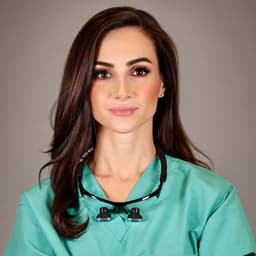
About This Episode
Dr. Sinehan Bayrak, a board-certified facial plastic surgeon, shares how she filled her Philadelphia practice in under two years without spending a dollar on paid advertising. Part of the Business of Aesthetics podcast collection, Episode 293, “Fully Booked on $0 in Ads. Here's What She Built Instead,” adds useful context for aesthetic-practice professionals. It focuses on the choices that shape trust, satisfaction, and loyalty, helping practices create experiences patients are more likely to value and return to. Listeners can use the conversation to reflect on their current approach, discuss relevant questions with their team, and identify practical next steps.
Read the full conversation
Introduction & Speaker/Topic Setup
Most aesthetic practice owners are being told the same thing. Spend more on ads, hire more people, buy more tools, and hope the growth eventually justifies the overhead. But what if the smarter path is the exact opposite? Welcome back to the Business of Aesthetics podcast. I'm your host for this session, Don. And to help us rethink what profitable growth actually looks like in a modern aesthetic practice, we are joined by Dr. Sinehan Bayrak. Dr. Bayrak is a board-certified, fellowship-trained facial plastic surgeon in Philadelphia who built a fully booked practice in under two years without spending a dollar on paid advertising. Her approach challenges many of the assumptions practice owners hear every day about growth, proving that strong patient trust, strategic positioning, and operational discipline can outperform expensive marketing campaigns. Today we are discussing how she landed her first surgical cases without paid advertising, how she turned Instagram into a powerful patient acquisition channel, and what it takes to build sustainable demand while keeping overhead under control. This episode is brought to you by Ekwa Marketing, the growth partner behind this podcast and a trusted resource in the aesthetic community. That being said, Dr. Bayrak, welcome to the podcast. It's great to have you here.
Thank you so much for having me. I'm so excited to be here, and I love talking about this stuff. So any chance or opportunity I get to do it, I'm game. I'm really excited, and thank you for inviting me.
Amazing. It's great to have you here, Dr. Bayrak, and we really appreciate you being here.
________________
Where the First 10 Surgical Cases Actually Came From
Now, let's get into the conversation. You were fully booked in under two years with zero paid advertising. Walk us through the very first thing you did to put surgical cases on your calendar before you had any name recognition in Philadelphia. And what was the actual mechanism that brought in patient number one through patient 10?
Right. So, as a surgeon, when I finished my fellowship, I immediately went into private practice, and I immediately went into a practice that was purely cosmetic. I didn't do any insurance cases, honestly, because it's just so complicated to do insurance-based surgery now that it was easier to focus on the cosmetic procedures. But the reality is, if that's what you're doing, people are not just going to walk into your office and ask you to operate on them. That was not my experience. For my first 10 surgical patients, and probably more than that, probably my first 25 surgical patients, they were patients of mine who were actually patients for non-surgical services. These were my filler patients. These were my neuromodulator patients. Even though I was a surgeon, I found value in providing those services because they allowed me the opportunity to meet people. A very typical scenario would be I meet somebody and I'm doing their Dysport, and it's a tale as old as time: "Dr. Bayrak, can you give me a little bit of a lift? My eyelids just feel heavier than they used to be. I can't do my eye shadow the way I used to." You can do a little bit for that with non-surgical modalities, but what a perfect conduit to the conversation of, "Hey, Lisa, have you ever heard about an upper blepharoplasty? It's a really straightforward, small surgical procedure." So my first 10 cases were very organic in the sense that they typically did not start as pure surgical consults. The non-surgical allowed me the opportunity to meet people in an area that I did not grow up in, that I am not from, that I had literally just moved to. No one knew who I was.
________________
Pricing on Value Instead of Discounting
Right. So the opportunity to meet people was really the value you were looking for. Now, when you were mentioning these smaller surgical procedures, were you also discounting them?
I wasn't discounting. There's a saying that if you ask 10 surgeons how to do something, you'll get 10 different opinions. I think that's true for any industry and in any walk of life. But to me, I saw and I knew that I was performing a service with a lot of value. Maybe it's ego, maybe it's narcissism, but I felt like I was doing it really well. I do think I'm a good surgeon. I have no problem saying that publicly. So while I didn't discount the service, if you look back at my prices from four years ago, they're different. They were lower back then, and I felt like that was fair. I felt like it still compensated me in a way that was fair to me, my time, and my skill. But at the same time, as a business owner, you have to remain objective and you have to zoom out a little. So when I zoomed out, I saw that I was the youngest facial plastic surgeon in an area with not only lots of other plastic surgeons, but other facial plastic surgeons who were more established. So there is an element of, yeah, I don't think I can charge what the surgeon who has been here for 20 years is charging, but I can charge something that's fair to me and fair to the patient, adequately compensates me for my time and skill, and gives the patient a result that I'm proud of and they're delighted with. I like the saying, you don't go to Chanel and expect a discount. And I do think I provide that level of service. A lot of work goes into providing that level of service. So I'm kind of allergic to the D word. But even now, although my prices are significantly higher than they were when I first started, I still think they accurately reflect the value the patient is getting. Ultimately, I think that's what cost should be based on.
________________